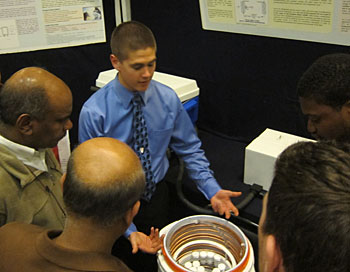
 As a student in "Communicating Complex Environmental Issues: Building Solutions and Communicating Ideas", you are a member of the Terrascope freshman learning community, and you have already taken the fall-semester Terrascope class, Subject 12.000, "Solving Complex Problems". In 12.000, you have spent the fall semester developing a solution to a complex problem strongly linked to environmental issues. In the process, you have become deeply knowledgeable about multiple aspects of the problem, including not just the scientific and technical issues, but political, economic, social and cultural ones as well.
 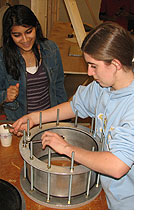 In the spring semester, your Terrascope experience expands to include hands-on original research and design work done under the guidance of MIT faculty members. For the first part of the semester, you and a small team of Terrascope classmates will engage in projects that address or illuminate some aspect of the problem you have been studying throughout your Terrascope year. Much of your work may be done in the lab, shop or research area of the faculty member advising your project; faculty advisors are drawn from departments throughout the Institute, as appropriate to the year’s Terrascope problem. As in all of Terrascope, the focus is on working in teams to accomplish challenging tasks, and you and your teammates may have great freedom to determine the scope, emphasis and content of your work.
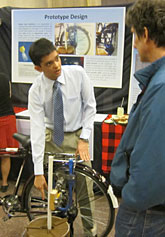
At the end of the semester, the teams join together in a large, public space to create a unique Bazaar of Ideas, a festive gathering in which you can show off the work you have done, both to the MIT community at large and to an expert panel invited specifically for the event. Individual teams design and construct working devices, prototypes, models or demonstrations, which they use (along with more conventional text/graphic panels and other displays) in presenting their work to attendees. The class as a whole constructs a physical setting and layout for the space, designed both to attract and inform visitors and to provide the best possible intellectual backdrop for the work they are presenting. Along the way, you will learn crucial techniques in brainstorming, design development, prototyping, construction and presentation.
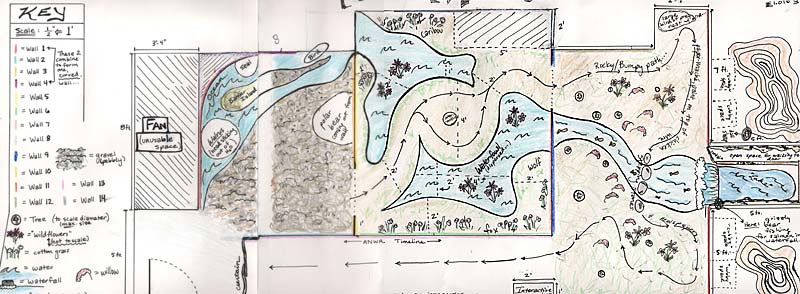
This year’s projects:
- Developing drip-irrigation apparatus capable of delivering specific amounts of water to different areas at different times. Advisor: Mark Jeunnette, Department of Mechanical Engineering.
- Creating a system to deliver filtered water to a village in Rwanda from a nearby stream containing varying levels of sediment and impurities. Advisors: Jesse Thornburg, Amohoro Energy Ltd; Dan Sweeney, D-Lab.
- Designing sensor systems capable of assessing water quality in rivers and communicating data automatically to a central hub. Advisor: Amy Mueller, Department of Civil and Environmental Engineering.
Beyond MIT
Terrascope, 12.000, 1.016 and Terrascope Radio have an impact beyond the MIT students they serve. Of course there is the students’ work, which enters the national and global discussion of the issues at hand. In addition, though, Terrascope serves as a model of a project-based, team-oriented learning community. We conduct detailed assessment of the program every year, and from that we gain new knowledge about what makes this kind of learning environment most effective. Here is a list of our publications in this rapidly-growing area of educational research.