Massachusetts Institute of Technology
11.s946:
Mini-Class on Urban Analytics and Spatial Data Management
Advanced Topics - Tuesday, Nov. 14, 2017
5:30-7:00 pm, Room 9-451
Part A (Roberto Ponce Lopez) |
Accessing Google APIs from R in order to geocode, get points-of-interest, compute distances, etc., |
Part B (Joe Ferreira) |
B-1:
PostGIS extensions to PostgreSQL: Including spatial
operations (such as intersection and distance) within SQL
statements
|
B-2: Auto insurance per-mile risk analysis using VMT data plus insurance claims data |
Part A: Accessing Google APIs from R
- Accessing Google APIs from R: ./GoogleAPIs.html
- Zip-file with MBTA example: http://mit.edu/11.s946/www/advanced1/MBTA_NODE.zip
Part B-1: PostGIS extensions to PostgreSQL
PostGIS adds user-defined objects to PostgreSQL that facilitate geospatial processing
- Bundled with PostgreSQL when downloaded from postgres.org
- Enable PostGIS within any database by adding it as a new 'Extension'
- Can also download separate PostGIS package from postgis.net
- PostGIS adds functions, tables and views to Postgres
- Look at 1000+ functions: st_distance, st_intersect, st_within, st_buffer, etc.
- View table that catalogs coordinate systems: public.spatial_ref_system
- Geometry information is saved in a view: public.geometry_columns
- What can you do with PostGIS
- Compute spatial indices to speed up processing by 'sorting' in 2D and 3D
- Include spatial operators in the 'where' clause of SQL select statements
- Example - which grid cells are in TAZ labeled as 'ready for more development' (codas=1)
- Suppose we did not have ct_grid table that links grid cell, town, TAZ, etc.
- Use PostGIS spatial operators to find the TAZ that each grid cell is within
- First, pick a few grid cells to test out our reasoning and syntax:
select * from vmtdata.v_vmt_join4
 where no_vin > 500;
-- 19 rows
- Next, use st_within() function to tag grid cells with the TAZ that contains them
select t.taz, t.codas, t.community_, t.town_name,
       g.g250m_id, no_vin, vmt_vin, vmt_hh, vmt_pop
  from vmtdata.g_bos_vmt_grid g, vmtdata.g_taz2727_codas t
 where g.no_vin >= 500
   and st_within(g.geom, t.geom);
-- works but only 4 rows in output!!
-- works but only 4 rows in output!!
- Aha, some grid cells may not be entirely within a single TAZ
- Redo query using the centroid of the grid cells
- Also, add geometry column (g.geom) to facilitate mapping later
create table jf_grid19_taz as
select t.taz, t.codas, t.community_, t.town_name,
       g.g250m_id, no_vin, vmt_vin, vmt_hh, vmt_pop, g.geom
  from vmtdata.g_bos_vmt_grid g, vmtdata.g_taz2727_codas t
 where g.no_vin >= 500
   and st_within(st_centroid(g.geom), t.geom);
-- okay, get all 19 rows
select t.taz, t.codas, t.community_, t.town_name, g.g250m_id, no_vin, vmt_vin, vmt_hh, vmt_pop, g.geom from vmtdata.g_bos_vmt_grid g, vmtdata.g_taz2727_codas t where g.no_vin >= 500 and st_within(st_centroid(g.geom), t.geom);
-- okay, get all 19 rows
- Use QGIS to read this table and compare with TAZ and grid cell geometries
Part B-2: Auto Insurance Per-Mile Risk Analysis
Does auto accident risk vary in proportion to miles driven?- Auto insurance cost varies by age, territory, etc. but not so much by mileage
- but, if you drive twice the mileage should not the risk be twice as high?
- age/residence are relatively fixed, but a per-mile charge could have more incentive
- VMT data tags each vehicle VIN with mileage
- Need to cross-reference with insurance claims to get risk
- Tricky since
- Inspection year and policy year differ for each car
- Vehicles change owners, territory, etc.
- Millions of vehicle and hundreds of millions of records
- Analysis by MIT and Conservation Law Foundation (CLF) studies
- J. Ferreira and E. Minikel, "Measuring Per Mile Risk for
Pay-As-You-Drive Automobile Insurance,"
Transportation Research Record, No. 2297, (2012), pp. 97–103,
https://DOI.org/10.3141/2297-12 - J. Ferreira and E. Minikel, "Pay-as-you-drive Auto Insurance in
Massachusetts: a Risk Assessment and Report on Consumer, Industry,
and Environmental Benefits," Conservation Law Foundation, Nov. 2010,
http://mit.edu/jf/www/payd/PAYD_CLF_Study_Nov2010.pdf - Public release of analytic dataset: http://mit.edu/jf/www/payd
- Examine key figures and charts:
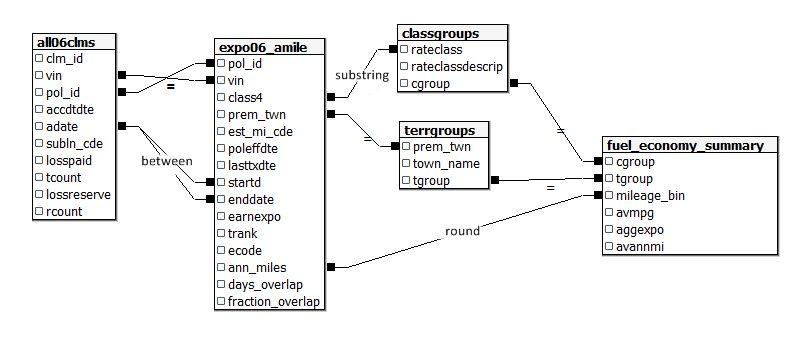
- Entity-relationship Diagram for PAYD Analytic Dataset with 700k claims and 4 million vehicle records
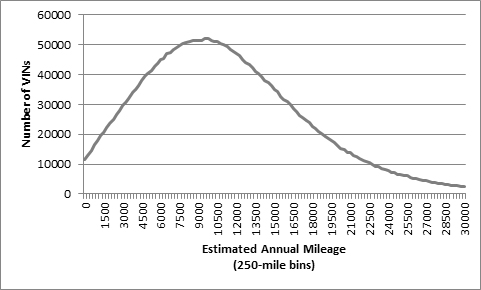
- Histogram of annual mileage for vehicles in the study
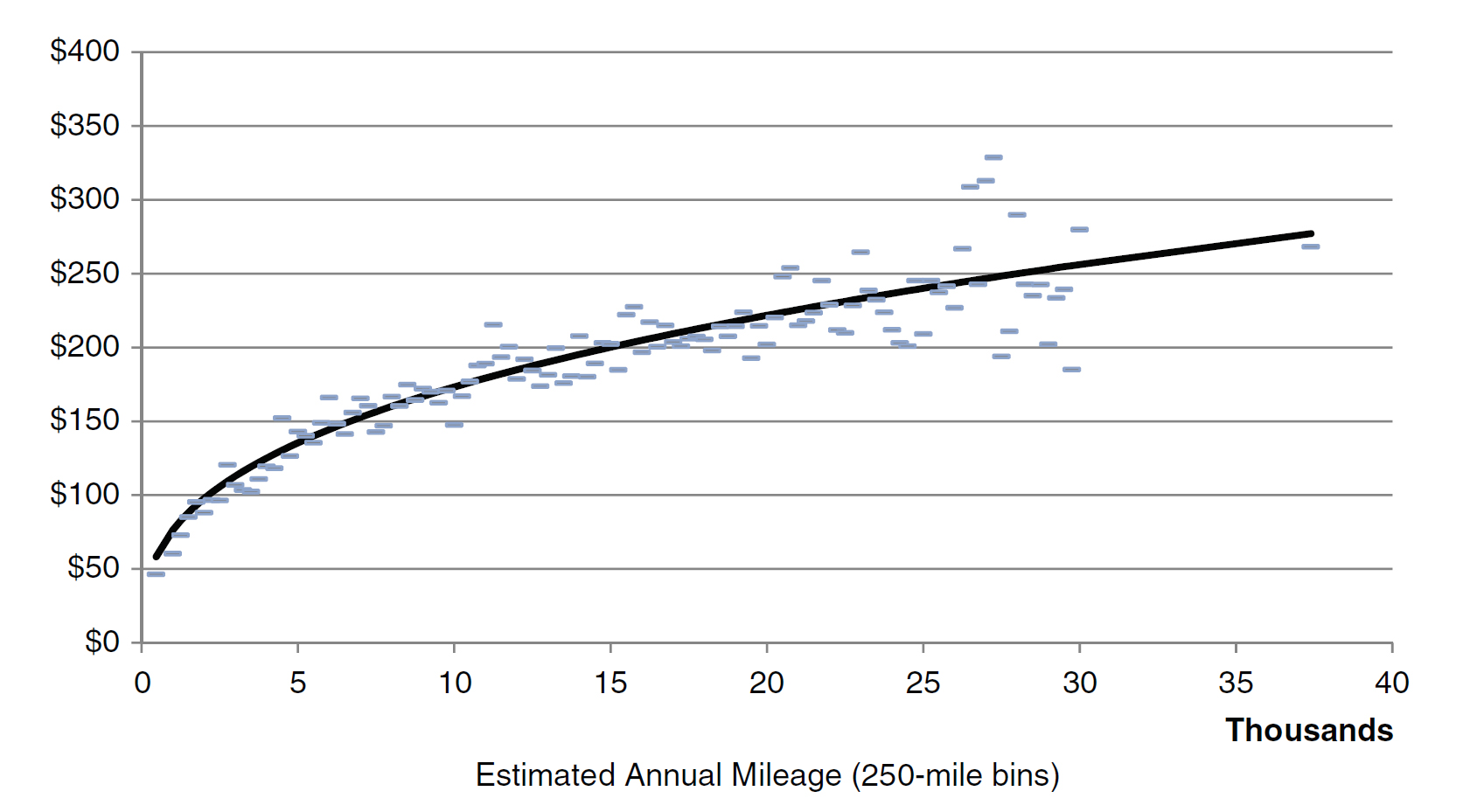
- Poisson regression of 'pure premium' by mileage - all vehicles
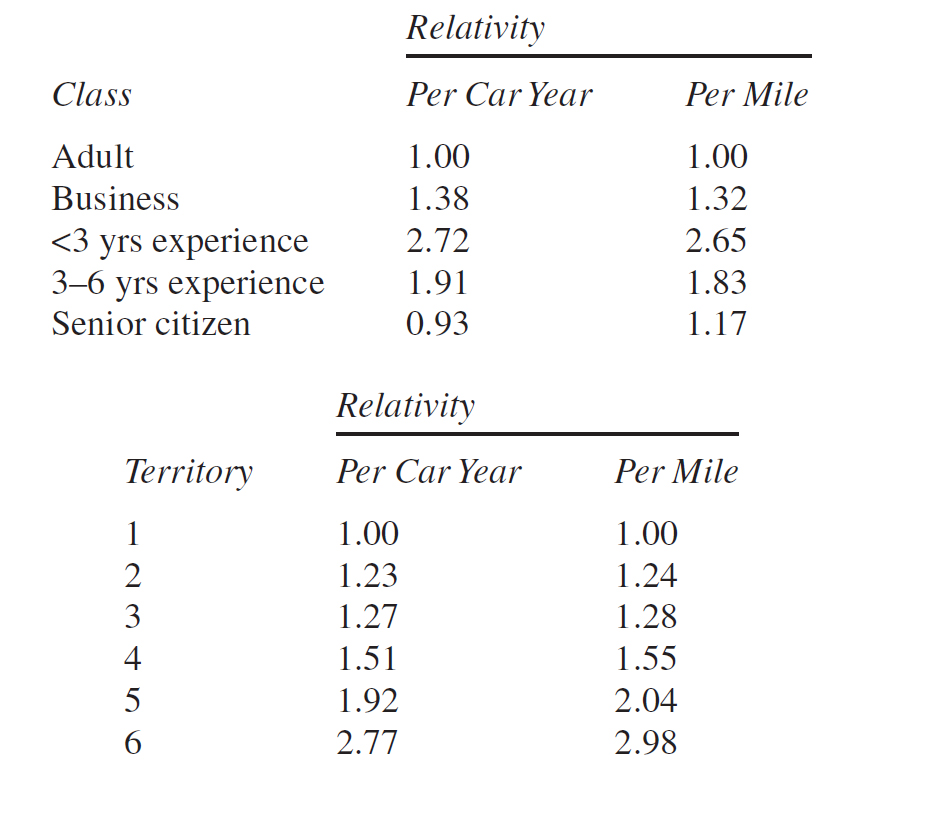
- Variation in annual mileage by driver class and territory
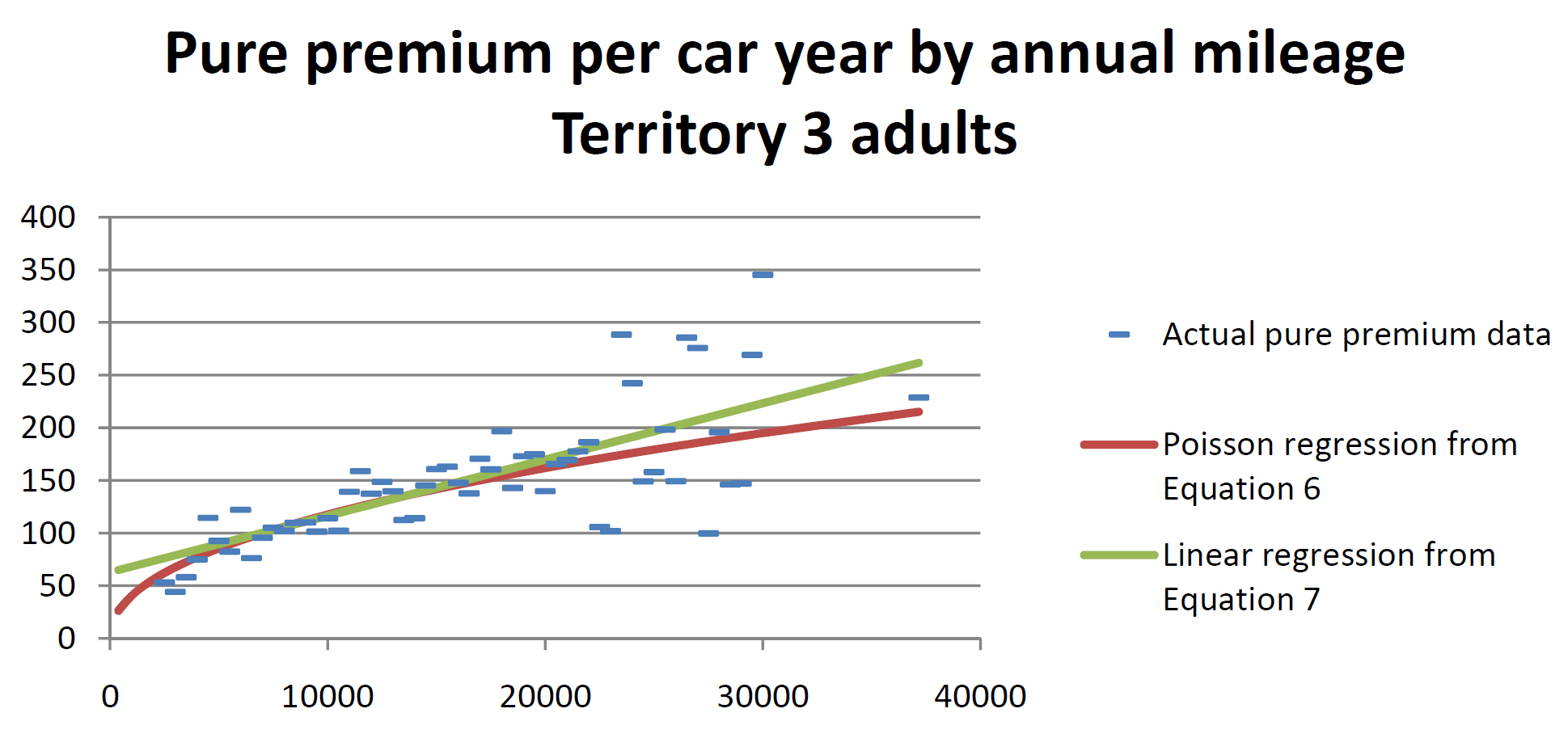
- Poisson regression of 'pure premium' by mileage - adults in territory 3
- Conclusions
- Strong per-mile effect on risk
- Some diminishing returns for higher mileage
- Stratifying by driver class and territory enhances the effectiveness of mileage
- Equity and environmental impacts
- Little differential impact by income and territory (shift in cost is from low mileage to high mileage vehicles)
- 5-9% reduction in GHG emissions if insurance were priced per-mile
Last modified: Nov. 13, 2017 [jf]
Back to DUSP | CRON | MIT | MiniClass Homepage