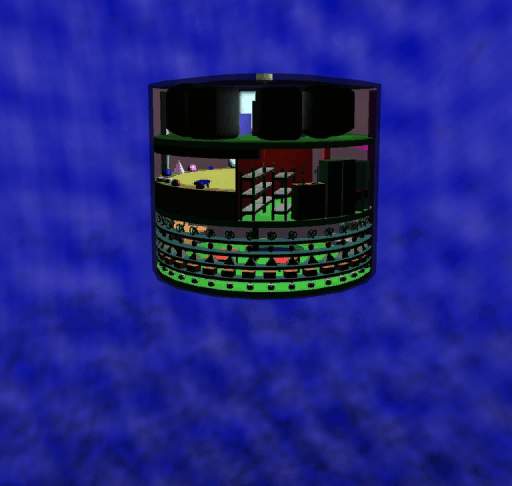
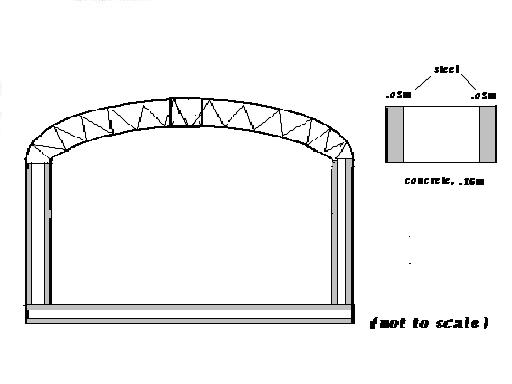
The exterior of the habitat is a cylinder of radius 5 meters, height 6.3m with a domed roof, radius 83.3m, maximum height 6.6m. The curved surfaces of the cylinder and dome provide structural strength. The transport vehicle attaches to a hatch, radius .375m, in the center of the dome. The habitat is kept at the same pressure as the surrounding water and there is a moon pool at the base (radius 1.5m) used for movement in and out of the habitat of both manned and unmanned robots. The pressure gradient between the interior and exterior at the base is virtually zero.
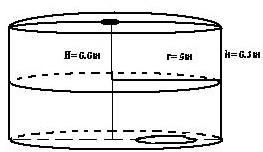
The structure is constructed primarily of steel and concrete. Steel is a non-corrosive industrial metal that stands up well to pressure and meets ASTM standards for pressure vessels. Concrete is used for weight. The walls of the cylinder and the floors of each level have an outer steel layer .02m thick and an inner layer of the same thickness, with a .16m layer of concrete between. The dome has the same three-layer structure, but within the concrete layer are steel poles positioned at angles to each other, to improve strength.

where epsilon is the strain, E is Young's Modulus; sigma is stress (for steel), ranging from 1500-1900 MN/m2; P is pressure, at 506.63 kilopascals; r is the radius, 5m; and t is the minimum thickness of the steel walls. t=.002mm A wall of this thickness is impractical, and so t is increased beyond the necessary safety factor, to a thickness of .02m.
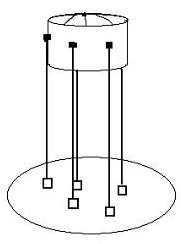
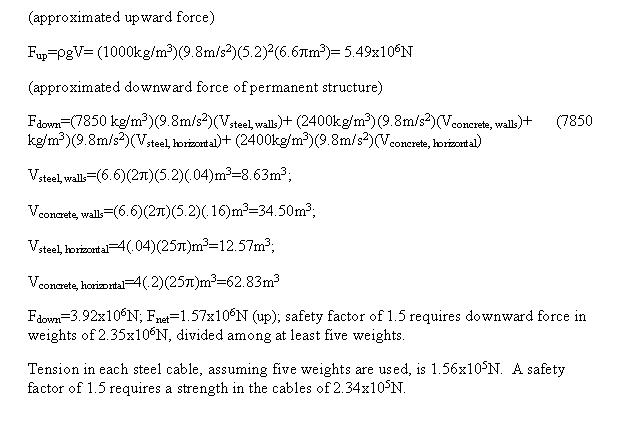
The habitat is naturally buoyant and the water within the blue hole is virtually stagnant, so it is both efficient and inexpensive to support the structure with tension cables. At least five cables, constructed of coated steel, with strength of 4.71 x 10⁵N each, will run from reels on the side of the habitat down to weights of 4.7 x 10⁵N each, on the sea floor. (Numbers assume 5 weights) The base of the habitat will be at a depth of 41.6m; the cables will be 160m long, extending 103.4m from the base of the habitat (extra length for initial lowering of habitat into blue hole) and run at an angle of approximately 90° to the base of the habitat.