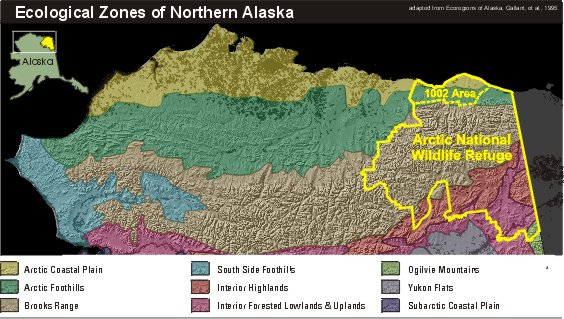
Overview of the ANWR ecosystem
Geography:
The Arctic National Wildlife Refuge (ANWR) was created in the 1960 as a sanctuary of "wildlife, wilderness, and recreational values." It spans 9.6 million acres and many regions, including the Arctic coast, the tundra plain, the Brooks Range mountains, and the Yukon basin forests. It contains over 20 rivers, including National Wild Rivers the Sheenjek, Ivishak, and Wind; North America's largest and most northerly alpine lakes Peters and Schrader; warm springs; lagoons; and glaciers.
The 1002 area is a 1.5 million acre stretch of coastal plain and Arctic foothills. This area is especially diverse in species because of the close proximity of the two ecoregions, which are only 10-40 miles apart from the Beaufort Sea in the 1002 region as opposed to farther west.
Climate:
The coastal plain of the 1002 area is a very dry region with average annual rainfall of about 10 inches but 54 percent cloud cover. It reaches highs of about 86 degrees F in the summer -averaging about 41 degrees- yet drops to well below zero -averaging -4 degrees- in the winter. It has few shallow lakes and mostly frozen permafrost and tundra. The tundra is most vulnerable to potential drilling operations and the subsequent global warming that is resulting from gas emissions. The idea of gravel and ice roads and travel during the frozen winter months will ideally limit the "footprint," but there is undeniable evidence that global warming will have a marked impact on the climate of the coastal plain. Current oil operations in the North Slope and the Prudhoe Bay Complex already emit millions of tons of carbon, methane, and nitrous oxides into the air. The global warming trend has already increased temperatures in the Arctic by 5 degrees F and 8 degrees in the winter since the 1960s, leading to shorter ice seasons, glacier melting, permafrost thaw, and increased precipitation. The inevitable change in climate may lengthen the growing season, but it will also alter the delicate ecological balance in ANWR.
Wildlife:
ANWR is considered "the most biologically diverse conservation unit in the circumpolar north," with "45 species of land and marine mammals, 36 species of fish, and 180 species of birds from four continents." Some of the mammals of most concern regarding the oil drilling issue are the caribou, who have very strict migrating patterns throught the 1002 region which could be interrupted by human disturbance with devastating effects to calving.
References:Official ANWR Site