Courtesy of HowStuffWorks Inc.
1. “El Nino Tightens
its Grip on the Galapagos.” New
Scientist. 25 April 1998.
(back to top)
General Team 4 Website Content
Random Facts about the Galapagos:
The islands are the Galapagos,
situated in the Pacific Ocean roughly 1000 kilometers west of mainland
Interesting facts:
·
Endemic
genera of cacti include Brachycereus and Jasminocereus, the lava and
candelabra
cactus, respectively.
·
Flamingos,
whose diets include crustaceans, tiny fish, and algae, can be found
wading in
brackish lagoons. Greater flamingos are primarily seen on Floreana and
other
southern islands.
·
A
change in ocean temperature associated with an episodic disruption in
atmospheric circulation led to a precipitous decline in the local
penguin
population. The Galapagos penguin population declined alarmingly during
1972
and 1998, when nutrients and fish were less abundant due to warmer
surface
waters associated with an El Niño event.
·
The
islands were officially discovered in 1535 by the Spanish missionary
Fray Tomas
de Berlanga, the Bishop of Panama. His ship veered off course while on
a
journey from
·
The
volcano of the westernmost
·
Several
plant species are endangered due to decimation by goats and competition
with
non-native vegetation. Invasive plants such as quinine and guava trees,
and
invasive animals such as goats, feral cattle, and the cottony cushion
scale
insect are contributing to the endangered status of native plant
species such
as the endemic daisy tree and the Floreana flax.
·
El
Junco Lake on
·
The
Pinta island subspecies of Galapagos Giant Tortoise (Geochelone
elephantopus
abingdoni) are survived by a single male named "Lonesome George".
Attempts to mate Lonesome George with female tortoises of the closest
subspecies have not been successful.
·
Naturalist
Charles Darwin (a native of
Barkstrom, Bruce R. Satellite
view of the Galapagos. 5 May 2003.
NASA. November 25, 2004. <http://nasa.gov>
Idealized
Village:
-Low/No
Waste Village:
Low
impact villages have been sought after for many places, including this
example
from the
Technology
used to create low waste impact: anaerobic biodigestor – reinforced
concrete
container that used oxygen reducing anaerobes to create organic biogas
from pig
waste that can fuel household heaters and small appliances. The nutrient enriched effluent is then sent
to algae ponds, which act as feed for the livestock and nourish the
soil for
crops of vegetables for the self-sustaining village.
A fresh-water pond produces fish that act as
a source of income for the school.
Klee, Robert. “Zero
Waste System in
This idea is applicable to all areas with population that uses packaged goods and produces waste. Biodegradable waste is a special polymer of plastic that is “programmed” to biodegrade after about 60 days or less, depending on the compound. Bioplastics are reported to be CO2 neutral, reduce fossil fuel necessity, a sustainable product, easily produced, and a way to produce jobs for those in the surrounding area. Obviously production of bioplastics would produce some waste, so it may not be advisable to set up an actual factory on the islands, but if goods imported to the islands were packaged in bioplastics, waste would be reduced. *Things to look into: would the bioplastic decompose faster in a tropical environment, what materials are needed for making them, what is the cost of the process and purchasing this type of plastic, what all can be made from it*
Handzik, Stefan. “Biodegradable Materials as a Strategic Element for a Sustainable Development.” Umwelt- und Systemburo, Environmental Consulting Office. February 1999. <http://www.environmental-expert.com/articles/article422/article422.htm>.
<>
Foundations and Other Organizations:
(Possible sources of funding for the Int’l Biopreserve Government)
A plethora of non-governmental organizations that may be prospective supporters of the Galapagos International BioPreserve the Mission 2008 group is creating can be found at http://www.idealist.org. These organizations may include radical environmentalists and others along those lines, but if funding can be found, where better to get it than people who really want to help in their own way?
Planet Drum Foundation:
Grassroots approach to ecology in
http://www.planetdrum.org/
New Era Galapagos Foundation
This organization works on conservation of
Galapagos, in
particular
Their agenda:
· Extracurricular classes for children in English and environmental education during term time.
· Continuous adult English classes in the evenings, to park wardens, fishermen, police and tour guides.
· Summer camp for children to learn English and become involved in environmental activities.
· Youth conservation activities at the weekends.
· English and environmental education in the Highlands of San Cristobal.
· Special activities involving the community, including mural painting, coastal clean ups, presentations and other environmental awareness projects.
http://www.neweragalapagos.org
Pig Farming in the
A typical hog factory farm has several metal barns, each containing
hundreds to thousands of animals confined cheek to jowl. The animals
may never see sunlight and spend their lives standing on slatted meal
floors, beneath which their feces and urine are flushed. The manure is
piped into open-air manure lagoons, where it is stored until it can be
pumped out to irrigate fields. A lagoon may be the size of several
football fields. Industrial-scale pig farming thus entails enormous
increases in the concentration and quantity of manure generated at
single sites. Because the scale of factory farms is so great, enormous
quantities of excess manure are now being spread on farmlands, posing
threats to drinking water and fisheries. Runoff and
spills from factory farms have precipitated water pollution disasters
in many states. In
An Alternative: Free-Range, Family-Sized Farms
On traditional family farms, pigs live in spacious barns with straw bedding that absorbs manure, or they root about outside and leave their manure to decay in a pasture or open lot. The Animal Welfare Institute (AWI) has established a set of Pig Husbandry Standards that codifies these advantages, and an increasing number of small farms are subscribing to the AWI standards. The standards include the following requirements:
* Sows must be able to build nests, and pigs must be able to root, explore, and play.
* Well-managed pastures are recommended. When animals are sheltered in barns, they must be given straw or materials suitable to be used as bedding.
* Animal factory practices-such as intensive confinement of animals in crates and cages-are prohibited.
* Large-scale animal factory owners or operators who commit only a portion of their operation to humane management are not accepted into the program.
* The routine use of antibiotics to promote growth or productivity or to control or mask disease is prohibited.
* Each farm must be a family farm-one on which an individual or family owns the hogs, depends upon the farm for a livelihood, and participates in the daily physical labor of caring for the animals and managing the farm.
(Portions of this story are adapted, with
permission, from
Eco-Village - Minimizing Impact
Objective 3: The
Located 1000km off the coast of
MIT Course 12.000, also known as Solving Complex Problems and Mission 2008, has been assigned the challenge of addressing these problems and designing an ideal solution for the preservation of the Galapagos. As part of the third objective of Mission 2008, we have the specific challenge of creating an “idealized” village for the archipelago.
I. Introduction
In order to approach the designing of an “idealized village,” the first step is defining the ideal for which we strive to reach. To justify these decisions, a little background information about the structure of the islands may be beneficial.
Although many islands make up the archipelago, the
majority of the population of 20,000 live on three islands:
In light of this population set-up, the ideal solution would be to leave the existing villages and towns in place, but to encourage a more ecologically minded running of the towns. This approach to the problem is justified because the damage already done in the Galapagos cannot be reversed, but the prevention of further devastation can only help. If the sources of endangering behavior are stopped, then the first step to allowing the ecosystem to rebuild and repair itself can begin. Our plan can be accomplished through minor regulations and the establishment of eco-friendly processes for municipal projects and daily life.
II. Plan of Action
In order to create an ideal village, the people living in the village must be the main concern, second only to the welfare of the ecosystem. This section will cover the aspects necessary for a town or village to adequately provide for its residents. Included in each section is a summary of what is the current situation on the islands and what a proposed solution would be to make the process more efficient, safer for the island ecosystem, or both.
III. Conclusion
In conclusion, the ideal village would minimize
impact caused by the human inhabitants while helping to improve their
standard of living in order to preserve the Galapagos. Key
methods in accomplishing this are through educating the people in the
Galapagos about the consequences of all actions and the importance of
their islands, establishing municipal systems for the people in order
to lower the impact the islands will sustain over time, and encouraging
that regulations be upheld either through clarification or funding to
enforcement organizations in order to help the islands run
smoothly. The Galapagos archipelago is a unique and fragile
environment that we are trying to save from further harm. Through
the creation of this city structure, the wellbeing of the islands can
hopefully be maintained and protected.
Report
on Proposed Improvements for Water Supply and Wastewater Management on
the
Third Draft
Amanda Morris, Erika Erickson, Aleksandra Hosa & Aleksandra Kopczynska
November 28, 2004
I. Past Record
Few of the
The water needed each
year in Santa Cruz (pop. 9,920),
In the city of
II. Proposed Improvements
a. Construct underground sewer system.
This is the best option for managing waste on the
b. Upgrade monitoring and maintenance system of
already installed septic tanks.
We suspect that the current septic tanks in the cities are neglected and only add to underground water contamination. Therefore, they should be monitored and maintained more carefully and consistently. Septic tanks must be emptied every three years, and the sludge transported to a wastewater treatment plant, where it is treated with woodchips and lime and converted into a nutrient-rich fertilizer. An alternative is to replace the current septic tanks with more efficient ones that can break down material faster or with ones that do not self-drain; however, it makes more sense to extend the sewer system to houses with septic tanks and remove the tanks, instead of installing new septic tanks because the sewer system is a better system altogether.
c. Construct wastewater treatment plant.
The Solar Aquatics System (SAS) is a wastewater
treatment method well-suited to the
d. Implement system of water and sludge reuse
through farming and irrigation.
Water reuse will conserve freshwater supply by making use of potentially large volume of lower quality water for irrigation. More than 50% of the water consumed is directed toward agriculture. On Isla Santa Cruz, this much water is the total consumption of water and this much water is used for farming. On Isla San Cristobal, here are the figures. Here are the figures for Isabela. Recycling sludge as fertilizer has potential for increased crop yield because it is extremely rich in nutrients and will decrease need for chemical fertilizers. Organic matter constitutes approximately 85% of all wastes produced in human settlements. At the moment only about 5% of solid wastes that households generate in the industrialized world is biologically digested to recover nutrients. Theoretically it is possible to use up to 85% of solid wastes as recyclable resource (Niemczynowicz). Disadvantages of water and sludge reuse on farms is that there is a potential health hazard in using lower quality water and sludge on crops that are not cooked before eaten, such as fruit or tomatoes. Sludge should not be used on root plants such as carrots because these types of plants are particularly vulnerable to viruses not removed during wastewater treatment. Cultural reasons may also prevent farmers from reusing wastewater on their land. This is where education can play an important role. Water cannot be reused if motor oil is present.
e. Repair leaks in water pipes.
Because more than half of the water carried through pipes is lost due to leaks, sealing the leaks would conserve freshwater supply. Modern geophysical technologies can help locate leaks in the pipes eliminating the need to physically disturb surface and subsurface structures. Electromagnetic resistivity and ground penetrating radar are two techniques. One method of electromagnetic reisistivity detects changes in electrical conductivity that occurs between subsurface zones, thereby detecting water leaks. Once leaks have been located, localized repairs are then possible. Several popular sealing grout mixtures can be employed. Sealants such as Bentonite-Cement can be directed to stop a leak with a hydraulic conductivity of 10 to the (minus 7)/second.
f. Install corrugated rooftops, cisterns, and
mini purification systems on all buildings for personal rainwater
collection. Construct larger cisterns on farms.
Household reservoirs would diminish amount of water drawn from municipal water supply and reduce pressure on water grid during peak consumption periods. Personal reservoirs would be advantageous during dry months and water shortages. Corrugated roof works by channeling rainwater to cistern, the size of which should be governed by amount of rainfall in that area. Water purified by solar disinfection. This system already in use in some areas - should be extended to more.
g. Install meters on pipes carrying water into
buildings to measure water intake.
In order to provide incentive to decrease unnecessary water consumption, meters should be installed on water pipes carrying water into buildings. These can also be installed in house basements. People would then pay by the amount of water they consume rather than by a flat rate. Currently on each islands, these are the rates they pay. ADD FIGURES.
h. Increase education efforts to raise public
awareness and support.
Reform plans will not be successful if people do not do their daily part to help conserve water and contain sewage. Even with new sewer pipes and a wastewater treatment plant, the environment will still be polluted if people continue to throw trash onto the street. Especially with a newly implemented system, education is necessary to teach people where to throw away their trash, how to reuse wastewater and sludge, and why it is important to conserve water. If education has a positive effect on younger generations, the future will be in better hands.
IV. Cost Estimate & Sources of Funding
The costs of constructing a sewer system and wastewater treatment plant and maintaining them are inevitably high, but because they are necessary for the sake of human health and environmental preservation, it should not be difficult to find support. First, a cost estimate must be made by civil and/or environmental engineers. Cost includes not only construction but also hiring of highly skilled operators. Possible sources of funding are:
a. UNESCO
Environmental component of United Nations that may
lend funds to assure wildlife preservation on
b. UNDP
United Nations Development Program is aimed toward helping nations increase long term sustainability. Already working with Galapagos to develop renewable energy, preserve biodiversity, and develop economy.
c. World Bank, European Bank, European Union, Global Environmental Facility, International Maritime Organization
Already funding at least 20
d. ORGALA
Collection of NGO’s (designed by the Mission 2008
Las Iguanas political team) whose primary focus is to provide funds for
sustainability and conservation projects on
III. Conclusion
It is necessary to implement a freshwater and wastewater management strategy. Otherwise the quantity and quality of water will continue to deteriorate on the islands, which would have disastrous effects on wildlife and human health. Although construction of a sewer system and wastewater treatment plant might seem expensive and temporarily inconvenient for the inhabitants, the long-term benefits far outweigh concerns. The improvements we have recommended will decrease waste pollution, make water reuse a possibility, conserve the freshwater supply, and improve the overall quality of life in the human settlements.
V. References
Assessment
of Barrier Containment Technologies,
“Growing
Together: Our Local Sustainable Agriculture Program Continues to
Achieve Success.” Charles Darwin Foundation.
2001. 27 Nov 2004. http://www.darwinfoundation.org/social/ag2001.html
Hardenbergh,
W. A. and Edward B. Rodie. Water Supply and
Waste Disposal.
Hollingsworth, A. M.I.T. Environmental Engineering Major. Interview. 2004.
Ishizuka, Kozo, Shigeru Hisajima, and Darryl R.J. Macer, eds. “Innovation of traditional and new technology to solve problems created by high technology.” Traditional Technology for Environmental Conservation and Sustainable Development in the Asian-Pacific Region. 1996. http://www.biol.tsukuba.ac.jp/~macer/TTEC/TTECFR.html
Koutsandreas, J. Retired member of U.S. Environmental Protection Agency. Interview. 26 Nov 2004.
Ley,
Deborah. “An Assessment of Energy and Water in the
Maharaj,
Utam S. and Tawari Tota-Maharaj. “High-Risk
Groundwater Development Option for
“Management of wastes in small island developing States.” Progress in the implementation of the programme of action for the sustainable development of small island developing States, Report of the Secretary-General – Addendum. 1998. http://www.unep.ch/islands/dd98-7a2.htm
Niemczynowicz, Janusz. “Innovation Trends in Urban Water Supply and Sanitation.” http://www.iris.ba.cnr.it/sksb/Innovation%20Trends%20in%20Urban%20Water%20Supply%20and%20Sanitation.htm
“Programme
of Action for the Sustainable Development of
“
“Solar Aquatics System (SAS) for Wastewater Purification.” New Environmental Technologies Evaluation (NETE) Program. http://www.ene.gov.on.ca/programs/3354e29.pdf
“Solar Aquatics System.” OCETA Environmental Technology. http://www.oceta.on.ca/profiles/earthtech/icon.html
United
Nations Environmental Programme, South Pacific Applied Geoscience
Commission. “Source Book of Alternative
Technologies for Freshwater Augmentation in
“Waste management.” EUROPA Environment. 2003. http://europa.eu.int/comm/environment/env-act5/chapt2-8.htm
Septic system design: a tank with an inflow pipe and an outflow pipe
used in the place of central sewage system
Courtesy of HowStuffWorks Inc.
The typical tank has two chambers, one containing aerobic bacteria oxygenated by airflow in pipes caused by flushing, and the second chamber containing anaerobic bacteria. The bacteria digest waste in the wastewater as it flows into the tank via inflow pipe. Indigestible materials sink to bottom of tank as sludge. The broken down materials are in aqueous solution that slowly move through the system, with the materials being broken down in a floating layer called the scum layer. The aqueous solution flows through the outflow pipe into the surrounding earth in a leech field. The surrounding soil filters the water as it percolates down as groundwater recharge. The type of soil the leech field has is very instrumental in the efficiency and effectiveness of the septic tank. Soil composed of high percentages of clay will not work well with a septic tank because it does not allow water to flow through it, thus causing back-ups in the septic tank. Soil with large particles will not filter the wastewater thus possibly contaminating the groundwater supply. Because approximately half of the houses in Puerto Ayora have septic tanks, this could in part contribute to the cholera outbreaks that have occurred there, paired with the leaky water pipe system.
In the interview with Mr. Erickson, he advised against a traditional septic tank system for every household in the city, as the city structure is compact. For a four person family, the general size of a septic tank is 20,000 gallons, which needs pumped of sludge every 2 to 3 years depending on usage. The ground surrounding the septic tank and the leech field must be able to support the volume of water flowing through the system, otherwise it becomes too saturated with waste water that, although very fertilizing, isn’t going to drain sufficiently and may contaminate groundwater supply by over-saturation. Thus, depending on the soil, only a few septic tanks can be functioning in an area at a time.
A second option would be for non-draining septic systems, that must be pumped quite frequently. The response in the interview advised against this as well, due to the fact that the amount of digging to put in very large tanks for septic systems would like be more extensive than a sewage system and the overall time vs. power efficiency of frequent pumping would negate the environmental and civil good of leaving the streets intact by foregoing a traditional sewage system.
As far as the sewage system is concerned, it is advised that a traditional small-town gravity flow system be established to minimize energy consumption by tanks. As Puerto Ayora is conveniently established on an incline towards the coast, a water treatment plant could be built near the coast outside of town. Depending on flow rate and usage in specific areas, the typical house would need a 4-inch diameter pipe leading from house to street, where the main vane is put under the stone streets, which will be easier to replace and repair than pavement streets. The main vane would typically be a 10 to 12-inch diameter pipe leading to the water treatment plant.
Traditional wastewater treatment plants are very complex and require a great deal of space for their construction. In addition, they are not very attractive. A system could occupy up to half a square mile depending on its waste-load for the treatment area.
Brain,
Definition
Aquaculture in the
Offshore aquaculture
Resources required for offshore aquaculture
Importance of sea cucumbers
The threat to the sea cucumbers is being driven by culinary demand. Sea cucumbers are highly prized delicacies in many East Asian cuisines, says David Challinor, the Smithsonian Institution's science adviser. A high-quality food, sea cucumber flesh is 50%-60% protein.
Of approximately 1200 species found worldwide, approximately two dozen are considered edible. In the Galapagos, only Stichopus fuscus is fished commercially.
The soft-bodied echinoderms live on the ocean
floor, ingesting mud and other sediments from with they extract their
food. In bottom sediments rich in organic matter, sea cucumbers can
account for 90% of the biomass, according to Elliott Norse, chief
scientist of the Center for Marine Conservation in
Sea cucumbers play a vital role in ocean ecology, says David Pawson, a scientist at the Smithsonian's National Museum of Natural History. Like earthworms on land, they turn over bottom sediments, which helps free nutrients. In the food chain, the sperm, eggs, and larvae of sea cucumbers are eaten by organisms from single-celled animals to fish, Pawson adds.
Scientists are concerned by the sea cucumber
harvesting, because studies show that when there is overfishing or when a natural die-off occurs,
sea cucumber numbers can be depressed for years. At Chuuk Atoll in
Aquaculture
Scientists and conservationists remain concerned.
Even though proposals have been made to raise sea cucumbers in
captivity as
Sources
Posadas, Benedict. “Economic Feasibility of
Offshore Aquaculture in the
Fletcher, Kirsten. “Marine Aquaculture
Zoning: A Sustainable Approach in the Growth of Offshore Aquaculture.”
[http://www.olemiss.edu/orgs/SGLC/zoning.htm]. March 26, 2004.
“USDA Agricultural Research Service.” [http://www.ars.usda.gov/research/programs/programs.htm?NP_CODE=106].
In order to make the Galapagos a more environmentally sound city structure, the methods of energy consumption, energy source, waste and water management and general opinion of being eco friendly must be changed. In order to make the village structure more favorable to maintaining the natural laboratory, here is a proposal:
1. Set up a time cushion for people to make changes and adapt to new standards and criteria of living in the Galapagos.
- For example, allow everyone 5* years to make the transition in his or her homes and businesses.
2. Determine the Criteria
- Water Usage allotments
- Type of Energy needed for powering the residence, business, or public location and limits of consumption. Solar Panels will be provided by the government, and rental-type system will generate funds for payment of them and upkeep.
- Waste Disposal methods – No dumping allowed, all waste must be separated into organic and inorganic wastes for proper disposal.
- Building standards – insulation if necessary, etc.
- Method of Renovation -- Most restructuring of buildings must be approved by INGALA, so a strategy for this would need to be determined as well.
3. Require certification from hotels and other businesses
- Determine course of best environmental action for a hotel (keeping in mind its size and capacity for visitors) to establish limits for the hotel’s consumption and harm of island resources.
- For example: Each hotel has 5 years to switch to solar and wind power, replace existing vehicles with hybrid or low-pollutant vehicles, set up system and practice in-hotel recycling for waste, etc. Inspections of the hotel to make sure these guidelines are in place or in progress will determine who is in violation of the transition efforts. Businesses that are quick on the uptake can advertise “Eco-Friendly” or something during the 5 years so it would be sort of a competitive edge, encouraging others to quickly follow suit in order to impress customers.
- Individual living quarters would also have 5 years to make the transition of power methods, waste disposal method, etc.
- Grants could be available or subsidies to help people pay for changes
4. All buildings built after enactment of the regulations must build according to specified practices to make entirely eco-friendly buildings.
5. Enforcement
*5 Years may be unrealistic. This figure was
used throughout the section, but it may be a more likely estimate of 10
years for everything to be implemented. This timeline would of
course depend highly on funding and worker supply.
Immigration and
Tourism – Galapagos Population Standardization
Fishing Regulation Concerns:
The United States Department of Agriculture offers
services to US farmers in response to the depression of the
1930’s. This is sort of a summary of how it works.
1. Market Stability Measures: In order to
prevent over planting one year and under-planting the next, the
government allows a certain number of acres of each crop to be planted
nation-wide each year. These acres are monitored through
Insurance practices – the USDA only insures a certain number of acres
of each crop each year dependant on foreseeable market size
(International and Domestic Markets).
2. Crops are insured for bad weather and
other damages – If a specified yield is not achieved in the harvest of
the crop, the farmer is paid reparations for insured acres and then
small subsidies for the overall farm.
3. Price Supports: To prevent drastic rises
and falls in the market, levels are put in place as the minimum and
maximum cost per bushel when selling to a Co-op, which is where most of
the grain is sold. The Co-op then sells it to foreign markets or
domestic producers through the government. If a crop is
overproduced, the Farmer will be paid to keep some of his yield or
possibly not to harvest at all. When a crop is in high demand,
farmers will be rewarded for contributions, but levels are set so as
not to encourage monopolies.
If modified and added to the Quotas system
discussed in the section about the economy,
these together could help to prevent black-market activity and economic
instability for fisherman when fishing levels are reduced in the
Galapagos.
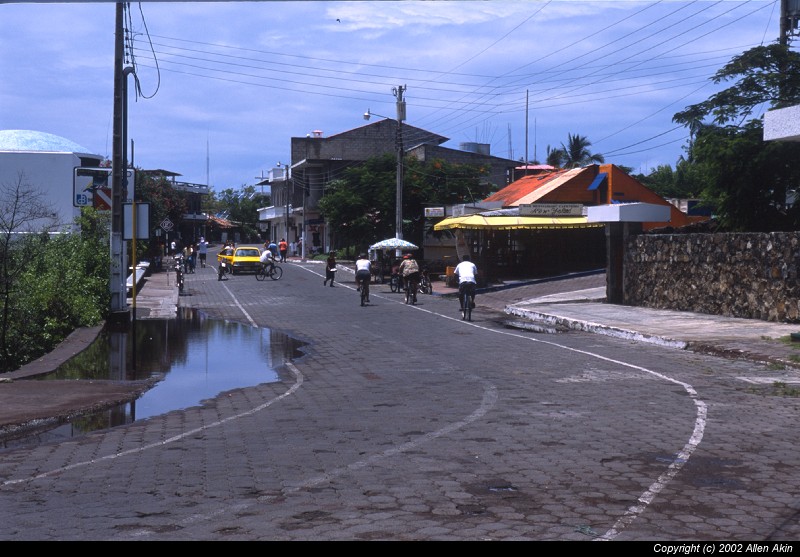
In order to understand what we are dealing with in
the Galapagos, not having been there yet, information regarding the
cities will help to get an idea of what the villages look like and
function like. Much of this information is provided by tourist
websites. Though this isn't a scientifically reliable source, the
general information about facilities on the island is helpful to us to
know. This will tell about power consumption, tourism amounts,
and whether the living conditions are inadequate for people.
Puerto Baquerizo
Transportation Required: To see Cerro Tijeretas (35 minutes away overlooking neighboring town), Playa de Oro – small town with a few hotels north of Puerto Baquerizo Moreno (swimming is popular), Playa Punta Carola (surfing), 20 minute walk South leads past the airport and to La Loberia, a coast with trails
Restaurants: 8 dining establishments in Puerto Baquerizo Moreno, 2 snack places (pastries and snacks) in PBM, 2 Restaurants in El ProgressoBars and Discos: 4 Bars/Discos in PBM
Hotels: 6Specialty Shops: a few crafts shops, 2 mentioned specifically
Transportation: Irregular Boat schedules offered
from
Flights into Galapagos always go through Guayaguil or
Bi-monthly cargo carriers will take passengers for a small fee, but not frequently done.
Daily Buses travel between El Progresso and Puerto Baquerizo Moreno
Services: 1 bank, 1 post office, 1 hospital, and 1 pharmacy
Internet and communication services available – expensive!
Attractions: Around Santa Rosa and Puerto Ayora some tourist attractions including Butterfly Ranch, Lava Tubes, El Chato, mangrove swamps, Conway Bay and Las Bachas, Cerro Dragon, Guided tours and small streams and inlets for “bathers”,
Hotels: 24 of varying costMinistry of Tourism, British Consul
Restaurants: More than 10 large restaurants and probably 3 bakeries, 3 main ranches and eating establishments outside of Puerto AyoraBars and Disco: 1 Bar and Grill, and 4 Bar/Disco
Shops: 1 supermarket, a large souvenir shop, and supplies shopRecreation activities – many many offered!
Services: 1 hospital, 1 bank, internet available,
Isabela:
Accommodations: 5 hotels, no banks, no hospital,
Restaurants: 7 restaurants at Puerto Vilamil (1 in Merceditas Highlands)
Floereana:
About 80 inhabitants
1 school and 1 telephone
Accommodations: 1 hotel and family bungalows
No regular boat services
Info above from http://www.thebestofecuador.com and http://www.ecuadorexplorer.com
Knowing what a place looks like can help a lot in
finding what to research next. Therefore, pictures of many things
on the Galapagos helped steer us in the direction of finding solutions
to our problems. These images have direct links below. This
is not information for specific research purposes, just for our general
information and amusement.
City location Maps
http://www.go2galapagos.com/maps_photos.html
http://www.ecuador.washcoll.edu/Santa%20Cruz/puertoayoramap.htmlhttp://www.arden.org/images/2002Galapagos/040016.jpg
http://www.arden.org/images/2002Galapagos/040020.jpg
http://www.arden.org/images/2002Galapagos/040017.jpg
http://www.arden.org/photos/2002Galapagos/full/index.htmlhttp://www.20riverside.freeserve.co.uk/gallery/pelican.jpg
http://www.20riverside.freeserve.co.uk/images/puertoayora.jpg
Photos
http://www.wrwagnerfamily.net/galapagosimages/0813PM%20Bartholome%203651-0019.JPG
http://www.wrwagnerfamily.net/galapagosindex7.htm
Because much of the Galapagos population has
arrived in the
past 15 years, the background of the citizens is very diverse. A large boom of immigration occurred in the
mid-90’s, when waves of Ecuadorian refugees fled to the Galapagos in
order to
find better jobs and get-rich-quick schemes (McFarland).
Because the education policies in
A large problem with ecosystem contamination of this sort is seen in the transport of produce. In an effort to reduce the need for transport of food onto the islands, the Charles Darwin Foundation is encouraging the agricultural projects on the islands to strive for self-sufficiency. According to an interview with resident of the Galapagos and Ministry of Agriculture worker, Byron Fonseca, the Galapagos can almost provide completely for itself, except most residents choose not to buy local produce. Although improvements are being made in shipment quarantine, the spread of invasive species has not been completely eliminated. A large factor in this is lack of funding for inspection stations and training and no permanent base camp for inspections. Additionally, the Ministry of Agriculture has had a history of personnel strikes and lack of workers (Kerr).
Additional problems with invasive species arise
when
considering the cattle that have been brought to the islands. Feral pigs and goats have been wreaking havoc
on the natural flora of
Or order to deal with all of these threats, our plan for the agricultural situation on the Galapagos is to support the projects currently underway through the Charles Darwin Foundation, as well as increasing education of local farmers and consumers of the benefits of green methods and buying local products. For example, by educating the farmers in the Galapagos about crop rotation and grazing portioning, the fertility of the soil can be conserved for many more years, preventing the need to abandon a plot of land for a new area.
Agriculture requires large tracts of land, a
commodity in
high demand in the Galapagos. In 1979,
the amount of farmland was decided to be 24,000 hectares, and only
varies
slightly because the rest of the land belongs to the
The Charles Darwin Foundation is also working towards providing water to farms during the dry season of the year. Implementing rainwater cisterns on farms and building a pipeline or trench system from the Solar Aquatic System will provide farms with more water without removing so much from the source wells used throughout the city. Of the current water usages in the Galapagos, the small percentage of the population that is farming is using almost half of the water pumped. The total water demand in the Galapagos is about 2,500,000 cubic meters per year, but almost exactly half of that is used for Agricultural purposes (Ley). By channeling the clean water from the SAS to water towers in the countryside, extra stress on city wells can be alleviated.
One more problem with the agricultural scene in the Galapagos is that more and more of the residents are seeking rural homes and jobs (Kerr). Although residences in a rural environment may seem desirable, this will be a spread of inhabited areas on the island, thus increasing surface area of human affected areas. This will need to be prevented through clarification in regulations on building and inter-island migration.
Sources:
McFarland, Craig and Miguel Cifuentas. “Case Study:
Suzi Kerr et al. “Migration and the Environment in the Galapagos.” 2003. <http://econwpa.wustl.edu:8089/eps/othr/papers/0403/0403001.pdf>.
“Growing Together.” Charles Darwin Foundation. 2001. <http://www.darwinfoundation.org/social/ag2001.html>.
Ley, Debora. “An
Assessment of Energy and Water in the
“Special Regime for the Preservation and
Sustainable
Development of the