Where to Be Jobless in Europe
By MARK LANDLER
Published: October 9, 2005 in The New York
Times
FRANKFURT
— EUROPEANS are famous for trying to take the sting out of unemployment, with
generous and long-lasting jobless benefits. Even when political and business
leaders have warned that their societies can no longer afford such largess, the
European public has clung to these safety nets.Skip to next paragraph
Lucas
Schifres/Bloomberg News
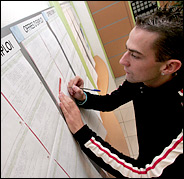
A Frenchman checks jobs at a Paris
unemployment office. France
does not have a good network of job-training centers.
But even within Western Europe, some
countries are more accommodating to those out of work than others. So it is
tempting to ask: Where is it easiest to be unemployed?
The answer, predictably, can depend on an individual's
situation: whether one is young or old, single or married, childless or with a
family, recently out of work or chronically unemployed. But attitude also plays
a role: Is the person eager to find another job or looking for a life of
leisure? And is the country trying hard to get the employee back to work?
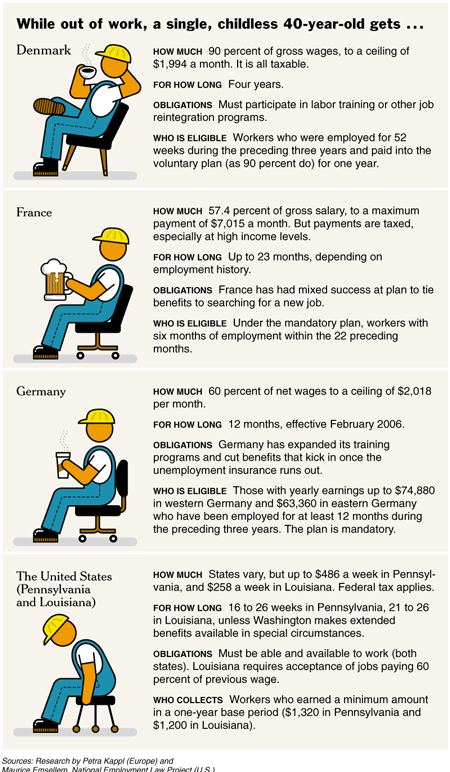
In Denmark,
said David B. Grubb, an economist at the Organization for Economic Cooperation
and Development, a typical unemployed person might get 80 percent of past
income for four years. "But after the first year," he said,
"you've got to spend a lot of your time in temporary jobs or training
programs."
Europe's lush benefits are often
blamed for helping to perpetuate its high unemployment, though it should be
noted that Denmark,
with perhaps the softest touch of all, has a jobless rate of 4.8 percent,
roughly equivalent to the United States'.
In addition to the emphasis on job seeking, Denmark
has relatively weak job-protection rules, which make it easier for companies to
fire workers in the first place, opening up the labor market.
Mr. Grubb, who has compared unemployment benefits in 26
countries, offers one general rule: the most generous countries are also the
ones most likely to put the most pressure on recipients to find new jobs.
Germany
has historically catered to both those in and out of work. Thanks to its
still-powerful labor movement, job protection laws here are among the strictest
in Europe. As for taking care of the unemployed, the
generosity was epitomized by the notorious 2003 case of "Florida
Rolf," a former banker found living in Miami
in an apartment near the beach that he paid for with $2,200 a month in German
welfare checks.
In Germany,
people who lose their jobs receive 60 percent of their salaries for 12 months
to 36 months. Following that, they previously were able to draw long-term
assistance and other benefits that could total 53 percent of their wages.
But Chancellor Gerhard Schröder
cut back the long-term payments, and as of next February, Germans who are out
of work for more than a year will be entitled to benefits similar to ordinary
welfare - about $414 a month, plus money for rent and utilities.
That cutback, however, has probably put a firm brake on any
further changes to the system. In the national election last month, the voters
punished Mr. Schröder by refusing to give him a
renewed mandate. But at the same time the electorate denied a majority to his
conservative challenger, Angela Merkel, who had advocated even stronger free-market
medicine. The likely outcome is government by an alliance of the two major
parties, each feeling it imperative not to mess with unemployment benefits.
Voters reacted so negatively because the government's
parsimony coincided with a wave of job cuts that have helped raise the
unemployment rate to 9.6 percent.
German officials said the change in long-term benefits was
intended to discourage able-bodied people from permanently opting out of the
work force. But other benefits are also available, and it is
unclear whether some people might still get paid more not to work rather than
to find a new job.
"This is a difficult question that occupies us as
well," said Eugen Spitznagel,
a researcher at the state-run Institute
of Employment Research in Nuremberg.
"It's a hypothesis that is plausible, but difficult to prove. We don't
have the empirical data yet to answer it directly."
Among other European countries, the Netherlands,
Norway and Portugal
are viewed as particularly generous to the unemployed, while Britain
and Greece are
seen as among the stingiest.
France
might be the cushiest alternative of all, however. France
not only offers generous compensation, but it has yet to organize an efficient
network of job training and placement centers. So in pratcical
terms, the most an out-of-work person has to do to maintain benefits, Mr. Grubb
said, is to call in every six months to confirm that no new job has been found.
The French government is trying to change this laissez-faire
approach - in part by adding yet another benefit. Prime Minister Dominique de Villepin has proposed giving the unemployed a bonus of
1,000 euros, or about $1,200, for taking a job, even as the government weighs a
three-strikes rule, under which jobless people would lose their unemployment
compensation if they turned down three job offers.
The French government is also trying to make it easier for
small companies to lay off workers. But that proposal provoked thousands of
strikers to take to the streets last week in Paris
and other cities. Mrs. Merkel floated a similar idea in Germany,
and it did her little good at the polls. Still, some European experts say that
French and German leaders are at least looking at the heart of the unemployment
problem: that companies are not likely to hire more freely unless they can fire
more freely.
As Katinka Barysch,
the chief economist of the Center for European Reform in London,
put it, "the best place to lose your job is in a country where it's
easiest to find a new job."