UNIFIED ENGINEERING Fall 2006
Problem T16 (Unified Thermodynamics) (LO#4)
Consider the following proposal for a nuclear power plant, which consists of a nuclear reactor as the heat source and a steam Rankine cycle to generate power. The peak cycle pressure is 15 MPa. Saturated steam passes through the turbine, expanding to a pressure of 5.94 MPa. The fluid is condensed in the condenser to the saturation point. The liquid water is then pumped through the main pumps and heated in the reactor. A sensor measures that the temperature at state 2 is 280ºC.
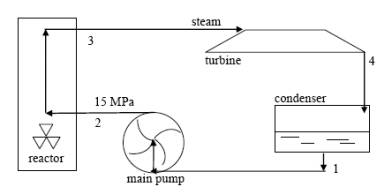
a) Sketch the cycle on a p-v diagram.
b) The turbine must resist water droplet erosion for the life of the plant such that the liquid water content in the turbine flow should not exceed 20% by mass. What is the quality at state 4 to satisfy this requirement? (i.e. What is x4?)
c) What mass flow of water is required to sustain a power generation of 500 MW? How does this compare to typical air flows in an aircraft engine?
d) How much power is required to drive the main pump?
e) What is the required heat input from the reactor?
f) What is the thermal efficiency?
It is suggested to modify the cycle by superheating the steam to 400°C. In this case the steam emerges from the turbine at saturated conditions (i.e. x4 =1) and with a pressure of 6 MPa.
g) What is the net cycle work with superheating for the flow rate calculated in part c?
h) What is the thermal efficiency with superheating?
