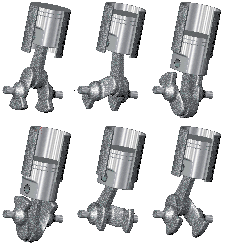
 |
|
|
|
|
|
Following is a short 6 slide presentation about 2.972 Understanding How Things Work
a new type of class which At the bequest of PTS, I Credit:
P/D/F
Units: 6 Units
Grading: Grading [75% = pass]
-35% Final Report -20% Class Participation/Field Trips -25% Labs -20% External Gear Pump/Motor Project
In the fall of 1998 a ME student suggested that the ME curriculum needed a course which taught how basic machines/machine components work. In addition, the class was also designed to teach/provide the following:
| 1. Hands on Experience: No "black boxes" everything is hands on 2. Visualization & communication skills 3. Confidence in applying theory 4. Understanding magnitudes of physical quantities |
|
| Skill / Knowledge | How Acquired | |
| Understanding
of how many devices operate |
 |
Taking a multiplicity of machines apart and using/running them |
| Ability to
learn/determine how things work |
|
Lectures and lab exercises on using geometry/structure, physics, and flow (material, information, energy, etc...) in machines/devices to determine how machines work. |
| Ability to
create, rotate, translate, and otherwise visualize 3D objects |
|
Sketching the machines/parts and solid modeling some of them |
| Understanding
of the limiting and dominant physics of many machines |
|
These will be covered in the workshops and demonstrated in lab |
| Understanding
of how geometry is linked to and affects performance |
|
Geometric modeling, mathematical modeling, and by making working model(s) |
Class time is split between workshops and labs. The workshops (held in a computer room) are used to convey material to the students which enhances the lab experience, prepares them for a design project, and improves their communication skills. In the workshops, the following are covered:
| 1. Solid modeling 2. Functional Requirements and Design Parameters 3. Limiting and dominant physics of machines 4. Spread sheets (used for performance modeling) 5. Basic sketching 6. Basic web page construction 7. A formal method for understanding how something works, which is to understand: a. Functional Requirements & Design Parameters b. Geometry & Structure c. Limiting & Dominant Physics d. Flow of material, energy, information, etc.. |
|
| Armed with the
knowledge and skill gained in the workshops, students go to lab where they spend the
majority of their time taking apart machines. For the first offering of the class, there were four stations dedicated to machines commonly used by engineers: -Gears and Bearings Groups of 4 students are guided by a lab write-up which points out important characteristics of the machines. Students sketch parts of the machine and identify their function. |
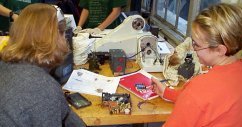 Katin Shields & Jennifer Blundo work on a tape recorder and several gear boxes. |
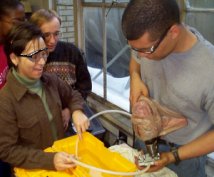
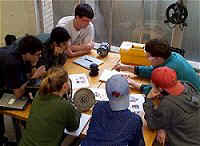 In lab, students take apart machines, learn how they work, then explain how they work to others |
|
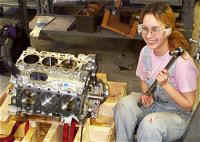 Rosalind Takata Prepares to Finish Off The Engine |
Each student writes a final report on a machine or device which interests them. These reports give the students the opportunity to explore machines which are impractical to take apart in lab. These reports are being collated and used to start the base of an Course 2 How Things Work Web Site. In each subsequent offering of the class, the database will grow as more reports are added to the database. These reports will be available, starting Sunday May 02.
The entire class took tours of the following to help them learn how large systems or systems with several components operate.
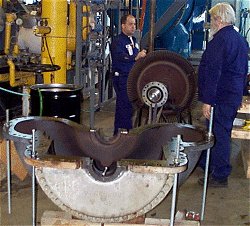 TOUR OF PHYSICAL PLANT: Case and shaft of steam turbine during an overhaul. |
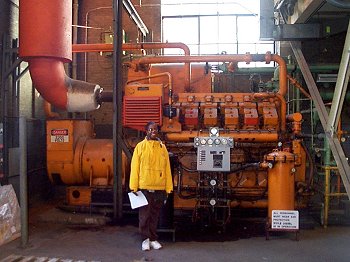 TOUR OF PHYSICAL PLANT: Allicia Jillian Hardy stands next to the MIT back up generator (diesel.) |
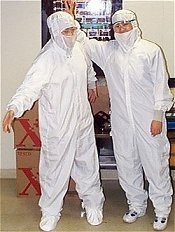 MEMS LAB TOUR: Gina and Christina Park Pose In Clean Room Suits |
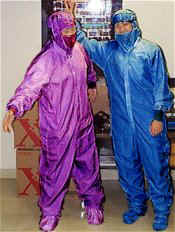 MEMS LAB TOUR: Gina and Christina as Enhanced by Pentium II™ Chips |
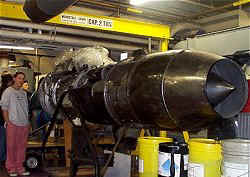 TOUR OF AERO-E DEPARTMENT: Lee Knight Looks inside A Jet Engine |
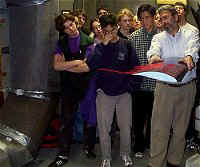 TOUR OF AERO-E DEPARTMENT: Demonstration of How An Airfoil Works |
DESIGN PROJECT: EXTERNAL GEAR PUMP
| In teams of 4,
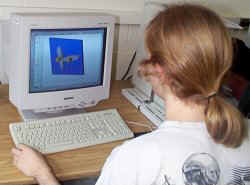
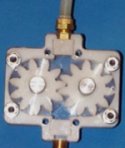
students design, solid model, manufacture, and run an external gear pump. This project was used to help the students learn solid modeling, which in turn developed their visualization skill. This project also helps students make the link between geometry and its affects on performance. Specifically, students varied critical dimensions of the gear pump and were able to determine the effect of these changes on the performance of the pump.
|
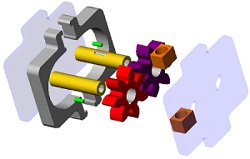 Solid Model of Pump |
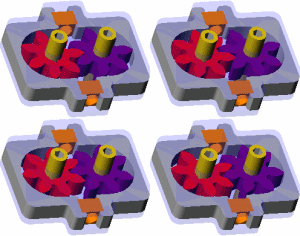 Animation of Solid Model |
|
|