MIT Lesson 19 Kanji: 第19課の漢字
 Warning! There
is Japanese text on this page. If it looks like this:
$BI4@i instead of this: "
Warning! There
is Japanese text on this page. If it looks like this:
$BI4@i instead of this: " ",
then read
this.
",
then read
this.
 Athena
users - for instructions on how to print this page, read
this.
Athena
users - for instructions on how to print this page, read
this.
 Each
large, brush-stroke
image below which shows up as a hypertext link (e.g. has a colored box
around it) is a link to a 1 Megabyte (or less) QuickTime movie of the
character being painted with a brush. Look
here for information on configuring your browser appropriately.
Each
large, brush-stroke
image below which shows up as a hypertext link (e.g. has a colored box
around it) is a link to a 1 Megabyte (or less) QuickTime movie of the
character being painted with a brush. Look
here for information on configuring your browser appropriately.
JP NET is grateful to Prof. Saeko Komori
of Chubu University for
permission to use the kanji movies at our site. All movie data is
copyright 1995, 1996 by Saeko Komori.
In the following definitions, on (Chinese-based) readings
are represented by katakana, and by capital romaji letters;
kun (native Japanese-based) readings are represented by
hiragana, and by lower-case romaji letters. This is a common
dictionary convention, and does not have any bearing on meaning.

- Printed form:
- 立
- Readings:
- た(つ)/た(てる)
- ta
- Meaning:
- to stand up
- Mnemonic:
- A person standing with feet firmly planted on the ground.
- Usage Examples:
- 立つ (たつ) stand up
- 立てる (たてる) erect

- Printed form:
- 売
- Readings:
- う(る)/バイ
- u/BAI
- Meaning:
- to sell
- Mnemonic:
- Some day you will write and sell a good book that people read 読.
- Usage Examples:
- 売る (うる) sell
- 売店 (ばいてん) kiosk

- Printed form:
- 課
- Readings:
- カ
- KA
- Meaning:
- section; lesson
- Mnemonic:
- The word radical 言 and a fruit 果物[くだもの].
- Usage Examples:
- 課長 (かちょう) section chief

- Printed form:
- 発
- Readings:
- ハツ
- HATSU
- Meaning:
- to start; to depart
- Mnemonic:
- Open the gate 開 right now. People are leaving for all directions!
- Usage Examples:
- 十時発 (じゅうじはつ) (train) departing at 10:00
- 京都発 (きょうとはつ) (train) departing Kyoto

- Printed form:
- 集
- Readings:
- あつ(まる)/あつ(める)
- atsu
- Meaning:
- to gather
- Mnemonic:
- Birds 隹 gathering on a tree 木. [曜(よう)"days of
week";難(むずか[しい])"difficult"]
- Usage Examples:
- 集める (あつめる) gather
- 集まる (あつまる) come together

- Printed form:
- 南
- Readings:
- みなみ
- minami
- Meaning:
- south
- Mnemonic:
- Can you the image of a whilte-stoned church building in New
Mexico?
- Usage Examples:
- 南 (みなみ) south
- 南口 (みなみぐち) south entrance
- 南アメリカ (みなみアメリカ) South America

- Printed form:
- 北
- Readings:
- きた
- kita
- Meaning:
- north
- Mnemonic:
- Two persons facing back to back.
- Usage Examples:
- 北 (きた) north
- 北口 (きたぐち) north entrance

- Printed form:
- 西
- Readings:
- にし
- nishi
- Meaning:
- west
- Mnemonic:
- A picture of a picher with lid.
- Usage Examples:
- 西 (にし) west
- 西口 (にしぐち) west entrance

- Printed form:
- 回
- Readings:
- カイ
- kai
- Meaning:
- turn; time(s)
- Mnemonic:
- A neat design of squares repeated several times.
- Usage Examples:
- 一回 (いっかい) once

- Printed form:
- 付
- Readings:
- つ(ける)
- tsu
- Meaning:
- to attach
- Mnemonic:
- A person with pulse 寸. [時(とき;ジ)"time"]
- Usage Examples:
- 受付 (うけつけ) receptionist

- Printed form:
- 符
- Readings:
- フ
- FU
- Meaning:
- tally
- Mnemonic:
- The bamboo radical 竹 and the kanji 付 for attachment.
- Usage Examples:
- 切符 (きっぷ) ticket

- Printed form:
- 鉄
- Readings:
- テツ
- TETSU
- Meaning:
- iron
- Mnemonic:
- Metal 金 gradually lost 失 through oxidation. [銀(ぎん)"silver"]
- Usage Examples:
- 地下鉄 (ちかてつ) subway

- Printed form:
- 替
- Readings:
- か(える)
- ka
- Meaning:
- to exchange
- Mnemonic:
- People 夫夫 are changing day by day 日.
- Usage Examples:
- 両替 (りょうがえ) money exchange

- Printed form:
- 場
- Readings:
- バ
- BA
- Meaning:
- place
- Mnemonic:
- Pigs 豚 under the sun 日 in the mud soil 土.
- Usage Examples:
- 切符売り場 (きっぷうりば) ticket counter

- Printed form:
- 通
- Readings:
- つう(じる)
- tuu
- Meaning:
- get through
- Mnemonic:
- A man マ with errands 用 and the radical of "advance movement".
- Usage Examples:
- 通じる (つうじる) get through

- Printed form:
- 々
- Readings:
- -
- -
- Meaning:
- (kanji repetition symbol)
- Mnemonic:
- A sympol to indicate "pluralism".
- Usage Examples:
- 時々 (ときどき) sometimes
- 家々 (いえいえ) houses
- 人々 (ひとびと) people
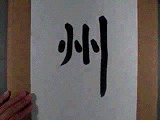
- Printed form:
- 州
- Readings:
- シュウ
- SYUU
- Meaning:
- state; province; continent
- Usage Examples:
- マサチューセッツ州 (しゅう) state of Massachusetts
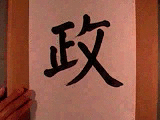
- Printed form:
- 政
- Readings:
- セイ
- SEI
- Meaning:
- govern
- Usage Examples:
- 政治家(せいじか)politician
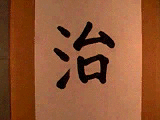
- Printed form:
- 治
- Readings:
- ジ/ なお(す)
- ZI / nao (su)
- Meaning:
- govern; rule; cure; heal; remedy; recover
- Usage Examples:
- かぜが治った。 (かぜがなおった) I recovered from a cold.
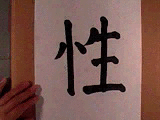
- Printed form:
- 性
- Readings:
- セイ
- SEI
- Meaning:
- nature; gender
- Usage Examples:
- 男性 (だんせい) male
- 女性 (じょせい) female
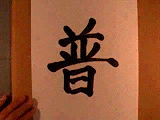
- Printed form:
- 普
- Readings:
- フ
- HU
- Meaning:
- general; common
- Usage Examples:
- 普通 (ふつう) ordinary
- New Readings:
- 当日 (とうじつ) the very day
- 東口 (ひがしぐち) east entrance
- 時々 (ときどき) sometimes
- お金 (おかね) money
[Japanese 4 Kanji]
[Japanese 4]