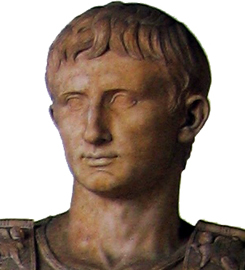
Interpretation of the Head
Greek sculpture treated the head as the primary entity of the statue and the body only acts as the support for this. The Roman tradition allows appendages to act independently from the rest of the body1. This statue is a fusion of the two styles, probably because of Augustus' admiration of classical Greek art1,9. The face of Augustus on the Prima Porta statue is categorized as the Primaporta-type and it is the most common representative form of the emperor with nearly 200 replicas found to date. The smooth face, simplistic features, and youthful look give the emperor an essence of eternal youth, even though he would have been around 40 at the time of the Parthian victory1. These facial features are reminiscent of the Doryphoros statue by Polykleitan. Both facial expressions of calm, self-control show the character of the man instead of his emotional response to the situation9. By combining the face of a Greek athlete and the smooth faraway look, Augustus is thought to look more like a god than human2. Probably further reinforcing this image, no representations of Augustus have been found showing him past his prime9. Also reminiscent of the Doryphoros is the cap-like hairstyle. Comma-shaped locks in a three-pronged arrangement have become the symbol of the emperor. Statues of Gaius and Trajan both incorporate the comma-like hair to indicate a closer relation to Augustus1.