Sala Dei Pilastri Dorici:
Hall with Doric Pillars
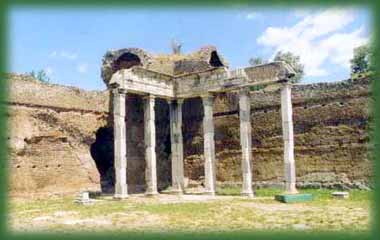
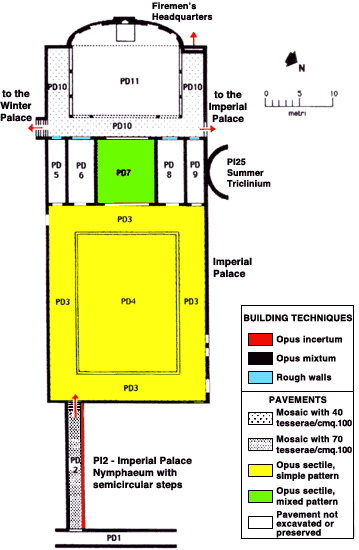
All that remains of the Hall with Doric Pillars, directly southwest of the Piazza d'Oro, are six of its columns. The original structure included a rectangular porch with Doric columns surrounding an open area. On the other end was a similar porch enclosing a garden, where the remains of a base for a statue have been found. Wedged in between these porches was the Central Hall, as well as various unexcavated rooms.
II. Building Materials and Decoration
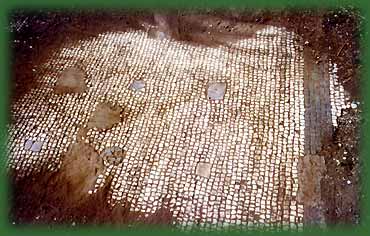
As with most buildings in the Villa, the Hall with Doric Pillars was constructed out of opus mixtum, a combination of cement and small tufa blocks. In addition, its polycrome marble mosaic pavement help further identify it as a noble building. The pattern of the mosaics also say something about Hadrian's choice to revive older republican styles throughout his Villa. Decorating the pavement of the outer porch (the one surrounding the garden) is a classic white background mixed in with colorful marble crustae. This is a typical style from earlier times, and similiar patterns can also be found in the nearby villa of the Imperial Palace.
III. Modern Interpretations
It is difficult to determine the precise function of the Hall with Doric Pillars because so few ruins remain. However, its location and open air garden have led many scholars to conclude that it served as a passageway to the Imperial Palace. Others believe that its proximity to the Piazza d'Oro and Peristyle was due to a legal purpose. Whatever the exact function, it's clear from the central location of the Hall with Doric Pillars that it was an easily accessible building.
IV. Wider Context
The Hall with Doric Pillars is representative of Hadrian's overall plan. It has already been mentioned how his choice of an older pavement pattern reflects the Emperor's revival of republican styles. As a complement to this classic approach, Hadrian incorporated the styles of various other cultures. The Greek influence on the Doric columns of this structure is just one example.
In a broader sense, this blending of cultures represents the melting pot that was ancient Rome. With the rapid expansion of Rome itself, new cultures were constantly being introduced to the old. The result was what one might expect: a vast multicultural conglomeration of everything from art to religion to food. Given the worldliness of Hadrian himself, it is then not at all surprising to find such diversity in a Greek styled hall.