Tanabe Sugano Exercises (Older)
These questions deal in part with concepts presented in today's lecture and assigned online readings.
- Two bands are readily observed in the spectrum of [Cr(en)3]Cl3. Use the applet to find the energies of these two bands
in cm-1.
- The applet from the previous question also tells you the ratio of the energies of the two bands; what it it?
- Use the right-hand side of the applet to find what value of Δo/B' this corresponds to.
- Now, submit the value of Δo/B' to get the value of B' together with the energies of the three
spin-allowed transitions. Write down the values you obtained. What are the states involved in each of the three spin-allowed
transitions?
- The highest energy spin-allowed transition for [Cr(en)3]Cl3 involves excitation to a state
that is derived from what configuration (orbital occupation)? Why is this transition not observed in the spectrum
provided by the applet? What would be the position of this band on the spectrum in nm?
- Repeat the above process using the applet for K3[Cr(NCS)6]. Write down the ratio of the two peak energies,
the value of Δo/B', and the values for the energy of B'
and all three of the spin-allowed allowed bands. What is the wavelength in nm of the highest-energy
spin-allowed band for this complex?
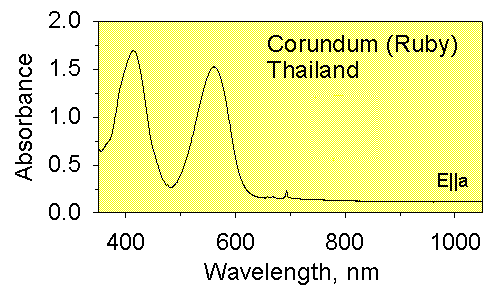
- Take a look at the spectrum of ruby
and estimate the band positions. Given your estimate, use the applet
from the previous problems to work out the wavelength expected for the
ruby laser, in nm.
Phosphorescence from what state back to the ground state is responsible
for the red color of ruby laser light?
The
above exercises are intended to help you prepare for our final exam.
They do not need to be handed in and will not be graded.
Back to 5.03 web page