\noalign
8
Magnetoquasistatic
Fields: Superposition
Integral and Boundary
Value Points of View
8.0 Introduction
\titleshortheadMQS Fields:
Superposition Integral and Boundary Value Views
We now follow the study of electroquasistatics with that of
magnetoquasistatics. In terms of the flow of ideas summarized in
Fig. 1.0.1, we have completed the EQS column to the left. Starting
from the top of the MQS column on the right, recall from Chap. 3 that
the laws of primary interest are Ampère's law (with the
displacement current density neglected) and the magnetic flux
continuity law (Table 3.6.1).


These laws have associated with them continuity conditions at
interfaces. If the interface carries a surface current density
K, then the continuity condition associated with (1) is (1.4.16)

and the continuity condition associated with (2) is (1.7.6).

In the absence of magnetizable materials, these laws determine the
magnetic field intensity H given its source, the current density
J. By contrast with the electroquasistatic field intensity E,
H is not everywhere irrotational. However, it is solenoidal
everywhere.
The similarities and contrasts between the primary EQS and MQS
laws are the topic of this and the next two chapters. The
similarities will streamline the development, while the contrasts
will deepen the understanding of both MQS and EQS systems.
Ideas already developed in Chaps. 4 and 5 will also be applicable
here. Thus, this chapter alone plays the role for MQS systems taken
by these two earlier chapters for EQS systems.
Chapter 4 began by expressing the irrotational E in terms of
a scalar potential. Here H is not generally irrotational,
although it may be in certain source-free regions. On the other
hand, even with
the effects of magnetization that are introduced in Chap. 9, the
generalization of the magnetic flux density  o H has no
divergence anywhere. Therefore, Sec. 8.1 focuses on the solenoidal
character of o H and develops a vector form of Poisson's
equation satisfied by the vector potential, from which the H field
may be obtained.
o H has no
divergence anywhere. Therefore, Sec. 8.1 focuses on the solenoidal
character of o H and develops a vector form of Poisson's
equation satisfied by the vector potential, from which the H field
may be obtained.
In Chap. 4, where the electric potential was used to represent an
irrotational electric field, we paused to develop insights into the
nature of the scalar potential. Similarly, here we could delve into
the way in which the vector potential represents the flux of a
solenoidal field. For two reasons, we delay developing this
interpretation of the vector potential for Sec. 8.6. First, as we
see in Sec. 8.2, the superposition integral approach is often used to
directly relate the source, the current density, to the magnetic
field intensity without the intetermediary of a potential. Second,
many situations of interest involving current-carrying coils can be
idealized by representing the coil wires as surface currents. In
this idealization, all of space is current free except for some
surfaces within which surface currents flow. But, because H is
irrotational everywhere except through these surfaces, this means
that the H field may be expressed as
the gradient of a scalar potential. Further, since the
magnetic field is divergence free (at least as treated in this
chapter, which does not deal with magnetizable materials), the
scalar potential obeys Laplace's equation. Thus, most methods
developed for EQS systems using solutions to Laplace's equation can
be applied to the solution to MQS problems as well. In this way, we
find "dual" situations to those solved already in earlier chapters.
The method extends to time-varying quasistatic magnetic fields in the
presence of perfect conductors in Sec. 8.4. Eventually, in Chap. 9,
we shall extend the approach to problems involving piece-wise uniform
and linear magnetizable materials.
Vector Field Uniquely Specified
A vector field is uniquely specified by its curl and divergence.
This fact, used in the next sections, follows from a slight
modification to the uniqueness theorem discussed in Sec. 5.2.
Suppose that the vector and scalar functions C(r) and
D(r) are given and represent the curl and divergence,
respectively, of a vector function F.


The same arguments used in this earlier uniqueness proof then shows
that F is uniquely specified provided the functions C (r)
and D(r) are given everywhere and have distributions consistent
with F going to zero at infinity. Suppose that Fa and
Fb are two different solutions of (5) and (6). Then the
difference solution Fd = Fa - Fb is both
irrotational and solenoidal.


The difference solution is governed by the same equations as in Sec.
5.2. With Fd taken to be the gradient of a Laplacian
potential, the remaining steps in the uniqueness argument are equally
applicable here.
The uniqueness proof shows the importance played by the two
differential vector operations, curl and divergence. Among the many
possible combinations of the partial derivatives of the vector
components of F, these two particular combinations have the
remarkable property that their specification gives full information
about F.
In Chap. 4, we determined a vector field F = E given that
the vector source C = 0 and the scalar source D =  /
/ o.
In Secs. 8.1 we find the vector field F = H, given that
the scalar source D = 0 and that the vector source is C = J.
o.
In Secs. 8.1 we find the vector field F = H, given that
the scalar source D = 0 and that the vector source is C = J.
The strategy in this chapter parallels that for Chaps. 4 and 5. We
can again think of dividing the fields into two parts, a particular
part due to the current density, and a homogeneous part that is
needed to satisfy boundary conditions. Thus, with the understanding
that the superposition principle makes it possible to take the fields
as the sum of particular and homogeneous solutions, (1) and (2)
become




In sections 8.1-8.3, it is presumed that the current density is
given everywhere. The resulting vector and scalar superposition
integrals provide solutions to (9) and (10) while (11) and (12) are
not relevant. In Sec. 8.4, where the fields are found in free-space
regions bounded by perfect conductors, (11) and (12) are solved and
boundary conditions are met without the use of particular solutions.
In Sec. 8.5, where currents are imposed but confined to surfaces, a
boundary value approach is taken to find a particular solution.
Finally, Sec. 8.6 concludes with an example in which the region of
interest includes a volume current density (which gives rise to a
particular field solution) bounded by a perfect conductor (in which
surface currents are induced that introduce a homogeneous solution).
8.1 The Vector Potential and the Vector Poisson Equation
A general solution to (8.0.2) is

where A is the vector potential. Just as E = -grad
 is the "integral" of the EQS equation curl E = 0,
so too is (1) the "integral" of (8.0.2).
Remember that we could add an arbitrary constant to without
affecting E. In the case of the vector potential, we can add the
gradient of an arbitrary scalar function to A without affecting
H. Indeed, because
is the "integral" of the EQS equation curl E = 0,
so too is (1) the "integral" of (8.0.2).
Remember that we could add an arbitrary constant to without
affecting E. In the case of the vector potential, we can add the
gradient of an arbitrary scalar function to A without affecting
H. Indeed, because  x (\nabla
 ) = 0,
we can replace A by A' = A + .
The curl of A is the same as of A'.
) = 0,
we can replace A by A' = A + .
The curl of A is the same as of A'.
We can interpret (1) as the specification of A in terms of
the assumedly known physical H field. But as pointed out in the
introduction, to uniquely specify a vector field, both its curl and
divergence must be given. In order to specify A uniquely, we must
also give its divergence. Just what we specify here is a matter of
convenience and will vary in accordance with the application. In MQS
systems, we shall find it convenient to make the vector potential
solenoidal

Specification of the potential in this way is sometimes called setting
the gauge, and with (2) we have established the Coulomb gauge.
We turn now to the evaluation of A, and hence H, from
the MQS Ampère's law and magnetic flux continuity law, (8.0.1) and
(8.0.2). The latter is automatically satisfied by letting the magnetic
flux density be represented in terms of the vector potential,
(1). Substituting (1) into Ampère's law (8.0.1) then gives

The following identity holds.

The reason for defining A as solenoidal was to eliminate the
 A term in this expression and to reduce (3) to
the vector Poisson's equation.
A term in this expression and to reduce (3) to
the vector Poisson's equation.

The vector Laplacian on the left in this expression is defined in
Cartesian coordinates as having components that are the scalar
Laplacian operating on the respective components of A. Thus,
(5) is equivalent to three scalar Poisson's equations, one for each
Cartesian component of the vector equation. For example, the z
component is

With the identification of Az  and o Jz
/o, this expression becomes the
scalar Poisson's equation of Chap. 4, (4.2.2). The integral of this
latter equation is the superposition integral, (4.5.3). Thus,
identification of variables gives as the integral of (6)
and o Jz
/o, this expression becomes the
scalar Poisson's equation of Chap. 4, (4.2.2). The integral of this
latter equation is the superposition integral, (4.5.3). Thus,
identification of variables gives as the integral of (6)

and two similar equations for the other two components of A.
Reconstructing the vector A by multiplying (7) by iz and
adding the corresponding x and y components, we obtain the
superposition integral for the vector potential.

Remember, r' is the coordinate of the current density source, while
r is the coordinate of the point at which A is evaluated, the
observer coordinate.
Given the current density everywhere, this integration provides the
vector potential. Hence, in principle, the flux density o H
is determined by carrying out the integration and then
taking the curl in accordance with (1).
The theorem at the end of Sec. 8.0 makes it clear that the
solution provided by (8) is indeed unique when the current density
is given everywhere.
In order that x A be a physical flux density,
J (r) cannot be an arbitrary vector field. Because div
(curl) of any vector is identically equal to zero, the divergence of
the quasistatic Ampère's law, (8.0.1), gives
( x H) = 0 = \nabla J and thus

The current distributions of magnetoquasistatics must be
solenoidal.
Of course, we know from the discussion of uniqueness given in
Sec. 8.0 that (9) does not uniquely specify the current distribution.
In an Ohmic conductor, stationary current distributions satisfying
(9) were determined in Secs. 7.1-7.5. Thus, any of these
distributions can be used in (8). Even under dynamic conditions, (9)
remains valid for MQS systems. However, in Secs. 8.4-8.6 and as
will be discussed in detail in Chap. 10, if time rates of change
become too rapid, Faraday's law demands a rotational electric field
which plays a role in determining the distribution of current
density. For now, we assume that the current distribution is that
for steady Ohmic conduction.
\sectnonumTwo-Dimensional Current and Vector Potential
Distributions
Suppose a current distribution J = iz Jz(x, y) exists
through all of space. Then the vector potential is z directed,
according to (8), and its z component obeys the scalar Poisson
equation

But this is formally the same expression, (4.5.3), as that of the
scalar potential produced by a charge distribution (x' ,
y' ).

It was inconvenient to integrate the above equation directly.
Instead, we determined the field of a line charge from symmetry and
Gauss' law and integrated the resulting expression to obtain the
potential (4.5.18)

where r is the distance from the line charge r =  (x -
x' )2 + (y - y' )2 and ro is the reference radius.
The scalar potential can thus be evaluated from the two-dimensional
integral
(x -
x' )2 + (y - y' )2 and ro is the reference radius.
The scalar potential can thus be evaluated from the two-dimensional
integral

The vector potential of a two-dimensional z-directed current
distribution obeys the same equation and thus has a solution by
analogy, after a proper interchange of parameters.

Two important consequences emerge from this derivation.
by a given charge distribution (x, y), has an MQS analog vector
potential Az(x, y) caused by a current density Jz(x, y) with
the same spatial distribution as (x, y). The magnetic field
follows from (1) and thus

Therefore the lines of magnetic flux density are perpendicular to the
gradient of Az. A plot of field lines and equipotential lines of
the EQS problem is transformed into a plot of an MQS field problem by
interpreting the equipotential lines as the lines of magnetic flux
density. Lines of constant Az are lines of magnetic flux.
| (a) | Every two-dimensional EQS potential (x, y) produced
|
| (b) | The vector potential of a line current of magnitude i
along the z direction is given by analogy with (12),

which is consistent with the magnetic field H = i (i/2
(i/2 r) given by (1.4.10), if one makes use of the curl
expression in polar coordinates, r) given by (1.4.10), if one makes use of the curl
expression in polar coordinates,

|
The following illustrates the integration called for in (8). The
fields associated with singular current distributions will be used
in later sections and chapters.
Example 8.1.1. Field Associated with a Current Sheet
A z-directed current density is uniformly distributed
over a strip located between x2 and x1 as shown in Fig. 8.1.1.
The thickness of the sheet,  , is very small compared to other
dimensions of interest. So, the integration of (14) in the y
direction amounts to a multiplication of the current density by .
The vector potential is therefore determined by completing the
integration on x'
, is very small compared to other
dimensions of interest. So, the integration of (14) in the y
direction amounts to a multiplication of the current density by .
The vector potential is therefore determined by completing the
integration on x'

where Ko \equiv Jz .

This integral is carried out in Example 4.5.3, where the
two dimensional electric potential of a charged strip was determined.
Thus, with  o /o o Ko, (4.5.24)
becomes the desired vector potential.
o /o o Ko, (4.5.24)
becomes the desired vector potential.
The profiles of surfaces of constant Az are shown in Fig.
8.1.1. Remember, these are also the lines of magnetic flux density,
o H.
Example 8.1.2. Two-Dimensional Magnetic Dipole Field
A pair of closely spaced conductors carrying oppositely directed
currents of magnitude i is shown in Fig. 8.1.2. The currents extend
to + and - infinity in the z direction, so the resulting fields are
two-dimensional and can be represented by Az. In polar
coordinates, the distance from the right conductor, which is at a
distance d from the z axis, to the observer location is essentially
r - d cos . The Az for each wire takes the form of (16),
with r the distance from the wire to the point of observation. Thus,
superposition of the vector potentials due to the two wires gives

In the limit d \ll r, this expression becomes

Thus, the surfaces of constant Az have intersections with planes
of constant z that are circular, as shown in Fig. 8.1.3. These are
also the lines of magnetic flux density, which follow from (17).



If the line currents are replaced by line charges, the resulting
equipotential lines (intersections of the equipotential surfaces with
the x - y plane) coincide with the magnetic field lines shown in Fig.
8.1.3. Thus, the lines of electric field intensity for the electric
dual of the magnetic configuration shown in Fig. 8.1.3 originate
on the positive line charge on the right and terminate on the negative
line charge at the left, following lines that are perpendicular to
those shown.
8.2 The Biot-Savart Superposition Integral
Once the vector potential has been determined from
the superposition integral of Sec. 8.1, the magnetic flux density
follows from an evaluation of curl A. However, in certain field
evaluations, it is best to have a superposition integral for the field
itself. For example, in numerical calculations, numerical derivatives
should be avoided.
The field superposition integral follows by operating on the
vector potential as given by (8.1.8) before the integration has been
carried out.

The integration is with respect to the source coordinates denoted by
r', while the curl operation involves taking derivatives with
respect to the observer coordinates r. Thus, the curl operation
can be carried out before the integral is completed, and (1) becomes

The curl operation required to evaluate the integrand in this
expression can be carried out without regard for the particular
dependence of the current density because the derivatives are with
respect to r, not r'. To make this evaluation, observe that
the curl operates on the product of the vector J and the scalar
= |r - r'|-1, and that operation obeys the vector
identity

Because J is independent of r, the first term on the right is
zero. Thus, (2) becomes

To evaluate the gradient in this expression, consider the special
case when
r' is at the origin in a spherical coordinate system, as shown
in Fig. 8.2.1. Then

where ir is the unit vector directed from the source
coordinate at the origin to the observer coordinate at (r,  ,
).
,
).

We now move the source coordinate from the origin to the
arbitrary location r'. Then the distance r in (5) is replaced
by the distance |r - r' |. To replace the unit vector
ir, the source-observer unit vector ir'
r is defined as being directed from an arbitrary source
coordinate to the observer coordinate P. In terms of this
source-observer unit vector, illustrated in Fig. 8.2.2, (5) becomes

Substitution of this expression into (4) gives the Biot-Savart
Law for the magnetic field intensity.

In evaluating the integrand, the cross-product is evaluated
at the source coordinate r'. The integrand represents the
contribution of the current density at r' to the
field at r. The following examples illustrate the Biot-Savart law.
Example 8.2.1. On Axis Field of Circular Cylindrical Solenoid
The cross-section of an N-turn solenoid of axial length d
and radius a is shown in Fig. 8.2.3. There are many turns, so the
current i passing through each is essentially directed. To keep
the integration simple, we confine ourselves to finding H on the z
axis, which is the axis of symmetry.

In cylindrical coordinates, the source coordinate incremental
volume element is dv' = r' dp dr' dz'. For many windings
uniformly distributed over a thickness , the current density is
essentially the total number of turns multiplied by the current per
turn and divided by the area through which the current flows.

The superposition integral, (7), is carried out first on r'.
This extends from r' = a to r' = a +
over the radial thickness of the
winding. Because \ll a, the source-observer distance and
direction remain essentially constant over this interval, and so the
integration amounts to a multiplication by . The axial symmetry
requires that H on the z axis be z directed. The integration
over z' and ' is

In terms of the angle  shown in Fig. 8.2.3 and its inset, the
source-observer unit vector is
shown in Fig. 8.2.3 and its inset, the
source-observer unit vector is

so that

The integrand in (9) is ' independent, and the
integration over ' amounts to multiplication by 2.

With the substitution z" = z' - z, it follows that

In the limit where d/2a \ll 1, the solenoid becomes a circular coil
with N turns concentrated at r = a in the plane z = 0. The field
intensity at the center of this coil follows from (13) as the
amp-turns divided by the loop diameter.

Thus, a 100-turn circular loop having a radius a = 5 cm (that is large
compared to its axial length d) and carrying a
current of i = 1 A would have a field intensity of 1000 A/m at its
center. The flux density measured by a magnetometer would then be
B_z = o H_z = 4 x 10⁻⁷ (1000) tesla = 4 gauss.
Further implications of this finding are discussed in the following
demonstration.
Demonstration 8.2.1. Fields of a Circular Cylindrical Solenoid
The solenoid shown in Fig. 8.2.4 has N = 141 turns, an axial length
d = 70.5 cm, and a radius a = 13.6 cm. A Hall-type magnetometer
measures the magnitude and direction of H in and around
the coil. The on-axis distribution
of H_z predicted by (13) for the experimental length-to-diameter
ratio d/2a = 2.58 is shown in Fig. 8.2.4. With i = 1 amp, the flux
density at the center approaches 2.5 gauss. The accuracy with which
theory and experiment agree is likely to be limited only by such
matters as the care with which the probe can be mounted and the
calibration of the magnetometer. Care must also be taken that there
are no magnetizable materials, such as iron, in the vicinity of the
coil. To avoid contributions from the earth's magnetic field (which
is on the order of a gauss), ac fields should be used. If ac is
used, there should be no large conducting objects near by in which
eddy currents might be induced. (Magnetization and eddy currents,
respectively, are taken up in the next two chapters.)

The infinitely long solenoid can be regarded as the analog for
MQS systems of the "plane parallel plate capacitor." Just as the
capacitor can be constructed to create a uniform electric field
between the plates with zero field outside the region bounded by the
plates, so too the long solenoid gives rise to a uniform magnetic field
throughout the interior region and an exterior field that is zero.
This can be seen by probing the field not only as a function of axial
position but of radius as well. For the finite length solenoid, the
on-axis interior field designated by H_ in Fig. 8.2.4 is given
by (13) for locations on the z axis where d/2 \gg z.
in Fig. 8.2.4 is given
by (13) for locations on the z axis where d/2 \gg z.

In the limit where the solenoid is also very long
compared to its radius, where d/2a \gg 1, this expression becomes

Probing of the field shows the field maintains the value and
direction of (16) over the interior cross-section as well. It also
shows that the magnetic field
intensity just outside the windings at an axial location that is
several radii a from the coil ends is relatively small.
Continuity of magnetic flux requires that the total flux passing
through the solenoid in the z direction must be
returned in the -z direction outside the solenoid. How, then, can the
exterior field of a long solenoid be negligible compared to that
inside? The outside flux returns in the -z direction through a much
larger exterior area than the area a2 through which the
interior flux passes. In fact, as the coil becomes infinitely long,
this return flux spreads out over an exterior area that stretches to
infinity in the x and y directions. The field intensity just
outside the winding tends to zero as the coil is made very long.
Stick Model for Computing Fields of Electromagnet
The Biot-Savart superposition integral can be completed
analytically for relatively few configurations. Nevertheless, its
evaluation amounts to no more than a summation of the field
contributions from each of the current elements. Thus, on the
computer, its evaluation is a straightforward matter.
Many practical current distributions are, or can be approximated
by, connected straight-line current segments, or current "sticks."
We will now use the Biot-Savart law to find the field at an arbitrary
observer position r associated with a current stick having an
arbitrary location. The result is a practical resource, because a
numerical summation over differential volume current elements can then
be replaced by one over the sticks.

The current stick, shown in Fig. 8.2.5, is represented by a
vector a. Thus, the current is uniformly distributed between the
base of this vector at r + b and the tip of the vector at
r + c. The source coordinate r' is located along
the current stick. The objective in the following paragraphs is to
carry out an integration over the length of the current stick and
obtain an expression for H (r). Because the current stick
does not represent a solenoidal current density at its ends, the
field derived is of physical significance only if used in conjunction
with other current sticks that together represent a continuous
current distribution.

The detailed view of the current stick, Fig. 8.2.6, shows
the source coordinate  denoting the position along the stick.
The origin of this coordinate is at the point on a line through the
stick that is closest to the observer coordinate.
denoting the position along the stick.
The origin of this coordinate is at the point on a line through the
stick that is closest to the observer coordinate.
The projection of b onto a vector a is _b = a
b /|a|. Thus, the current stick begins at this
distance from = 0, as shown in Fig. 8.2.6, and terminates at
_c, the projection of c onto the axis of a, as also shown.
The cross-product c x a/|a| is perpendicular to the
plane of Fig. 8.2.6 and equal in magnitude to the projection of c
onto a vector that is perpendicular to a and in the plane of Fig.
8.2.6. Thus, the shortest distance between the observer position and
the axis of the current stick is r_o = |c x
a|/|a|. It follows from this fact and the definition of
the cross-product that

where ds is the differential along the line current and

Integration of the Biot-Savart law, (7), is first performed
over the cross-section of the stick. The cross-sectional dimensions
are small, so during this integration, the integrand remains
essentially constant. Thus, the current density is replaced by the
total current and the integral reduced to one on the axial coordinate
of the stick.

In view of (17), this integral is expressed in terms of the source
coordinate integration variable as

This integral is carried out to obtain

In evaluating this expression at the integration endpoints, note that
by definition,

so that (20) becomes an expression for the field intensity at the
observer location expressed in terms of vectors a , b, and
c
that serve to define the relative location of the current
stick.
1 Private communication, Mr. John G. Aspinall.

The following illustrates how this expression can be used
repetitively to determine the field induced by currents represented
in a piece-wise fashion by current sticks. Expressed in Cartesian
coordinates, the vectors are a convenient way to specify the sticks
making up a complex winding. On the computer, the evaluation of
(22) is then conveniently carried out by a subroutine that is
used many times.
Example 8.2.2. Axial Field of a Pair of Square Coils
Shown in Fig. 8.2.7 is a pair of coils, each having N turns
carrying a current i in such a direction that the fields induced by
each coil reinforce along the z axis. The four linear sections
of the two coils comprise the sides of a cube, centered at the origin
and with dimensions 2d.

We confine ourselves to finding H along the z axis where, by
symmetry, it has only a z component. Thus, for an observer at (0,
0, z), the vectors specifying element (1) of the right-hand coil in
Fig. 8.2.7 are



Evaluation of the z component of (22) then gives the part of H_z
due to element (1). Because of the axial symmetry, the field induced
by elements (2), (3), and (4) in the same coil are the same as already
found for element (1). The field induced by element (5) in the second
coil is similarly found starting from vectors that are the same as in
(23), except that d -d in the z components of b
and c.
Here too, the other three elements each contribute the same field as
already found. Thus, the axial field intensity, the sum of the
contributions from the individual coils, is
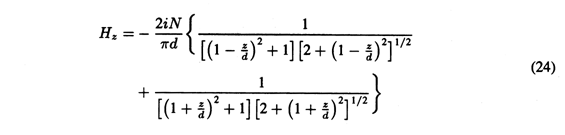
This distribution is plotted on the inset to Fig. 8.2.8. Because the
fields induced by the separate coils reinforce, the pair can be used
to produce a relatively uniform field in the midregion.

Demonstration 8.2.2. Field of Square Pair of Coils
In the experiment of Fig. 8.2.8, the axial field is probed by
means of a Hall magnetometer. The output is connected to the vertical
trace of a high persistence scope. The probe is mounted on a carriage
that is attached to a potentiometer in such a way that there is an
output voltage proportional to the horizontal position of the probe.
This is used to control the horizontal scope deflection. The result
is a trace that follows the predicted contour.
The plot is shown in terms of normalized coordinates that
can be used to compare theory to experiment using any size of coils
and any level of current.
8.3 The Scalar Magnetic Potential
The vector potential A describes magnetic fields that possess
curl wherever there is a current density J (r). In the
space free of current,

and thus H ought to be derivable there from the gradient of a
potential.

Because

we further have

The potential obeys Laplace's equation.
Example 8.3.1. The Scalar Potential of a Line Current
A line current is a source singularity (at the origin of a polar
coordinate system if it is placed along its z axis). From
Ampère's integral law applied to the contour C of Fig. 1.4.4,
we have

and thus

It follows that the potential \Psi that has H_ of (6) as the
negative of its gradient is

Note that the potential is multiple valued as the origin is encircled
more than once. This property reflects the fact that strictly, H is
not curl free in all of space. As the origin is encircled,
Ampère's integral law identifies J as the source of the curl
of H.
Because \Psi is a solution to Laplace's equation, it must possess an
EQS analog. The electroquasistatic potential

describes the fringing field of a capacitor of semi-infinite extent,
extending from x = 0 to x = +, with a voltage V across
the plates, in the limit as the spacing between the plates is
negligible (Fig. 5.7.2 with V reversed in sign). It can also be
interpreted as the field of a semi-infinite dipole layer with the
dipole density _s = _s d = o V defined by (4.5.27),
where d is the spacing between the surface charge densities, \pm
_s, on the outside surfaces of the semi-infinite plates (Fig.
5.7.2 with the signs of the charges reversed). We now have further
opportunity to relate H fields of current-carrying wires to EQS
analogs involving dipole layers.
The Scalar Potential of a Current Loop
A current loop carrying a current i has a magnetic
field that is curl free everywhere except at the location of the
wire. We shall now determine the scalar potential produced by the
current loop. The line integral \oint H
ds enclosing the current does not give zero, and hence
paths that enclose the current in the loop are not allowed, if the
potential is to be single valued. Suppose that we
mount over the loop a surface S spanning the loop which is not
crossed by any path of integration. The actual shape of the surface
is arbitrary, but the contour C_l is defined by the wire which is
its edge. The potential is then made single valued. The
discontinuity of potential across the surface follows from
Ampère's law

where the broken circle on the integral sign is to indicate a path as
shown in Fig. 8.3.1 that goes from one side of the surface to a point
on the opposite side. Thus, the potential \Psi of a current loop
has the discontinuity


We have found in electroquasistatics that a uniform dipole layer of
magnitude _s on a surface S produces a potential that
experiences a constant potential jump _s/o across the surface,
(4.5.31). Its potential was (4.5.30)

where \Omega is the solid angle subtended by the rim of the surface
as seen by an observer at the point r. Thus, we conclude that
the scalar potential \Psi, a solution to Laplace's equation with a
constant jump i across the surface S spanning the wire loop, must
have a potential jump _s/o i, and hence the
solution

where again the solid angle is that subtended by the contour along
the wire as seen by an observer at the point r as shown by Fig.
8.3.2. In the example of a dipole layer, the surface S specified
the physical distribution of the dipole layer. In the present case,
S is arbitrary as long as it spans the contour C of the wire.
This is consistent with the fact that the solid angle \Omega is
invariant with respect to changes of the surface S and depends only
on the geometry of the rim.

Example 8.3.2. The H Field of Small Loop
Consider a small loop of area a at the origin of a spherical
coordinate system with the normal to the surface parallel to the
z axis. According to (12), the scalar potential of the loop is
then

This is the potential of a dipole. The H field follows from
using (2)

As far as its field around and far from the loop is concerned, the
current loop can be viewed as if it were a "magnetic" dipole,
consisting of two equal and opposite magnetic charges \pm q_m
spaced a distance d apart (Fig. 4.4.1 with q q_m).
The magnetic charges (monopoles) are
sources of divergence of the magnetic flux _oH analogous to
electric charges as sources of divergence of the
displacement flux density oE. Thus, if Maxwell's equations
are modified to include the action of a magnetic charge density
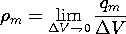
in units of voltsec/m4, then the new magnetic Gauss' law must be

in analogy with

Now, magnetic monopoles have been postulated by Dirac, and recent
searches for the existence of such monopoles have been apparently
successful
2 Science Vol. 216, (June 4, 1982).
.
Because the search is so difficult, it is apparent that, if they exist
at all, they are very
rare in nature. Here the introduction of magnetic charge is a
matter of convenience so that the field produced by a small current
loop can be pictured as the field of a magnetic dipole. This
can serve as a mnemonic for the reconstruction of the field. Thus,
if it is remembered that the potential of the electric dipole is

the potential of a magnetic dipole can be easily recalled as

where

The magnetic dipole moment is defined as the product of the magnetic
charge, q_m, and the separation, d, or by _o times the
current times the area of the current loop. Another symbol is used
commonly for the "dipole moment" of a current loop, m \equiv ia,
the product of the current times the area of the loop without the
factor _o. The reader must gather from the context whether the
words dipole moment refer to p_m or m = p_m/_o. The magnetic
field intensity H of a magnetic dipole at the origin, (14), is

Of course, the details of the field
produced by the current loop and the magnetic charge-dipole differ in
the near field. One has _o H \not= 0, and the
other has a solenoidal H field.
8.4 Magnetoquasistatic Fields in the Presence of PerfectConductors
There are physical situations in which the current distribution
is not prespecified but is given by some equivalent information.
Thus, for example, a perfectly conducting body in a time-varying
magnetic field supports surface currents that shield the H field
from the interior of the body. The effect of the conductor on the
magnetic field is reminiscent of the EQS situations of Sec. 4.6, where
charges distributed themselves on the surface of a conductor in such a
way as to shield the electric field out of the material.
We found in Chap. 7 that the EQS model of a perfect conductor
described the low-frequency response of systems in the sinusoidal
steady state, or the long-time response to a step function drive. We
will find in Chap. 10 that the MQS model of a perfect conductor
represents the high-frequency sinusoidal steady state response or the
short-time response to a step drive.
Usually, we use the model of perfect conductivity to describe
bodies of high but finite conductivity. The value of conductivity
which justifies use of the perfect conductor model depends on the
frequency (or time scale in the case of a transient) as
well as the geometry and size, as will be seen in Chap. 10. When the
material is cooled to the point where it becomes superconducting, a
type I superconductor (for example lead) expels any mangetic field
that might have originally been within its interior, while showing
zero resistance to currrent flow. Thus, even for dc, the material
acts on the magnetic field like a perfect conductor. However, type I
materials also act to exclude the flux from the material, so they
should be regarded as perfect conductors in which flux cannot be
trapped. The newer "high temperature ceramic superconductors,"
such as Y_1Ba_2Cu_3O_7, show a type II regime. In this class
of superconductors, there can be trapped flux if the material is
cooled in a dc field. "High temperature superconductors" are those
that show a zero resistance at temperatures above that of liquid
nitrogen, 77 degrees Kelvin.
As for EQS systems, Faraday's continuity condition, (1.6.12),
requires that the tangential E be continuous at a boundary between
free space and a conductor. By definition, a stationary perfect
conductor cannot have an electric field in its interior. Thus, in MQS
as well as EQS systems, there can be no tangential E at the
surface of a perfect conductor. But the primary laws determining
H in the free space region, Ampère's law with J = 0 and
the flux continuity condition, do not involve the electric field.
Rather, they involve the magnetic field, or perhaps the vector or
scalar potential. Thus, it is desirable to also state the boundary
condition in terms of H or \Psi.
\sectnonumBoundary Conditions and Evaluation of Induced Surface
Current Density
To identify the boundary condition on the magnetic field at the
surface of a perfect conductor, observe first that the magnetic flux
continuity condition requires that if there is a time-varying flux
density n o H normal to the surface on the free
space side, then there must be the same flux density on the conductor
side. But this means that there is then a time-varying flux density
in the volume of the perfect conductor. Faraday's law, in turn,
requires that there be a curl of E in the conductor. For this to
be true, E must be finite there, a contradiction of our definition
of the perfect conductor. We conclude that there can be no normal
component of a time-varying magnetic flux density at a perfectly
conducting surface.

Correspondingly, if the H field is the gradient of the scalar
potential \Psi, we find that

on the surface of a perfect conductor. This should be contrasted
with the boundary condition for an EQS potential which must be
constant on the surface of a perfect conductor.
This boundary condition can be used to determine the magnetic field
distribution in the neighborhood of a perfect conductor. Once this
has been done, Ampère's continuity condition, (1.4.16), can be used
to find the surface current density that has been induced by the
time-varying magnetic field. With n directed from the perfect
conductor into the region of free space,

Because there is no time-varying magnetic field in the conductor, only
the tangential field intensity on the free space side of the surface
is required in this evaluation of the surface current density.
Example 8.4.1. Perfectly Conducting Cylinder in a Uniform
Magnetic Field
A perfectly conducting cylinder having radius R and extending to
z = \pm is immersed in a uniform time-varying magnetic field.
This field is y directed and has intensity H_o at infinity, as
shown in Fig. 8.4.1. What is the distribution of H in the
neighborhood of the cylinder?

In the free space region around the cylinder, there is no current
density. Thus, the field can be written as the gradient of a scalar
potential (in two dimensions)

The far field has the potential

The condition  \Psi / n = 0 on the surface of the
cylinder suggests that the boundary condition
at r = R can be satisfied by adding to (5) a dipole solution
proportional to sin /r. By inspection,
\Psi / n = 0 on the surface of the
cylinder suggests that the boundary condition
at r = R can be satisfied by adding to (5) a dipole solution
proportional to sin /r. By inspection,

has the property \Psi / r = 0 at r = R. The magnetic
field follows from (6) by taking its negative gradient

The current density induced on the surface of the cylinder, and
responsible for generating the magnetic field that excludes the field
from the interior of the cylinder, is found by evaluating (3) at r = R.

The field intensity of (7) and this surface current density are shown
in Fig. 8.4.2. Note that the polarity of K is such that it gives
rise to a magnetic dipole field
that tends to buck out the imposed field. Comparison of (7) and the
field of a two-dimensional dipole, (8.1.21), shows that the induced
moment is id = 2 H_o R2.

There is an analogy to steady conduction (H
\leftrightarrow J) in the neighborhood of an insulating rod
immersed in a conductor carrying a uniform current density. In
Demonstration 7.5.2, an electric dipole field also bucked out an
imposed uniform field (J) in such a way that there was no
normal field on the surface of a cylinder.
Voltage at the Terminals of a Perfectly Conducting Coil
Faraday's law was the underlying reason for the vanishing of the
flux density normal to a perfect conductor. By stating this boundary
condition in terms of the magnetic field alone, we have been able to
formulate the magnetic field of perfect conductors without explicitly
solving for the distribution of electric field intensity. It would
seem that for the determination of the voltage induced by a
time-varying magnetic field at the terminals of the coil, knowledge
of the E field would be necessary. In fact, as we now take
care to define the circumstances required to make the terminal
voltage of a coil a well-defined variable, we shall see that we can
put off the detailed determination of E for Chap. 10.
The EMF at point (a) relative to that at point (b) was defined in
Sec. 1.6 as the line integral of E ds from (a) to
(b). In Sec.
4.1, where the electric field was irrotational, this integral was then
defined as the voltage at point (a) relative to (b). We shall
continue to use this terminology, which is consistent with that used
in circuit theory.
If the voltage is to be a well-defined quantity, independent of
the layout of the connecting wires, the terminals of the coil shown in
Fig. 8.4.3 must be in a region where the magnetic induction is
negligible compared to that in other regions and where, as a result,
the electric field is irrotational. To determine the
voltage, the integral form of Faraday's law, (1.6.1), is applied to
the closed line integral C shown in Fig. 8.4.3.


The contour goes from the terminal at (a) to that at (b) along the
coil wire and closes through a path outside the coil. However, we
know that E is zero along
the perfectly conducting wire. Hence, the entire contribution to
the line integral comes from the short path between the terminals.
Thus, the left side of (9) reduces to

It follows from Faraday's law, (9), that the terminal voltage
is

where  is the flux linkage
3 We drop the
subscript f on the symbol for flux linkage where there
is no chance to mistake it for line charge density.

By definition, the surface S spans the closed
contour C. Thus, as shown in Fig. 8.4.3, it has as its edge the
perfectly conducting coil, C_1, and the contour used to close the
circuit in the region where the terminals are located, C_2. If
the magnetic induction is negligible in the latter region, the
electric field is irrotational. In that case, the specific contour,
C_2, is arbitrary, and the EMF between the terminals becomes the
voltage of circuit theory.
Our discussion has emphasized the importance of having the
terminals in a region where the magnetic induction, o H/
t, is negligible. If a time-varying
magnetic field is significant in this region, then different
arrangements of the leads connecting the terminals to the voltmeter
will result in different voltmeter readings. (We will emphasize this
point in Sec. 10.1, where we develop an appreciation for the electric
field implied by Faraday's law throughout the free space region
surrounding the perfect conductors.) However, there remains the task
of identifying configurations in which the flux linkage is not
appreciably affected by the layout of leads connected to the
terminals. In the absence of magnetizable materials, this is
generally realized by making coils with many turns that are connected
to the outside world through leads arranged to link a minimum of
flux. The inset to Fig. 8.4.3 shows an example. The large number of
turns assures a magnetic field within the coil that is much larger
than that associated with the wires that connect the coil to the
terminals. By intertwining these wires, or at least having them
close together, the terminal voltage becomes independent of the
detailed wire layout.
Demonstration 8.4.1. Surface used to Define the Flux Linkage
The surface S used to define in (12) is often
geometrically complex. It is helpful to picture the surface in terms
of a model. Shown in Fig. 8.4.4 is a three-turn coil. The surface is
filled in by stringing yarn between a vertical rod joining the
terminals in the external region and points on the wire. The surface
is filled in by connecting points of decreasing altitude on the rod to
points of increasing distance along the wire. Note from Fig. 8.4.3
that da and ds are related by the right-hand rule, where the
latter is directed along the contour from the positive terminal to
the negative one.

Another way of demonstrating the relationship of the surface to
the coil geometry takes advantage of the phenomenon familiar from
blowing bubbles. A small coil, closed along the external segment
between the terminals, can be dipped into materials like soap solution
to form a continuous film having the wire as one continuous edge. In
fact, if the film is formed from a material that hardens into a
plastic sheet, a permanent model for the surface is obtained.
Inductance
When the flux linked by the perfectly conducting coil of Fig.
8.4.3 is due entirely to a current i in the coil itself, is
proportional to i, = Li. Thus, the inductance
L, defined as

becomes a parameter that is only a function of geometric variables and
o. In this case, the terminal voltage given by (11) assumes
a form familiar from circuit theory.

The following example illustrates this rule.
Example 8.4.2. Inductance of a Long Solenoid
In Demonstration 8.2.1, we examined the field of a long N-turn
solenoid and found that in the limit where the length d becomes
very large, the field intensity along the axis is

where i is the current in each turn.
For an
infinitely long solenoid this is not only the field on the axis of
symmetry but everywhere inside the solenoid. To see this, observe
that a uniform magnetic field intensity satisfies both Ampère's law
and the flux continuity condition throughout the free space interior
region. (A uniform field is irrotational and solenoidal.) Further,
with the field given by (15) inside the coil and taken as zero
outside, Ampère's continuity condition (1.4.16) is satisfied at
the surface of the coil where K_ = Ni/d. The normal flux
continuity condition is automatically satisfied, since there is no
flux density normal to the coil surface.
Because the field is uniform over the circular cylindrical
cross-section, the magnetic flux _
4 We use
the symbol _ for the flux through one turn of a coil or
a loop. passing through one turn of the
solenoid is simply the cross-sectional area A of the solenoid
multiplied by the flux density o H.

The flux linkage, defined by (12), is obtained by summing the
contributions of all the turns.

Thus, from (13),

For the circular cylindrical solenoid of radius a, A = a2.
The same arguments used to see that the interior field of a
solenoid of circular cross-section is given by (15) show that the
solenoid can have an arbitrary cross-sectional geometry and the field
will still be given by (15) everywhere inside and be zero outside.
Thus, (18) is applicable to a solenoid of arbitrary cross-section.
Example 8.4.3. Dipole Moment Induced in Perfectly Conducting Sphere
by Imposed Uniform Magnetic Field
If a highly conducting material is immersed in a magnetic field,
it will modify the field in its vicinity via a surface current that
cancels the field in its interior. If
the material is spherical, we can superimpose the field of a dipole
and the uniform field to exactly satisfy the boundary condition on the
conducting surface. For a sphere having radius R in an imposed field
H_o iz, as shown in Fig. 8.4.5, what is the equivalent
dipole moment m?

The imposed field is conveniently analyzed into radial and
azimuthal components. Then the irrotational and solenoidal field
proposed to satisfy the boundary conditions is the sum of that
uniform field and the field of a dipole at the origin, as given by
(8.3.14) together with the definition (8.3.19).

By design, this field already approaches the uniform field at
infinity. To satisfy the condition that n o H = 0
at r = R,

It follows that the equivalent dipole moment is

The surface currents induced in the sphere which buck
out the imposed magnetic flux are responsible for the dipole moment,
as illustrated in Fig. 8.4.5.
Example 8.4.4. One-Turn "Solenoid"
The structure of perfectly conducting sheets shown in Fig. 8.4.6 has
width w much greater than a and is excited by a uniform (in the
z direction) current per unit length K at y = -b.
The H-field solution that satisfies the boundary condition n
H = 0 and n x H = K on the perfect conductor
is


What is the voltage that appears across the current generator? From
(11) and (12) we conclude

with

where i is the total current supplied by the generator. The
voltage is thus

where

8.5 Piece-Wise Magnetic Fields
In a typical physical situation to which the scalar potential is
applicable, layers of wire are used to make a winding that is thin
compared to other dimensions of interest. Currents are then confined
to surfaces that separate the regions where H is irrotational.
Thus, the sources of the magnetic field intensity can be represented
as surface currents. The field produced by these currents is then
found by choosing source-free solutions in the space surrounding the
current-carrying surfaces and "connecting" these solutions across
the surfaces by the proper boundary conditions. This procedure is
analogous to finding EQS potentials produced by
charge sheets in Chap. 5. Solutions to Laplace's equation were set
up on the two sides of a charge sheet and the jump in normal
oE adjusted to equal the surface charge density.
In the MQS situation, the H field obeys Ampère's continuity
condition, (1.4.16).

At this same surface, the magnetic flux continuity condition,
(1.7.6), also applies.

Remember that in Chap. 5, continuity of tangential E was implied
by making the electric potential continuous. By contrast, according to
(1), where there is a surface current density, the tangential H
is discontinuous and this implies that the magnetic scalar potential
\Psi is not generally continuous. To see this, consider the
application of Ampère's integral law to an incremental surface that
is pierced by the surface current density, as shown in Fig. 8.5.1. If
H is finite, then in the limit where the width w goes to zero,
the contributions to the line integral from the segments B
B' and A' \rightarrow A vanish, and so

where the unit vectors is and in are defined in Fig.
8.5.1.

Multiplication of (3) by the incremental line element ds and
integration over the length of the incremental surface gives

In view of the gradient integral theorem, (4.1.16), the integrals on
the left can be carried out to obtain

Now think of A - A' as a fixed reference position on the
surface, where \Psi_A is defined as being equal to
\Psi_A'. It then follows
that the discontinuity in \Psi at the location B - B' is a
measure of the net current passing normal to the strip joining A -
A' to B - B'.
A further contrast with the electric field comes from the normal
field continuity condition, (2). At a surface carrying a surface
current density in free space, the normal derivative of \Psi is
continuous.
The following example shows how to find \Psi, and hence H, when
a surface current distribution is given.
Example 8.5.1. The Spherical Coil
The magnetic field intensity produced inside a properly wound
spherical coil has the important property that it is uniform. This
should be contrasted with the field of a long solenoid that is
uniform only to the extent that the fringing field can be neglected.
The coil is wound of thin wire so that the turns density is
sinusoidally distributed between the north and south poles of a
sphere. To the extent that we can disregard the slight pitch in the
coil needed to connect the loops with each other, loops of
appropriately varying diameter, spaced evenly as projected onto the
z
axis, automatically simulate such a distribution. The coil, with a
radius R and a wire carrying the current i, is shown in Fig.
8.5.2.

To deduce the surface current density representing this winding,
note that the density of turns on the surface is the total number, N,
divided by the total length, 2R, and so the number of turns in the
incremental length dz is (N/2R)dz. Because z = r cos ,
a differential length dz corresponds to an angular increment
d: dz = - sin R d. Therefore, the number of
turns in the differential length Rd as measured along the periphery
of the sphere is (N/2R) sin . With each turn carrying
the current i, the surface current density is

In the spaces interior and exterior to the surface of the sphere,
H is both irrotational and solenoidal. Hence, it is represented
by scalar magnetic potentials.
The component of (1) is the link between the surface current
density and the induced field.

To obtain H_, the derivative of \Psi with respect to
must be taken, and this suggests that the dependence
of \Psi be taken as cos . The field is finite at the
origin and zero at infinity, so, from the three solutions to Laplace's
equation given in Sec. 5.9, we select


The continuity conditions, used now to determine the coefficients A
and C, are in terms of the field intensity. Thus, (8) and (9) are
used to write H in the two regions as


Substitution of the appropriate components into the continuity
conditions, (2) and (7), gives


Thus, the magnetic field intensity of (10) and (11) is evaluated by
setting C = -2A = -Ni/3.


The exterior lines of magnetic field intensity are those of a
dipole, while the interior field is
uniform. Thus, the total picture, shown in Fig. 8.5.3, is one of
field lines circulating from south to north inside the sphere and back
from north to south on the outside around currents that follow lines
of equilatitude around the sphere.

The magnetic potential follows by substituting C = -2A = -Ni/3 for
C and A in (8) and (9).


Note that these potentials are equal at the equator of the sphere
and become increasingly disparate as the poles are approached. With
the vertical dimension used to denote \Psi, a sketch of \Psi
evaluated in a plane of fixed would appear as shown in Fig.
8.5.4. Inside, \Psi slopes linearly from its highest value at the
south pole to its lowest at the north. Outside, \Psi has its highest
value at the north pole and lowest at the south. This is consistent
with the picture afforded by Fig. 8.5.1 and (5). Even though it
closes on itself, the line of H shown goes continuously
"down hill." The potential \Psi regains its altitude in
the region of discontinuity.

Finally, we illustrate the computation of the inductance of a
coil modeled by a surface current and represented in terms of the
magnetic scalar potential. To compute the total flux linked by the
winding, first consider the flux linked by one turn at the location r
= R and = '. Using the flat surface at
z' = R cos '
that is enclosed by this circular turn, the flux is

In this particular problem, H_z is uniform inside the sphere, so
this integration amounts to multiplying the area enclosed by the turn
by the normal flux density.
The turns density multiplied by R d gives the number of
turns linking this flux in an increment of peripheral length. Thus,
the total flux is obtained by carrying out a second integration over
all of the turns.


Demonstration 8.5.1. Field and Inductance of a Spherical Coil
In the experiment shown in Fig. 8.5.5, the "flux ball" has 64
turns and a radius of R = 5 cm. The turns are wound on a plastic
sphere that essentially has the magnetic properties of free space.

The Hall magnetometer makes it possible to probe the magnitude
and direction of the field outside the coil. For example, at the
north pole, where the magnetic flux density is perpendicular to the
sphere surface, the flux density is vertical and for i = 1 A
predicted by either (14) or (15) to be o Ni/3R = 5.36 x
10-4 T = 5.36
gauss. The inductance is determined by measuring the voltage and
current, varying the frequency to determine that it is high enough to
assure that the resistance of the coil plays a negligible role in the
terminal impedance (the impedance should be of magnitude  L, and
hence vary linearly with frequency). The inductance predicted by
(20) is 180 H, and the value measured using the oscilloscope
is typically within 10 percent.
L, and
hence vary linearly with frequency). The inductance predicted by
(20) is 180 H, and the value measured using the oscilloscope
is typically within 10 percent.
8.6 Vector Potential and the Boundary Value Point ofView
We have found that many interesting MQS cases can be treated by the
use of the scalar potential obeying Laplace's equation. The vector
potential, defined by (8.1.1), is necessary when analyzing fields with
nonzero curl. There are other cases as well in which its use may be
advantageous. The vector potential is the natural variable for
evaluating the flux passing through a surface. In view of (8.1.1),
integration of the flux density over the open surface S of Fig.
8.6.1 gives


and it follows from Stokes' theorem that this flux is equal to the
line integral of A ds around the contour enclosing the
surface.

In certain important cases, A has only one component and a
vector field is again represented in terms of one scalar function.
Two such cases are identified in the following subsections.
Vector Potential for Two-Dimensional Fields
Suppose that the flux density is parallel to the x - y plane and is
independent of z. It can then be represented by a vector potential
having only a z component.

Note that the divergence of this A is automatically zero and that
in Cartesian coordinates, the components of the flux density are given
in terms of A_z by


Consider now the evaluation of the net flux of magnetic flux
density through a surface S that has length l in the z direction,
as shown in Fig. 8.6.2. The points (a) and (b) denote the
coordinates of the corners of the contour enclosing S.
The contour consists of a pair of parallel straight segments of length
l parallel to the z axis, one at the location (a) in the x - y plane
and the other at (b), and contours joining (a) and (b) in x - y planes.
Contributions to the contour integral, (2), from these latter
segments of C are zero, because A is perpendicular to ds.
Integration along the z-directed segments amounts to multiplication
of A_z evaluated at (a) or (b) by the length of the segment. Thus,
(1) becomes

The vector potential at (a) relative to (b) is the net magnetic flux
per unit length passing through a surface of unit length in the z
direction subtended between the two points and a corresponding pair at
unity distance along the z axis. Note that the flux
has a sign, relative to the direction of the contour integration,
governed by the right-hand rule (Fig. 1.4.1).
\sectnonumVector Potential for Axisymmetric Fields in Spherical
Coordinates
If the magnetic flux density is invariant with respect to
rotation around the z
axis, having components in the r and directions only, the
vector potential again has a single component.

The net flux through the annular surface "spanned" over the contour
shown in Fig. 8.6.3, having constant outer and inner radii denoted by
(a) and (b), respectively, is given by the contributions to (2) of the
azimuthal segments, A_ multiplied by the circumferences. The
contour is closed by adjacent oppositely directed segments joining
points (a) and (b) in a plane of constant . Thus, the
contributions to the line integral of (2) from these segments
cancel, even if A had components in the direction of ds on these
segments. Thus, the net flux through the annulus is simply the
axisymmetric stream function \Lambda at (a) relative to that
at (b).
5 With A used to represent the velocity
distribution of an incompressible fluid, \Lambda_s (or \Lambda_s
/2) is called Stokes' stream function.


where

Lines of flux density are tangential to the axisymmetric surfaces
of constant \Lambda_s. Just as A_z provides a ready visualization of
the flux lines in two dimensions, \Lambda_s portrays the axisymmetric flux
lines.
Boundary Value Solution by "Inspection"
In two-dimensional configurations, any surface of constant A_z
can be replaced by the surface of a perfect conductor. Moreover, in
the free space region between conductors, A_z satisfies Laplace's
equation. Thus, any two-dimensional configuration from Chaps. 4 and 5
can be replaced by one where the potential lines are field lines.
The equipotential (constant ) surfaces of the EQS perfect
conductors become the perfectly conducting (constant A_z) surfaces
of an MQS system.
Illustration. Field Trapped between Hyperbolic Perfect Conductors
The two-dimensional potential distribution of Example 4.1.1
suggests the vector potential A_z = \Lambda_o xy/a2. The lines
of magnetic field intensity, which are the surfaces of constant
A_z, are shown in Fig. 8.6.4. Here, the surfaces
A_z = \pm \Lambda_o are taken as being the surfaces of perfect
conductors. Thus, the current density on the surfaces of these
conductors are, given by using (4) to determine H and, in
turn, (8.4.3) to find K_z. These currents shield the fields from
the volume of the perfect conductors.
The net flux per unit length passing downward between the upper
pair of conductors is [in view of (7)] simply 2\Lambda_o.

This solution is the superposition of the fields of
four line currents. Two directed in the +z direction are at infinity
in the first and third quadrants, while two in the -z direction are in
the second and fourth quadrants.
Example 8.6.1. Field and Inductance of Oppositely Directed Currents
in Parallel Perfectly Conducting Cylinders
The cross-section of a pair of parallel perfectly conducting
cylinders that extend to \pm in the z direction is shown in
Fig. 8.6.5. The conductors have the same geometry as in the EQS case
considered in Example 4.6.3. However, they should be regarded as
shorted at one end and driven by a current source i at the other.
Thus, current in the +z direction in the right conductor is returned
in the left conductor. Although the net current in each conductor is
given, its distribution on the surface of the conductors is to be
determined.

Example 4.6.3 suggests our strategy. Instead of superimposing
the potentials of a pair of line charges of opposite sign, we
superimpose the A_z of oppositely directed line currents. With
r_1 and r_2 the distances from the observer coordinate to the
source coordinates, defined in Fig. 8.6.5, it follows from the
vector potential for a line current given by (8.1.16) that

With the identification of variables

this expression is identical to that for the antidual EQS
configuration, (4.6.18). We can conclude that the line currents
should be located at a = (l2 - R2)1/2, and that the constant
k used in that deduction (4.6.20) is identified using (10).

Here, the potential U in (4.6.20) is replaced by the flux per unit
length \Lambda. Thus, the surfaces of constant A_z are circular
cylinders and represent the field lines shown in Fig. 8.6.6.

The inductance per unit length L is now deduced from (11).

In the limit where the conductors represent wires that are thin
compared to their spacing, the inductance per unit length of (12) is
approximated using (4.6.28).

Once the vector potential has been determined, it is possible to
evaluate the distribution of current density on the conductors. Note
that the currents tend to concentrate on the inside surfaces of the
conductors, where the magnetic field intensity is more intense.
We are one step short of a general relationship between the
capacitance per unit length and inductance per unit length of a pair
of parallel perfect conductors, regardless of the cross-sectional
geometry. With and A_z defined as zero on one of the
conductors, evaluated on the other conductor they represent the
voltage and the flux linkage per unit length, respectively. Thus,
with the understanding that and A_z are evaluated on the
second conductor, L = A_z/i, and C = _l /,
(4.6.5). Here, i and _l, respectively, are the line
current and line charge density that give rise to the same fields as
do those sources actually on the
surfaces of the conductors. These quantitities are related by (10),
so we can conclude that regardless of the cross-sectional geometry,
the product of the inductance per unit length and the capacitance per
unit length is

where c is the velocity of light (3.1.16).
Note that inductance per unit length of parallel circular conductors
given by (12) and the capacitance per
unit length for the same conductors under "open circuit" conditions
(4.6.27) satisfy the general relation (14).
Method of Images
In the presence of a planar perfect conductor, the zero normal
flux condition can be satisfied by symmetrically mounting
source distributions on both sides of the plane. This approach is
familiar from Sec. 4.7, where the boundary condition required a plane
of symmetry on which the tangential electric field was zero. Here we
require that the field intensity be tangential to the boundary. For
two-dimensional configurations, the analogy between the electric
potential and A_z makes the image method of Sec. 4.7 directly
applicable here. In both cases, the symmetry plane is one of
constant potential ( or A_z).
The most obvious example is an infinitely long line current at a
distance d/2 from a perfectly conducting plane. If Fig. 4.7.1 were a
picture of line charges rather than point charges, this would be the
dual situation. The appropriate image is then an oppositely
directed line current located at a distance d/2 to the other side of
the perfectly conducting plane. By making a pair of symmetrically
located line currents the image for this pair of currents, the
boundary condition on yet another plane can be satisfied, the analog
to the configuration of Fig. 4.7.3.
The following demonstration is intended to emphasize that the
perfectly conducting symmetry plane carries a surface current that
terminates the field in the region of interest.
\begindemo1Surface Currents Induced in Ground Plane by Overhead
Conductor
The metal cylinder mounted over a metal ground plane shown in Fig.
8.6.7 is familiar from Demonstration 4.7.1. Rather than being
insulated from the ground plane and driven by a voltage source, this
cylinder is shorted to the ground plane at one end and driven by a
current source at the other. The height l is small compared to the
length, so that the two-dimensional model describes the field
distribution in the midregion.

A probe is used to measure the magnetic flux density tangential
to the metal ground plane. The distribution of this field, and hence
of the surface current density in the adjacent metal, can be
determined by recognizing that the ground plane boundary condition of
no normal flux density is met by symmetrically mounting a distribution
of oppositely directed currents below the metal sheet. This is just
what was done in determining the fields for the pair of cylindrical
conductors, Fig. 8.6.5. Thus, (9) is the image solution for the
region x \geq 0. In terms of x and y,

The flux density tangential to the ground plane at the location y =
Y is

Normalized to H_o = i/ a, this distribution is shown as a
function of the probe position, Y, in the inset to Fig. 8.6.7.
The role of the surface current density implied by this
tangential field is demonstrated by the same probe measurement of
the magnetic flux density normal to the conducting sheet. Provided
that the frequency is high enough so that the sheet does indeed
behave as a perfect conductor, this flux density is small compared to
that tangential to the sheet. This is also true at the surface of the
cylindrical conductor.
To appreciate the physical origins of this distribution, a dc
current source is used in place of the ac source. The
distribution of current in the sheet is then dictated by the rules of
steady conduction, as enunciated in the first half of Chap. 7. If the
sheet is long enough compared to its width, the current is uniformly
distributed over the sheet and over the cross-section of the cylinder.
By contrast with the high-frequency ac case, where the field is
terminated by surface currents in the sheet, the magnetic field now
extends below the sheet.
The method of images is not restricted to the two-dimensional
situations where there is a convenient analogy between and
A_z. In the following example, involving a three-dimensional field,
the symmetry conditions are viewed without the aid of the vector
potential.
Example 8.6.2. Current Loop above a Perfectly Conducting Plane
A current loop with time-varying current i is mounted a distance
h above a perfectly conducting plane, as shown in Fig. 8.6.8. Its
axis is inclined at an angle with respect to the normal to
the plane. What is the net field produced by the current loop and
the currents it induces in the plane?

To satisfy the boundary condition in the plane of the perfectly
conducting sheet, an image loop is mounted as shown in Fig. 8.6.9.
For each current segment in the actual loop, there is a segment in the
image loop giving rise to an oppositely directed vertical component of
H. Thus, the net normal flux density in the plane of the perfect
conductor is zero.
Two-Dimensional Boundary Value Problems
The vector potential of a two-dimensional field parallel to the x -
y plane is z directed and thus only one scalar function describes
fully the associated field, as already pointed out earlier. In
problems in which currents are confined to the boundaries, the scalar
potential can be used as effectively as the vector potential. The
lines of steepest descent of the scalar potential are the lines of
constant height of the vector potential. When the region of interest
contains current distributions, then use of the vector potential is
required. We shall consider both situations in the examples to
follow.
Example 8.6.3. Inductive Attenuator
The cross-section of two conducting electrodes that extend to
infinity in the \pm z directions is shown in Fig. 8.6.10. The
time-varying current in the +z direction in the electrode at y = b is
returned in the -z direction through the \sqcup-shaped electrode. This
current is so rapidly varying that the electrodes behave as though
they were perfectly conducting. The gaps of width insulating
the electrodes from each other are small compared to the other
dimensions of interest. The magnetic flux (per unit length in the z
direction) passing through these gaps in the directions shown is
defined as \Lambda (t).

The magnetic fields are two dimensional and there are no sources
in the region of interest. Thus, _oH can be represented in
terms of A_z, which satisfies

The walls are perfectly conducting in the sense that they
are modeled as having no normal _oH. This means that
A_z is constant on these walls. We define A_z to be
zero on the vertical and bottom walls. Thus, A_z must be equal to
\Lambda on the upper electrode, so that the flux per unit length in
the z direction through the gaps is \Lambda.

The boundary value problem is now formally identical to the EQS
capacitive attenuator that was the theme of Sec. 5.5, with the
identification of variables

Thus, it follows from (5.5.9) that

The lines of magnetic flux density are the lines of constant A_z.
They are the equipotential "lines" of Fig. 5.5.3, shown in
Fig. 8.6.10 with arrows added to indicate the field direction.
Remember, there is a z-directed surface current density that is
proportional to the tangential field intensity. For the flux lines
shown, K_z is out of the page in the upper electrode and returned
into the page on the side walls and (to an extent determined by b
relative to a) on the bottom wall as well.
From the cross-sectional view given by Fig. 8.6.10, the provision
for the current through the driven plate at the top to recirculate
through the side and bottom plates is not shown. The following
demonstration emphasizes the implied current paths at the ends of the
configuration.
Demonstration 8.6.2. Inductive Attenuator
One configuration described by Example 8.6.3 is shown in Fig.
8.6.11. Here the upper plate is shorted to the adjacent walls at the
near end and driven at the far end through a step-down transformer by
a 20 kHz oscillator. The driving voltage v(t) at the far end of the
upper plate is measured by means of an oscilloscope. The lower plate
is shorted to the side walls at the far end and also connected to
these walls at the near end, but in such a way that the induced
current i(t) can be measured by means of a current probe.
The walls and upper and lower plates are made from brass or
copper. To insure that the resistances of the plate terminations are
negligible, they are made from heavy copper wire with the connections
soldered. (To make it possible to adjust the spacing b, braided wire
is used for the shorts on the lower electrode.)
If the length w of the plates in the z direction is large
compared to a and b, H within the volume follows from (20).
The surface current density K_z in the lower plate then follows
from evaluation of the tangential H on its surface. In turn, the
total current follows from integration of K_z over the width, a, of
the plate.

With the objective of relating this current to the driving voltage,
note that (8.4.11) gives

so that with the driving voltage a sinusoid of magnitude V,

Thus, in terms of the driving voltage, the output current is
i_o sin ( t), where it follows from (21) and (23) that

We have found that the output current, normalized to I, has the
dependence on spacing between upper and lower plates shown by the
inset to Fig. 8.6.11. With the spacing b small compared to a, almost
all of the current through the upper plate is returned in the lower
one, and the field between is essentially uniform. As the spacing b
becomes comparable to the distance a between the side walls, most of
the current through the upper electrode is returned in these side
walls. Thus, for large b/a, the normalized output current of Fig.
8.6.11 reflects the exponential decay in the -y direction of the
field.

Value is added to this demonstration if it is compared to its EQS
antidual, Demonstration 5.5.1. For the EQS configuration, the lower
plate was properly constrained to essentially the same potential as
the walls by connecting it to these side walls through a resistance
(which was then used to measure the induced current). Up to
frequencies above 100 Hz in the EQS case, this resistance could be as
high as that of the oscilloscope (say 1 M\Omega) and still constrain
the lower plate to essentially the same zero potential as the walls.
In the MQS case, we did not use a resistance to connect the lower
plate to the side walls (and hence provide a means of measuring the
output current), because that resistance would have had to be
extremely low, even at 20 kHz, to prevent flux from leaking through the
gaps between the lower plate and the side walls. We used the current
probe instead. The effects of finite conductivity in MQS systems are
the subject of Chap. 10.
In a final example, we exemplify how the particular and
homogeneous solutions are combined to satisfy boundary conditions while
also illustrating how the inductance of a distributed winding is
determined.
Example 8.6.4. Field and Inductance of Distributed Winding Bounded
by Perfect Conductor
The cross-section of a distributed winding of radius a is shown in Fig.
8.6.12. It consists of turns carrying current i in the +z direction at
a location (r, ) and returning the current at (r, - ) in
the -z
direction. The density of turns, each carrying the current i in the
+z direction for 0  \leq and in the -z direction
for < < 2, is
\leq and in the -z direction
for < < 2, is


The total number of wires N in the left-hand half of the coil is

so that the current density is

The windings are very long in the z direction so that effects of the
end turns are ignored and the fields taken as independent of z.
The coil is bounded at r = a by a perfect conductor. With the
following steps we determine the field distribution throughout the
winding and finally, its inductance.
The vector potential is z independent and must satisfy Poisson's
equation (8.1.6). In polar coordinates,

First we look for a particular solution. If it is to take a product
form, inspection shows that sin is the appropriate
dependence. Substitution of an r dependence rn shows that the
equation can be satisfied if n = 2. Thus, we have "guessed" a
particular solution.

The magnetic flux density normal to the perfectly conducting
surface at r = a must be zero, so the total vector potential must be
constant there. It follows that one must add a vector potential with
no associated current density in the region r < a, a homogeneous
solution A_zh. At r = a, the homogeneous solution, A_zh,
must be the negative of the particular solution, A_zp.

A linear combination of the two solutions to Laplace's equation that
have the same dependence as this condition is

The coefficient D must be zero so that the solution is finite at the
origin. The coefficient C is then adjusted to make (31) satisfy
the condition of (30). Hence, the sum of the particular and
homogeneous solutions is

A graphical representation of what has been accomplished is given
in Fig. 8.6.13, where the surfaces of constant A_z (and hence the
lines of field intensity) are shown for the particular, homogeneous,
and total solutions.

Each turn of the coil links a different magnetic flux. Thus, to
determine the total flux linked by the distribution of turns, it is
necessary to carry out an integration. To do this, first observe that
the flux linked by the turns with their right legs within the area
rd dr in the neighborhood of (r, ) and their left legs
within a similar area in the neighborhood of (r,- ) is

Here, l is the length of the system in the z direction.
The total flux linked by all of the turns is obtained by
integrating over all of the turns.

Substitution for A_z from (32) and use of (26) then gives

where L will be recognized as the inductance.
8.7 Summary
Just as Chap. 4 was initiated with the representation of an
irrotational vector field E, this chapter began by focusing on the
solenoidal character of the magnetic flux density. Thus, o H
was portrayed as the curl of another vector, the
vector potential A.
The determination of the
magnetic field intensity, given the current density everywhere, was
pursued first using the vector potential. The integration of the
vector Poisson's equation for A was the first of many
exploitations of analogies between EQS and MQS descriptions. In
Cartesian coordinates, the superposition integral for A, (8.1.8)
in Table 8.7.1, has components that are analogous to the scalar
potential superposition integral, (4.5.3), from Table 4.9.1.
Similarly, the two-dimensional superposition integral, (8.1.14), has
as its analog (4.5.20) from Table 4.9.l.
Especially if a computer is to be used, it is often most
practical to work directly with the magnetic field intensity. The
Biot-Savart law, (8.2.7) in Table 8.7.1, gives H directly as an
integration over the given distribution of current density.
In many applications, the current distribution can be
approximated by piece-wise continuous straight-line segments. In this
case, the total field is conveniently represented by the superposition
of contributions given by (8.2.22) in Table 8.7.1 due to the
individual "sticks."
In regions free of current density, H is not only solenoidal,
but also irrotational. Thus, like the electric field intensity of
Chap. 4, it can be represented by a scalar potential \Psi , H
= - \Psi. The magnetic scalar potential is, in general,
discontinuous across a surface carrying a surface current density.
It is its normal derivative that is continuous. The scalar potential
provides an elegant representation of the fields in free space
regions surrounding current loops. The superposition integral,
(8.3.12) in Table 8.7.1, is written in terms of the solid angle
\Omega.

Through the combined effects of Faraday's law, flux continuity, and
Ohm's law, currents are induced in a conductor by a time-varying
magnetic field. In a perfect conductor, these currents are on the
surface, distributed in such a way as to shield the magnetic field out
of the conductor. As a result, the normal component of the magnetic
flux density must be zero on the surface of a perfect conductor.
Although useful for representing any solenoidal field, the vector
potential is especially useful in the situations summarized by Table
8.7.2. It is especially convenient for describing systems with
perfectly conducting boundaries.
In two dimensions, the boundary condition on a perfect conductor
is satisfied by making the vector potential constant on the boundary.
The approaches of Chaps. 4 and 5 apply equally well to solving MQS
boundary value problems involving perfect conductors. In fact, the
two-dimensional EQS and MQS configurations of perfect conductors in
free space, exemplified by the configurations of Figs. 4.7.2 and 8.6.7,
were found to be duals. Formally, the solution for H follows
from that for E by identifying A_z,
/o _o J_z. However, while the
electric field intensity E is perpendicular to the surfaces of
constant , H is tangential to the surfaces of constant
A_z.

The boundary conditions obeyed by the vector potential at surfaces of
discontinuity (containing surface currents) reflect the discontinuity
in tangential H field and the continuity of the normal flux
density. The vector potential itself must be continuous (a
discontinuity of A would imply an infinite H in the surface)

where Ampère's continuity condition

requires that curl A have discontinuous tangential components.
The condition that A be continuous, (1), guarantees the
continuity of the normal flux density. [According to (1), the
integral of A ds around an incremental closed contour
lying on one side of the surface is equal to that on the other.
Thus, the normal flux which each of these integrals represents, is
the same as well.]
In fluid mechanics, the scalar A_z would be called a
"stream-function", because in two dimensions, lines of constant vector
potential constitute the flux lines. In axisymmetric configurations,
the flux lines are lines of constant \Lambda_s, as defined in Table
8.7.2.
Of course, a similar representation can be used for any solenoidal
vector. For example, an expression for the two-dimensional lines of
electric field intensity in a region free of charge density could be
obtained by finding a vector potential representation of E.
Thus, in these special cases, the vector potential is convenient for
plotting any solenoidal field.
The electric potential of EQS systems, evaluated on the
surface of a perfectly conducting capacitor electrode, can be used to
evaluate the terminal voltage. The vector potential is similarly
related to the terminal characteristics of a lumped parameter
element, this time an inductor. Indeed, we found in Sec. 8.6 that
the flux per unit length linked by a pair of conductors in two
dimensions was simply the difference of vector potentials evaluated
on the two conductors. In Sec. 8.4, we found that the terminal
voltage is the time rate of change of this flux linkage.
The division of the field into particular and homogeneous parts
makes possible a number of different approaches to obtaining the total
field. The particular part can be obtained using the vector
potential, using the Biot-Savart law, or by superimposing the fields
of thin coils represented in terms the scalar magnetic potential.
The homogeneous solution is both irrotational and solenoidal, so
it is possible to use either the vector or the scalar potential to
represent this part of the field everywhere. The vector potential
helps determine the net flux, as required for calculating the
inductance, but is of limited usefulness for three-dimensional
configurations. The scalar potential does not directly portray the
net flux, but does generally apply to three-dimensional
configurations.