 |
6.101 Analog Electronics Lab
Spring Term 2016 |
Time: TR 2:30-4:00PM
Location: 34-304
Prerequisiste: 6.002 or 6.071.
| Staff |
| Duties |
Name |
Email
( @mit.edu ) |
| Lectures |
Gim Hom |
gim |
| TA |
Elliott Williams |
gadgy |
| LAs |
Alex Sloboda |
asloboda |
| Yanni Coroneos |
ycorone |
| Jason Yang |
jasony |
| CIM Instructor |
Amelia Herb |
aherb |
| Mary Caulfield |
mcaulf |
|
Course Overview
Introductory
experimental laboratory explores the design, construction, and
debugging of analog electronic circuits. Lectures and laboratory
projects in the first half of the course investigate the performance
characteristics of semiconductor devices (diodes, BJTs and MOSFETs)
and functional analog building blocks, including single stage
amplifiers, op amps, small audio amplifier, filters, converters,
sensor circuits and medical electronics (ECG, pulse-oximetry). The
second half of the course is devoted to the design, implementation,
and written and oral presentation of a project in an environment
similar to that of engineering design teams in industry. Provides
opportunity to simulate real-world problems and solutions that involve
trade offs and the use of engineering judgment. Engineers from local
analog engineering companies come to campus to help students with
their design projects. 12 Engineering Design Points
6.101 aims to emphasize visual and intuitive circuit
understanding: to create a practical and useful design experience.
In the process, students will learn to understand and use a wide
variety of analog circuits. During the course, students will
solder circuits, make measurements and build interesting circuits such
as an ECG amplifier that allows you to view your ECG on an
your laptop, a USB powered 1.4 watt audio amplifier
and other useful circuits. Students will run Matlab scripts to
analyze and plot their ECG.
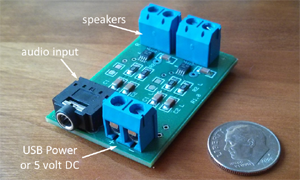
Students will layout and have fabricated
their own printed circuit board (PCB). They will learn to research
the literature to find circuit ideas and to supplement their
textbook knowledge.
Project Overview
The final project in 6.101 is your opportunity to work on a small
analog system. You will design, build, debug, demonstrate, and
report on this system. Here are some ideas for possible projects:
- Pure Circuit
- Music controlled LED display
- Radio Wave Powered Receiver
- Descrete Component High Power Audio Power Amplifier
- 1.5-9V high efficiency USB charger
- Discrete AD Converter
- Sensor based
- Simple Magnet Resonance Spectrometer
- Body power ECG AM transmitter
- Analog Pulse-Oximeter
- Road tracking model car
- Analog servo controller
- Romba robot
- MIT ID Reader
- Electronic seismograph
- Practical/Fun
- Talking Robot (moving mouth/lights)
- Switchless home lighting control system
Past final projects have included:
- Theremin (an electronic instrument that produces sounds based on
how far the user's hands are from a pair of metal rods)
- Audio mixer, effects engine, Dolby decoder, and multichannel
power amplifiers
- Noise cancelling headphones
- Guitar Amplifier and Effects
- Plasma Tweeter
- FM modulated transmission over a power line
- Laser link audio transmitter and receiver
- 400W class D full range audio amplifier
The course is a CI-M subject for course 6 and satisfies either
the institute laboratory requirement or the course 6 laboratory
requirement.
The level of difficulty of the final project is based on the
students background. Having taken more advanced circuit design
classes will be helpful but not required. Course material by Ron Roscoe.
Text books
The required text is Microelectronics: Electronic Circuit Analysis and Design by
Donald Neamen - third edition ISBN 007328596X. The third edition is
an older edition and can be purchased from online sources. The Art
of Electronics by Horowitz and Hill is strongly recommended.
Grading
The first half of the class accounts for 53% of the grade:
13% homework
10% for one quiz
30% for labs
The other 47% of the grade comes from the final project:
32% from project presentation and operation
15% from writeup
