MASSACHUSETTS
INSTITUTE OF TECHNOLOGY
Department of Physics
Physics 8.01X
Fall Term
2001
EXPERIMENT FLOW
INTRODUCTION
Steady flows are driven by forces
that are balanced by resisting forces. For instance, the amount of water coming
out of a shower depends on the water pressure as provided by private or
municipal water systems, and the resistance of the many small holes in the
shower head. Depending on the diameter of the holes and the velocity of the
flow, the resistance can be due to viscosity (the friction of water against
water when there are differences in velocity within the flow), momentum given
to the fluid as it speeds up as it passes through the holes, and additional
resistance when the flow becomes turbulent and there is vortex motion in the
fluid.
EXPERIMENT
You'll measure the rate at which
water flows out of a container through a tube placed near the bottom. You'll do
this for different length tubes. For each tube length you will calculate
characteristic time constant for the flow rate. You will then compare these
time constants as a function of the tube length. This experiment is primarily
about taking data but later in the semester you will interpret your data to
determine the viscosity of water.
APPARATUS
You have a 0.5 liter clear plastic bottle which you will cut to
make a cylindrical container, four cups, one piece sugarless
chewing gum, four stirrers (plastic tubes
about 130 mm long and 2.8 mm inside diameter), two paper plates, one
push pin, one 8-penny nail, one 1 1/2"-length poly
tube, and paper towels. You also have a
photocopy of a ruler on your parts list. You can use thermometer in
your Red Box that will be used in Expt ET. You'll need either a
stopwatch, or a clock or watch with a sweep second hand for timing the
drop in water height.
Use the attached three copies of Data Sheet for EXPERIMENT FL: FLOW for
experiments I, II, and III, with 3, 2 and 1 stirrers, respectively. There are
spaces for recording the length of the tube, the diameter of the tube (see
parts list), room and water temperatures at start and finish of each
experiment, and a table with six columns: one for water level (the ``head''),
three columns for three sets of time measurements, one for the calculated
average time, and one for the standard deviation of the average time. Record
any relevant circumstances, phenomena, troubles, etc. in the space below
labeled notes.
There are attached to the write-up
four pieces of linear graph paper and three pieces of semi-log graph paper
although you may plot your data using a computer.
PROCEDURE
Open up the cap
of the bottle and empty the contents. You should have one piece of sugarless
chewing gum, four stirrers (plastic tubes about 130
mm long and 2.8 mm inside diameter), 1 1/2''-inch length of
poly tube, one 8-penny nail, rubber bands, and a push pin.
You will first
connect three stirrers together with small pieces of poly tubing. Cut a 15-mm
piece of the poly tubing and place the end of one stirrer into the tubing
(Figure 1).
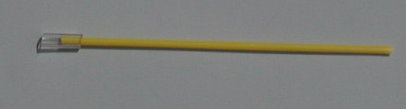
Figure 1: Stirrer inserted into poly tube
Fit a
second stirrer into the other end of the tubing until the stirrers
meet together in the middle of the poly tube (Figure 2). This
step is delicate; you can easily rip the
stirrer.
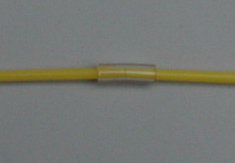
Figure 2: Two
stirrers connected by a poly tube
Now cut
another 15-mm piece of the plastic tubing and connect a third stirrer
to the other two. Measure and
write down the length of this tube. (It should be about
390 mm).
Cut the
plastic bottle with scissors about 15 mm from its bottom so as to
make a cylindrical container that tapers down to the screw cap at the
end. In order to cut the container begin by making a hole with the
push pin and enlarging it with the nail so that you can get the
scissors in to cut the bottle.
Make
sure the cap is screwed on tight.
Turn the container upside down and put it in one of the
cups. You will make a hole in the container at a point that is just
above the rim of the paper cup. Mark a spot for your hole with a
pen. This hole will be about 65 mm from the bottom of the
cap.
(You can now
take the container out of the cup).
Start
making the hole with a push pin. Enlarge this small hole with the
point of the nail, turning the nail like a drill. The stirrer should
just fit; press it in about 10 mm. (If you wish, you can practice
beforehand making holes in the otherwise useless cut off part of the
container). Use a small
amount of chewing gum to seal around the plastic tube and black tape
or gum to seal undesired holes.
If necessary, cut away the rim of the cup to make room for the
gum seal.
You'll
need to measure the depth of water in the container in 10-mm steps to
within ±1 mm or less. You have a photocopy of a ruler on the
side of your Experiment Flow parts list. Attach the ruler to the side
of the container with rubber bands so that zero of the metric scale is
at the center of the hole and so that it extends upward about
90 mm.

Figure 3: Container, ruler, and stirrer inserted in hole
Your
apparatus will consist of the upside down container in a cup; an
upside down second cup that supports the tube; and a third cup that
will collects the outflow. Make sure that the stirrers are
straight. Figure 4 shows the apparatus when two stirrers are
connected together.

Figure 4: Apparatus with two stirrers
Remove
items from your desk that might be damaged by water and arrange your
apparatus as shown in Figure 4 but with three stirrers instead of
two. Sand, pebbles or coins might be put in the bottom of the
container support cup to make it sit steadier. Use the paper plates
under the container support cup and the collector cup to contain
spills. Paper, folded or wadded, can be used to adjust heights so that
the tube is reasonably level.
TAKING
DATA
Your
first data measurements will use a tube made from three stirrers. You
will fill the container and then record the time it takes for the
water level in the container to pass
successive 10-mm (1-cm) scale marks. You will repeat the experiment
three times. Then you will detach the third stirrer and repeat the
process making three more trial runs. You will then detach the second
stirrer and repeat the process making three more trial runs.
Fill a
cup with water as close to room temperature as possible, as indicated
on your thermometer that you will find in your red box. Record room and water
temperatures at the start and finish of your experiment. Record the
length of your stirrers. Record your results on the accompanying Data
Sheet for Experiment Flow.
Fill
the container and observe what happens as the water level drops. You
and your partner should decide on a method for taking data. For
instance, one partner can call out as the water level passes
successive 10-mm (1-cm) scale marks and the other writes down the time
to the nearest second as the level passes each mark. Refill the
container using the collector cup, keeping water from flowing until
you're ready by putting a finger lightly over the end of the
tube. Have another cup at
hand to catch any extra flow. Note that at some level the nature of
the flow changes from a continuous stream to a series of drops. Either
stop timing or, if you wish, record the level and time corresponding
to this change. Take data for
three trial runs. Record your results on the accompanying Data Sheet
for Experiment Flow.
Repeat
the above procedure after shortening the plastic tube from
3 stirrers (about
390 mm) to 2 stirrers (about 260 mm) and then to
1 stirrer (about 130 mm). Take data for three trial runs
for two stirrers and take data for three trial runs for one
stirrer. Record your results on the accompanying Data Sheet for
Experiment Flow.
Averaging
For each combination of stirrers,
you have three time measurements for each height that the water level passes.
Average the three times to give an average time corresponding to each water
level. Record your results on the
accompanying Data Sheet for Experiment Flow.
GRAPHING THE DATA
You have four linear and three
semi-log graph papers. In addition you have one linear graph paper for the time
constants vs. length of tube graph.
On three linear graph papers, plot the level of the water above
the hole (the ``head'') in mm versus the average time in seconds to
reach that level for each of the tube lengths. (You should have
three graphs.)
On the semi-log paper, plot the head vs. average time for
each of the tube lengths. On semi-log paper, the horizontal axis
is a normal linear scale, but the vertical axis is marked off in proportion to the logarithms or
natural logarithms of the numbers represented. (Recall logarithms in
base 10 are proportional to natural logarithms according
to ) You can choose the numbers
1, 2, 3 etc on the vertical axis to represent
10 mm, 20 mm, 30 mm, etc. So, a data point such as
(30 mm, 55 sec) is placed at the 3 on the vertical axis and
at the 55 on the horizontal axis. You should have three semi-log
graphs. Draw the best straight lines through the points as judged by
eye. (When choosing the `best straight line', consider which points
are most reliable. Are the first and last measurements as reliable as
the others?)
) You can choose the numbers
1, 2, 3 etc on the vertical axis to represent
10 mm, 20 mm, 30 mm, etc. So, a data point such as
(30 mm, 55 sec) is placed at the 3 on the vertical axis and
at the 55 on the horizontal axis. You should have three semi-log
graphs. Draw the best straight lines through the points as judged by
eye. (When choosing the `best straight line', consider which points
are most reliable. Are the first and last measurements as reliable as
the others?)
REPORTING THE
DATA
Your linear graph
of head vs. average time should be an exponentially decaying
function,
 (1)
(1)
where
 is the value of the head at t = 0 and a is a constant. The time
constant t
associated with this exponentially decay is defined to be the time
that it takes for the head to reach a value of
is the value of the head at t = 0 and a is a constant. The time
constant t
associated with this exponentially decay is defined to be the time
that it takes for the head to reach a value of  . Since
  . The time constant t
is
related to the constant a according
to
. The time constant t
is
related to the constant a according
to
 or
or  .
.
Your
semi-log plot should be nearly a straight line. The natural logarithm
of equation (1) is
 .
.
So a
plot of  vs. time t will be a straight line
with
vs. time t will be a straight line
with
 .
.
Finding the Time
Constant:
Method
1: Obtain the time constant
t for
the flows with the three tube lengths by the following procedure that
will use results from both your semi-log graph or your linear
graph. Use your best straight line in the semi-log paper graph to
determine the value of the head,  , at t = 0 for each of the three
experiments. (Note: if you just choose your initial value from your
data sheet you are ignoring the rest of your data values.) You can
obtain the time constant from the linear graph of head vs. average
time by directly reading off the time that the head reaches the value
, at t = 0 for each of the three
experiments. (Note: if you just choose your initial value from your
data sheet you are ignoring the rest of your data values.) You can
obtain the time constant from the linear graph of head vs. average
time by directly reading off the time that the head reaches the value
 .
Determine the time constants for each of your three
experiments. Report your
results in the table Time Constants for Experiment Flow that is
attached to the write-up.
.
Determine the time constants for each of your three
experiments. Report your
results in the table Time Constants for Experiment Flow that is
attached to the write-up.
Method
2: From your semi-log plot,
calculate the slope of your best fit straight line. Compute the time
constant according to  .
.
Make a plot of tube length vs. time constant. Is there any nice curve that passes through the data points? What does the extrapolation to zero tube length mean?
Data Sheet for FLOW EXPERIMENT
Expt. I: Length of tube
=
Room
Temperature: Start_____Finish
_____
Water
Temperature: Start_____Finish
_____
Time of
Day: __________
| Water
level (mm) |
T1
(sec) |
T2
(sec) |
T3
(sec) |
Tave
(sec) |
| |
|
|
|
|
| |
|
|
|
|
| |
|
|
|
|
|
|
|
|
|
|
|
|
|
|
|
|
|
|
|
|
|
|
|
|
|
|
|
|
|
|
|
|
|
|
Notes:
Data
Sheet for FLOW EXPERIMENT
Expt. II: Length of tube
=
Room
Temperature: Start_____Finish
_____
Water
Temperature: Start_____Finish
_____
Time of
Day: __________
| Water
level (mm) |
T1 (sec) |
T2 (sec) |
T3 (sec) |
Tave (sec) |
| |
|
|
|
|
| |
|
|
|
|
| |
|
|
|
|
| |
|
|
|
|
| |
|
|
|
|
| |
|
|
|
|
| |
|
|
|
|
| |
|
|
|
|
Notes:
Data
Sheet for FLOW EXPERIMENT
Expt. III: Length of tube
=
Room
Temperature: Start_____Finish
_____
Water
Temperature: Start_____Finish
_____
Time of
Day: __________
| Water
level (mm) |
T1
(sec) |
T2
(sec) |
T3
(sec) |
Tave
(sec) |
| |
|
|
|
|
| |
|
|
|
|
| |
|
|
|
|
| |
|
|
|
|
| |
|
|
|
|
| |
|
|
|
|
| |
|
|
|
|
| |
|
|
|
|
Notes:
Time
Constants for Experiment Flow
| Trial |
Tube
length (mm) |
Time
constant (sec) |
Container
diameter (mm) |
Temperature start
(0C) |
Temperature finish
(0C) |
| Experiment
I |
|
|
|
|
|
| Experiment
II |
|
|
|
|
|
| Experiment
III |
|
|
|
|
|
Notes: