Massachusetts Institute of Technology
Physics Department
8.01X - Fall 2001
EXPERIMENT FO: FALLING OBJECT
INTRODUCTION
We
spend most of our time in the earth's gravitational field, so feeling the
weight of objects and falling with constant acceleration are among our basic
experiences.
The
International Committee on Weights and Measures has adopted as a standard value
for the acceleration of a body freely falling in a vacuum g= 9.80665 m/s2.
The actual value of g varies as a function of elevation and latitude. If  is the latitude and
H the elevation in meters then the acceleration of gravity in SI units is
is the latitude and
H the elevation in meters then the acceleration of gravity in SI units is

This is known as Helmert's equation. The
strength of this gravitational field at 42° latitude is 9.80 N/kg, and the
acceleration due to gravity, g, is therefore 9.80 m/s2 for all
objects. At the equator, g = 9.78 m/s2,
and at the poles 9.83 m/s2. (This is because the radius of the Earth
is larger at the equator than it is at the poles by about 26.5 km, and because
the Earth rotates at 2 radians per day introducing an apparent repulsive force that
flattens the spherical shape). Both the
magnitude and the direction of the gravitational force also show variations
that depend on local features to an extent that's useful in prospecting for oil
and navigating submerged nuclear submarines.
Such variations in g can be measured with a sensitive spring
balance. Local variations have been
much studied over the past two decades in attempts to discover a proposed
``fifth force'' which would fall off faster than the gravitational
force that falls off as inverse square of the distance between the masses.
radians per day introducing an apparent repulsive force that
flattens the spherical shape). Both the
magnitude and the direction of the gravitational force also show variations
that depend on local features to an extent that's useful in prospecting for oil
and navigating submerged nuclear submarines.
Such variations in g can be measured with a sensitive spring
balance. Local variations have been
much studied over the past two decades in attempts to discover a proposed
``fifth force'' which would fall off faster than the gravitational
force that falls off as inverse square of the distance between the masses.
One
can measure g by timing either a freely falling object or an object suspended
from a support, oscillating as a pendulum.
PRINCIPLE
OF THE
METHOD
In
this experiment you'll time the free fall of a plastic wire nut by measuring
the voltage across a capacitor in an RC charging circuit .The goal is to
measure the time of fall of a wire nut as a function of the distance of
fall. The distance is measured directly
with a ruler. To measure the rather
short time of fall, you will measure the voltage developed across a capacitor
charged by an essentially constant current that flows only during the time the
wire nut is falling.
The diagrams of Fig. 1 show the sequence
of events:
• Initially
both switches are closed, the upper switch shorts the capacitor and the voltage
across it is zero.
• When
the wire nut is released and during its fall the upper switch is open and the
capacitor charges.
• When
the wire nut hits the cup and opens the lower switch the
charging current stops.
Figure 1: Circuit diagrams for falling
object
THEORY
The
relation between height and time for free fall is given by
 (1)
(1)
The time of fall can be determined by
measuring the voltage across a capacitor that is charging during the fall.
Let the voltage of the LVPS supply be V0. The capacitor C is charged through
the resistance R. When the capacitor is charging, the voltage across the
capacitor varies in time according to
 (2).
(2).
The voltage as a function of time is graphed in Figure 2.
Figure 2: Graph of voltage as a function
of time for charging capacitor
You
will study capacitors in detail in 8.02X so for the moment we will use this
charging voltage as a device to time how long the wire nut takes to fall a
height h. wire nut hits the cup and opens the lower switch the charging current
stops. You will then make a voltage measurement. So you will measure the
quantities V, V0, R and C.
The time of flight is experimentally much
less than the product RC. This means that the exponential term in the
expression for voltage, eq. (2), is approximately
 .
.
Therefore the voltage is approximately
 .
.
We can solve this equation for the time,
 (3).
(3).
This equation tells us that our charging
capacitor acts like a clock: the time elapsed is proportional to the voltage
across the capacitor.
Now that we have measured the time of
falling in terms of V, we can solve eq. (1) for the acceleration of
gravity,
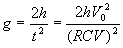 (4).
(4).
The time constant,  , of the 1.0 mF capacitor and the 10 MW
resistor is given by the nominal value,
, of the 1.0 mF capacitor and the 10 MW
resistor is given by the nominal value,
 ,
,
that could be off by 10 % or more.
Figure 3: Apparatus
APPARATUS
The
apparatus is shown in figure 3. The wire nut has an aluminum rod screwed into
it so that it can be held in the jaws of an alligator clip and released by
squeezing the clip open. There is an
insulated contact on one jaw of the clip; releasing the wire nut opens a
circuit and allows the charging of the capacitor to begin. The binder clip that holds the alligator
clip can be slid to various positions on the vertical piece of PVC pipe pressed
into a wooden block clamped to your desk with a C-clamp.
On
the wooden block is a switch made of a pivoted piece of bent brass rod, a paper
clip and a cup to catch the wire nut.
When the wire nut hits the cup, the switch opens and the charging
current to the capacitor stops.
The
apparatus is made of every-day stuff to illustrate what can be done without
complicated, costly, specialized material. Just as describing a simple action
like tying shoelaces in words can be lengthy, so are the instructions for
assembling the 20 items into an apparatus that works properly and yields
reasonably good data. Assembly
instructions and explanatory drawings are at the end of this hand-out.
DOING THE
EXPERIMENT
After
wiring up the circuit as shown in the diagrams, clamp the wire nut in the
release switch, leaving the lower switch open.
Set the LVPS to near 6 V and record the reading (and recheck it from
time to time). Higher voltages up to 10
V may give better accuracy, but the automatic range-switching feature of the
DMM between millivolt ranges and volt ranges, can give unreliable and unsteady readings.
Use
your plastic ruler to measure the height (to the nearest millimeter) from the
bottom of the suspended wire nut to the bottom of the cup in its lower position
(lower switch open). Also measure the distance you have to raise the cup (just a
few millimeters) to just close the lower switch from below—the position it has
when it just opens. This distance has to be subtracted from the height
Close
the lower switch.The DMM should read zero. Then release the wire nut by opening
the alligator clip decisively but without shaking the whole works — squeeze it
firmly between thumb and index finger — and hold it open until the wire nut has dropped into the cup and
the DMM reading has reached a steady maximum value that you should record.
Put
the wire nut back in the release switch; then
close the lower switch. (This sequence
avoids unnecessary charging of the capacitor.Then drop the wire nut again. Make 5 voltage measurements at each of 4
heights, eg. 0.2 m, 0.15 m, 0.1 m and 0.05 m.
Unsteady
readings while holding the upper switch open arise from electrical leakage. Be
sure that you are not touching anything besides the alligator clip. Leakage may
be caused by high humidity, and a warm electric lamp nearby may help dry the
apparatus out.
ANALYSIS
For
each height h, average the voltage measurements and using the formula in
equation (3) for the time of a charging capacitor, calculate the time of fall.
Plot
the square of the time (vertically) against h in m. There’s also a point at the origin since it takes 0 time to fall
0 distance.
Fit
the best straight line (by eye), and determine the slope. Since the relation
between height and time for free fall is given by
 ,
,
the slope of your graph can be used to
calculate your average value for g,
 .
.
STEP-BY-STEP
ASSEMBLY OF EXPERIMENT FO APPARATUS
PARTS LIST The parts are numbered as they appear
in figures 4 and 5.
01 1” 1/8” Al rod
02 1 Wire Nut
03 8” 1/16” brass rod *
04 1’
#22 stranded wire
05 2 plastic stirrers
06 2 paper clips
07 2” 5kV test lead
08 1 paper cup *
09 2 cable clamps
10 2 #6 sheet metal screws
11 3 #6
steel washers
12 1 pre-drilled wood block * (ALSO USED IN EXPT. FM)
13 1 5/8” binder clip
14 1 alligator clip
15 1 solder lug
16 1 6-32 x 1/2" steel screw
17 1 6-32 steel nut
18 12” 1/2” PVC pipe *
19 1 10 MW resistor, 5%
20 1 1.0 mF 100-V
capacitor, 10%,
The four items marked with an asterisk *
are in the Redbox. The remainder are in a plastic bag.
PRELIMINARY
1) Fig. 5a Hold the 1 inch long piece of
1/8 inch aluminum rod (01) with your slip-joint pliers and screw the wire nut
(02) onto it so that they are firmly joined and the wire lies along the central
axis of the nut. This is the “falling object”, and is shown in Fig. 5a.
2) Fig. 4a. Hold the 8 inch long piece of
1/16 inch brass rod (03) with your slip-joint pliers so that 4-3/4 inches
sticks out sideways from the jaws of the pliers. Bend the rod to a right angle
as in Fig. 4a.
3) Strip 1-1/2 inches of insulation off
one end of the piece of #22 stranded wire (04). Don’t twist up the strands. Cut
the wire to 8 inches length and strip 1/4 inch off the other end and twist up
the strands. Use the wire stripper, properly set for stripping the #22
wire. If in doubt, practice on the
extra 4 inch piece.
4) Cut, with scissors, one of the plastic
stirrers (05) into 3 pieces, one piece 1 inch long and two pieces 2 inches
long.
5) Fig. 4i: Use long-nose pliers to straighten the smaller radius end of one of the paper clips (06) so that it becomes a hook. Hold the clip so that 1-1/2 inches sticks out sideways from the jaws of the pliers and bend it 90° into a V-shape as in Fig. 4i.
6) Cut a 1 inch long piece of 5 kV
(kilovolt) test lead (07) with wire cutters. Use your long nose pliers to pull
out the wire strands and wrapping thread from the rubber insulation, leaving in
effect a piece of small-inside- diameter, thick-wall tubing.
7) Use scissors to cut around the paper
cup (08) parallel to its rim 1-1/2 inches from the bottom so that the cup
becomes smaller and less deep.
ASSEMBLY
OF THE LOWER SWITCH
8) Figs. 4a and 4b: Grasp the shorter
bent part of the brass rod (03) and wrap the 1-1/2 inch stripped part of the
stranded wire (04) about the rod, starting at the bend as shown in Fig. 4a.
Slide the 1 inch length of plastic stirrer (05) over the rod and the wrapped
wire, turning it as if to screw it on (Fig. 4b).
9) Fig. 4c: Hold the longer part of the brass rod (03) with your slip-joint
pliers so that 3-1/4 inches sticks out sideways from the jaws of the pliers.
Bend the rod to a right angle as in Fig. 4c so as to form a “U”. Adjust the
bends so that the arms of the U are parallel and in the same plane.
10)
Fig. 4d: Bend the wire (04) back
180° so it’s next to the stirrer and slip the plastic cable clamp (09) with its
flat side down over the piece of stirrer and the wire as in
Fig. 4d.
11) Fig. 4e: Use one of the sheet metal
screws (10) and washers (11) to fasten the assembly of Fig. 4d to the wood
block (12). Be sure that you use the pilot hole closer to the top of the block.
The top side of the block is the one with the largest hole, 5/8 inch. A side
view is shown, about 3 times full size, in Fig. 4e. Note: There should be
enough friction so that the U-shaped piece barely falls under its own
weight—this is to prevent it bouncing back when the falling object hits.
12) Fig. 4f: Slide onto the two arms of the U the two 2 inch pieces of
stirrer, making sure that they don’t extend beyond the edge of the block. Lift
up the two arms and place a 6 inch length of black electrical tape, adhesive side up, on the wooden
block with one end of the tape at the end nearest the 5/8 inch hole. See Fig.
4f. Press the arms of the U down so that the stirrer pieces stick to the tape.
13) Fig. 4g: Hold the cut-off cup (08)
centered over the space between the two 2 inch pieces of stirrer (Fig. 4f) and
pull up the tape on each side and down into the cup, as in Fig. 4g. Press the
tape up so that it stretches and sticks to the bottom of the cup.
14) Fig. 4h: Screw a sheet metal screw
(10) with a washer (11) part way into the wooden block (12) using the pilot
hole closer to the bottom of the block.
15) Figs. 4h and 4i: Slip the piece of rubber insulation (07)
over the right angle bend in the straightened paper clip (06) and attach it to
the wooden block by tightening the screw and thus clamping the rubber insulated
paper clip between the washer and the wooden block. See Figs. 4h and 4i. Note
that the loop of the paper clip should be so positioned that the brass rod sits
on it and can slip off easily. The
straightened left end of the paper clip should be bent down as indicated by the
dotted lines in Fig. 4h. To avoid electrical leakage, no part of the
paper clip should touch the wood
block.
ASSEMBLY
OF THE UPPER SWITCH
16) Fig. 5a: Clip the 5/8” binder clip (14) to the 12 inch long piece of 1/2
inch PVC pipe (18). Notice that by
squeezing the clip levers slightly while keeping it pressed against the pipe
you can slide it back and forth.
17) Figs. 5a: Take the alligator clip
(14), remove the screw and put a #6 washer (11) on it. Replace the washer and screw with a few
turns. Hook the screw and washer so the lever of the binder clip (13) is betwen
the washer and the alligator clip as in Fig. 5a, and tighten the screw firmly.
18) Fig. 5b: Put the solder lug (15) on the 1/2 inch 6-32 machine screw (16),
put the screw through the hole in a cable clamp from the flat side and screw on
the 6-32 nut (17). With the small hole end of the lug lying on the flat side of
the clamp tighten the nut moderately. See Fig. 5b. Use pliers to bend the small
hole end of the lug so that it conforms to the curve of the clamp.
19) Fig. 5c: Loosen the nut (17) so that you can slip the clamp (09) over the
stationary jaw of the alligator clip (14). Tighten the nut firmly. The lug is
now sandwiched between the two jaws as shown in Fig. 5c.
FINAL ASSEMBLY
20) Fig. 6: Fit the PVC pipe into the 5/8 inch hole in the wood block with a careful rocking and/or twisting motion. A few taps with your slip-joint pliers may help seat the pipe firmly.
21) Fig. 6: With a well tinned soldering iron, tin the left end of the paper
clip and solder one end of the 10 megohm resistor—no need to twist wires;
simply hold them parallel and let the solder join them. Likewise, solder the 1
microfarad capacitor to the resistor, as shown in Fig. 6.
22) Clamp the apparatus to a desk or
table. Use a C-clamp on the corner of the wood block furthest from the paper
clip of the lower switch.
23) Connect the two switches, an LVPS,
and a DMM to the resistor and capacitor with clip leads, as shown in Fig. 6.
ADJUSTMENT
AND OPERATION
24) Figs. 4h and Fig. 6: Slide the brass U sideways in its cable
clamp hinge so that the right arm of the U rests on the U-shaped part of the
paper clip as shown in Figs. 4h and Fig. 6. Hold the wire nut in your fingers
and drop it into the cup from a height of ~2 inches—this should operate the
switch and open the circuit.
25) Fig. 6: Slide the binder clip to the top of the PVC pipe with the jaws of the alligator clip approximately centered over the cup. Grab the aluminum rod of the falling object in the alligator clip, with the rod pointing straight down and with its end flush with the upper edges of the jaws. Again, see Fig. 6.
26) Try dropping the wiring nut and
observe the action of the lower switch. It shouldn’t bounce back up when the
wire nut hits. Reclosing the circuit on bouncing will cause incorrect high
readings. This was the reason for
having some friction in the hinge. That friction can be increased by tightening
the clamp screw or even by adding a straightened paper clip between the clamp
and the piece of stirrer. If the switch doesn’t open there’s too much friction
which can be reduced by loosening the clamp screw. Another way of preventing
bouncing is to put a piece of electrical tape, adhesive side up, under the U of
the lower switch so that the pieces of stirrer stick to it. Use three more
pieces of tape to hold the first one to the wooden block.