- Morphogenesis is the process whereby a living organism develops form and structure, e.g.
- Where
do spots come from? Turing's answer: morphogens
- "The chemical basis of morphogenesis," A.M. Turing, Phil. Trans. Roy. Soc. 237, 37 (1952) (offline) Wikipedia
- Patterns may form in reaction/diffusion equations:
- Long-range inhibition and short-range excitation
- Well-defined size
- Stripes or spots
- Brusselator pattern formation- One dimensional linear stability
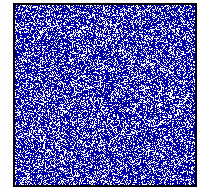
- Demonstrations of two dimensional patterns:
- Biological Relevance?
- "The impact of Turing's work on pattern formation in biology," P.K. Maini, Math. Today 40, 140 (2004) (offline)
- Noise can increase range of (incoherent) Turing pattern formation.
- "Fluctuation-driven Turing patterns," T. Butler and N. Goldenfeld, Phys. Rev. E 84, 011112 (2011).(offline)
- The Belousov-Zhabotinsky Reaction (video, video)
- Fakhri group spatiotemporal protein patterns (Nature Physics 2021) video