|

General Research Interests:
- Mechanism of natural product DNA Cleavers used clinically:
our interests include: 2D NMR methods to determine the structures of
the drugs bound to DNA, synthesis and structure of the deoxyribose lesions
generated by the drugs and mechanism of repair of these lesions
- Mechanism and Regulation of Ribonucleotide Ruductases: our
interests include study of clinically active compounds that inactivate
reductases; Mechanism of metallo-cofactor assembly in vivo; mechanism
of radical initiation using technology to insert unnatural amino acids
into the proteins; signal transduction cascades induced by DNA damaging
agents;
- Polyester Biosynthesis: understanding non-template driven polymerization
reactions and use of bioengineering methods to generate new biodegradable
polymers;
- Mechanism, Structure, and Regulation of the Purine Biosynthetic
Pathway: studies to understand the importance of transient protein-protein
interactions in vivo.
Ribonucleotide Reductases (RNRs):
RNRs are enzymes that catalyze an essensial step in DNA replication and
repair. They use unusual metallo-cofactors (a diferric tyrosyl radical,
adenosylcobalamin and a glycyl radical). These cofactors serve as radical
initiators to generate a cysteinyl radical that initiates radical dependent
nucleotide reduction at homologous active sites. Studies are ongoing to
understand: the biosynthetic pathway for diferric-tyrosyl radical cofactor
assembly in vivo in yeast; the mechanism of radical initiation over 35
Å using unnatural amino acids and the regulation of dNTP production
at all levels. Collaborative efforts with the Griffin, Nocera and Drennan
labs are ongoing.
Mechanism of Action Anittumor Natural Products:
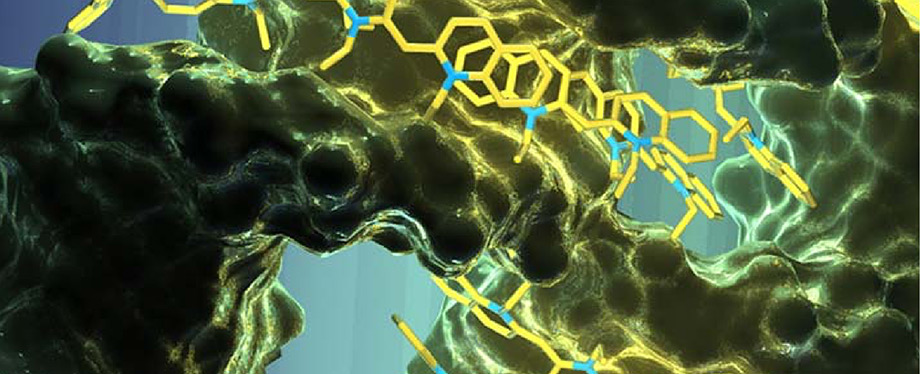
Metallo-bleomycins (BLMs), are natural products used clinically
and act catalytically to destroy DNA. Physical organic methods have been
used to understand the chemistry of DNA cleavage. Multidimensional NMR
methods using colbalt-BLM and oligonucleotides have been used to elucidate
the basis for the chemical and sequence specificity of DNA cleavage. These
studies have resulted in a proposal for how one BLM can catalyze ds-DNA
cleavage without dissociation from the DNA. NMR methods are being used
to investigate the structure of the lesions produced in the DNA backbone
by BLM, enedynes, and ionizing radiation. These lesioned DNAs are being
used as substrates to understand the mechanism of DNA repair. The genes
for the biosynthetic pathways for these natural products have been identified
and the glycosylation mechanism are being examined.
Enzymes Involved in Purine Biosynthesis:
Understanding the regulation of the purine biosynthetic pathway and the
importance of transient protein-protein interactions in the channeling
of chemically reactive intermediates produced in this pathway. Our investigations
have led to isolation and structural determination of all the enzymes
in the pathway giving new insight into the evolution of a biosynthetic
pathway. These studies have uncovered a new substrate and two new enzymes
in this pathway!
Polyhydroxybutyrate Polymerase:
The potential for using biological systems as a source of biodegradable
thermoplastics is becoming increasingly attractive given the problems
associated with oil based polymers. In collaboration with the Sinskey
lab in Biology, studies on the polyhydroxybutyrate polymerases, depolymerases,
transcription factors and phasin proteins that govern PHB homeostasis
are in progress. The mechanism of homopolymerization reactions is being
used to make novel block co-polymers.

"Radical Initiation in the Class I Ribonucleotide Reductases: Long
Range Electron Coupled Proton Transfer?" (2003) J. Stubbe. D. Nocera,
C. Yee and M. Chang Chem Reviews in press.
"Why multiple small subunits (Y2 and Y4) for yeast ribonucleotide
reductase? Toward understanding the role of Y4". Ge J, Perlstein
DL, Nguyen HH, Bar G, Griffin RG, Stubbe J. Proc Natl Acad Sci U S A.
2001, 98(18):10067-72.
"Synthesis, Characterization and Solution Structure of Tethered
Oligonucleotides Containing an Internal 3-Phosphoglycolate, 5-Phosphate
Gapped Lesion" H-D. Junker, S. T. Hoehn, R. C. Bunt, C. J. Turner,
J. Stubbe (2002) Nucleic Acids Research 30, 5497-508 (2002)
"The Ralstonia eutropha PhaR protein couples synthesis of the PhaP
phasin to the presence of polyhydroxybutyrate in cells and promotes polyhydroxybutyrate
production." York GM, Stubbe J, Sinskey AJ. J Bacteriol. 2002, 184(1):59-66.
"Mechanistic Studies on Class I Polyhydroxybutyrate (PHB) Synthase"
Ralstonia eutropha: Class I and Class III Synthases Share a Similar
Catalytic Mechanism, Y. Jia, W. Yuan, J. Wodzinska, C. Park, A.
J. Sinskey, and J. Stubbe, Biochemistry, 40, 1011-1019 (2001).
"Modular Evolution of the Purine Biosynthetic Pathway", T.
J. Kappock, S. E. Ealick, and J. Stubbe, Curr. Op. Chem. Biol., 4,
567-572 (2000).
|