
The Problem: A Water Purifier under Pressure
For a community of about three hundred households in Honduras , the safety of its drinking and general use water depends on a single spigot that controls the chlorination system. But pressure variations in the chlorine holding tank and imprecision in the tap that controls the chlorine flow led to inconsitencies in the effectiveness of water treatment.
The system is basically composed of two holding tanks, one large tank, about 3 meters high and 5 meters in diameter, with another smaller tank (about 1 meter by 1 meter) on top. Water is piped down from a spring in the mountains and flows into the large tank; the smaller tank is filled with a chlorine solution and is set to drip chlorine into the larger tank as the water flows in. The flow-rate of the incoming water is used to calculate what the drip rate of the chlorine should be, however the valve that is used to control the drip rate was not made for this job. In less than a minute after setting the drip rate, the flow of chlorine solution slows down to half the original rate. This leads to a lot of guess work on the part of the plumber, and an extremely unreliable supply of drinking water—sometimes the chlorine levels were too high, sometimes too low, but almost always, unsafe to drink.

Inspiration from a Toilet
The problem was brought to the attention of the D-Lab team in Honduras in January, 2004 by the leader of a local technical center. The plumber had often complained about the flow control system, and the community had often complained about the plumber, blaming him for the poorly treated water. But the fault was in the plumbing, not the plumber. A better system was needed to regulate the flow of chlorine into the water tank. The D-Lab team took inspiration from the temple of contemplation, the toilet…
What the team needed was a reservoir (the red plastic gas container pictured at right), a flow controller (the clamp from an intra-venous drip kit), and something to control the level of liquid in the reservoir, (the valve apparatus found in almost all flush toilets). The idea was this: allow the chlorine solution to flow from the main holding tank into the smaller holding tank (the red container) and then control the flow coming out of the smaller tank with the IV clamp. The toilet valve was used to keep the level of chlorine solution in the small tank constant.
Here is the trick. When the chlorine level in the small red container drops significantly, the inflated bulb of the toilet valve will also drop. This action will open the valve coming from the main chlorine holding tank, which will result in the small plastic red container being filled with chlorine solution. As the container is filled again, the float valve will rise, cutting off the flow from the main holding tank. And on and on it goes.
Through this simple feedback mechanism, the level of chlorine solution is kept roughly constant in the small red container. This means that the pressure at the IV clamp is also kept roughly constant. Which, most importantly of all, means that the chlorine is added to the water at a constant rate, meaning that safe chlorination is made possible.
The team went to the local pharmacy and the hardware store to get the parts, and for just a few dollars they had everything they needed. With the help of the plumber, who had several suggestions for improving the system, they installed it in the tank.
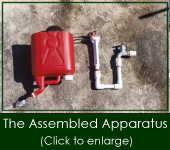


After the apparatus had been in place and functioning for three days, the team tested the treated water for chlorine levels and the presence of bacteria. All tests indicated that the water was clean and safe! Additionally, the retrofit has also enabled the system to run for three days at a time without requiring any adjustments by the technician.
Perhaps most importantly of all, however, this fix used locally available materials and locally available skills. A fact that will enable this technology to be a sustainable solution for the community in which it was developed, allowing for local innovation in the near future.
One year later, the team returned to Honduras and found that not only was the chlorine dispensing system still working, but that the plumber had devised several improvements to the system and had installed them in other water tanks in the surrounding area.
If you have any comments on this or other projects, please email Amy Smith at abs@mit.edu.