(Page 2 of 4)
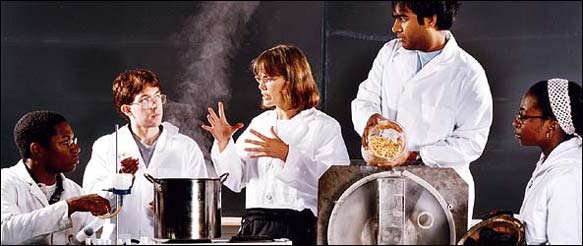
Now, Smith wants to demo a bacteria test in the dark. She asks
a student to cut the lights. He flips a switch. For a moment, nothing
happens, and then the room vibrates with a mechanical hum and panels
close over a bank of skylights in the ceiling. All crane their necks
to watch. The panels move in menacing slo-mo, like something out
of a James Bond movie. A few people giggle, as if they have suddenly
become aware of the contradictions thrumming in this room -- they've
come to one of the best-financed technical institutes in the world
to learn how to work with Playtex baby bottles.
A few weeks from now, Smith will give them one of their toughest
lessons in the gaps between first world and third. The students
will spend a week surviving on $2 a day in Cambridge -- the equivalent
of what the average Haitian earns. Last year, Jamy Drouillard, who
was a teacher's assistant for Smith's class, performed the assignment
along with his students. Drouillard grew up in Haiti, but that didn't
give him any special edge. He laughs, remembering his chief mistake.
''I bought a bunch of Ramen noodles, a packet of hotdogs, a bunch
of spaghetti and some ketchup,'' he says. ''It got sickening after
Day 3. Actually, before Day 3. I should have mixed and matched instead
of buying five boxes of spaghetti. In Haiti, people come up with
creative ways of varying their food intake.'' He said the assignment
drove home Smith's point quickly: living at subsistence level requires
enormous creativity. The African farmwoman who finds a way to make
a scrap of land yield enough cassava root for her family is as much
an inventor as any M.I.T.-trained engineer.
Last year, at an academic dinner with a plentiful buffet, Smith
pulled out crackers from her pocket and nibbled while colleagues
feasted around her; she was sticking to the $2-a-day assignment
in fellowship with her students.
In the late 1980's, as a Peace Corps volunteer, Smith was stationed
in Ghanzi, then a backwater of Botswana, down a dirt road that could
take as long as three days to travel. ''Nobody wanted to live there,''
she says. ''You got sent there for punishment if you did badly in
a job.''
Smith grew up in a comfortable, academic family. Her father taught
electrical engineering at M.I.T.; her mother taught junior-high
math. At the dinner table, the family would chitchat about ways
to prove the Pythagorean theorem. In her first couple of years in
the Peace Corps, she missed the kind of people she had known growing
up in the orbit of M.I.T. -- people willing to engage, for instance,
in passionate discussion about the innards of a motor. ''I'd run
into development workers who had no clue about engineering. They
wouldn't understand that there was a way you could solve a problem.''
In 1987, Smith returned home to Lexington, Mass., for her mother's
funeral. Wandering through a supermarket after the service, she
marveled at the lunacy of her own country: an entire aisle just
for soup? It seemed impossible to bridge the gap between America
and Botswana.
About a year later, Smith was gazing out the window of her room,
studying the expanse of the Kalahari Desert pocked by thorn bushes.
Suddenly, she says, she understood the arc of her life: she would
learn how to be an engineer and bring her skills to a place like
this. So she applied to graduate programs and ended up back at M.I.T.
in 1990.
Sometime after she got there, a professor suggested that she try
to solve a problem that bedevils people who live in rural Africa.
It involves the hammer mill, a no-frills, motorized grain mill that
women use to grind sorghum or millet into flour. The hammer mill
can do a job in just a few minutes that might otherwise take hours,
which makes it a hotly coveted item in developing nations. But there's
a built-in flaw: the mill uses a wire-mesh screen. When that screen
breaks, it cannot easily be replaced, because parts like that are
scarce in Africa and not easy to fabricate. So for lack of a wire
screen, grain mills often end up in the corner of a room, gathering
dust.