Blade Tonals in Underwater Vehicles
Modern SISUP, swirl inducing stator upstream of rotor, underwater vehicles consist of a torperdo-shaped body with a row of stators (fins) mounted upstream of a rear-mounted propeller. The purpose of these stators is to pre-swirl the flow to counteract propeller reaction torque as well as improve propeller efficiency. Unfortunately these stators also create a downstream velocity or wake deficit due to surface drag. This means that propeller inflow becomes non-uniform due to the spatial distribution of stators. As a propeller blade passes through regions of varying inflow velocity its effective angle attack changes and it experiences unsteady forces. These unsteady forces are a major source of directly radiated underwater noise. Each blade geometry results in a specific spectrum of noise, and therefore
generates a specific "blade tonal" of the radiated noise
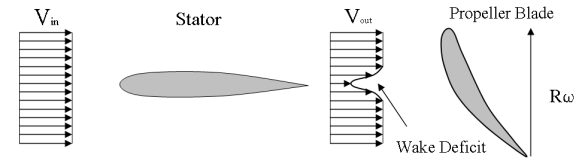
The goal of this research is to use active control to modulate a control surface in order to suitably modify the tonal. In this case a biologically inspired method of tail articulation, consisting of a hinged stator trailing edge, is used to modify propeller inflow. The flapping stator induces a point circulation which convects downstream towards the propeller. Experimental work has been carried out at both low and high Reynold's number to observe the effect of tail articulation on the stator wake.

Previous Work:
Small-scale experiments carried in a low speed open-channel water tunnel at MIT and high-speed experiments carried out in a closed-channel water tunnel at the Newport Naval Undersea Warfare Center (NUWC) in Newport, RI, show that tail articulation can have a beneficial effect on the unsteady flowfield behind a stator. The image below shows the experimental setup used to obtain Laser PIV data for high-speed flow field observation.

The experiments showed that the most efficient tail articulation seemed occur at certain Strouhal numbers (St), which is a non-dimensionalized frequency of the flowfield. At low St, the stator generated vortex sheet moves in a quasi-steady fashion with tail articulation. At moderate St, the vortext sheet begins to roll up, and at high St, the vortex sheets roll up into tight discrete vortices of alternating direction.


Click here to see tail flapping and convecting wake animation
A reduced order simulation was created to capture the major flow-field phenomena observed. A simplified 2-D non-lifting propeller blade was incorporated into the simulation to observe the effects of tail articulation on propeller forces. The simplified simulation allowed a parametric study to find the optimum noise reduction operating parameters. A 3-D propeller simulation (PUF) was then used to quantify any possible reduction in blade tonal noise. The simulation studies show that a 5dB reduction in radiated noise was possible. Current research is focused on the quantification of the effect of tail articulation on unsteady forces produced on a propeller downstream of the tail.

Sponsor:
Publications:
D. Opila, P. Madden, and B. Schmid, “Biomimetic Active Control of Propulsor Noise Using Conducting Polymers”, Proceedings of the 13th International Symposium on Unmanned Untethered Submersible Technology, AUSI,Durham, NH, 2003. (Winner of best student paper award)
D. Opila, A.M. Annaswamy, W.P. Krol, and S. Raghu, “Biomimetic reduction of wake deficit using tail articulation at low Reynolds number,” IEEE Transactions on Ocean Engineering, vol. 29, No. 3, pp. 766-776, July 2004.
D. Macumber, “Reduction of Noise Due to the Stator Wake Blade Interaction by Tail Articulation at High Reynolds Number,” Proceedings of the 14th International Symposium on Unmanned Untethered Submersible Technology, AUSI, Durham, NH, 2005 (Winner of best student paper award)
|


