Color Realism and Color Science
Alex Byrne
Department of Linguistics and Philosophy
Massachusetts Institute of Technology
Cambridge, MA 02139
David R. Hilbert
Department of Philosophy and Laboratory
of Integrative Neuroscience
University of Illinois at Chicago
Chicago, IL 60607
Abstract: The target article is an attempt to make some progress on the problem of color realism. Are objects colored? And what is the nature of the color properties? We defend the view that physical objects (for instance, tomatoes, radishes, and rubies) are colored, and that colors are physical properties, specifically types of reflectance. This is probably a minority opinion, at least among color scientists. Textbooks frequently claim that physical objects are not colored, and that the colors are "subjective" or "in the mind." The article has two other purposes: first, to introduce an interdisciplinary audience to some distinctively philosophical tools that are useful in tackling the problem of color realism and, second, to clarify the various positions and central arguments in the debate.
The first part explains the problem of color realism and makes some useful distinctions. These distinctions are then used to expose various confusions that often prevent people from seeing that the issues are genuine and difficult, and that the problem of color realism ought to be of interest to anyone working in the field of color science. The second part explains the various leading answers to the problem of color realism, and (briefly) argues that all views other than our own have serious difficulties or are unmotivated. The third part explains and motivates our own view, that colors are types of reflectances, and defends it against objections made in the recent literature that are often taken as fatal.
Keywords: Color; color vision; comparative vision; ecological view; inverted spectrum; mental representation; perception; physicalism; qualia; realism; similarity
1. The problem of color realism
Color is the subject of a vast and impressive body of empirical research and theory. A lot is known about the physical properties of objects that are responsible for the appearance of color: photoreceptors in the eye; color processing in the visual system; the genetics of color vision; the various defects of color vision; the variations in color vocabulary and categories across cultures; color constancy; the variation in apparent color with viewing conditions; color vision in animals; and about the evolution of color vision.[1] Unsurprisingly the fine details are often subject to vigorous dispute, for example whether or not macaque cortical area V4 is a color center (Heywood et al. 1995; Schiller 1996; Zeki 1990), and sometimes the fundamental assumptions of a particular sub-field are questioned, e.g. (Saunders & van Brakel 1997) on color categories, but by and large the field of color science commands a broad consensus.
Rather strikingly, however, there are some basic and important issues missing from this agreeable picture. What is redness? A physical property of some sort–for example, a certain way of reflecting light? Or is it a disposition to produce certain sensations in certain perceivers? Or is redness a sui generis property about which not much can be said? Further, do those objects like tomatoes, strawberries, and radishes that appear to have this property really have it? In other words, are objects like tomatoes red? Color scientists, philosophers, and other cognitive scientists with opinions on the matter strongly disagree about the answers to these questions.[2]
In fact, the most popular opinion, at any rate among color scientists, may well be the view that nothing is colored–at least not physical objects in the perceiver's environment, like tomatoes. For example:
[W]e know from psychophysical and neurophysiological investigations that color is created somewhere in the brain, although the exact location of this process is still unknown, and we even have no idea what entities the sensations called color are . . . In short, colors appear only at a first naïve glance to be located in objects. (Backhaus & Menzel 1992, p. 28)
And in a well-known passage, Semir Zeki writes:
The results described here . . . suggest that the nervous system, rather than analyze colours, takes what information there is in the external environment, namely, the reflectance of different surfaces for different wavelengths of light, and transforms that information to construct colours, using its own algorithms to do so. In other words, it constructs something which is a property of the brain, not the world outside. (1983, p. 764)
Finally, in an excellent recent textbook on vision, Stephen Palmer claims that:
[C]olor is a psychological property of our visual experiences when we look at objects and lights, not a physical property of those objects or lights. (1999b, p. 95)
And:
There may be light of different wavelengths independent of an observer, but there is no color independent of an observer, because color is a psychological phenomenon that arises only within an observer. (1999b, p. 97)[3]
Although contemporary color science would be quite unrecognizable to Galileo, this is one respect in which he is perfectly up to date:
I think that tastes, odors, colors, and so on are no more than mere names so far as the object in which we place them is concerned, and that they reside only in the consciousness. Hence, if the living creatures were removed, all these qualities would be wiped away and annihilated. (Drake 1957, p. 274)[4]
This target article is an attempt to make some progress on the problem of color realism (Boghossian & Velleman 1991): Are objects colored? And what is the nature of the colors? In particular, we defend the view that objects are colored, and that colors are physical properties, specifically types of reflectance (Byrne & Hilbert 1997a; Hilbert 1987); (see also Armstrong 1999; Jackson 1998; Lewis 1997; Matthen 1988; Tye 1995; 2000).
The article has two other purposes: first, to introduce an interdisciplinary audience to some distinctively philosophical tools that are useful in tackling the problem of color realism and, second, to clarify the various positions and central arguments in the debate. We hope that our discussion will at least remove some obstacles to progress in research, even if our conclusion is not accepted. The article is therefore very much in the spirit of Block's "On a confusion about a function of consciousness" (1995).
The article is in three main parts. The first part explains the problem of color realism and makes some useful distinctions. These distinctions are then used to expose various confusions that often prevent people from seeing that the issues are genuine and difficult, and that the problem of color realism ought to be of interest to anyone working in the field of color science. The second part explains the various leading answers to the problem of color realism, and (briefly) argues that all of them except physicalism have serious difficulties or are unmotivated. The third part explains and motivates our own view, that colors are types of reflectances, and defends it against objections made in the recent literature that are often taken as fatal.
1.1. The problem of color realism explained
If someone with normal color vision looks at a tomato in good light, the tomato will appear to have a distinctive property–a property that strawberries and cherries also appear to have–and which we call "red" in English. The problem of color realism is posed by the following two questions. First, do objects like tomatoes, strawberries, and radishes really have the distinctive property that they appear to have? Second, what is this property? (Of course, there are parallel questions for the other colors that objects appear to have.)
It is important to emphasize that a negative answer to the first question is a genuine theoretical option. As we all know, it does not follow from the fact that an object visually appears to have a certain property that the object has that property. The study of visual illusions is well-established; a visual illusion is precisely a case where an object visually appears to have a property it does not in fact have. For example, in the Ponzo and Müller-Lyer illusions, lines that are of the same length appear to be of different lengths. There are also color illusions, for instance produced by changes in illuminants, or by simultaneous contrast. An example of the latter kind of color illusion is neon color spreading, in which a region that is in fact white appears pink (Nakayama et al. 1990; Van Tuijl & de Weert 1979). A negative answer to the first question amounts to the view that color illusions are the rule, not the exception. This might seem odd, but it is not incoherent.
The problem of color realism concerns various especially salient properties that objects visually appear to have. It does not concern, at least in the first instance, color language or color concepts. The issue is not how to define the words "red," "yellow," and so on. Neither is it about the nature of the concept RED (where concepts are either taken to be mental representations used in thought and inference (Fodor 1998), or the semantic contents of such representations (Peacocke 1992)). Of course it is natural to suppose that there are intimate connections between a certain salient property that tomatoes appear to have, the word "red" and the concept RED; in particular, the word "red" refers to this property, and the concept RED is a concept of this property. Some scientists and philosophers would argue for more intimate connections between color experiences and color vocabulary and concepts.[5] But the present point is simply that the problem of color realism is primarily a problem in the theory of perception, not a problem in the theory of thought or language.
Consider an analogy. From the point of view of the biologist, the word "food" is applied by ordinary people in a somewhat arbitrary way. According to them, the synthetic cooking oil Olestra, which has no nutritional value at all, is a food, but vitamin tablets and beer are not. An investigation of how ordinary people use the word "food" is not particularly relevant to biology. What is relevant is an investigation into the sorts of substances human beings can digest, whether or not the biological category of the digestible lines up exactly with the folk category of food. The problem of color realism is like the investigation of what humans can digest, not the investigation of the folk category of food. The enquiry concerns certain properties that objects visually appear to have, not how ordinary people use color words, or how they conceptualize color categories.[6]
A final point of clarification: although the main focus of the problem of color realism is on human color vision, any satisfactory solution must address the issue of color vision in non-human animals. We shall say something about this later, in section 3.3.
1.2. The representational content of experience
It is helpful to put the problem of color realism in terms of the representational content ("content" for short) of color experience. When someone has a visual experience, the scene before her eyes visually appears a certain way: for example, it might visually appear to a subject that there is a red bulgy object on the table. The proposition that there is a red bulgy object on the table is part of the content of the subject's experience. In general, the proposition that p is part of the content of a subject's visual experience if and only if it visually appears to the subject that p. Propositions are bearers of truth and falsity: the proposition that there is a red bulgy object on the table is true just in case there is a red bulgy object on the table, and false otherwise. A subject's visual experience will be illusory (at least to some extent) if a proposition that is part of the content of her experience is false. Likewise, a subject's visual experience will be veridical (at least to some extent) if a proposition that is part of the content of her experience is true.[7]
The representational content of a subject's experience specifies the way the world appears to the subject. So the content of an experience is content at the personal level–it is not subpersonal content. If the proposition that there are such-and-such edges, blobs, and bars is part of the content of an early stage of visual processing, it does not follow that that proposition is part of the content of the subject's visual experience.
As discussed in the previous section, Backhaus and Menzel, Zeki, Palmer, and Galileo hold the view that nothing–at any rate no physical object like a tomato–is colored. Some of these theorists might well disown the apparatus of representational content as explained above (indulging in some anachronism, Galileo probably would). But assuming–as we shall–that this apparatus provides a useful and relatively innocuous way of framing the debate, the view that no physical objects are colored is equivalent to the view that the contents distinctive of color experiences (for example, that there is a red bulgy object on the table) are uniformly false.
The problem of color realism, then, concerns the representational content of color experiences. Is this content–for example, that there is a red bulgy object on the table–sometimes true? And what is the property red that figures in the content of such experiences?
So, on pain of changing the subject, it is not an option, as Matthen urges, "to maintain, paradoxically perhaps, that it is not color that is the content of color vision, but some other physical quantity" (1992, p. 46). Colors, at any rate in the sense in which they concern us in this article, are (at least) properties represented by certain kinds of visual experiences. According to Thompson et al., "That color should be the content of chromatic perceptual states is a criterion of adequacy for any theory of perceptual content" (1992, p. 62), and we agree.[8]
Enough has been said, we hope, to make it clear that the problem of color realism is not a recherché philosophical issue of little concern to working color scientists, solvable if at all by a priori reasoning from the armchair. The problem concerns the kinds of properties that are represented by visual experiences, and so inextricably involves empirical research into animal visual systems.[9]
1.3. Useful distinctions and common confusions
When someone looks at a tomato in good light, she undergoes a visual experience. This experience is an event, like an explosion or a thunderstorm: it begins at one time and ends at a later time. The object of the experience is the tomato, which is not an event (tomatoes don't occur). The content of the experience includes (we may suppose) the proposition that there is a red bulgy object on the table. The color property represented by the experience is the property red. If the experience is veridical, then the object of the experience has the color property represented by the experience: in other words, if the experience is veridical, the tomato is red.
1.3.1. Sense data. A long tradition in philosophy has it that the subject's visual awareness of the tomato is mediated by the awareness of something else, an object called a sense datum (Moore 1953, Ch. 2; Price 1950, Ch. 1; Russell 1912, Ch. 1). Afterimages provide the easiest way to introduce the idea. Consider the experience of a red circular afterimage, produced by fixating on a green circular patch for a minute or so, and then looking at a white wall. It is perennially tempting to suppose that there is something red and circular that the perceiver is aware of. If there is, then because there is nothing red and circular in the world external to the perceiver, there must be something red and circular in the perceiver's internal world–something mental, presumably, since nothing in the brain is red and circular. This red circular thing is a sense datum. Sense data are supposed to be not only present in the case of afterimages, but in cases of normal vision as well: the perception of a tomato, as well as the afterimage experience, involves a red circular sense datum.
Sense data have been under heavy attack in analytic philosophy since the 1950s, in our opinion rightly so. We are not going to rehash this debate here, but are simply going to assume that the arguments against sense data are successful (Armstrong 1961, Ch. 3; Pitcher 1971, Ch. 1; Sellars 1956). But we should say something about the afterimage example. Afterimages are simply illusions, as Smart pointed out many years ago (Smart 1959). When one has an experience of a red circular afterimage, the content of the experience is–to a first approximation–that there is a red circular patch at a certain location. But this proposition is simply false. There is no red circular patch–not even in some internal mental realm.
1.3.2. Properties of an experience vs. represented properties. A classic confusion is the conflation of the properties of an experience with the properties represented by the experience (Harman 1990). An experience of a tomato is an event, presumably a neural event of some kind, and although it represents the property red, the experience is certainly not red, any more than the word "red," which refers to the property red, is itself red. If anything is red it is the tomato.
Failure to attend to this distinction can make it seem obvious that color is some sort of mental or psychological property, rather than a property of physical objects like tomatoes. This sort of mistake is probably one of the main reasons why many textbooks state that color is produced by the brain, or is in the mind; it may well also underlie the International Lighting Vocabulary definition of "hue" as a certain "attribute of visual sensation" (CIE 1970, 45-25-215).
1.3.3. Color vs. conditions necessary for its perception. In order for a household thermostat to detect that the temperature is below 65°F, the thermostat dial must be set correctly. It does not follow that the property of being below 65°F is in any interesting sense dependent on, or relative to, thermostats or their settings. No one is likely to make this mistake of confusing temperature with conditions necessary for the detection of temperature. But an analogous mistake is for some reason often made in the case of color. (We will give a particularly nice illustration of this in sect. 3.1.3 below.)
The presence of perceivers and the occurrence of certain mental events are obviously necessary for the perception of color. Just as in the thermostat example, it does not follow that the colors themselves are in any interesting sense dependent on, or relative to, perceivers or mental events. To think it did would be to confuse conditions necessary for the perception of color with color itself.
1.3.4. Subjective, objective, phenomenal, and physical color. As mentioned earlier, there are some relatively uncontroversial color illusions, for example spreading effects (Bressan 1995; Van Tuijl & de Weert 1979) and the appearance of chromatic colors on rotating discs painted with an achromatic pattern (Festinger et al. 1971; Karvellas et al. 1979). Sometimes the claim of illusion is put by saying that "subjective" or "illusory" colors are "produced in the visual system" by objects like the discs (the contrast being with the "objective" colors that objects like tomatoes appear to have). This is not a happy way of speaking, for two reasons. The first is that the color properties do not come in two varieties, "subjective" ("illusory") and "objective," as the terminology suggests: there is just one property of being red. Rather, the distinction here is really between two kinds of objects: those that look to have colors they do not have (perhaps the discs), and those that look to have colors they do have (perhaps tomatoes). The second reason why the terminology is unhappy is that it suggests that "subjective" colors are somehow "in the mind." What is certainly "in the mind"–at any rate if this expression is not taken too seriously–are visual experiences of colored discs, or red tomatoes. The colors, however, are not in the mind, even if the experience is an illusion (on this point, recall the distinction between properties of an experience and represented properties in sect. 1.3.2 above).[10]
Now consider this passage:
The physicist uses the term ["color"] to refer to certain phenomena in the field of optics. Hence, the physicist, when confronted with the task of measuring the color of a material, measures the relevant optical properties of the material. Physiologists and psychologists employ the term in . . . another sense. They are interested primarily in understanding the nature of the visual process, and use the term, on occasion, to denote sensation in the consciousness of a human observer. (MacAdam 1985, pp. 3-4)
The first part of MacAdam's distinction is straightforward: the optical properties of an object that are responsible for its appearance of color–sometimes called physical color. Colorimetry is largely concerned with physical color; and so the chromaticity and purity of a light source can be said to be measures of its physical color.
Since nothing but confusion can come from using color terms to "denote sensations," the second part of MacAdam's distinction needs some adjustment. On the one hand, the things distinguished are intended to be "sensations." On the other hand, color terms are supposed to be an appropriate way of denoting the things distinguished. We cannot have both. If we stress "sensations," then the things to be distinguished are certain kinds of visual experiences (for example, an experience of a tomato in good light). If we stress the appropriateness of color terms, then the things to be distinguished are certain salient properties represented by those experiences (for example, the salient surface property the tomato visually appears to have). These properties are sometimes called phenomenal colors, or colors-as-we-see-them.
There is, then, a perfectly good distinction between physical color and phenomenal color–although it must be emphasized that this is not a distinction between properties of objects like tomatoes and properties of sensations. Using this terminology, the problem of color realism explained above concerns phenomenal color. What are the phenomenal colors? Do the objects that appear to have phenomenal colors really have them? Accordingly, whenever "color" occurs unmodified in this article, it means phenomenal color.
But here's the important point: rather paradoxically, a distinction may turn out not to distinguish anything! At the start of enquiry, one would want to make a distinction between salt and sodium chloride, or the butler and the murderer, even though it may turn out that salt is sodium chloride or that the butler is the murderer. It may similarly turn out with phenomenal color and (a kind of) physical color. Although care must be taken to make this distinction at the outset, perhaps phenomenal and physical color are one and the same (see sect. 2.4 below).
2. Theories of color
We now briefly review the main contenders for solutions to the problem of color realism, noting some of their main problems.[11]
2.1. Eliminativism
We have already met eliminativism in the quotations given at the beginning. It is the view that nothing is colored–not, at any rate, ordinary physical objects like tomatoes. An eliminativist might be a kind of projectivist, and hold that some things are colored (for example, sensations, neural states, or sense data), which we then mistakenly take for properties of objects like tomatoes (Boghossian & Velleman 1989; 1991; Jackson 1977). Indeed, the projectivist view is the most straightforward interpretation of the quotations from Backhaus and Menzel, Zeki, and Palmer. This position is extremely unpalatable, however, because either the objects that the projectivist says are colored don't have the right colors, if indeed they have any color at all (sensations, neural states), or else they are highly dubious entities (sense data).
The most defensible kind of eliminativism is simply the view that absolutely nothing is colored. Eliminativism (about color) is then comparable to eliminativism about witches or phlogiston. The eliminativist about witches says that there simply aren't any, not–as a "projectivist" about witches would have it–that there are witches but we mistakenly think they are women.[12]
The main line of argument for eliminativism proceeds by claiming that science has straightforwardly shown that objects like tomatoes do not in fact have colors. The surface of a tomato has a reflectance, various microphysical properties, and is disposed to affect perceivers in certain ways. No other properties of the tomato are required to explain causally our experiences when we look at the tomato. In particular, the alleged color of the tomato does no work in causally explaining our experiences. But since a perceptible property must do this kind of causal work, this implies that we cannot perceive the color of tomato; and if we cannot perceive the color of the tomato, there is no reason to suppose that it has any color (cf. Jackson 1977, pp. 121-27; Johnston 1992; Mackie 1976, Ch. 1).
This argument does issue a powerful challenge to those who think that tomatoes are red, but that this property is not to be identified with a reflectance, a microphysical property, or a disposition to affect perceivers (see the discussion of primitivism in sect. 2.3 below). However, it begs the question against someone who identifies redness with (say) a reflectance.
Hence, the case for eliminativism crucially depends on showing that colors cannot be identified with properties of objects that do causally explain our perceptions of color. According to us this cannot be shown, at least not across the board: the objections against identifying colors with physical properties do not succeed.
2.2. Dispositionalism
Dispositionalism is the view that colors are dispositions (powers, tendencies) to cause certain visual experiences in certain perceivers in certain conditions; that is, colors are psychological dispositions.[13] (Strictly speaking we should add that, according to dispositionalism, at least sometimes our perceptions of color are veridical. This qualification should also be added to the three other views discussed below.)
Dispositionalism is a position often associated with the seventeenth century English philosopher John Locke (1689/1975, Bk. II, Ch. viii). Locke, like other seventeenth century philosophers, drew a distinction between primary and secondary qualities. Primary qualities have been characterized in a number of different (and often incompatible) ways, but the core idea is that they comprise a set of fundamental properties in terms of which all material phenomena can be explained. For Locke, the primary qualities included shape, size, motion, and solidity (and determinates of these determinables, e.g., being a square, or being one yard long). Because objects have certain primary qualities, they are disposed to affect perceivers in certain ways; these dispositional properties are the secondary qualities. In this Lockean terminology, dispositionalism is the view that colors are secondary qualities.
A simple version of dispositionalism is this: yellowness = the disposition to look yellow to typical human beings in daylight. Dispositionalism has been much discussed by philosophers, although no consensus has been reached.[14] It is sometimes tacitly accepted, although rarely explicitly formulated, by color scientists.[15]
One traditional objection to dispositionalism is that "certain perceivers" and "certain conditions" cannot be specified in a principled way (Hardin 1993, pp. 67-82). This certainly is a difficulty, but in our view the fundamental problem with dispositionalism is that it is unmotivated. It is certainly plausible that–qualifications and caveats aside–green objects are disposed to look green. However, it is equally plausible that–qualifications and caveats aside–square objects are disposed to look square. It is not very tempting to conclude from this that squareness is a disposition to look square. Why should it be any more tempting in the case of color? The dispositionalist, in our view, has failed to answer what we might call Berkeley's Challenge, namely, to explain why perceivers should be mentioned in the story about the nature of color, but not in the story about shape.[16]
2.3. Primitivism
According to primitivism, objects are colored, but the colors are not dispositions to affect perceivers, or physical properties (Campbell 1993; Hacker 1987; Stroud 2000; Yablo 1995).[17] What are the colors then? No especially informative answer is forthcoming. According to the primitivist, the colors can usefully be compared with irreducible physical properties, like the property of being electrically charged. Given the reductive cast of mind in cognitive science, it is not surprising that primitivism is generally the preserve of philosophers.
Like eliminativism, primitivism is quite unmotivated if there are already perfectly good candidates to be the color properties, for instance physical properties of some sort. The basic argument for primitivism, then, is similar to the argument for eliminativism: the alternatives must be dispatched first. Thus if, as we shall argue, the case for eliminativism does not get off the ground, neither does the case for primitivism.
2.4. Physicalism
Physicalism is the view that colors are physical properties of some kind, for example microphysical properties (Armstrong 1968, Ch. 12; Jackson 1998, Ch. 4; Jackson and Pargetter 1987; Lewis 1997; Smart 1975) or reflectances (Armstrong 1999, Ch. 3; Byrne and Hilbert 1997a; Dretske 1995, Ch. 3; Hilbert 1987; Matthen 1988; Tye 1995, pp. 144-150; 2000, Ch. 7).[18]
There are two main challenges to physicalism. First, it is argued that physicalism cannot account for the apparent similarities and differences between colors. In other words, the physicalist cannot explain the structure of phenomenal color space (Boghossian & Velleman 1991).
Second, and connectedly, it is argued that physicalism cannot account for the phenomenological observations that provided the inspiration for the opponent-process theory of color vision. For example, it is argued that physicalism cannot explain why orange is a binary hue (every shade of orange is seen as reddish and yellowish), while yellow is a unique hue (there is a shade of yellow that is neither reddish nor greenish) (Hardin 1993).
We do not think these objections work. In section 3.2 below, we shall give a physicalistically acceptable account of both similarity and opponency.[19]
2.5. The ecological view
In an important article, Thompson et al. (1992) have developed an "ecological view" of color, inspired by Gibson (1979). The view is best expressed in (Thompson 1995a), and so we shall focus on this book (see also Thompson et al. 1992; Varela et al. 1991). According to the ecological view, "a proper account of the ontology of colour and of chromatic perceptual content should be relational and ecological" (Thompson 1995a, p. 243, our emphasis).
By "relational," Thompson means that the colors are relational properties. A relational property is the property of bearing a specific relation to a specific thing (or things). For example, being a sibling (or, in an alternative notation, x is a sibling) is a relational property, because it is the property of bearing the two-place relation x is a sibling of y, to someone.[20] Dispositions are also relational properties: for example, the property of being disposed to look red to humans is the property of bearing the two-place relation x is disposed to look red to y, to human beings. So, as Thompson notes (p. 243), dispositionalism is also a relational theory of color. Thompson himself thinks that colors are kinds of dispositions to affect perceivers, although he emphasizes that his brand of dispositionalism is quite different from the traditional sort. The really distinctive part of his position is supposed to be its "ecological" character. But what does this amount to? According to Thompson:
For a relational account to be philosophically satisfying and naturalistic it must be ecological. The world outside the perceiver must be considered as an environment, rather than a neutral material universe. And the perceiver must be considered as an active exploring animal, rather than a passive spectator that simply receives sensations from physical impressions. (p. 244; see also pp. 177-78)
There is a way of reading this passage on which "ecological" doesn't add very much to "relational." As a piece of methodology, it is surely true that an investigation of color vision should not limit itself to laboratory situations in which subjects are highly constrained behaviorally, and visual stimuli are also severely limited. There is nothing here for a physicalist or anyone else to disagree with.
Clearly something stronger is intended. What is wrong with the theories of color we have considered so far is supposed to be that "the animal and its environment are treated as fundamentally separate systems. The distal world is specified in advance and provides a source of input that is independent of the animal" (p. 222). What "ecological" is intended to add to "relational" is (at least) the claim that the environment and the perceiver are not "fundamentally separate systems" (p. 222)–they are "inherently interdependent" (p. 245).
We find this addition to a large degree obscure. Thompson's main illustration is the possibility that color vision in various species coevolved with the colors of plants and other animals. Perhaps trichromatic vision in primates coevolved with colored fruits (Mollon 1989): it is mutually advantageous for the fruits to be seen by the primates (the primates get food and the fruits get their seeds dispersed). If so, then the colors of the fruits in the primates' environment is partly explained by the primates' color vision, as well as conversely. The trouble is that this sort of dependence between color vision and the colors of objects does not constrain the nature of the colors in any interesting way: coevolution is not in any tension with physicalism, for example.[21] The easiest way of seeing this is to consider a parallel case. Imagine that a popular car company designs its cupholders to accommodate cups from a popular coffee company. The initial fit could be a little more snug, so some time later the coffee company makes a small adjustment in the size of its cups. Yet more improvement is possible, hence the next generation of cupholders is amended accordingly; and so on. The cupholders therefore "coevolve" with the shape of the cups. But this obviously does not show much of anything about the nature of shapes; in particular, it doesn't show that shapes are nonphysical properties.
So, as far as we can make out, the ecological view boils down to something not much different from traditional dispositionalism (for a similar criticism see Whitmyer 1999). Moreover, it is somewhat less developed, because Thompson tells us very little about how the "ecological-level" dispositions are to be specified. Evidently the "particular perceivers" and "particular viewing conditions" (Thompson 1995a, p. 245) should be specified in a number of different ways to accommodate, among other things, color vision across species (p. 246), but Thompson does not supply any of the details.
2.6. Digression on naturalistic theories of content
A lot of philosophical ink has been spilt on the problem of "naturalizing semantics" or the "symbol grounding problem" (Harnad 1990). This is the problem of providing a naturalistically acceptable account of mental representation. If a language of thought theory is assumed (Fodor 1975; 1987; 1990; Rey 1997), the particular form the problem takes is this: What are the sufficient (or, better, necessary, and sufficient) conditions, statable in a non-psychological and non-semantic vocabulary, for a simple predicate F in Mentalese to refer to a property P? (The problem takes a correspondingly different form for other accounts of mental representation.) For example, one guiding idea is that representation is a matter of causal covariation of some kind (Stampe 1977). In the language of thought example, and greatly oversimplifying, F refers to P if tokens of F in the brain are caused by the instantiation of P.[22]
Now, one way of settling the question of color realism would be via some naturalistic theory of content. Suppose for illustration that a causal covariational account were correct, and that property P causally covaried in the right way with experiences of tomatoes for P to be the surface property of tomatoes represented by those experiences. Then P would be the property red. If P turned out to be a type of reflectance (a not implausible eventuality), then physicalism would have been established.
Unfortunately none of these theories is well-enough developed to allow this sort of argument to be formulated in the required detail. And in any case we do not actually find any of these theories convincing. But it is worth noting that many of them–particularly the causal covariation sort–are quite hospitable to physicalism.
Unless and until the problem of naturalizing semantics is solved, a defense of physicalism, in particular, must rely heavily on plausibility considerations. In what follows we are not pretending to demonstrate the truth of physicalism; we will be satisfied if we make it a credible hypothesis.
3. Physicalism defended
3.1. Reflectance physicalism
Any plausible version of physicalism will identify the colors with physical properties implicated in the causal process that underlies the perception of color (see Fig. 1 below). In its simplest form, this process involves a constant illuminant interacting with a matte surface (with fixed reflecting characteristics) to produce reflected light which enters the eye.[23] Although the causal chain extends from the illuminant to the stimulus via the object, it is of course the object that looks colored (more strictly, its surface), and so the relevant physical property must be a property of objects (more strictly, surfaces). We can narrow the field further by noting that the color vision of human beings and many other organisms exhibits approximate color constancy (Jameson & Hurvich 1989; Werner et al. 1988); for instance, tomatoes do not seem to change color when they are taken from a sunny vegetable patch into a kitchen illuminated with incandescent light. Assuming that our perceptions of color are often veridical, we therefore need a physical property of objects that is largely illumination-independent–a physical property that an object can retain through changes in illumination. This last constraint rules out properties an object has only if it is actually reflecting light of a specific character–for instance, light with a certain wavelength-energy distribution (spectral power distribution), or wavelength composition. Finally, we need a property that human visual systems could plausibly recover from the responses of the three kinds of cone photoreceptors. The property that initially suggests itself is surface spectral reflectance: the proportion of incident light the object is disposed to reflect at each wavelength in the visible spectrum.[24] This property is a property of objects that appear colored, it is (largely) illumination-independent, and much empirical work has been devoted to showing how it might be recovered from receptor responses (D'Zmura 1992; Finlayson 1996; Maloney & Wandell 1986; Funt et al. 1991). For illustrations of the reflectance functions of various common objects, see Figure 2 below.
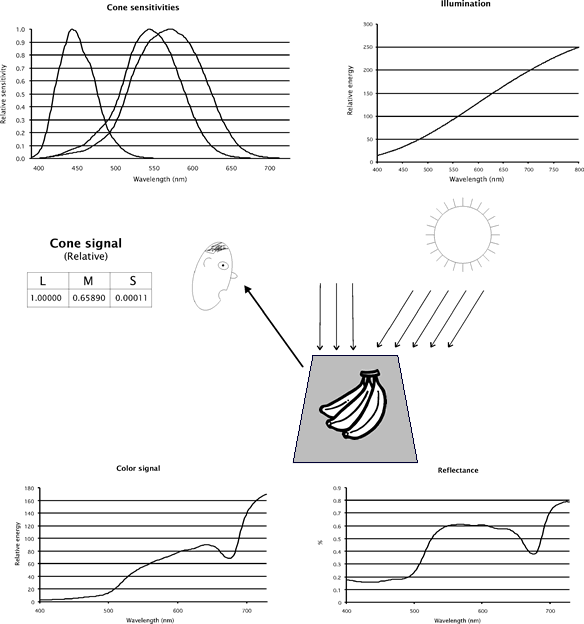
Figure 1: The causal process leading to color vision.
An illuminant such as sunlight falls on an object, in this case a bunch of bananas. (For clarity, the spectral power distribution of CIE illuminant A is given rather than that of daylight or sunlight.) The light reaching the eye (the color signal) represents the illuminant as transformed by the reflectance of the object. This light then stimulates the three cone types to generate the cone signal. This process is repeated for each region in the visual field and the cone signals collectively contain all the information available to the visual system regarding the colors of the objects in the visual field. (For simplicity, we represent this process only for one region.)
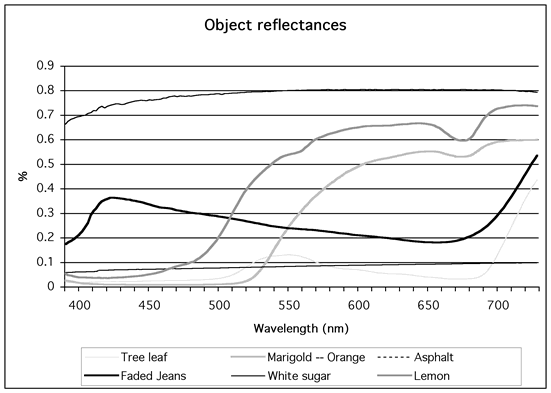
Figure 2: Spectral reflectances for some common objects.
(Data courtesy of Eastman Kodak company via http://www.cns.nyu.edu/ftp/ltm/SSR/kodak/)
Now this basic suggestion, that colors are reflectances, is open to three immediate objections, in addition to the charge that physicalism of any variety cannot account for color similarities. We will address these objections in turn, in the following three sections. In order to reply to the first two (although not the third), the basic suggestion will need to be elaborated and modified.[25]
3.1.1. The problem of metamers. The first objection starts from the phenomenon of metamerism: objects with quite different reflectances can match in color under a given illuminant.[26] Two such objects are a metameric pair with respect to that illuminant. Metamerism is a consequence of the fact that all the information available for perception of color derives from just three receptor types with broad spectral sensitivity. If the light reaching the eye from two objects produces the same response in each of these three receptor types then they will appear to have exactly the same color no matter how their reflectances differ. (See Fig. 3 below.) There are reasons for thinking that metameric pairs are uncommon for natural objects (Cohen 1964; Maloney 1986), although contemporary color technology produces many approximate perceptual matches between physically distinct objects. Consequently there is some uncertainty as to the practical (as opposed to theoretical) significance of metamerism for animals inhabiting their natural environments. In any case, it is sometimes argued that the mere possibility of metameric pairs poses a serious obstacle to any attempt to identify colors with reflectances (Dedrick 1996; Hall 1996; Hardin 1993, pp. 63-64).
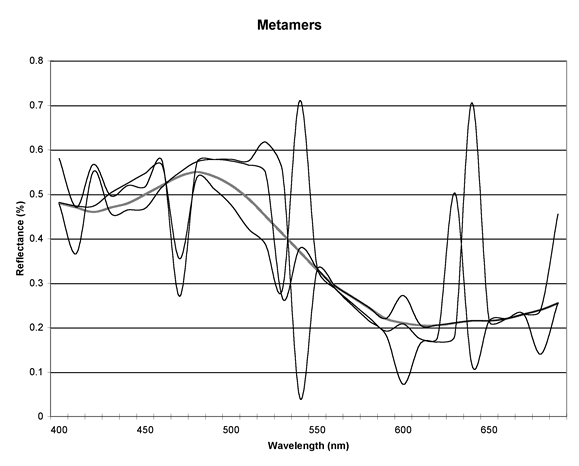
Figure 3: Reflectances of four objects that look alike.
Objects with these spectral reflectance curves would match in color for the CIE 1931 standard observer when viewed under illuminant C.
If we say that a color is determinate if and only if no normal human observer can, in normal circumstances discriminate (on the basis of color) between two objects that appear to have that color,[27] then the problem can be put as follows. Determinate colors cannot be identified with specific reflectances because there will typically be (indefinitely) many reflectances that result in the appearance of a given determinate color, and no motivation for choosing between them.
This objection is correct, as far as it goes. But it can be defused by making a slight change that was required in any event. Notice that even if we ignore metamerism, there is already a problem with determinable colors–red, green, purple, and so forth. Typically two purple objects will have different reflectances. The solution to this problem is clear: we can identify the determinable colors with reflectance-types (or sets of reflectances) rather than with the specific reflectances themselves. For example, the property purple, on this modified account, is a type of reflectance rather than a specific reflectance. As a bonus this proposal also solves the problem of metamers (and so it is not really an additional problem): both determinable and determinate colors are reflectance-types. Metameric surfaces are, according to the revised theory, the same in determinate color in spite of their physical differences (Byrne & Hilbert 1997a; Hilbert 1987).[28]
As is well known, the relation between reflectance and apparent color is in some ways more complicated than the relation between simple physical magnitudes and some other perceptible properties (length, for example). The various reflectances that are perceptually equivalent (with respect to a given illuminant) are not just minor variants of each other. Surfaces with grossly different reflectances can perceptually match even under fairly normal illuminants (see again Fig. 3). So the reflectance-types that we identify with the colors will be quite uninteresting from the point of view of physics or any other branch of science unconcerned with the reactions of human perceivers. This fact does not, however, imply that these categories are unreal or somehow subjective (Hilbert 1987). It is just a plain matter of fact that an object has a particular type of reflectance, and this fact need not depend in any interesting way on the existence of creatures with color vision. No doubt fire engines would not have had that distinctive reflectance-type if humans had not evolved color vision, but rubies and garnets would still have had it–even if humans had never evolved at all.
There is a useful comparison here with the CIE 1931 Standard Observer. Given a fixed illuminant, the Standard Observer allows reflectances to be sorted into types (in particular, equivalence classes: two reflectances will be in the same class if and only if their tristimulus coordinates relative to the illuminant are identical). Although tristimulus coordinates are derived from the color matching behavior of human beings, that a particular reflectance has a certain set of coordinates is not dependent on the existence of perceivers, human or otherwise. If humans had never evolved at all reflectances would still have had tristimulus coordinates. Further, like the types reflectance physicalism identifies with the colors, the types of reflectances generated by the Standard Observer will seem a motley jumble to a physicist, precisely because they are psychophysically inspired.
We should emphasize that tristimulus coordinates in the CIE system are not suitable to specify the reflectance-types that a plausible version of reflectance physicalism will identify with the colors. The coordinates vary with illumination, do not capture perceived similarity relations, and are tied to very specific and (outside the laboratory) uncommon viewing conditions. Similar points apply to other standard colorimetric systems. A further issue arises in the case of color appearance models. Plausible versions of physicalism (and, indeed, any defensible view of color) will allow that some (perhaps very few) color perceptions are illusory–even under good viewing conditions. The goal of color appearance models is, on the other hand, to provide a computational procedure allowing the perfect prediction of color appearance on the basis of physical measurements. If a color appearance model were taken as the basis of color categories it would not admit the possibility of error or illusion. Thus a model that classified reflectances on the basis of color appearance would not necessarily be classifying them on the basis of color.
3.1.2. Colored lights, filters, and volumes. Reflectance physicalism as we have described it so far has been tailored to the colors of objects with opaque surfaces that do not emit light. But of course these are not the only things that appear colored. Many apparently colored objects are translucent or transparent, for instance, glasses of beer, the previously mentioned examples of rubies and garnets, and filters like amber sunglasses. The perceived color of such objects is significantly, and frequently almost entirely, determined by their transmittance characteristics. In addition, light sources provide some paradigmatic instances of colored things: stoplights, like tomatoes, grapefruit, and limes, are red, yellow, and green. Again, the perceived color of a light source often has little to do with its reflectance characteristics. So the second objection is that reflectance physicalism seems committed to describing the perceived color of many ordinary things as illusory. Admittedly, occasional color illusions come with the territory, but this sort of widespread illusion is hard to swallow.[29]
One possible reply is to claim that the colors come in several flavors: surface colors, volume colors, and illuminant colors.[30] On this proposal, surface colors are reflectances, while volume colors are some other physical property and illuminant colors yet a third. Such a move would be quite unacceptable, however. Opaque objects, translucent objects, and light sources can look the same in respect of color. Therefore the natural inference is that there is a single property that vision represents all these objects as having–a conclusion supported by common speech as well as by what is known about the extraction of color information by the visual system.
Fortunately, though, another reply is available. Earlier, we gave a standard definition of reflectance: the proportion of incident light the object is disposed to reflect at each wavelength in the visible spectrum. However, we could just as well have characterized reflectance slightly differently, in terms of the light that would leave the object rather than the light that the object would reflect. For clarity, let us adopt some new terminology, and say that the productance of a surface is its disposition to produce (i.e. reflect or emit or transmit) a specific proportion of incident light. For opaque non-luminous surfaces this will be equivalent to the original definition of reflectance in terms of reflected light. For surfaces that emit or transmit light, however, the productance and the reflectance will sharply diverge. Characterizing physicalism in terms of productance rather than reflectance will allow us to account for all the problem cases just mentioned.We will consider light sources first, and then turn to translucent or transparent objects.[31]
The light leaving the surface of an (opaque[32]) light source consists of two components: the light reflected and the light emitted. Because of this fact, productances are always relative to an illuminant.
To see this, consider a simple example involving a surface that emits monochromatic light of wavelength λ with intensity e, reflects fraction r of light with wavelength λ, and emits or reflects no other light. Assume also, as is true of many light sources, that the intensity of the emitted light does not depend on the intensity of the illuminant. Consider an illuminant I1 whose intensity at λ is i1. Then with this choice of illuminant the productance is measured by the ratio (ri1+e)/i1. However, with another choice of illuminant I2, whose intensity at l is i2, the productance is measured by the ratio (ri2+e)/i2. These ratios will of course be different if i1 and i2 are different: increasing the illuminant decreases the productance. Hence, relative to I1, the productance of the surface is measured by (ri1+e)/i1. In other words, the productance of the surface (relative to I1) is its disposition, when illuminated by I1, to produce light that is (ri1+e)/i1 of I1 at wavelength λ, and zero at all other wavelengths. Similarly for I2. This relativity of productances to illuminants is illustrated in Figure 4 below.
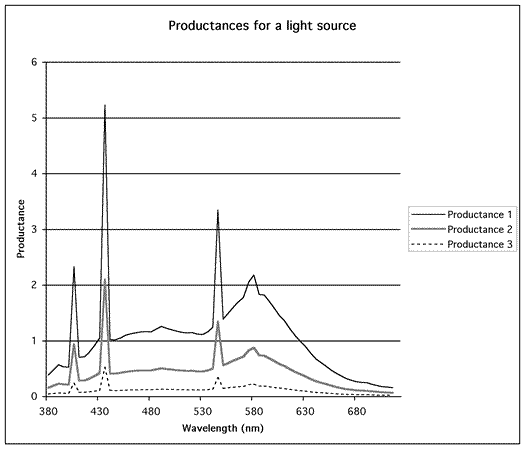
Figure 4: The productance of a standard fluorescent light source with respect to three (increasing) levels of a daylight (D65) illuminant.
Two points are worth noting. First, for surfaces that do not emit light we can ignore the relativity of productances to illuminants, because the productance functions for different illuminants will be the same. Second, since the sum of the intensities of the emitted and reflected light at a wavelength λ can exceed the intensity of the incident light at λ, some productance functions for a light source may have values greater than one.
Although productances are relative to illuminants, it is important to stress that the productance of a surface is illumination-independent–that is, independent of the actual illuminant. The surface of a stoplight or tomato has a certain productance relative to an illuminant I, and it has this productance independently of the light that is in fact illuminating it. Hence it has a certain type of productance independent of the actual illumination. The ordinary person thinks that some stoplights are red at night, and that tomatoes are red in a closed refrigerator, and the revised version of physicalism characterized in terms of productance agrees.
Turning now to translucent or transparent objects, it might seem that the change from reflectance to productance does not solve all our problems. Suppose we take a thin filter and measure the ratio of the light produced by its facing surface to the light incident on the surface, at each wavelength. Assuming the filter is not backlit, this procedure will not take into account the transmitting characteristics of the filter, and therefore the result will not appropriately correlate with its perceived color. So, if this is the right way to measure "the ratio of the produced light to the incident light," and thus productance, then "productance physicalism" will not accomodate the colors of objects that transmit light. However, there is no special reason–other than convenience for certain technical purposes–to take the "incident light" to be incident just on the facing surface. In the case of the filter, we could take the reflectance to be measured by the usual ratio, but with the entire filter (i.e., its front and back) uniformly illuminated. In the case of the productance of an opaque surface, this procedure will make no difference. It will, though, take the transmitting characteristics of filters into account, which is just what we want. Since translucent or transparent volumes like glasses of beer can be thought of as composed of layers of filters, we do not need to add anything else to provide for their colors.
(Because none of what follows hinges on the complexities just raised, for simplicity we will henceforth ignore productance and return to the initial characterization of physicalism in terms of reflectance.)
3.1.3. Related and unrelated colors. The distinction between related and unrelated colors is frequently employed in the empirical study of color vision (Fairchild 1998, pp. 105-106). Unrelated colors are colors that are seen in isolation from other colors, typically against a black or other neutral background. Related colors, by contrast, are colors seen against a background of other colors. Take the case of brown. Brown is only ever seen as a related color: an object is never seen as brown unless some other (lighter) color is visible at the same time. If an object looks brown against a light background then it will look orange against a dark one. This fact, and the terminology of "related color," might suggest that brown, unlike colors that can be seen as unrelated, is a relational property, in particular one involving a relation between an object and its surround. And if brown is this sort of relational property, then it cannot be a reflectance: whether or not an object has a given reflectance does not depend at all on the surround.
However, if we avoid the confusion mentioned in section 1.3.3 above, between the conditions necessary for perception and what is perceived, there should be no temptation to think of brown as being a relational property different in kind from other colors. The conditions necessary to see an object as brown involve a relation between the object and its surround, but this is perfectly compatible with our claim that brown is a type of reflectance.[33]
In support of this point it is worth observing that viewing objects in isolation is not an ideal condition for extraction of reflectance information. Because the light reaching the eye from a surface does not by itself contain information that uniquely specifies the reflectance of that surface, proposals for how the human visual system achieves approximate color constancy typically involve making use of light from the entire scene.[34] Consequently, the perception of unrelated colors will often be illusory. If this is right then the fact that brown is only ever seen as a related color tells us nothing about the nature of brown. It merely illustrates the fact that color perception works better under some conditions than others.
So, although the distinction between related and unrelated colors is important to understanding and modeling the mechanisms of color vision, it is no threat to reflectance physicalism.
3.2. The phenomenal structure of the colors.
The colors stand to each other in a complex web of similarity relations. (Here we will concentrate exclusively on similarities between the hues.) For example, purple is more similar to blue than to green; and the numerous shades of red are more or less similar to each other. Relations of hue similarity also have an opponent structure. Red is opposed to green in the sense that no reddish shade is greenish, and vice versa; similarly for yellow and blue. Further, there is a shade of red ("unique red") that is neither yellowish nor bluish, and similarly for the three other unique hues–yellow, green, and blue. This is nicely shown in experiments summarized by Hurvich (1981, Ch. 5): a normal observer looking at a stimulus produced by two monochromators is able to adjust one of them until he reports seeing a yellow stimulus that is not at all reddish or greenish. In contrast, every shade of purple is both reddish and bluish, and similarly for the other three binary hues (orange, olive, and turquoise). The binary hues are sometimes said to be "perceptual mixtures" of the unique hues.
These facts form the basis of an objection to physicalism. (As we are defending reflectance physicalism, we will take this as the specific target.) The supposed problem can be vividly illustrated by displaying representative instances of the reflectance-types that, on a view like ours, are the properties purple, blue, and green (see Figure 5 below).
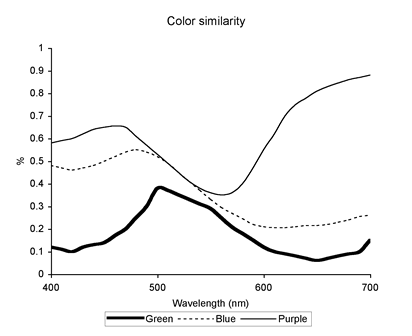
Figure 5: Spectral reflectance curves typical of purple, blue, and green objects.
There does not seem to be an obvious respect in which the first reflectance-type is more similar to the second than it is to the third. Neither does there seem to be anything in the reflectance-types corresponding to the difference between the unique and binary hues: any reflectance-type that a physicalist might identify with purple, for instance, will not in any intelligible sense be a "mixture" of the reflectance-types that are identified with red and blue. If physicalism cannot respect the fact that purple is more similar to blue than to green, and the fact that purple is a binary hue, then physicalism is Hamlet without the prince–it strips the hues of their essences, and so cannot be a satisfactory theory of color at all.
Thus Hardin writes:
If we reflect on what it is to be red, we readily see that it is possible for there to be a red that is unique, i.e., neither yellowish nor bluish. It is equally apparent that it is impossible for there to be a unique orange, one that is neither reddish nor yellowish . . . If yellow is identical with G, and orange is identical with H, it must be possible for there to be a unique G but impossible for there to be a unique H. If hues are physical complexes, those physical complexes must admit of a division into unique and binary complexes. No matter how gerrymandered the physical complex that is to be identical with the hues, it must have this fourfold structure, and, if objectivism [i.e., physicalism] is to be sustained, once the complex is identified, it must be possible to characterize that structure on the basis of physical predicates alone. (Hardin 1993, p. 66)
And:
The unitary-binary structure of the colors as we experience them corresponds to no known physical structure lying outside of nervous systems that is causally involved in the perception of color. This makes it very difficult to subscribe to a color realism that is supposed to be about red, yellow, green, blue, black, and white–that is, the colors with which we are perceptually acquainted. (Hardin 1993, p. 300, n. 2)
Following Hardin, Thompson et al. claim that:
Light waves or surface spectral reflectances do not stand in relations to each other that can be described as unique or binary, or for that matter opponent or nonopponent, balanced or unbalanced, saturated or unsaturated, and so forth. There simply is no mapping from such physical properties to the properties of color that is sufficient to establish the objectivist [i.e., physicalist] identification. (Thompson et al. 1992, p. 16)[35]
Complaints against physicalism along these lines are also endorsed by (Boghossian & Velleman 1991; Johnston 1992; Thompson 1995a).
One reply is to concede that physicalism cannot recover similarity relations and the binary/unique distinction, but nonetheless insist that this is not a fatal defect (Matthen 1999, pp. 67-68).[36] However, such heroism is not required. In our view, the phenomena of color similarity and opponency show us something important about the representational content of color experience–about the way the color properties are encoded by our visual systems. And once we have the basic account of the content of color experience on the table, it will be apparent that there is no problem here for physicalism.
3.2.1. The content of color experience revisited. So far, we have been assuming that the content of a typical experience of looking at a green object includes the proposition that the object is green or, to be a little more realistic, that the object is green31 (suppose "green31" is a determinate shade of green). In any case, the assumption so far has been that color experiences simply attribute color properties to objects.
The right picture is more complicated, however. (Remember that we are presently focusing on hue, ignoring saturation and lightness.) It is natural to say, and subjects do say, that one colored chip has "more blue" and "less red" in it than another, that a certain yellow chip has "no red and no orange" in it, that any orange chip has "some red and some yellow" in it, and so forth. If subjects are asked to estimate the "relative amounts of hues" in a stimulus (for example 40 percent red, 60 percent yellow), not only do they seem to understand the instruction, but they give similar answers (Sternheim and Boynton 1966; Werner and Wooten 1979).[37]
This is puzzling. Red, yellow, green, and blue are properties, and it does not make any sense to say that one object has more of a property than another object, or a relative amount of a property. An object either has a property or it doesn't.
We suggest that the way to connect this talk with the content of visual experience is to recognize that visual experience represents objects as having proportions of hue-magnitudes. This needs some explaining.[38]
For our purposes, a magnitude M is a set of properties M, the members of which are the values of M, together with a ratio scale SM. The ratio scale SM is simply an equivalence class of functions from the members of M to the real numbers, with the equivalence relation holding between functions f and g if there is a positive real number n such that for all x, f(x) = ng(x). Thus the magnitude length in the intuitive sense can be identified with the magnitude L, which comprises the set L of all particular length properties (being two inches long, being six inches long, being three miles long, . . .) plus a ratio scale SL which includes the function that takes a length property l to the number that specifies l in meters, and so also includes the function that takes l to the number specifying l in feet.[39]
The values of a magnitude M are just properties, and so an individual a can be represented as having one of these properties. For present purposes, the crucial fact is that such a representation might encode information abut the scale of M, or it might not. As an example of the former and richer kind of representation, consider the sentences “a is three feet long” and “b is two feet long.” They jointly encode the information that a is longer than b: someone who knew that a is three feet long and that b is two feet long would be able to conclude that a is longer than b. Now imagine that stick x and stick y are three feet and two feet long, respectively. The sentence “a is the actual length of stick x” is true just in case a is three feet long, and similarly for the sentence “b is the actual length of stick y.” These sentences are examples of the latter and weaker kind of representation. They do not encode the information that a is longer than b, even though, of course, if they are true, then a is longer than b.
Suppose now we have two magnitudes, say "height" H and "width" W. Think of the values of H and W as properties had by suitably oriented rectangles, and call the sum of a rectangle's width and height (picking some unit of measurement) its size. The sentence "a's height is 25 percent of its size" does more than simply attribute a certain property to the rectangle a, just as "a is three feet long" does more than attribute a certain property to a. Someone who knew both that a's height is 25 percent of its size and that b's height is 20 percent of its size could conclude that b is a "skinnier" rectangle than a. We can mark this fact about the extra information encoded by saying that sentences like "a's height is 25 percent of its size" represent an object as having proportions of the magnitudes H and W.
Our proposal is that objects are represented as having proportions of "hue" magnitudes, just as, in the example of sentences like "a's height is 25 percent of its size," the rectangle a is represented as having certain proportions of the magnitudes H and W.[40] We need four hue-magnitudes, R, Y, G, and B (set aside for the moment the question of just what these magnitudes are). An object will possess certain values of these magnitudes; call their sum (picking some unit of measurement) the object's total hue (analogous to a rectangle's size in the previous example). The idea is that if an object is perceived as orange, then it is represented as having a value of R that is approximately 50 percent of its total hue, and similarly with Y: say, a 60 percent proportion of R and a 40 percent proportion of Y. If an object is perceived as purple, it is seen as having R and B in a similar proportion, say a 55 percent proportion of R and 45 percent proportion of B. If an object appears blue, it is seen as having a high proportion of B and a relatively low proportion of either R or G, and so on.[41]
To a first approximation, then, if someone with normal color vision looks at a tomato, the representational content of her experience is not simply that the tomato is red29 (suppose "red29" is a determinate shade of yellowish-red). Rather, the content is, for example, that the tomato has a value of R that is 80 percent of its total hue, and a value of Y that is 20 percent of its total hue. (Recall from section 1.2 that the content of experience is personal level content: it specifies the way the world appears to the subject.)
This is, of course, no more than a very simplified model of the representational content of color experience insofar as it concerns hue. However, as we shall shortly explain, if something roughly like it is correct, we can give an appealing account of the similarity relations between the hues, and the binary/unique distinction.
3.2.2. The fit with opponent-process theory. As should come as no surprise, there is a nice fit between the claim that hues are represented as proportions of hue-magnitudes, and opponent-process theory (Hurvich & Jameson 1957; Lennie & D'Zmura 1988). However, it should be emphasized that there is nothing in the magnitude proposal that requires the truth of opponent-process theory, let alone the simplified version of it we will use for the purposes of illustration.[42]
The basic idea of opponent-process theory is that the outputs of the three cone-types are transformed into two opponent chromatic signals and one nonopponent achromatic signal. Letting the cone outputs for the long, medium, and shortwave cones be L, M, and S, in the simplified version of the theory the red-green signal is L-M, the yellow-blue signal is (L+M)-S, and the achromatic signal is L+M.
Focusing on the two chromatic signals, if L-M>0 then the red-green signal produces a "red response," and produces a "green response" if L-M<0. Similarly, the yellow-blue signal produces a "yellow response" if (L+M)-S>0, and a "blue response" if (L+M)-S<0. Hence the experience of unique red is produced when the red-green signal is positive (L-M>0) and the yellow-blue signal is zero ((L+M)-S=0).
The opponent hues when (additively) mixed cancel each other. For example, a greenish light when mixed with an appropriate intensity of reddish light will appear neither greenish nor reddish. Suppose we have two greenish lights, l1 and l2, and that the second requires more of the same reddish light in order to produce a light that is neither greenish nor reddish. Then (according to opponent-process theory), the "green response" produced by l2 is greater than that produced by l1. By using such a psychophysical cancellation technique, the responses of the opponent channels by wavelength (chromatic response functions) can be experimentally determined. (For an accessible textbook presentation, see (Hurvich 1981, Ch. 5).)
However, it is not altogether clear how to interpret opponent-process theory. What does it mean to say, for example, that a stimulus produces both a "red" and "yellow" response? Typically, the explanation is left at an intuitive level: a stimulus that produces both a "red" and "yellow" response is one that looks to be a "combination" or a "mixture" of red and yellow. This may be metaphorically illuminating, but it is not theoretically satisfying.[43] Our proposal offers a way to fill the gap: such a stimulus is visually represented as having a (non-extreme) proportion of both the red- and yellow-magnitudes.
Moreover, opponent-process theory fills a gap in the magnitude proposal. It provides a functional account of how the visual system could derive information about the proportions of hue-magnitudes in a stimulus from the cone outputs.
3.2.3. Similarity and the binary/unique distinction revisited. If the magnitude proposal is along the right lines, then we can explain the similarity relations among the hues and the binary/unique distinction, in terms of the content of color experience.
Take similarity first, and in particular the fact that purple is more similar to blue than to green. Objects that appear blue are represented as having a high proportion of B (and a lower proportion of either G or R); objects that appear purple are represented as having a roughly equal proportion of B and R, and objects that appear green are represented as having a high proportion of G (and a lower proportion of either Y or B). There is therefore a perceptually obvious respect in which blue is more similar to purple than to green. Namely, there is a hue-magnitude (B) that all blue-appearing objects and purple-appearing objects, but not all green-appearing objects, are represented as having.
The reason why a binary hue like orange appears to be a "mixture" of red and yellow is that any object that appears orange is visually represented as having some proportion of both R and Y. On the other hand, an object can appear green and be represented as having a value of G that is 100 percent of its total hue. That is why green (and yellow, red, and blue) are said to be "unique" hues.
In this way, the phenomena of color similarity and opponency can be explained on the assumption that visual experiences represent objects as having proportions of hue-magnitudes. Hence if there is a physicalist account of the hue-magnitudes then color similarity and opponency do not pose any difficulty for physicalism. So we must now show that there is such an account.
There are reasons independent of the present claim about hue-magnitudes to identify the colors with reflectance-types, as we argued above in section 3.1. It is legitimate, then, to work backwards and ask–under the assumption that colors are reflectance-types–if there are any obvious physicalistically acceptable candidates to be the hue-magnitudes.
Consider light with a fixed spectral power distribution. Let us say that the light’s L-intensity is the degree to which it stimulates the L-cones, its M-intensity is the degree to which it stimulates the M-cones, and its S-intensity is the degree to which it stimulates the S-cones. (This is, of course, imprecise, but will do for our purposes.[44]) Now take unique red. Assuming that colors are reflectance-types, and simplifying for illustration, an object is unique red if and only if, under an equal energy illuminant, it would reflect light with a greater L-intensity than M-intensity, and with an S-intensity equal to the sum of its L- and M-intensities (recall that we are ignoring complications introduced in sect. 3.1.2 above). Assuming that the magnitude proposal is correct, an object that looks unique red is represented as having some value of R that is 100 percent of its total hue (and is therefore represented as having no proportion of Y or B). Putting reflectance physicalism and the magnitude proposal together, an object has some value of R if and only if, under an equal energy illuminant, it would reflect light with a greater L-intensity than M-intensity–the greater the difference, the higher the value of R. And similarly for the other magnitudes. An object has some value of G if and only if, under an equal energy illuminant, it would reflect light with a greater M-intensity than L-intensity. An object has some value of Y (B) if and only if, under an equal energy illuminant, it would reflect light the sum of whose M- and L-intensities is greater (lesser) than its S-intensity–the greater the difference, the higher the value of Y (B).
3.3. Evolution and animal color vision
Color vision is very widely distributed among animals. Some degree of color vision appears to be the default condition for all the major groups of vertebrates and is also common among invertebrates (Jacobs 1981; 1993; Menzel 1979). As one would expect, color vision systems vary widely across species. Using just the most basic classification, some organisms are dichromats, others (including human beings) are trichromats, and still others tetra- or pentachromats[45](Bowmaker et al. 1997; Jacobs 1981; 1993). So some organisms possess color vision that is in certain respects more highly developed than the human standard. Different organisms also use their color vision for different purposes, for instance foraging, communication (in particular sexual signaling), and detection of predators (Lythgoe 1979; McFarland & Munz 1975; Menzel & Shmida 1993; Thompson et al. 1992). Given the prevalence of color vision and its deep theoretical relations to color, it is something of a scandal that hardly any philosophical accounts of color so much as mention the existence of color vision in non-human animals.
Moreover, it might seem that elementary considerations concerning color vision in other species and its evolution shows that reflectance physicalism is at best unmotivated, and at worst straightforwardly false. One objection starts by pointing out that reflectance-types have no primary ecological significance. What matters in foraging, for example, is locating edible material, not detecting reflectances. Given the dubious ecological significance of reflectance-types–the objection continues–it is unlikely that there was selection for a visual subsystem devoted to extracting and encoding information about these properties. Further, there is a good deal of empirical evidence that color vision was selected for–it did not arise as a by-product of selection for other visual functions. The pigment types involved in color vision have been studied in a large number of organisms and they display a good deal of fit with what is known about the organisms' visual environments (Bowmaker et al. 1994; Lythgoe 1979; McFarland & Munz 1975). Therefore–the objection concludes–reflectance physicalism is incompatible with very plausible hypotheses about the evolution of color vision.
This objection relies on the assumption that selection cannot act to produce detectors for properties that lack primary ecological significance for an organism. Notice that spatial properties, like shape, are equally suspect if this reasoning is correct.[46] However, it is incorrect. Consider an analogous argument: there could not be selection for flight because there is no advantage to the organism merely to move through the air rather than on the ground. Here the mistake is clear. Flying contributes to an organism's fitness by enabling it do other things better, for example finding mates or food. In addition, flying contributes to an organism's fitness in multiple ways, making it inappropriate to describe it simply as, say, a mechanism for evading predators. Thus, to return to the color case, it is mistaken to argue that animals cannot have mechanisms devoted to extracting and coding information about reflectance-types because these mechanisms are not of primary ecological significance for the animal. If there is a correlation between reflectances and more ecologically significant properties, then selection for the mechanisms may well occur. Although the selection pressures driving the evolution of color vision are still a subject of controversy, plausibly it at least partly involves the use of color vision for object discrimination, detection, and recognition (Jacobs 1981; 1990; Mollon 1989).
Another objection begins by claiming that not all organisms with color vision appear to be using it to detect reflectance-types: some seem to use their color vision to respond to illuminant characteristics and not surface features at all (Hatfield 1992; Matthen 1999; Thompson 1995a; 1995b; Thompson et al. 1992). For instance, some fish have color vision specialized for detecting contrast between other objects and the background illumination. Therefore–the objection concludes–since color is whatever is detected by color vision, colors cannot be reflectance-types.[47]
This objection relies on what is admittedly the standard conception of color vision: an organism has color vision if and only if it is capable of discriminating some spectrally different stimuli independently of brightness. Equivalently, an organism has color vision if and only if there is at least one pair of wavelengths that the organism is capable of discriminating for every value of their relative intensity (Jacobs 1981). This criterion has the great virtue of being closely connected with the underlying physiology. A necessary condition for being able to make discriminations based on spectral (as opposed to luminance) differences is the possession of at least two types of photoreceptors with differing spectral sensitivity characteristics. Hence, by using this criterion, it is possible to get significant information about an organism's color vision based on physiological as opposed to behavioral tests.
However, although useful and important, this criterion does not tell us what sort of properties are extracted from the visual stimulus and represented by the color vision system. Two organisms who both pass the discrimination test could be using their shared machinery to represent quite different types of properties–perhaps luminances in one case and reflectances in the other. So if color vision is thought of as a system for visually representing certain properties–paradigm instances of which are represented by the human visual system–then the criterion based on wavelength discrimination is not adequate. Moreover, in the context of the problem of color realism, this is how we should think of color vision. Hence, if it turns out that certain salient properties represented by the human visual system are reflectance-types, then organisms with visual systems that do not represent reflectance-types cannot have color vision in the sense relevant to this article.[48] For our purposes, the standard discriminatory criterion is necessary but not sufficient for possession of color vision (Hilbert 1992).
Even given this more restrictive conception of what it is to possess color vision, very many non-human organisms will plausibly possess it. These include most old-world primates, many birds, many shallow water fish, and invertebrates such as bees. The reflectances represented will depend on the details of the visual system in question: human color and bee color vision, for instance, presumably represent quite different reflectance-types. Since a single surface falls under many different reflectance-types (in fact, infinitely many), there need not be any conflict between color appearances across species. Goldfish and human beings see objects as having different colors, but reflectance physicalism gives no reason to suppose that if one species is right then the other must be wrong.
Thus, contrary to initial appearances, the facts about the types and distribution of color among non-human organisms fit nicely into the framework of reflectance physicalism.
3.4. Variation in normal color vision
There is a surprising amount of variation in the color vision of people classified on standard tests–for example the Farnsworth-Munsell 100-Hue Test–as having "normal" color vision. Hurvich et al. (1968) found that the location of "unique green" for spectral lights among 50 subjects varied from 490 to 520nm. This is a large range: 15nm either side of unique green looks distinctly bluish or yellowish. Earlier color matching data used to construct the CIE standard observers showed similar variation between individual subjects (Wyszecki & Stiles 1982, pp. 425-35). A large part of this variation is due to differences in macular and lens pigments, but some of it is due to differences in photopigments. A more recent study of color matching results among 50 males discovered that they divided into two broad groups, with the difference between the groups traceable to a polymorphism in the L-cone photopigment gene (Winderickx et al. 1992). The maximum points of the absorption spectra of the resulting two photopigments were found to differ by 5nm (Merbs & Nathans 1992). Because the L-cone photopigment genes are on the X chromosome, the distribution of the two photopigments varies significantly between men and women (Neitz & Neitz 1998).
In addition to variation between subjects, there is also variation within subjects. Color matching depends on visual angle (Stiles 1937). The degeneration of the lens with age makes it yellower, producing a shift in perceived hue, with purple objects looking significantly redder (Fairchild 1998, p. 5). Color perception can vary between the right and left eyes due to differences in the optical density of the macula (Fairchild 1998, p. 7).
These facts give rise to an obvious problem, which C. L. Hardin nicely expresses as follows:
[Imagine that all of the] hue chips manufactured by the Munsell Company covering [the] 5 Blue-Green to 2.5 Green range were randomly spread out before you to be separately viewed on a dark gray background in North Daylight. One of them would be your considered choice for unique green. Your colleague might make a different choice. If so, which of the chips is unique green? (1993, p. 80, endnote omitted)
According to Hardin, "if this question is to be answered at all, it can be answered only by convention. We might, for example, decree that the most frequently chosen chip is to be unique green. But we could decide otherwise" (p. 80).
Hardin's answer to his own question is a little odd. Suppose a certain chip looks to you to be unique green. Convention has nothing to do with this: what makes it the case that the chip looks unique green are facts about your visual system and its interaction with the chip, and these are not matters of convention or decision. Now consider the question of whether the chip is as it looks. Convention has nothing to do with this either: it is entirely a matter of how things are with the chip. If the chip is unique green, then the answer is yes; if not, no.
We suspect that Hardin's eliminativism is influencing his answer. Even if, as Hardin thinks, nothing is red, blue, yellow or green (let alone unique green), color terminology has great practical value. For various pragmatic reasons, it would not be a good idea to speak the literal truth and to refuse to apply color expressions–for example "unique green"–to anything. So how should we use this expression? Obviously the answer to this question is a matter of convention: the question calls for a decision, not a statement of fact. But this is not the question that Hardin is officially asking, although the two might be easily confused. By his own lights, what Hardin should have said in answer to his official question is that–as a plain matter of non-conventional fact–neither chip is unique green.
If this answer–that neither chip is unique green–is correct, then we are in trouble. For, since we may fairly suppose that if anything is unique green, one of the chips is unique green, the proper conclusion is that nothing is unique green. And if nothing is unique green, it is hard to see why other shades of green, or of any other color, are any better off. The natural terminus of this line of thought is therefore that nothing has any color, that is, that eliminativism is true. So we do not have here a problem solely for physicalism, but rather for any realist theory of color.
But what is the problem, exactly? What the facts about individual differences in color vision show is that, under the twin assumptions (a) that objects do not have many different colors simultaneously (for example, if a chip is unique green it is not also bluish-green), and (b) that if objects really are colored (for example, a certain chip is unique green), then there is widespread misperception of the determinate colors: many people will misperceive a chip that is in fact unique green as slightly bluish-green, for instance. If this can be turned into a good argument against color realism then two things must be established. First, that the conclusion, widespread misperception of the determinate colors, is unacceptable. If this is right, then we have to reject either (a) or (b). Second, to complete the argument it must be established that (b) is the culprit.
We think this argument fails at the first stage, because the conclusion is not unacceptable. First, note that the conclusion is not especially astonishing or at odds with apparently obvious facts. The conclusion is not that people rarely see objects as having the colors they actually have, but that they rarely see objects as having the determinate colors they actually have. It is consistent with the conclusion that people typically see green objects as green, orange objects as orange, and so forth. Second, note that similar conclusions hold for other perceptible properties, for example spatial properties. For a concrete case consider aniseikonia; a moderately common opthalmological condition in which the size (or shape) of the retinal image differs between the two eyes.[49]
One effect of aniseikonia is that the orientation of surfaces in the horizontal plane is misperceived because of the binocular distance errors introduced by the difference in magnification. The result is that a significant fraction of the population is unable to perceive correctly whether or not a surface is oriented perpendicular to the line of sight (in the horizontal dimension). Since this is just one of many common deficits of spatial vision we can safely say that people rarely see objects as having exactly the spatial properties that they really have. This observation does not lend support to the conclusion that objects do not really possess spatial properties.
There is one final worry, which can be brought out by noting that in the shape case we have independent tests for whether someone is perceiving a shape correctly. In the color case, there is no such test. As things stand, the best evidence for a Munsell chip's having a certain color is that the majority of those with normal color vision see the object as having that color. The lack of an independent test is partly due to the fact that colors are not perceived by any other sensory modality, and partly due to the fact that we have no acceptable naturalistic theory of the content of color experience (see sect. 2.6 above). In addition, colors as such do not figure significantly in the data or theories of any sciences other than those concerned with animal behavior. Attributions of properties such as shape are constrained by the role of those properties in a network of causal relations. Since there is no chip that the majority will pronounce to be unique green, we have no good reason to believe, of any chip, that it is unique green. So, someone might argue, it follows that we have no good reason to believe that there are any unique green chips. Doesn't this contradict what a typical physicalist or color realist will want to say?
Yes, it does. But the argument is fallacious. From the fact that we have no good reason to believe, of any chip, that it is unique green, it does not follow that we have no good reason to believe that there are any unique green chips. That would be like arguing that we have no good reason to believe that Professor Plum has been murdered, on the ground that there is no particular person who is clearly the culprit.[50]
3.5. The inverted spectrum
The "inverted spectrum" thought experiment (Locke 1689/1975, Bk. II, Ch. xxvii, para. 15) is well-known. Here is a neutral way–begging no important questions–of describing the basic setup. We have two perceivers, Invert and Nonvert. Nonvert's color vision is the same as yours (assuming you have normal color vision). Now take some (roughly) symmetric transformation T of the psychological color solid, say a reversal of the red-green axis, or a reversal of the red-green, yellow-blue, and black-white axes (for useful discussion see Palmer 1999a). Imagine Nonvert is looking at some scene S, say a radish against a background of lettuce leaves. The inversion of S is a scene which differs from S only in the colors that objects appear to have to Nonvert: if the color of an object o is C, then the color of o in S is T(C). Concentrate on what it is like for you (i.e., Nonvert, in effect) to look at colored objects. Now here is the important part: what it is like for Invert to look at a scene S is just the same as what it is like to Nonvert to look at the inversion of S.
Invert and Nonvert, in the hypothetical circumstance described, are said to be spectrally inverted with respect to each other. So far, we have no controversial argument, just a description of what certainly seems to be a possibility, although perhaps only a far-fetched one.
The inverted spectrum turns up in a variety of different philosophical disputes. Only one of these has some relevance to physicalism about color; however, some short discussion of the irrelevant ones is necessary to prevent confusion.
Some arguments based on the inverted spectrum start by adding further stipulations to the basic inverted spectrum case. Three stipulations are of particular importance (here it is not necessary to spell them out with much precision). The first is that Invert and Nonvert are behaviorally alike, in the sense that they are alike in how they are disposed to move their bodies and utter sounds. The second, that they are functionally alike (their brains have the same inner causal structure). The third, that Invert and Nonvert are physically alike (they are "molecule-for-molecule" replicas of each other). "Behavioral" and "functional" are usually understood so that these three stipulations are in ascending order of strength: physical sameness implies functional and behavioral sameness, functional sameness implies behavioral sameness, while none of the converse implications holds.
Now suppose–controversially–that one of these three enriched inverted spectrum cases is genuinely possible; for example, the one about sameness of functional organization. Take Invert and Nonvert, both looking at the same scene. They are functionally identical. But they are plainly mentally distinct. Therefore there has got to be more to mental life than functional organization, and so the popular position in philosophy and cognitive science known as functionalism is thereby refuted (Block & Fodor 1972).
It is important to see that this kind of debate has nothing to do with physicalism about color. Physicalism about color is not a thesis about the nature of the mind, or mental states: it is a thesis about certain properties that objects like tomatoes visually appear to have. Physicalism about color is compatible with practically any view about the nature of mind: that mental properties are not identical to physical properties, that the mind is some kind of computer, that the mind is an immaterial substance directing the movement of the body via the pineal gland, or whatever.[51]
Now consider a quite different inverted spectrum argument, one that is relevant to physicalism about color. For this argument, we just need the original Invert/Nonvert example: we do not need the controversial suppositions that Invert and Nonvert are behaviorally, functionally, or physically identical. Imagine that Invert and Nonvert have been "inverted" with respect to each other since birth. They both use their color vision to navigate the world and identify objects. They are part of the same linguistic community: they both call blood "red," and grass "green," and so forth. Now–the argument continues–it would be implausible to hold that either Invert or Nonvert is systematically misperceiving the colors of objects. Surely, when Invert and Nonvert are both looking at a tomato, their visual experiences both represent it as red. But, of course, Invert's and Nonvert's experiences, when they each look at the tomato, are very different: what it's like for Invert to look at a tomato is not the same as what it's like for Nonvert to look at a tomato. In other words, there is more to "what it's like" to undergo an experience than the experience's representational content, and so the position in philosophy known as representationism or intentionalism is thereby refuted.[52] Here is essentially the same conclusion put in the terminology of Block's much-discussed BBS article (Block 1995): there is more to phenomenal consciousness than access consciousness.
We can now see why it was necessary to describe the initial inverted spectrum case with what might have seemed excessive circumspection. One might think the obvious description of Invert's condition is that radishes look green to him and lettuces look red. We did not put it that way, because this would have begged the question against positions like Block's: that radishes look green to Invert is precisely what Block denies (at any rate, if Invert has been "inverted" for some time).
The present section and the previous one raise similar issues: the actual variation in normal color vision discussed in the previous section can be thought of as an extremely mild case of spectrum inversion. One might therefore use actual variation to run an empirically-based argument against representationism, of exactly the same kind as the argument based on the hypothetical example of Invert and Nonvert (Block 1999).
As it happens, we do not accept these arguments against representationism. We have argued elsewhere that representationism (about color experience) is correct (Byrne & Hilbert 1997a).[53] Therefore we think, pace Block, that the right description of Invert is that radishes look green to him. But our purpose is not to engage in this dispute here. Rather, we want to explain just what (slight) relevance it has to physicalism about color.
Suppose, first, that Block is right and that phenomenism–the view opposed to representationism–is correct. There is no obvious threat to physicalism here, and indeed Block is a physicalist about color. But the phenomenist physicalist does have a particular problem of his own. Intuitively color similarity and the binary/unique distinction are inextricably bound up with "what it's like" to see colored objects. Since the phenomenist thinks that "what it's like" is not wholly a matter of the representational content of color experience, he will think that color similarity and the binary/unique distinction are not wholly a matter of representational content either. Therefore a physicalist about color who also denies representationism will have to tell a somewhat different story about the binary/unique distinction and color similarity than the one we gave above in section 3.2. However, in the absence of an argument that a phenomenist cannot solve this problem and consistently remain a physicalist, this is no great objection.[54]
Suppose, on the other hand, that Block is wrong and that representationism is correct. Here, it might be thought, there is an obvious threat to physicalism, and indeed to any realist theory of color, on the basis of the following argument. For all we know, various kinds of spectrum inversion that are hard to detect behaviorally are widespread (Block 1990; Palmer 1999a). So, for all we know, perhaps only a small segment of the population actually sees objects as having their true colors! To insist that objects are colored while admitting that maybe most people completely misperceive the colors of objects would be a weak and unmotivated form of realism. Much better–the argument concludes–to say that nothing has any color.
In response, we deny the sceptical premise: that, for all we know, spectrum inversion is widespread. The epistemological issues are far too complex to be discussed here (for a review of some relevant literature see Pryor 2001). We will have to rest with admitting that while there is a case to be made for the sceptical premise, there is an equally persuasive argument against it. For surely we do know that tomatoes look red to most people; only a general sceptic about our knowledge of others' mental states would deny it. But now it follows, given representationism, that we do know that spectrum inversion is not widespread (Byrne 1999). This is hardly enough to establish that the sceptical premise is false, but it is enough to show that the matter is far from straightforward.
It might be replied that spectrum inversion is not just a remote possibility suggested by the overactive imaginations of philosophers, but a live empirical one. It has been argued that, given the genetic basis of protanopia and deuteranopia, cases of "pseudonormal vision" should occur in the human population (Piantanida 1974; see also Boynton 1979, pp. 356-58; Nida-Rümelin 1996). A normal subject has L-cones containing the photopigment erythrolabe, and M-cones containing the photopigment chlorolabe–a pseudonormal subject would have the photopigments switched round. If the subject's visual pathways were unchanged, a pseudonormal subject would be red-green spectrally inverted.[55] There are three points to be made in reply. First, even if pseudonormal vision actually occurs, its frequency will be very low (Piantanida gives an estimate of 14 in 10,000 males); thus the possibility of pseudonormal vision does not show that spectrum inversion might be widespread. Second, there is in any case no reason to suppose that pseudonormal genes would preserve normal visual pathways: the opponent channels might be switched as well, in which case pseudonormal subjects would not be red-green spectrally inverted. Third, there is evidence that for the M- and L-cones the development of the retinal circuitry for the red-green opponent channel is insensitive to which pigment the cone contains. In other words, pseudonormal subjects would just be normal subjects (Dacey 2000; de Valois and de Valois 1993; Mullen and Kingdom 1996).
To summarize. Some "inverted spectrum" arguments are irrelevant to physicalism about color; those that are relevant do not pose a clear danger to physicalism.
4. Conclusion
Physicalism is not a particularly popular theory of color. Sometimes philosophers malign it as the product of a "scientistic" ideology that unthinkingly takes science as the touchstone of what is real. Some color scientists would complain that physicalism does not respect science enough. Proper attention to the facts of color vision, they would say, shows that colors are really "in the brain."
We have tried to counteract this tendency, by showing that physicalism–reflectance physicalism, in particular–has the resources to deal with common objections, and can be smoothly integrated with much empirical work. At the very least, physicalism should be taken more seriously by color scientists.
ACKNOWLEDGMENT
We would like to thank Justin Broackes, Jonathan Cohen, Ian Davies, Larry Hardin, Rolf Kuehni, Greg Lockhead, Alva Noë, Jon Opie, Daniel Stoljar and a number of anonymous referees for very helpful comments on an earlier draft. We are also grateful to the Philosophy Program in the Research School of Social Sciences at the Australian National University for its hospitality and support.
Notes
1. Physics: (Nassau 1983); photoreceptors: (Lamb 1999; Merbs & Nathans 1992; Schnapf and Schneeweis 1999). Color processing: (Dacey 2000; Gegenfurtner & Sharpe 1999, Chs. in Parts II and III). Genetics: (Nathans et al. 1986a; 1986b; 1992). Color vision defects: (Kaiser & Boynton 1996). Vocabulary and categories: (Berlin & Kay 1969; Hardin & Maffi 1997; MacLaury 1997). Color constancy: (Arend & Reeves 1986; Jameson & Hurvich 1989; Kraft & Brainard 1999). Dependence on viewing conditions: (Fairchild 1998). Animal color vision: (Jacobs 1981; 1993; Menzel 1979). Evolution of color vision: (Jacobs 1990; Bowmaker 1998; Yokoyama 1999; Mollon 2000).
2. For a representative sampling of the contemporary philosophical dispute, see Byrne & Hilbert 1997b; for a variety of views in cognitive science see the commentaries to Palmer 1999a; Saunders & van Brakel 1997; Thompson et al. 1992.
3. There are many other examples from textbooks; here are five: "[O]bjects themselves have no color . . . Instead, color is a psychological phenomenon, an entirely subjective experience" (Sekuler & Blake 1985, p. 181); "'Redness' cannot be measured with a physical measuring instrument because it is a creation of our visual system" (Goldstein 1989, p. 140); "The illusion that color is an inherent property of an object is enhanced by our remarkable ability to use language to communicate about the perceived color of things . . . color is ultimately subjective" (Kaiser & Boynton 1996, p. 486); "At this point in time our ideas concerning the nature of color are still largely speculative. For now, the most convincing account, in conflict with few if any facts, is that color is identical to a particular brain state" (Kuehni 1997, p. 26); "[W]ithout the human observer there is no color" (Fairchild 1998, p. xv).
4. Many other seventeenth century scientists and philosophers shared Galileo's view, for instance Boyle, Newton, and Descartes.
5. An example from science: it is a common view that the phenomenology of color experience has a large influence on color vocabulary (Berlin & Kay 1969; MacLaury 1997). For an example from philosophy, see the following note.
6. Admittedly some philosophers–in particular Jackson (1998) and Lewis (1997)–will disagree, at least with our emphasis. They agree that the problem of color realism concerns properties that objects appear to have, but according to them the only way to solve it is to analyze our "folk concept" of color. For present purposes we need not pursue this disagreement.
7. We are here indulging in a great deal of simplification and skating over a number of important issues about the content of perceptual experience that have been extensively discussed in the philosophical literature, which we can afford to ignore here. For some of these issues, see (Evans 1982; McDowell 1994; Peacocke 1983; 1992); a useful collection is (Crane 1992).
8.Strictly speaking, color is not the content of visual experience; rather the content is a proposition to the effect that an object has a color.
9. It perhaps should be emphasized that our use of the philosophical jargon of "representational content," "propositions," and the like, does not commit us to any particular doctrines about the nature and form of perceptual representation. In particular, it does not commit us to the view that perceptual representations are linguistic. We are assuming that perceptual states embody putative information about the world external to the organism–but this is of course a widespread assumption in cognitive science. Our statement of the problem of color realism is not intended to involve any other assumptions that a typical theorist of vision might find tendentious, althought it doubtless involves unfamiliar terminology.
10. Of course, we are not disputing that "subjective" color effects are importantly different from "objective" or normal color perception. We simply want to resist the misleading connotations of this terminology.
11. For another review, from a more philosophical standpoint, see the introduction to Byrne & Hilbert 1997b.
12. This kind of eliminativism is defended in (Hardin 1984; 1993); see also (Averill 1992; Clark 1996; Landesman 1989; Mackie 1976; Maund 1995).
13. Reflectances are also dispositions–dispositions to reflect certain proportions of the incident light (see sect. 3.1 below). Because they are not psychological dispositions, however, the view that identifies colors with reflectances is not, in our terminology, a version of dispositionalism.
14. For explanation of the various varieties see (Byrne & Hilbert 1997b, pp. xx-xxii); for defenses of dispositionalism see (Evans 1980; Johnston 1992; Langsam 2000; McDowell 1985; McGinn 1983); for criticism see (Boghossian & Velleman 1989; Byrne 2001b; Hardin 1993, Ch. 2; Hilbert 1987; Stroud 2000, Ch. 6).
15. Cf. Sekuler & Blake 1985, p. 182: "So to refer to a ‘red sweater’ is incorrect, strictly speaking. To be correct you should describe it as a sweater that when seen in daylight can evoke a sensation most humans call 'red'." This is not quite dispositionalism, because Sekuler and Blake are eliminativists: they think that the sweater isn't red. Rather, their view seems to be that the disposition to produce certain sensations is a scientifically respectable surrogate for redness. Although objects like sweaters and tomatoes do not have the property red, they do possess the dispositional surrogate. Locke arguably held a view of just this sort (see, for example, Smith 1990).
16. The philosopher George Berkeley claimed that Locke's arguments "may with equal force, be brought to prove the same thing of extension, figure, and motion" (Berkeley 1710/1998, Pt. 1, para. 15).
17. For a position that combines elements from primitivism and dispositionalism, see McGinn 1996.
18. Since psychological dispositions might (in some views) turn out to be physical properties, the official distinction between physicalism and dispositionalism is not exclusive. This is a complication that is best ignored.
19. These versions of physicalism are analogous to type-type identity theories in the philosophy of mind. There is a related theory of color that is analogous to ("role state") functionalism in the philosophy of mind: orange (say) is the "higher order" property of having some property or other that realizes a certain functional role. Dispositionalism is a kind of color functionalism (of the "role state" sort); other kinds are possible, although as far as we know they are never discussed. Some theories of color are analogous to "realizer state" functionalism: orange (say) is the property that in fact realizes a certain functional role, not the higher order property of having the role realized. These theories are varieties of physicalism that are also dispositional in spirit. See Cohen 2000; 2001; Jackson 1998; Jackson & Pargetter 1987; McLaughlin 1999; 2003. On the identity theory and functionalism in the philosophy of mind, see, for example, Kim 1996.
20. In fact, drawing the relational/non-relational distinction is by no means as straightforward as this explanation makes out. Fortunately we can ignore the complications here.
21. What is essentially this point is made by a number of commentators to Thompson et al. 1992), in particular Broackes (1992) and Levine (1992).
22. Other theories of representation appeal to a biological notion of function (Dretske 1995; Millikan 1984) or to the "conceptual/functional role" of inner symbols (Block 1986).
23. Throughout we will adopt the idealization of ignoring the specular (mirror) component of the reflectance. The component of the reflectance that is of interest to us is the body reflectance, which carries more information about the material properties of the reflecting surface. We will also ignore the complications posed by fluorescence, and the transmitting characteristics of the medium between the object and the eye.
24. For some materials, especially diffracting ones, the reflectance measured in some directions varies greatly from the reflectance measured in others. In the standard account of reflectance–the one adopted here–it is the average of the reflectance measured in all directions (i.e. the average, over all directions d, of the object's reflectance factor at d). Because reflectances are not direction-dependent, this has the result that on the theory of color proposed below, objects like peacocks' tails will often produce color illusions. For precise definitions of "reflectance" and "reflectance factor," see Judd & Wyszecki 1975 (p. 463).
25. There is one objection to reflectance physicalism that we will not consider, partly because it is really more of a friendly amendment, and partly because it would take us too far into metaphysics. The objection is this: the colors should be identified with the "categorical bases" of dispositions to reflect light, not with the dispositions (reflectances) themselves, on the ground that the colors are causally efficacious and dispositions are not. For a clear presentation of the argument, see Jackson 1998, Ch. 4.
26. If two objects have different reflectances there will be some illuminant under which the objects do not match.
27. This definition is intended merely to sharpen the problem of metamers. A more precise definition would have to give more details about "normal human observers," "normal circumstances," and what "discrimination" amounts to (because discrimination is a statistical matter, the boundary between discrimination and non-discrimination is somewhat arbitrary). In addition, this account of determinate color would be difficult to apply in practice.
28. This solution to the problem of metamers neither contradicts (nor implies) the view defended by one of us that, in addition to reflectance-types, the specific reflectances are also examples of colors, although not colors that humans perceive (Hilbert 1987).
29. We will only discuss the colors of light sources, not the color of light itself. On one view, light is not colored because it is invisible: instead, it is part of the causal process that leads to the visibility of other things. We need not address this complicated issue here.
30. That is, the reply is to identify the various modes of color appearance (of which there are more than the three we list) with different color properties. Katz (1935) provides a still useful description of the modes of color appearance, while Fairchild (1998, pp. 168-172) gives a convenient recent summary.
31. Notice that in ordinary life, the distinction between light sources and light transmitters is somewhat arbitrary. The top stop light is a red light source but it consists of a red filter in front of a more or less white light source. A tinted windshield might transmit much more light than the stop light emits but it is classified as a filter. Part of what underlies this distinction is that the stop light is treated as a unified object while we conceptually separate the sun and the windshield. Since the revised definition of reflectance gives a unified treatment to all these phenomena we need not concern ourselves here with how to draw these lines.
32. Some light sources are translucent, for instance "light sticks," which contain liquids that are luminescent when mixed.
33. For some related points, see Tye (2000, pp. 150-62).
34. There is little agreement as to the actual set of scene features that are used by the human visual system to achieve approximate color constancy. Proposals include features such as the average background (equivalent background), specularities, and local contrast. A useful review is found in Kaiser and Boynton (1996, pp. 507-22) and two recent examples of attempts to assess the contribution of these and other factors are Kraft and Brainard (1999); Yang and Maloney (2001).
35. It will become clear that if our account works for the binary/unique distinction, then no special problem is posed by, say, saturation. We will therefore not spend time discussing the other distinctions mentioned by Thompson et al.
36. We should add that Matthen does not endorse physicalism in the paper just cited (a change from his earlier reflectance physicalism, Matthen 1988). He calls his currently favored position pluralistic realism, which to a first approximation might be characterized as the view that color experience represents a variety of different properties (including but not limited to reflectances); the only thing these properties have in common is that they are all detectable by a wavelength-sensitive perceptual system.
37. The Natural Color System (NCS) is derived from subjects' judgments about the proportion of the four unique hues in a stimulus. See (Sivik 1997).
38. For a more "philosophical" treatment, see(Byrne (2001a), on which this section is based.
39. Note that temperature is not happily thought of as a magnitude in the above account because the usual temperature scale (i.e., that equivalence class whose members include the Centigrade function that takes the temperature property of boiling water to the number 100, and the Fahrenheit function that takes this property to the number 212) is an interval scale, not a ratio scale (there is no privileged zero point). This problem could easily be fixed by broadening the definition of a magnitude, but there is no need to do it here.
40. We are not endorsing the claim that there is a single representation of color that is used for all purposes. For example, we take no stand on the question of whether the representation of colors relevant to explicit judgments of similarity and difference is the same as the representation used for visual search (Boynton & Olson 1990; D'Zmura 1991).
41. There is a formal parallel between our proposal and the spectral hue coefficients (the ratio, at any given wavelength, of each chromatic response–red, green, blue, yellow–to the total chromatic response; for the details, see Hurvich (1981, pp. 70-71)).
42. Although opponent-process theory is very influential it is not without its detractors. For a recent very critical review see Saunders and van Brakel (1997). We are not here endorsing opponent-process theory, but merely showing that our account of color similarity is consistent with it.
43. Two non-metaphorical ways of explaining the sense in which orange is a "mixture" of red and yellow are non-starters. First, orange objects are not both red and yellow. Rather, they are both reddish and yellowish. Second, orange objects are not composed of smaller red objects and yellow objects, as a bouquet might be composed of red and yellow flowers.
44. Further precision is pointless because we are not pretending to give an exact physical characterization of the colors. Given some more precise definition of "L-intensity," the L-intensity of light reaching the eye from an object could be calculated from the spectral power distribution of the reflected light and the spectral sensitivity of the L-cones (ignoring the pre-receptoral media).
45. This classification is in terms of the number of spectrally different photoreceptor types contributing to color vision.
46. This is not, of course, a novel observation. Gibson (1979) made it (and produced the mistaken inference). (See also Thompson et al. 1992.)
47. It should be noted that the primary literature is often less definitive about the function of color vision than the secondary literature sometimes implies.
48. It is not our contention that color scientists have been making a mistake or have been confused in relying on the discriminatory criterion in their work. If it is the basic physiological mechanisms of color vision (and their evolution) that is of interest, then the discriminatory criterion is perfectly adequate (and much easier to apply than alternatives). As is often pointed out, for other purposes it is appropriate to supplement the discriminatory criterion with, for example, the requirement that some kind of opponent process transformation be present (Thompson et al. 1992).
49. Bennett and Rabbetts (1998, p. 273) give an estimated incidence of 3-5 percent. It is likely to be much higher among cognitive scientists since one common cause is spectacles (as opposed to contact lenses) with lenses of unequal power. Personal observation suggests that academia is one of the last strongholds of spectacle wearing, and unequal refractive errors for the two eyes are quite common.
50. Thus we are prepared to countenance "unknowable color facts"–that a certain chip is unique green, for instance. And so should any color realist who accepts some assumptions that are (we think) highly plausible.
51.This is a bit of a rhetorical overstatement. Different theories of mind offer different accounts of perception, and of course some of these will be less hospitable to physicalism about color than others.
52. For a classic and sophisticated presentation of the argument, see (Block 1990) (see also Block 1986; 1998; 1999; 2000; Peacocke 1983; Shoemaker 1982).
53. For extended defenses of representationism see (Byrne 2001c; Dretske 1995; Tye 1995; Lycan 1987; 1996; Tye 2000). Although it might not be immediately apparent, representationism is also defended in Dennett (1991).
54. Admittedly, there are some difficulties–perhaps not insuperable–in combining phenomenism with physicalism (Boghossian & Velleman 1991).
55. As Ross (1999) points out, this argument depends on the claim that "internalism" about the phenomenal character of experience is correct: that phenomenal character is determined by the intrinsic state of the subject's brain, not what environment the brain happens to be in. Internalism is the usual view, but it has been denied, notably by Dretske (1995).
References
Arend, L. and A. Reeves (1986) Simultaneous color constancy. Journal of the Optical Society of America A. Optics and Image Science 3: 1743-51.
Armstrong, D. M. (1961) Perception and the physical world. Routledge & Kegan Paul.
(1968) A materialist theory of the mind. Humanities Press.
(1999) The mind-body problem: An opinionated introduction. Westview Press.
Averill, E. W. (1992) The relational nature of color. Philosophical Review 101:551-88.
Backhaus, W. and R. Menzel (1992) Conclusions from color-vision of insects. Behavioral and Brain Sciences 15(1):28.
Bennett, A. G. and R. B. Rabbetts (1998) Bennett and Rabbetts' clinical visual optics. Butterworth-Heinemann.
Berkeley, G. (1710/1998) A treatise concerning the principles of human knowledge. Oxford University Press.
Berlin, B. and P. Kay (1969) Basic color terms: Their universality and evolution. University of California Press.
Block, N. (1986) Advertisement for a semantics for psychology. In:Midwest studies in philosophy, Vol. 10, eds. P. A. French, T. E. Uehling & H. K. Wettstein. University of Minnesota Press.
(1990) Inverted earth. In: Philosophical perspectives, ed. J. Tomberlin. Vol. 4. Ridgeview.
(1995) On a confusion about a function of consciousness. Behavioral and Brain Sciences 18(2):227-87.
(1998) Is experiencing just representing? (On Michael Tye's 'Ten Problems of Consciousness') Philosophy and Phenomenological Research 58(3):663-70.
(1999) Sexism, racism, ageism and the nature of consciousness. Philosophical Topics 26(1&2):39-70.
(2000) Mental paint. In: Others on Burge: 10 essays with responses from Tyler Burge, eds. M. Hahn and B. Ramberg. MIT Press.
Block, N. and J. A. Fodor (1972) What psychological states are not. Philosophical Review 81:159-81
Boghossian, P. A. and J. D. Velleman (1989) Colour as a secondary quality. Mind 98:81-103.
(1991) Physicalist theories of color. Philosophical Review 100: 67-106.
Bowmaker, J. K. (1998) Evolution of colour vision in vertebrates. Eye 12(Part 3B):541-47.
Bowmaker, J. K., V. I. Govardovskii, S.A. Shukolyukov, L.V. Zueva, D.M. Hunt, V.G. Sideleva & O.G. Smirnova (1994) Visual pigments and the photic environment - the cottoid fish of Lake Baikal. Vision Research 34(5):591-605.
Bowmaker, J. K., L. A. Heath, S.E. Wilkie, & D.M. Hunt (1997) Visual pigments and oil droplets from six classes of photoreceptor in the retinas of birds. Vision Research 37(16):2183-94.
Boynton, R. M. (1979) Human color vision. Holt, Rinehart and Winston.
Boynton, R. M. and C. X. Olson (1990) Salience of chromatic basic color terms confirmed by three measures. Vision Research 30:1311-17.
Bressan, P. (1995) A closer look at the dependence of neon colour spreading on wavelength and illuminance. Vision Research 35(3):375-79.
Broackes, J. (1992) Nonreductionism, content, and evolutionary explanation. Behavioral and Brain Sciences 15:31-32.
Byrne, A. (1999) Subjectivity is no barrier. Behavioral and Brain Sciences 22(6):833.
(2001a) Color and similarity. Philosophy and phenomenological research 66:641-65.
(2001b) Colors and dispositions. Unpublished manuscript.
(2001c) Intentionalism defended. Philosophical Review 110:49-90.
Byrne, A. and D. R. Hilbert (1997a) Colors and reflectances. In: Readings on color, Volume 1: The philosophy of color, eds. A. Byrne and D. R. Hilbert. MIT Press.
(1997b) Readings on color, Volume 1: The philosophy of color. MIT Press.
Campbell, J. (1993) A simple view of colour. In: Reality, representation and projection, eds. J. Haldane and C. Wright:257-77.
Clark, A. (1996) True theories, false colors. Philosophy of Science 63(Proceedings):S143-50.
Cohen, J. (1964) Dependency of the spectral reflectance curves of the Munsell color chips. Psychonomic Science 1(12):369-70.
Cohen, J. (2000) Color properties and color perception: a functionalist account. Doctoral dissertation, Rutgers University.
(2001) Color: A functionalist proposal. Unpublished manuscript. http://aardvark.ucsd.edu/~joncohen/functionalism.pdf
CIE (1970) International lighting vocabulary. Bureau central de la CIE.
Crane, T. (1992) The contents of experience:Essays on perception. Cambridge University Press.
Dacey, D. M. (2000) Parallel pathways for spectral coding in primate retina. Annual Review of Neuroscience 23:743-75.
De Valois, R. L. and K. K. de Valois (1993) A multi-stage color model. Vision Research 33:1053-65.
Dedrick, D. (1996) Can color be reduced to anything? Philosophy of Science 63(Proceedings):S134-42.
Dennett, D. C. (1991) Consciousness explained. Little Brown and Co.
Drake, S., ed. (1957) Discoveries and opinions of Galileo. Doubleday & Company, Inc.
Dretske, F. I. (1995) Naturalizing the mind. Cambridge, MA, MIT Press.
D'Zmura, M. (1991) Color in visual search. Vision Research 31:951-66.
(1992) Color constancy: Surface color from changing illumination. Journal of the Optical Society of America A. Optics and Image Science 9:490-93.
Evans, G. (1980) Things without the mind–a commentary upon chapter two of Strawson's Individuals. In: Philosophical sujects, ed. Z. van Straaten. Oxford University Press.
(1982) The Varieties of reference. Oxford, Oxford University Press.
Fairchild, M. D. (1998) Color appearance models. Addison-Wesley.
Festinger, L., M. R. Allyn & C.W. White (1971) The perception of color with achromatic stimulation. Vision Research 11:591-612.
Finlayson, G. D. (1996) Color in perspective. IEEE Transactions on Pattern Analysis and Machine Intelligence 18(10):1034-38.
Fodor, J. A. (1975) The language of thought. Crowell.
(1987) Psychosemantics: The problem of meaning in the philosophy of mind. MIT Press.
(1990) A theory of content and other essays. MIT Press.
(1998) Concepts: Where cognitive science went wrong. Oxford University Press.
Funt, B. V., M. S. Drew & J. Ho (1991) Color constancy from mutual reflection. International Journal of Computer Vision 6:5-24.
Gegenfurtner, K. R. and L. T. Sharpe, eds. (1999) Color vision: From genes to perception. Cambridge University Press.
Gibson, J. J. (1979) The ecological approach to visual perception. Houghton Mifflin.
Goldstein, E. B. (1989) Sensation and perception. Wadsworth Pub. Co.
Hacker, P. M. S. (1987) Appearance and reality. Blackwell.
Hall, R. J. (1996) The evolution of color vision without colors. Philosophy of Science 63(Proceedings):S125-33.
Hardin, C. L. (1984) A new look at color. American Philosophical Quarterly 21:125-34.
(1993) Color for philosophers: Unweaving the rainbow (expanded edition). Hackett.
Hardin, C. L. and L. Maffi (1997) Color categories in thought and language. Cambridge University Press.
Harman, G. (1990) The intrinsic quality of experience. In: Philosophical perspectives, ed. J. Tomberlin. Vol. 4:31-52. Ridgeview.
Harnad, S. (1990) The symbol grounding problem. Physica D 42:335-46.
Hatfield, G. (1992) Color perception and neural encoding: Does metameric matching entail a loss of information? Proceedings of the Philosophy of Science Association 1:492-504.
Heywood, C. A., D. Gaffan & A. Cowey (1995) Cerebral achromatopsia in monkeys. European Journal of Neuroscience 7:1064-73.
Hilbert, D. R. (1987) Color and color perception: A study in anthropocentric realism. CSLI.
(1992) What is color vision? Philosophical Studies 68:351-70.
Hurvich, L. M. (1981) Color vision. Sinauer Associates Inc.
Hurvich, L. M. and D. Jameson (1957) An opponent-process theory of color vision. Psychological Review 64:384-403.
Hurvich, L. M., D. Jameson & J. Cohen (1968) The experimental determination of unique green in the spectrum. Perception and Psychophysics 4(2):65-68.
Jackson, F. (1977) Perception: A representative theory. Cambridge University Press.
(1998) From metaphysics to ethics: A defence of conceptual analysis. Oxford University Press.
Jackson, F. and R. Pargetter (1987) An objectivist's guide to subjectivism about colour. Revue Internationale de Philosophie 41:127-41.
Jacobs, G. H. (1981) Comparative color vision. Academic Press.
(1990) Evolution of mechanisms for color vision. Proc. SPIE 1250:287-92.
(1993) The distribution and nature of colour vision among the mammals. Biological Reviews of the Cambridge Philosophical Society 68(3):413-71.
Jameson, D. and L. M. Hurvich (1989) Essay concerning color constancy. Annual Review of Psychology 40:1-22.
Johnston, M. (1992) How to speak of the colors. Philosophical Studies 68:221-63.
Judd, D. B. and G. Wyszecki (1975) Color in business, science and industry. John Wiley & Sons.
Kaiser, P. K. and R. M. Boynton (1996) Human color vision. Optical Society of America.
Karvellas, P. C., J. Pokorney, V.C. Smith & T. Tanczos (1979) Hue reversal in the Fechner-Benham color effect following white light adaptation. Vision Research 19(11):1277-79.
Katz, D. (1935) The world of colour. Kegan Paul, Trench, Trubner & Co. Ltd.
Kim, J. (1996) Philosophy of mind. Westview Press.
Kraft, J. M. and D. H. Brainard (1999) Mechanisms of color constancy under nearly natural viewing. Proceedings of the National Academy of Sciences of the United States of America 96(1):307-12.
Kuehni, R. G. (1997) Color: An introduction to practice and principles. John Wiley & Sons.
Lamb, T. (1999) Photopigments and the biophysics of transduction in cone photoreceptors. In: color vision: From genes to perception, eds. K. R. Gegenfurtner and L. T. Sharpe. Cambridge University Press.
Landesman, C. (1989) Color and consciousness: An essay in metaphysics. Temple University Press.
Langsam, H. (2000) Why colours do look like dispositions. Philosophical Quarterly 50:68-75.
Lennie, P. D. and M. D'Zmura (1988) Mechanisms of color vision. Critical Reviews in Neurobiology 3:333-400.
Levine, J. (1992) Objectivism-subjectivism: A false dilemma? Behavioral and Brain Sciences 15:42-43.
Lewis, D. K. (1997) Naming the colors. Australasian Journal of Philosophy 75:325-42.
Locke, J. (1689/1975) An essay concerning human understanding. Oxford University Press.
Lycan, W. G. (1987) Consciousness. Cambridge, MA, MIT Press.
(1996) Consciousness and experience. MIT Press.
Lythgoe, J. N. (1979) The ecology of vision. Oxford University Press.
MacAdam, D. L. (1985) Color measurement. Springer-Verlag.
Mackie, J. L. (1976) Problems from Locke. Clarendon Press.
MacLaury, R. E. (1997) Color and cognition in mesoamerica: Constructing categories as vantages. University of Texas Press.
Maloney, L. T. (1986) Evaluation of linear models of surface spectral reflectance with small numbers of parameters. Journal of the Optical Society of America A. Optics and Image Science 3:1673-83.
Maloney, L. T. and B. A. Wandell (1986) Color constancy: A method for recovering surface spectral reflectance. Journal of the Optical Society of America A. Optics and Image Science 3:29-33.
Matthen, M. (1988) Biological functions and perceptual content. Journal of Philosophy 85:5-27.
(1992) Color vision: Content versus experience. Behavioral and Brain Sciences 15:46-47
(1999) The disunity of color. Philosophical Review 108(1):47-84.
Maund, J. B. (1995) Colours: Their nature and representation. Cambridge University Press.
McDowell, J. (1985) Values and secondary qualities. In: Morality and Objectivity, ed. T. Honderich. Routledge and Kegan Paul.
McDowell, J. H. (1994) Mind and world. Harvard University Press.
McFarland, W. N. and F. W. Munz (1975) The evolution of photopic visual pigments in fishes (Part 3 of 3) Vision Research 15:1071-80.
McGinn, C. (1983) The subjective view: Secondary qualities and indexical thoughts. Oxford University Press.
(1996) Another look at color. Journal of Philosophy 93:537-53.
McLaughlin, B. (1999) Colors and color spaces. In: Proceedings of the Twentieth World Congress of Philosophy, ed. R. Cobb-Stevens. Vol.5 Philosophy Documentation Center
(2003) The place of color in nature. In: From light to object, eds. R. Mausfield and D. Hieter. Oxford University Press (in press).
Menzel, R. (1979) Spectral sensitivity and color vision in invertebrates. In: Handbook of Sensory Physiology, ed. H. Autrum. Vol. Vol. VII/6A:503-80.
Menzel, R. and A. Shmida (1993) The ecology of flower colours and the natural colour vision of insect pollinators: The Israeli flora as a study case. Biological Reviews of the Cambridge Philosophical Society 68:81-120.
Merbs, S. L. and J. Nathans (1992) Absorption spectra of human cone pigments. Nature 356:433-35.
Millikan, R. G. (1984) Language, thought, and other biological categories : New foundations for realism. MIT Press.
Mollon, J. D. (1989) "Tho' she kneel'd in the place where they grew...": The uses and origins of primate colour vision. Journal of Experimental Biology 146:21-38.
(2000) "Cherries among the leaves": The evolutionary origins of color vision. In: Color perception: Philosophical, psychological, artistic, and computational perspectives, ed. S. Davis. 9:10-30. Oxford University Press.
Moore, G. E. (1953) Some main problems of philosophy. Allen & Unwin.
Mullen, K. T. and F. A. A. Kingdom (1996) Losses in peripheral colour sensitivity predicted from hit and miss post-receptoral cone connections. Vision Research 36(13):1995-2000.
Nakayama, K., S. Shimojo & V.S. Ramachandran (1990) Transparency: relation to depth, subjective contours, luminance, and neon color spreading. Perception 19:497-513.
Nassau, K. (1983) The physics and chemistry of color. John Wiley & Sons.
Nathans, J., S. L. Merbs, C-H. Sung, C.J. Weitz & Y. Wang (1992) Molecular genetics of human visual pigments. Annual Review of Genetics 26:403-24.
Nathans, J., T. P. Piantanida, R.L. Eddy, T.B. Shows & D.S. Hogness (1986a) Molecular genetics of inherited variation in human color vision. Science 232(4747):203-10.
Nathans, J., D. Thomas & D.S. Hogness (1986b) Molecular genetics of human color vision: The genes encoding blue, green, and red pigments. Science 232(4747):193-202.
Neitz, M. and J. Neitz (1998) Molecular genetics and the biological basis of color vision. In: Color vision: Perspectives from different disciplines, eds. W. Backhaus, R. Kliegl and J. S. Werner. Walter de Gruyter.
Nida-Rümelin, M. (1996) Pseudonormal vision. An actual case of qualia inversion? Philosophical Studies 82:145–57.
Palmer, S. E. (1999a) Color, consciousness, and the isomorphism constraint. Behavioral and Brain Sciences 22(6):923-43.
(1999b) Vision science: Photons to phenomenology. MIT Press.
Peacocke, C. (1983) Sense and content. Clarendon Press.
(1992) A study of concepts. MIT Press.
Piantanida, T. P. (1974) A replacement model of X-linked recessive colour
vision defects. Annals of Human Genetics London 37:393-404.
Pitcher, G. (1971) A theory of perception. Princeton University Press.
Price, H. H. (1950) Perception. Methuen.
Pryor, J. (2001) Highlights of recent epistemology. British Journal for the Philosophy of Science 52:95-124.
Rey, G. (1997) Contemporary philosophy of mind: A contentiously classical approach. Blackwell.
Ross, P. W. (1999) Color science and spectrum inversion: A reply to Nida-Rümelin. Consciousness and Cognition 8:566–70.
Russell, B. (1912) The problems of philosophy. Oxford University Press.
Saunders, B. A. and J. van Brakel (1997) Are there nontrivial constraints on colour categorization? Behavioral and Brain Sciences 20(2):167-79.
Schiller, P. H. (1996) On the specificity of neurons and visual areas. Behavioural Brain Research 76:21-35.
Schnapf, J. L. and D. M. Schneeweis (1999) Electrophysiology of cone photoreceptors in the primate retina. In: Color vision: From genes to perception, eds. K. R. Gegenfurtner and L. T. Sharpe. Cambridge University Press.
Sekuler, R. and R. Blake (1985) Perception. A.A. Knopf.
Sellars, W. (1956) Empiricism and the philosophy of mind. In: Minnesota studies in the philosophy of science, eds. H. Feigl and M. Scriven. Vol. 1. University of Minnesota Press.
Shoemaker, S. (1982) The inverted spectrum. Journal of Philosophy 79:357-81.
Sivik, L. (1997) Color systems for cognitive research. In: Color categories in thought and language, eds. C. L. Hardin and L. Maffi. Cambridge University Press.
Smart, J. J. C. (1959) Sensations and brain processes. Philosophical Review 68:141-56.
(1975) On some criticisms of a physicalist theory of colors. In: Philosophical aspects of the mind-body problem, ed. C.-y. Cheng:54-63. University Press of Hawaii.
Smith, A. D. (1990) Of primary and secondary qualities. Philosophical Review 99:221-54.
Stampe, D. (1977) Towards a causal theory of linguistic representation. In: Midwest studies in philosophy, eds. P. A. French, T. E. Uehling and H. K. Wettstein. Vol. 2. University of Minnesota Press.
Sternheim, C. E. and R. M. Boynton (1966) Uniqueness of perceived hues investigated with a continuous judgmental technique. Journal of Experimental Psychology 72(5):770-76.
Stiles, W. S. (1937) The luminous efficiency of monochromatic rays entering the eye pupil at different points and a new color effect. Proceedings of the Royal Society B123:90-118.
Stroud, B. (2000) The quest for reality : Subjectivism and the metaphysics of colour. Oxford University Press.
Thompson, E. (1995a) Colour vision. Routledge.
(1995b) Colour vision, evolution, and perceptual content. Synthese 104:1-32.
Thompson, E., A. Palacios & F.J. Varela (1992) Ways of coloring: Comparative color vision as a case study for cognitive science. Behavioral and Brain Sciences 15:1-74.
Tye, M. (1995) Ten problems of consciousness: A representational theory of the phenomenal mind. MIT Press.
(2000) Consciousness, color, and content. MIT Press.
Van Tuijl, H. F. and C. M. de Weert (1979) Sensory conditions for the occurrence of the neon spreading illusion. Perception 8(2):211-15.
Varela, F. J., E. Thompson & E. Rosch (1991) The embodied mind: Cognitive science and human experience. MIT Press.
Werner, A., R. Menzel & C. Wehrhahn (1988) Color constancy in the honeybee. The Journal of Neuroscience 8:156-59.
Werner, J. S. and B. R. Wooten (1979) Opponent chromatic mechanisms: Relation to photopigments and hue naming. Journal of the Optical Society of America 69:422-34.
Whitmyer, V. G. (1999) Ecological color. Philosophical Psychology 12(2):197-214.
Winderickx, J., D. T. Lindsey, E. Sanocki, D.Y. Teller, A.G. Motulsky & S.S. Deeb (1992) Polymorphism in red photopigment underlies variation in colour matching. Nature 356(6368):431-33.
Wyszecki, G. and W. S. Stiles (1982) Color science: Concepts and methods, quantitative data and formulae. Wiley.
Yablo, S. (1995) Singling out properties. In: Philosophical perspectives, ed. J. Tomberlin. Vol. 9. Ridgeview.
Yang, J. N. and L. T. Maloney (2001) Illuminant cues in surface color perception: Tests of three candidate cues. Vision Research 41(20):2581-600.
Yokoyama, S. (1999) Molecular bases of color vision in vertebrates. Genes and Genetic Systems 74(5):189-99.
Zeki, S. (1983) Colour coding in the cerebral cortex: The reaction of cells in monkey visual cortex to wavelengths and colours. Neuroscience 9:741-65.
(1990) Colour vision and functional specialisation in the visual cortex. Discussions in Neuroscience 6:8-64.