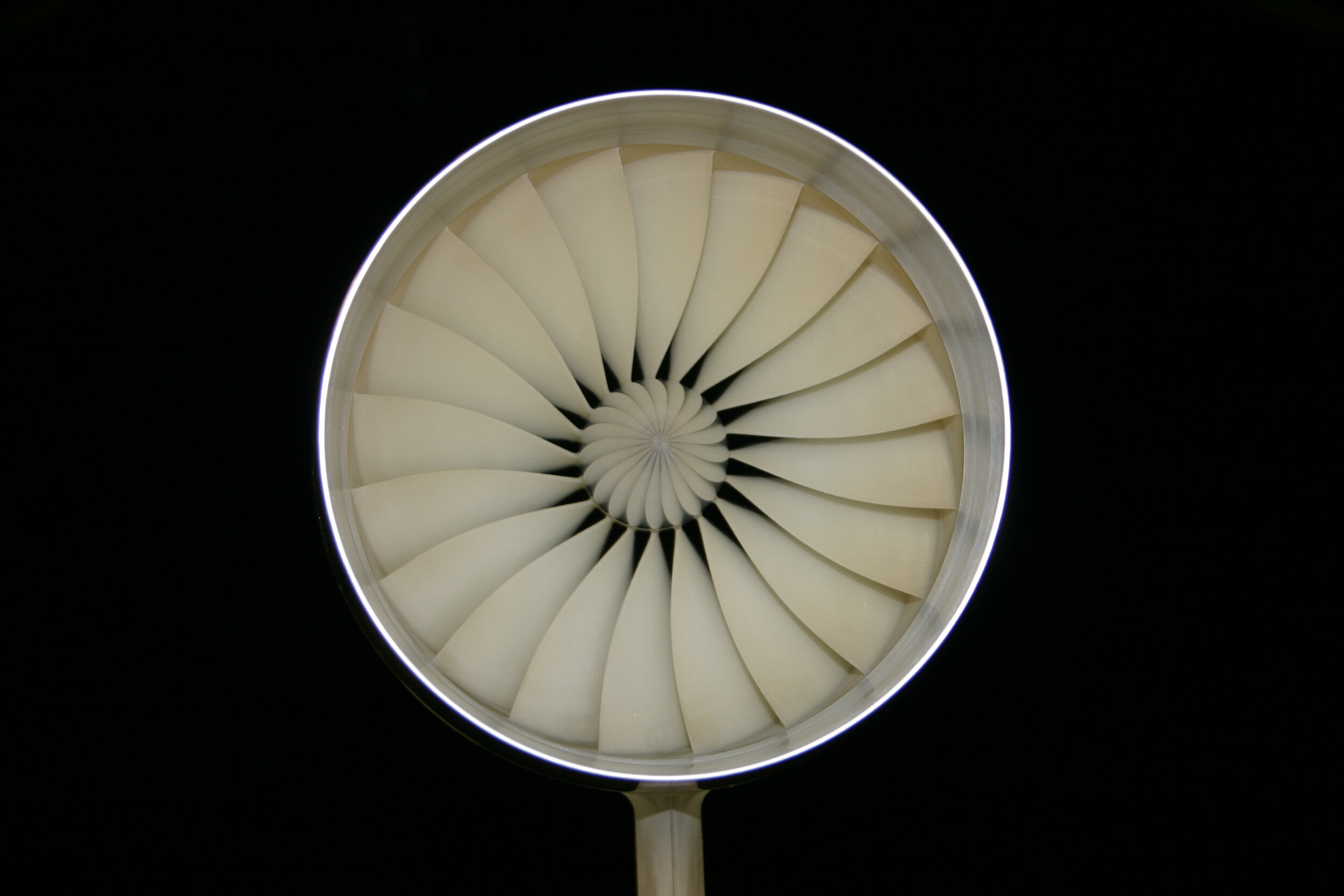
Current Research at the Gas Turbine Laboratory
Design and Assessment of a Low-Noise Hybrid Wing Body Aircraft
Leo Ng
Advisor: Prof. Spakovszky
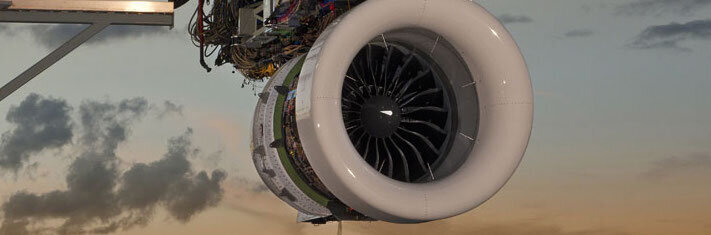
Reducing the environmental impact of air travel is a major focus in aeronautical research today. The hybrid wing body aircraft, in which the fuselage and the wings are blended together, has the potential to be more fuel efficient, produces fewer emissions, and generates less noise. This project aims to develop a set of advanced predictive methods that will enable the design of a hybrid wing body aircraft to meet NASA’s N+2 objectives: (i) 25% less fuel burn, (ii) 80% less emissions, and (iii) 52 dB less noise compared to current aircrafts in service.
This research is performed in collaboration with industry and builds upon the work done on the SAX-40 prototype from the Silent Aircraft Initiative. The existing tools for analyzing aircraft performance and predicting airframe noise will be further refined. The goal is to design and optimize a hybrid wing body aircraft that will meet industry requirements. A wind tunnel experiment is planned for the final phase of this project to validate the design and predictive methodologies used throughout the development process.
![]()
Effects of Impeller-Diffuser Interaction on Aerodynamic Performance
of Centrifugal Compressors
David Tarr
Advisors: Dr. Tan, Prof. Greitzer
![]() |
CC3 compressor; photo courtesy of NASA Glenn Research Center |
This work is aimed at a key problem of modern centrifugal compressor stages: the impact of unsteady interaction between the rotating impeller blades and stationary diffuser vanes on performance and aeromechanics. Three important technical issues are of engineering interest:
- The effect of these unsteady interactions on the time-averaged performance of a modern centrifugal compressor stage;
- Initiation and development of aerodynamic instabilities in a centrifugal compressor; and
- Use of (1) to propose design guidelines and potential innovative designs for achieving incremental improvements in performance.
The current focus is on technical issues (1) and (3), however future project phases will use the initial results to infer their potential impact on issue (2). In addition to addressing the technical aerodynamic issues, assessment and validation of new analytical approaches and computational tools for use in centrifugal compressor stage design and analysis will be carried out during the course of the research program.
This research currently uses MSU TURBO, developed by Mississippi State University
http://www.simcenter.msstate.edu/simcenter/docs/msu_turbo/
Carbon Nanotube Bearing
Eugene Cook, Draper & MIT
Project lead at Draper: David J Carter (PI),
Marc Weinberg,
Peter Miraglia
Advisor: Zoltan Spakovszky
![]() |
Carbon nanotube rotor [not to scale] |
Rotating Micro Electro-Mechanical Systems (MEMS) require rotary bearings, but current MEMS bearing technologies have drawbacks. Silicon rubbing on silicon wears out quickly. Gas bearings require a gas source, and are relatively low stiffness. A promising alternative, proposed and being pursued by the Charles Stark Draper Laboratory in collaboration with the GTL, is to use Carbon Nanotubes (CNTs). Multi-walled CNTs have a concentric-tube structure that lends itself to bearings. Each tube is strong, but there is little or no bonding between tubes, allowing them to slide relative to each other. However, the friction characteristics of these bearings are not precisely quantified. This project’s goal is to construct a simple CNT bearing rotary device, demonstrating MEMS and CNT compatible fabrication techniques, and allowing some data on the friction characteristics to be gathered. Applications of such a bearing technology could include microscale turbomachinery, as well as gyroscopes, pumps, and other rotating devices.
![]()
Assessment of Inlet Distortion Noise in Highly Integrated Propulsion Systems
Jeff Defoe, Alex Narkaj
Advisor: Prof. Spakovszky
Among the Silent Aircraft Initiative SAX40’s many unique characteristics are engines which are highly integrated into the airframe. S-shaped inlet ducts deliver air to the engines, but these ducts ingest the boundary layer over the wing and thus the flow through the duct is highly non-uniform. Predicting noise propagation through non-uniform flow fields is a complex task, as most classical acoustics formulations deal with uniform flow fields.
This research project deals with the numerical simulation of the noise source caused by the engine fan in the duct and with its propagation upstream through the duct and to far-field receivers. The acoustic waves involved are nonlinear and the propagation is through a highly non-uniform flow field.
Predictions of noise propagation for these types of conditions are challenging, but a new approach is being attempted to simplify the effort. The intended approach uses different numerical tools for various aspects of the simulation, in order to reduce the computational cost to a reasonable level without sacrificing accuracy. A 3-D steady RANS calculation will be performed to obtain the flow distortion characteristics at the fan inlet. A body force representation of the fan stage will then be used to obtain the initial conditions for a three-dimensional, unsteady calculation of the fan stage, which will set the unsteady flow and acoustic boundary conditions for an unsteady Euler calculation of the S-duct and surrounding air, providing propagation of the noise to the far field. The intention is to examine the noise propagation characteristics of several duct designs with the ultimate goal of developing a semi-empirical model for the noise propagation characteristics of S-shaped ducts as a function of major flow and geometric parameters.
![]()
Single Crystal Silicon as a Macro-World Structural Material: Design of Compact,
Lightweight High Pressure Vessels
Tanya Cruz Garza
Advisor, Prof. Epstein
This research explores the use of micromachined single crystal silicon as a macro-world structural material, understanding its advantages and limitations. Single crystal silicon is a material with theoretical strengths higher than steel and with a lower density than aluminum. This high strength, light weight nature of silicon make it an ideal structural material. Silicon has shown favorable performance as a structural material in micro-scale applications but the brittle nature of this material makes it difficult to reliably achieve high usable strengths on a macro-scale. This research explores how microfabrication techniques affect silicon strength and how high strength macro-scale silicon structures can be made.
This research has an engineering objective which is to find better ways of building compact, lightweight high pressure vessels for demanding applications such as spacecraft. The advantages of a silicon based pressure vessel is the potential to integrate the vessel regulator and control circuit on chip, the large inherent strength of silicon, the low density and thus lightweight characteristic of silicon and the ability to machine silicon into unique, compact geometries. This work is part of a joint effort of MIT and Ventions, LLC, to design a silicon-based microlaunch vehicle system for small satellite applications. This launch system will be complete with chamber and nozzle, valve, regulator, power supply and tanks. The motivation of this endeavor is to expand the definition of low cost access to space with a cost per mission versus cost per payload pound.
![]()
Assessment of Propfan Propulsion Systems for Reduced Environmental Impact
Andreas Peters
Advisor: Prof. Spakovszky
![]() |
Open counter-rotating propfan engine [from Flug Revue, July 2007] |
Current aircraft engine design studies tend towards higher bypass ratio, low-speed fan configurations in order to attain reductions in fuel consumption, emissions and noise. Propfan (advanced turboprop) engine concepts investigated in the past by American, European and Russian aircraft manufacturers have demonstrated significant benefits in these areas. However, considerable concern remains about the potential noise generated by propfan engines, including both inflight cabin noise and community noise during takeoff and approach. In addition, performance limitations at high flight Mach number as well as engine configuration and airframe integration present challenges to be addressed in the course of assessing a propfan-powered next generation commercial aircraft.
Taking into account the stringent noise certification requirements, the level of potential propfan overall noise reduction using advanced technologies in conjunction with a design strategy for both low noise and reduced fuel burn / emissions is investigated within the scope of this research effort. The goal of the project is to define the optimum propfan engine configuration and airframe integration concept with respect to improved performance and reduced noise and fuel burn.
![]()
A Methodology for Centrifugal Compressor Stability Prediction
Björn Benneke, Isabelle Delefortrie
Advisor: Prof. Spakovszky
Although centrifugal compressors exhibit the same type of instabilities as axial compressors, rotating stall and surge are characterized by a much broader spectrum of unstable behavior. The wide variety of instability behavior, among with the inherently complicated flow in such a machine, are primary reasons that rotating stall and surge in centrifugal compressors are less well understood than similar phenomena in axial compressors. As a consequence, a general theory or a criterion for the onset of instability in centrifugal compressors does not exist.
Instead, correlations are used to describe the surge point for a certain class of centrifugal compressors and to estimate the stability limit based on a priori knowledge of blade row characteristics. The major limitation of these methods is that these characteristics are only available after experimental measurements and thus the method is not of predictive nature. This research project is different from past efforts in that the prediction is purely based on centrifugal compressor geometry and does not rely on correlations or a priori knowledge of compressor characteristics.
The approach borrows ideas from previous work on axial compressors and consists of 3-D steady RANS calculations to determine the body force distributions representing the effects of discrete blades on the flow field. The body forces are then coupled to a 3-D unsteady Euler solver. The compressor model is then forced with either a short wavelength (spike-shaped) radial body force impulse in the vaneless space or a long wavelength modal wave-like body force impulse at the same location. If the disturbance grows in time, the machine is deemed dynamically unstable, and the operating point is determined to be the surge point. The goal is to demonstrate that the method can accurately predict both the stall point and the type of stall inception pattern (spike or modal waves) in centrifugal compressors.
![]() ![]() |
Experimental evidence of spike and modal stall inception in a high pressure ratio centrifugal compressor of advanced design - diffuser static pressure rise characteristic with and without air bleed) |
![]()
Blade Row Interactions in High-Speed Axial Compressors
Sean Nolan
Advisor: Dr. Tan
The purpose of this project is to understand and quantitatively assess the role of blade row interactions in the performance of highly-loaded, high Mach number (HLHM) axial compressors. These interactions include that of the rotor shock on the upstream blade row, as well as the influence of blade wakes on downstream blade rows. Using this knowledge, guidelines for the design of efficient HLHM compressors can be recommended, ultimately resulting in smaller, lighter, and less complex compressor cores.
![]()
Small-scale Gas Turbine Engines
Shinji Tanaka, Daanish Maqbool
Advisor: Prof. Zoltan Spakovszky
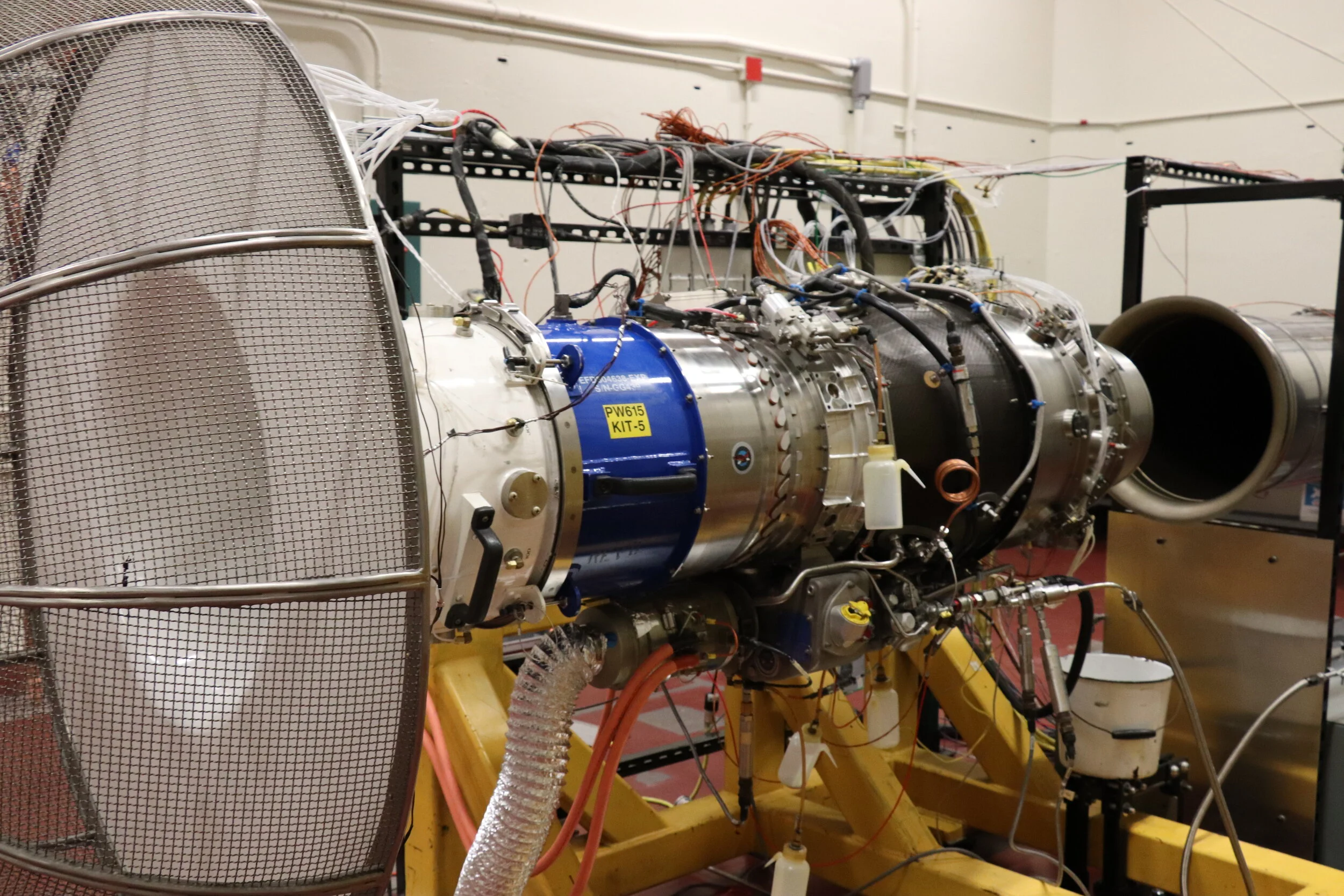
Small scale gas turbine engines can provide much higher power densities than conventional batteries, and show promise as a portable and enduring power source. Such a small-scale turboshaft engine is being developed for this purpose, but some challenges remain before it can be considered practical for ground-based, portable use. The first challenge is noise, which must be kept within comfortable limits. An understanding and assessment of the noise sources is essential for devising noise reduction strategies. However, the dominant phenomena might be different from those in aircraft engines because of the unique operating condition, which makes the problem more challenging. Secondly, the engine generates heat which must be effectively removed in order to keep the surface temperatures within safe limits. Therefore, another goal is to devise an efficient cooling scheme, which will allow safe hand-held operation.
![]()
The "Swirl Tube" - an Aircraft Drag Management Device
to Reduce Noise and Fuel Burn
Darius Mobed, Parthiv Shah
Advisor: Prof. Zoltan Spakovszky
Aircraft on approach in high-drag and high-lift configuration create unsteady flow structures which inherently generate noise. For devices such as flaps, spoilers and the undercarriage there is a strong correlation between overall noise and drag such that, in the quest for quieter aircraft, one challenge is to generate drag at low noise levels.
The invention is a novel aircraft drag management concept to reduce aircraft noise during approach and to improve fuel burn in cruise. The idea is based on a swirling exhaust flow emanating, for example, from a jet engine nacelle (see figure) or a wing-tip mounted duct. A novel application is to exploit the low pressure in the vortex core of the swirling exhaust flow to generate drag. The idea is that in a steady streamwise vortex the centripetal acceleration of fluid particles is balanced by a radial pressure gradient. The very low pressure near the vortex core at the exit of the duct generates pressure drag. This streamwise vortex is in essence steady, yielding low noise levels and a quiet acoustic signature. To see a Quicktime movie of the swirl tube in action, click here (this is a large file so please be patient while it loads).
![]()
A Fully-Integrated Permanent Magnet Turbine Generator
Bernard Yen
Advisors: Prof. Jeff Lang, Prof. Zoltan Spakovszky
There is a need for compact, high-performance power sources that can outperform the energy density of modern batteries for use in portable electronics, autonomous sensors, robotics, and other applications. The current research aims to produce a fully-integrated, synchronous permanent magnet microturbogenerator capable of generating 10W DC output power using compressed air as its energy source. Presently, all the silicon die fabrication is complete, and the magnetic components are being integrated onto the die in preparation for power generation testing.
While the magnetic integration is in progress, efforts are underway to separately test and qualify the gas-lubricated bearings that will support the magnetic rotor to very high speeds. To make the tests relevant, they are conducted on silicon dies similar to the final generator dies, with the only differences being the lack of surface windings and a laminated magnetic stator. Figure 1 shows a bearing rig die enclosed in an acrylic package, as well as the metal tubulations and O-rings used to bring nitrogen into the die. The circular hole on the top of the package, together with additional holes on the backside, serves as an air vent.
Three sets of bearing rig tests are currently planned. All of them involve the same bearing rig die shown in Figure 1, but different rotors – light silicon rotor, heavy silicon rotor, and magnetic rotor – will be spun. A light rotor made purely of silicon and shown in Figure 2 will be used to assess the nominal imbalance, defined as the distance between the geometric and mass center of the rotor, introduced by the fabrication process. This rotor has approximately half the mass of the magnetic rotor, so a solder-filled rotor twice as heavy will be tested next to determine whether the bearings perform well with a massive rotor. After these two sets of experiments are complete, the magnetic rotor, which has permanent magnets and a soft magnetic back iron embedded, will be characterized. Because the silicon die can be easily opened along its eutectic interface, it is anticipated that the magnetic rotor can be removed from the die after testing and reused for the generator die.