Macroscopic Modeling of Anisotropic Crystallization
| Personnel: | M. Hütter, R.C. Armstrong, G.C. Rutledge |
| Sponsorship: | This work is supported by the ERC Program of the National Science Foundation under NSF Award Number EEC-9731680 (CAEFF) |
Flow-induced crystallization of polymers produces different crystal shapes depending on flow type and flow strength. However, modeling and simulation of complex processing conditions usually resolves length scales only much larger than the crystal size, and hence the crystal and melt phases are not distinguised locally. In order to still account for not only the degree of crystallinity but also for crystal shape, we develop a continuum-level crystallization model using four structural variables. The latter characterize the crystal volume, surface, characteristic length scale, and the number density.
One finds that distinction is possible between the growths of, for example, row-structures (1-dim. growth), lamellae (2-dim. growth), and spherulites (3-dim. growth). Transient processing conditions can be implemented in a straightforward manner, including a change in growth dimensionality, which is a prerequisite for a successful modeling of shish-kebab growth. Experimental and simulation knowledge of the shape and growth mechanisms and rates can be built into the model in a compact form. The description of crystal shape is detailed enough to, e.g., account for the different surface properties of growth and fold surfaces of lamellae (see also corresponding projects in the group of G.C. Rutledge). Under certain conditions, the dynamic crystallization model allows one to extract the relation between processing conditions and crystal shape from experimental data, even in transient processing situations.
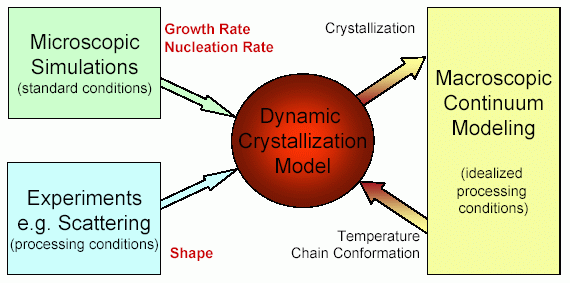
|
Figure: By way of a versatile crystallization model, microscopic simulation results and experimental data can be incorporated in macroscopic continuum modeling of complex processes. |