Ed Boyden , Ph.D.
Benesse Career Development Professor of the Media Lab,
and the Department of Biological Engineering

Email: esb@media.mit.edu
Office: E15-430
Phone: (617) 324-3085
Fax: (617) 253-7035

Administrative Assistant: Laureen Chapman
Phone: (617) 253-0632

Research group web site: http://neuro.media.mit.edu/

Research Focus

  • Our brains and nervous systems mediate everything we perceive, feel, decide, and do -- and act as our ultimate interface to the world. An outstanding challenge for humanity is to understand the brain at a
    level of abstraction that enables us to engineer its function -- repairing pathology, augmenting cognition, and revealing insights into the human condition. We are inventing and applying tools to the analysis and engineering of brain circuits in both humans and in model systems, with a current focus on devising technologies for interfacing to specific circuit targets, and controlling the processing within. Our research will hopefully allow a better understanding of the nature of human existence, and the ability to engineer improvements thereupon.

Projects

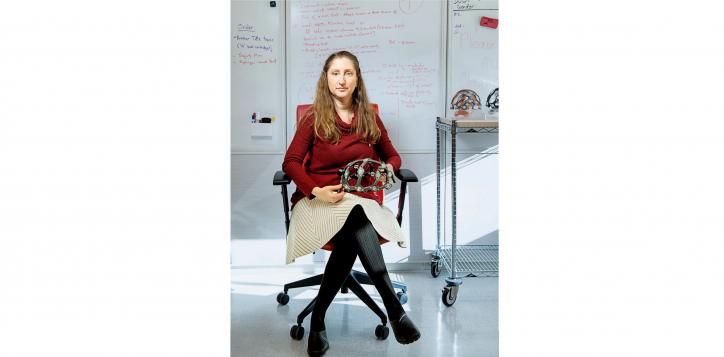
  • A Wearable, Non-Invasive Brain Stimulator
    Despite promise in treating depression, headache, stroke, tinnitus, and other disorders, brain stimulation technology is bulky, power-hungry, and requires precision alignment with neural structures. We are applying modern engineering techniques to create a wearable brain stimulator that is safe and efficacious.
  • Multiple-Color, Optical Activation and Silencing of Neurons
    We have engineered molecular sensitizers that make genetically specified neurons that can be activated by pulses of blue light, and silenced by pulses of yellow light. This revolutionary technology enables us to reprogram neural networks at the millisecond timescale, opening up the systematic analysis and engineering of the brain, as well as completely novel methods of therapy. We are applying molecular engineering, viral engineering, and optical engineering to make this dream a reality.
  • Neural Models of Mind
    This project addresses human cognitive models in terms of neuroscience and artificial intelligence. Detailed cognitive models are directed toward both the consumer HCI and medical psychological markets, and has applications for neural-interface computer gaming peripherals, aging population cognitive evaluation and training, as well as breakthrough neuroscience and artificial intelligence research.
  • Optical Brain Stimulation Interfaces
    Neural stimulation hardware has traditionally been either electrical or magnetic in nature. Our lab has recently developed molecular methods for making neurons able to be activated or silenced by blue and yellow light respectively. We are engineering optical systems for targetedly stimulating neurons precisely, even in dense tissue in the living brain. Our goal is to find ways to cure persistent psychiatric.

Selected Publications

  1. Boyden, E. S., et al. (2005) Millisecond-timescale, genetically-targeted optical control of neural activity, Nature Neuroscience 8(9):1263-1268.

  2. Han X. and Boyden E. S. (2007) Multiple-Color Optical Activation, Silencing, and Desynchronization of Neural Activity, with Single-Spike Temporal Resolution, PLoS ONE 2(3):e299 doi:10.1371/journal.pone.0000299.

  3. Wang, H., et al. (2007) High-speed mapping of synaptic connectivity using photostimulation in channelrhodopsin-2 transgenic mice, Proceedings of the National Academy of Sciences 104(19):8143-848.

top

Copyright 2003 MIT Biological Engineering. All Rights Reserved.
Site designed by Academic Web Pages.