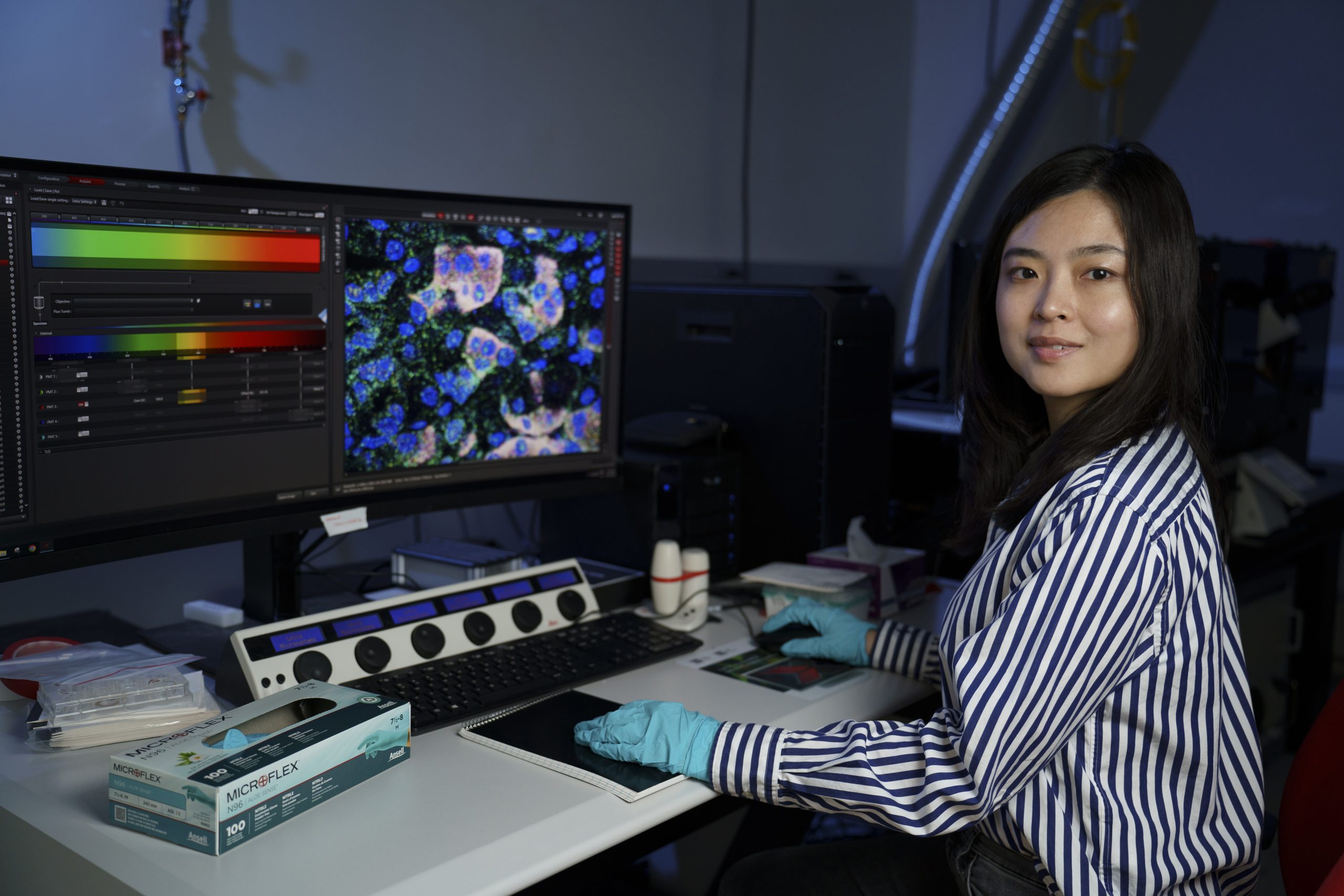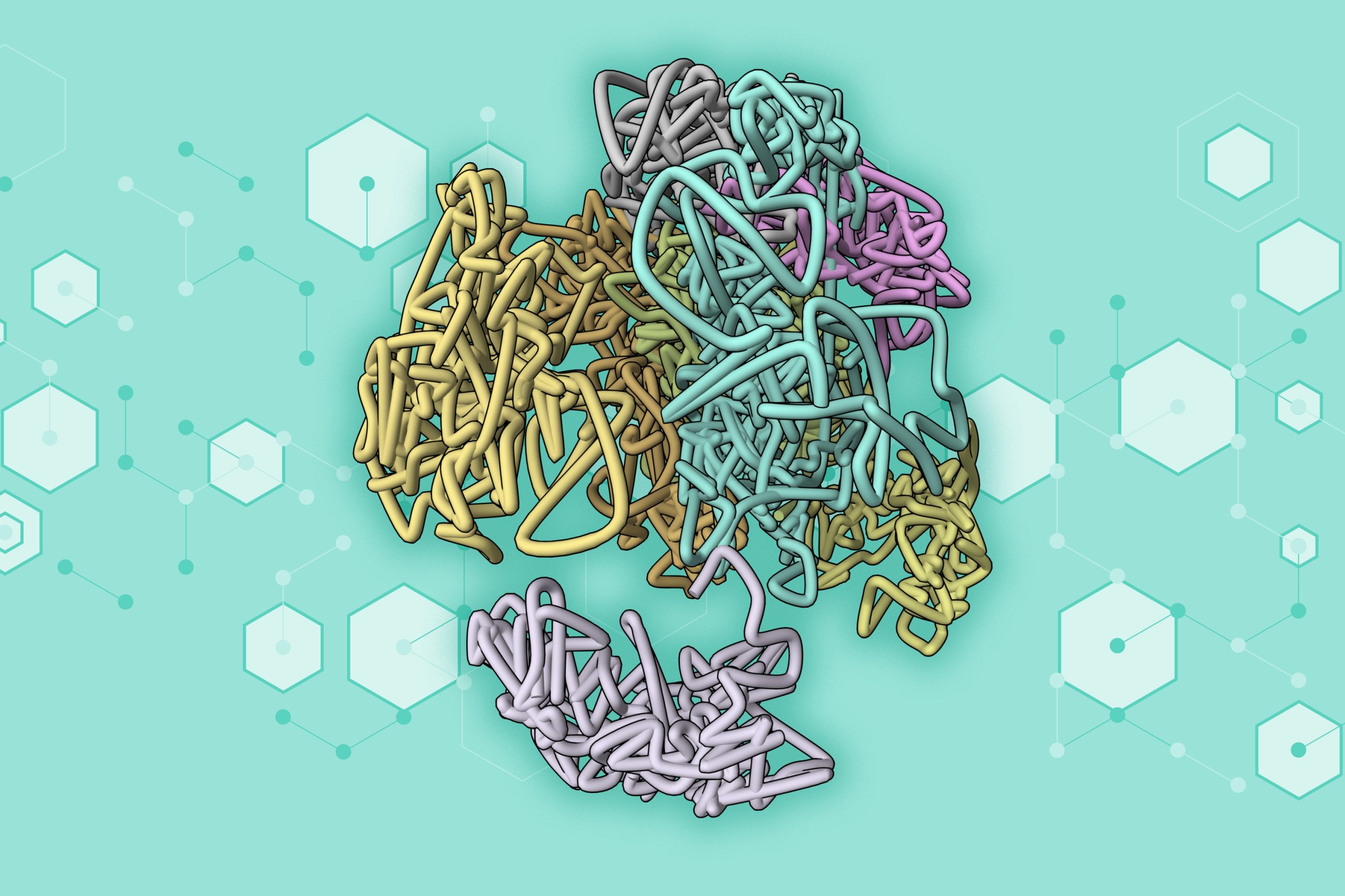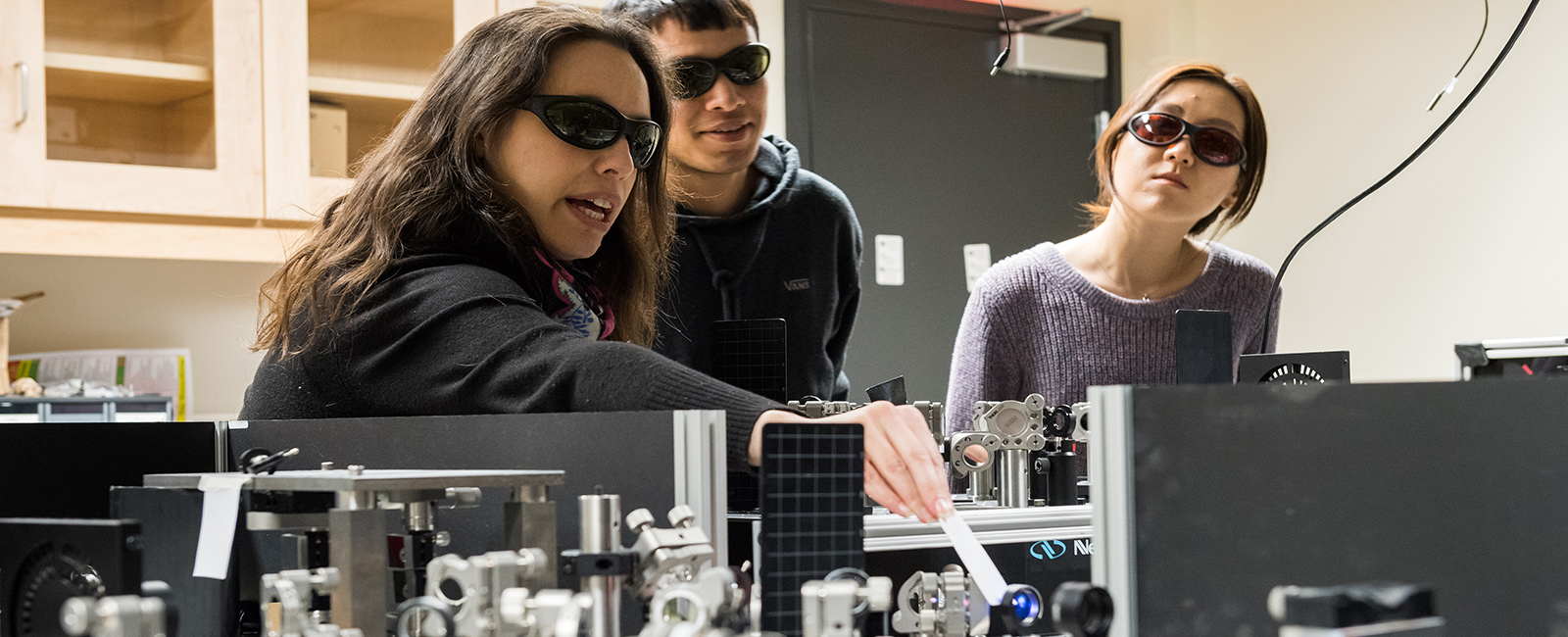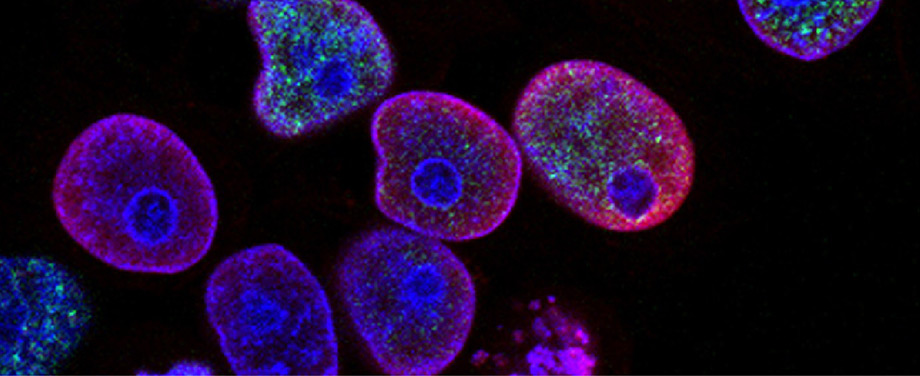
Each URIECA module is based on or linked to the current research of a faculty member in our department. URIECA teaches core chemistry concepts within the modern contexts of:
Catalysis
Synthesis
Nanoscience
Materials engineering
Biological imaging
Spectroscopy
In addition, many modules emphasize inquiry into the mechanical and electrical inner workings of the spectroscopic instrumentation used in the experiments, thereby presenting elementary engineering principles to the students.
For the purpose of satisfying the definition of a subject in the faculty regulations, the 12 URIECA modules (Labeled Module 1 through 12) have been divided into four URIECA subjects (5.35, 5.36, 5.37, 5.38). Each 12 unit subject contains three, four-unit modules. Because the grouping of the modules does not fall neatly into the 12 unit definition of a subject, many modules do not need to be taken and cannot be taken according to their numerical sequence of 1 - 12. In addition, many modules within a subject are not offered in the same semester. (See sample Roadmaps below.)
Students who do not plan to complete all three modules in a subject should register for the "u" equivalent subject (5.35u, 5.36u, 5.37u).
Students who will typically opt for a "u" subject are:
freshmen who are exploring chemistry and wish to take only one or two modules in 5.35
premed students who wish to take only the organic and biochemistry modules within 5.36 and 5.37.
5.35 or 5.35u - INTRODUCTION TO EXPERIMENTAL CHEMISTRY (Institute Lab)
Module 1 Fundamentals of Spectroscopy
Offered Fall and Spring
Prereq: 5.111, 5.112 or 3.091
4 units
Basis of the research of Professor Keith Nelson
Module 2 Synthesis of Coordination Compounds and Kinetics
Offered Fall and Spring
Prereq: 5.111, 5.112 or 3.091; Module 1
4 units
Similar to the research of Professor Richard Schrock
Module 3 Fabrication of a Polymeric Light Emitting Device
Offered Fall and Spring
Prereq: 5.111, 5.112 or 3.091; 5.12; Module 2
4 units
Based on the research of Professor Tim Swager
5.36 or 5.36u - BIOCHEMISTRY AND ORGANIC LABORATORY (CI-M)
Module 4 Expression and Purification of Enzyme Mutants
Must be taken simultaneously with Module 5
Offered in Spring
Prereq: 5.07 or 7.05; Module 2 or 5.310; Module 5
4 units
Based on the research of Professor Alice Ting
Module 5 Kinetics of Enzyme Inhibition
Must be taken simultaneously with Module 4
Offered in Spring
Prereq: 5.07 or 7.05; Module 2 or 5.310; Module 4
4 units
Similar to the research of Professor Joanne Stubbe
Module 6 Organic Structure Determination
Offered in Fall
Prereq: 5.12; Module 2 or 5.310; 5.13
4 units
Based on the research of Professors Steve Buchwald and Greg Fu
Developed by Professor Rick Danheiser
5.37 or 5.37u - ORGANIC AND INORGANIC LABORATORY
Module 7 Introduction to Organic Synthesis
Offered in Spring
Prereq: 5.13; Module 6
4 units
Based on the research of Professor Rick Danheiser
Module 8 Two Electron Bond
Offered in Fall, beginning in 2008
Prereq: 5.03; Module 6; 5.61
4 units
Based on the research of Professor Dan Nocera
Module 9 Dinitrogen Cleavage
Offered in Fall, beginning in 2008
Prereq: 5.03; Module 6; 5.61
4 units
Based on the research of Professor Kit Cummins
5.38 - PHYSICAL CHEMISTRY LABORATORY (CI-M)
Module 10 Quantum Dots
Offered in Spring
Prereq: 5.61; Module 6
4 units
Based on the research of Professor Moungi Bawendi
Module 11 Time Resolved Molecular Spectroscopy
Offered in Spring
Prereq: 5.61; 5.07 or 7.05; Module 5
4 units
Based on the research of Professor Andrei Tokmakoff
Each module of a URIECA subject is worth 4 units of credit, and students pre-register for URIECA modules in a two-step process. In addition to the usual pre-registration process through WebSIS, students must also sign up for specific modules through the Course 5 website. Failure to sign up for the modules could result in being denied access to them.
To sign up for specific modules, students may access the appropriate online form through either the online subject listing for each class or by following the appropriate link(s) below:
Important note regarding Registration Day: Because these courses are set up as variable-unit subjects, students must verify the number of units that they are taking for each URIECA subject on their Registration Forms. Students registering for any non-U subject (5.35., 5.36, 5.37, 5.38) may register for 4, 8, or 12 units of credit per term, up to a maximum of 12 units per subject. Students registering for any U subject (5.35U, 5.36U, 5.37U) may register for 4 or 8 units of credit per term, up to a maximum of 12 units per subject.
The URIECA subjects are J-graded. A J-graded subject is one where the final subject grade is not recorded until 12 units, or three modules, are completed. Students will receive a grade of J in each semester that they complete less than three modules in the subject. Once three modules are complete, each J grade on the transcript will appear as J-X, where X is the grade for the subject.
Note that although 5.36 and 5.37 each carry three modules totaling 12 units, the modules are not offered in the same semester. Students will not be able to register for 12 units of these subjects in any one semester.
The first subject for upperclassmen non-chemistry majors is 5.310 Laboratory Chemistry. Students who desire to take more laboratory chemistry modules in the URIECA curriculum but who do not want to complete all modules in a given subject should register for the “u” equivalent of the subject (5.36u, 5.37u).
Chemistry Minors
The required laboratory subject for minors in chemistry remains 5.310. Either 5.36 , 5.37 or a total of 12 units of credit from the modules in 5.36u or 5.37u satisfies one elective subject of a chemistry minor.
For a course 10 degree, students interested in taking a Chemistry CI-M subject should take 5.36.
For a course 10C degree, students interested in taking a Chemistry CI-M subject should take 5.36.
Students who don’t want CI-M credit but wish to take a subset of 5.36 modules should register for 5.36u.
Biology – Course 7
For a course 7A degree, students interested in taking two Chemistry CI-M subjects should take 5.36 and 5.38 starting with the class of 2010.
Students who don’t want CI-M credit but wish to take a subset of 5.36 modules should register for 5.36u.
Materials Science and Engineering – Course 3
For a course 3A degree, students interested in taking two Chemistry CI-M subjects should take 5.36 and 5.38 starting with the class of 2010.
Students who don’t want CI-M credit but wish to take a subset of 5.36 modules should register for 5.36u.
FRESHMEN
First-year students, with 5.111, 5.112 or 3.091 as a prerequisite, may register for some of the 5.35u modules allowing them to explore the chemistry curriculum and to acquire hands-on laboratory experience. First-year students, with 5.111, 5.112 or 3.091 as a prerequisite and 5.12 as a corequisite may register for 12 units of 5.35.
What do I do if I have completed one or two of the modules in 5.35, 5.36 or 5.37 as a chemistry major but then decide to change majors?
Submit a petition to the Committee on Curricula requesting that the subject number be changed to the “u” equivalent and that a letter grade be assigned for the completed work (either for 4 units or 8 units depending on the number of modules completed). This petition should be approved by the URIECA director, with a copy to the Chemistry Education office.
What do I do if I have completed one or two of the modules as a non-chemistry major and then decide to become a chemistry major?
Complete the subject with the “u” designation. You will receive credit for completing the entire subject when you complete the final module.
How do I register for the individual modules?
Each module of a URIECA subject is worth 4 units of credit, and students pre-register for URIECA modules in a two-step process. In addition to the usual pre-registration process through WebSIS, students must also sign up for specific modules through the Course 5 website. Failure to sign up for the modules could result in being denied access to them.
To sign up for specific modules, students may access the appropriate online form through either the online subject listing for each class or by following the appropriate link(s) below:
Important note regarding Registration Day: Because these courses are set up as variable-unit subjects, students must verify the number of units that they are taking for each URIECA subject on their Registration Forms. Students registering for any non-U subject (5.35., 5.36, 5.37, 5.38) may register for 4, 8, or 12 units of credit per term, up to a maximum of 12 units per subject. Students registering for any U subject (5.35U, 5.36U, 5.37U) may register for 4 or 8 units of credit per term, up to a maximum of 12 units per subject.
How are grades assigned for 5.35, 5.36, 5.37 and 5.38?
The URIECA subjects are J-graded. A J-graded subject is one where the final subject grade is not recorded until 12 units, or three modules, are completed. Students will receive a grade of J in each semester that they complete less than three modules in the subject. Once three modules are complete, each J grade on the transcript will appear as J-X, where X is the grade for the subject.
Note that although 5.36 and 5.37 each carry three modules totaling 12 units, the modules are not offered in the same semester. Students will not be able to register for 12 units of these subjects in any one semester.
How are grades assigned for 5.35u, 5.36u and 5.37u?
Students are assigned a grade at the end of each semester for 4 or 8 units depending on the number of modules registered for and completed. Subjects with “u” designation may be repeated for up to 12 units.
Module 1 Fundamentals of Spectroscopy
This experimental module provides an introduction to the fundamental principles of the most common types of spectroscopy, including UV-visible absorption and fluorescence, infrared, and nuclear magnetic resonance. Emphasis is on the principles of how light interacts with matter, a fundamental and hands-on understanding of how spectrometers work, and what can be learned through spectroscopy about prototype molecules and materials. Spectra of small organic molecules, native and denatured proteins, semiconductor quantum dots, and laser crystals are recorded and analyzed.
Basis of the research of Professor Keith Nelson.
Module 2 Synthesis of Coordination Compounds and Kinetics
This experiment is an introduction to the synthesis of simple coordination compounds and chemical kinetics. Cobalt coordination chemistry and its transformations are illustrated in the preparation of [Co(NH3)4(CO3)]NO3 and [Co(NH3)5Cl]Cl2, followed by the aquation of [Co(NH3)5Cl]2+ to yield [Co(NH3)5(H2O)]3+, as detected by visible spectroscopy. Isosbestic points are observed in visible spectra, the rate and rate law is determined, the rate constant is measured at several temperatures, and the activation energy is derived for the aquation reaction.
Similar to the research of Professor Richard Schrock.
Module 3 Fabrication of a Polymeric Light Emitting Device
This experiment involves the polymerization of a monomer to produce a high molecular weight conjugated polymer of the poly(phenylene vinylene) family. This material is fully characterized and then used to fabricate a light emitting device by spin coating and metal evaporation methods in an inert glovebox environment. The optical absorption and photoemission of the polymer device is determined and compared to the electrically induced emission. Students will learn about the theory of electroluminescent and photovoltaic devices including relative energy levels of organic materials and the nature charge carriers in organic polymers.
Based on the research of Professor Tim Swager.
Module 4 Expression and Purification of Enzyme Mutants
In this experiment, students will use biochemical techniques for protein expression and DNA manipulation of Bcr-Abl kinase, which is inhibited by the blockbuster drug Gleevec in the treatment of chronic myelogenous leukemia. The kinase domain of the recombinant Abl enzyme will be expressed in E. coli and then purified and analyzed using nickel affinity chromatography, polyacrylamide gel electrophoresis, UV-Vis spectroscopy, and BSA assays. In addition, the DNA of selected Abl mutants identified in Gleevec-resistant cancer patients will be constructed using site-directed mutagenesis, which will include DNA primer design and agarose-gel electrophoresis. Based on the research of Professor Alice Ting.
Module 5 Kinetics of Enzyme Inhibition
In this experiment, students will study the activity and structure of the domains developed in Module 4 to understand the role of mutations in the development of resistance to Gleevec. Both mutant and wild-type Abl kinase domains will be assayed for phosphorylation activity to determine enzyme kinetics and the inhibition efficacy of Gleevec. The kinase activity of Gleevec-resistant mutants will be further tested in the presence of other potential inhibitors. The use of structure-viewing programs will enable analysis of the mechanistic basis of Bcr-Abl inhibition and Gleevec-resistance.
Similar to the research of Professor Joanne Stubbe.
Module 6 Organic Structure Determination
The objective of this experiment is to introduce students to modern methods for the elucidation of the structure of organic compounds. Students will carry out transition metal-catalyzed coupling reactions based on chemistry developed in the Fu and Buchwald laboratories using reactants of unknown structure. Full spectroscopic characterization, by proton and carbon NMR, IR, and mass spectrometry of the reactants and the coupling products will be carried out in order to identify the structures of each compound. Other techniques taught are transfer and manipulation of organic and organometallic reagents and compounds, separation by extraction, and purification by column chromatography.
Developed by Professor Rick Danheiser
Module 7 Introduction to Organic Synthesis
Students carry out a short synthetic sequence including a catalytic asymmetric cycloaddition reaction. This experiment provides students with experience with a variety of advanced techniques for carrying out organic reactions including the use of air-sensitive reagents, distillation, recrystallization, and column chromatography. Analytical techniques include the use of chiral GC for determination of enantiomeric purity.
Similar to the research of Professor Rick Danheiser
Module 8 Two Electron Bond
Students prepare two molybdenum quadruple bond species and measure their absorption spectra. The d-orbital molecular orbital diagram is developed and the delta to delta star absorption is identified. Oxidation of one of the complexes shifts the delta to delta star absorption from the visible to the near IR. The shift is due to the strong two-electron (Coulomb and exchange integrals) contribution to the overall transition (as opposed to the conventional one-electron splitting). The basic theory behind the valence bond model will be developed, and employed to explain the large red shift.
Based on research by Professor Dan Nocera.
Module 9 Dinitrogen Cleavage
An introduction to the research area of small-molecule activation by transition-element complexes. A three-coordinate molybdenum(III) complex is synthesized and its NaH-catalyzed six-electron reductive cleavage of the dinitrogen molecule is investigated. The techniques covered in this module include glove-box methods for synthesis for exclusion of oxygen and water; filtration, reaction mixture concentration, and recrystallization under a dinitrogen atmosphere and under static vacuum. Characterization methods include proton NMR spectroscopy of both paramagnetic and diamagnetic systems, Evans’ method magnetic susceptibility measurement, UV-Vis spectroscopy, and infrared spectroscopy of a metal-nitrogen triple bond system.
Based on research by Professor Kit Cummins.
Module 10 Quantum Dots
Synthesis of a discrete size series of quantum dots, followed by synthesis of a single size of core-shell quantum dots utilizing air free Schlenk manipulations of precursors. Characterization by absorption spectroscopy and fluorescence will be used to rationalize the compositional/size dependence of the shell on the electronic structure of the quantum dot as well as the phenomena of "blinking". Fluorescence resonance energy transfer between quantum dot/dye conjugates. Based on research by Professor Moungi Bawendi.
Module 11 Time Resolved Molecular Spectroscopy
Time resolved molecular spectroscopy of intermolecular distances and rotation. Förster energy transfer theory (FRET) and fluorescence anisotropy measurements are used to investigate the monomer-dimer kinetics of insulin. Based on research by Professor Andrei Tokmakoff.
Module 12 Solid State NMR
Introduction to magic angle spinning NMR, a technique that enables the characterization of local bonding environments in amorphous and semi-crystalline solids.
Similar to research by Professor Bob Griffin.