The motivation for my research group is to develop molecular models
for understanding the structure and dynamics of condensed phase molecular
systems, to establish relationships between these models and experimental
observables,and to explore new ways to measure and manipulate molecular
dynamics.
1. Condensed Phase Quantum Processes
Currently, we are studying the kinetics of non-adiabatic processes with full
account of multiple time-scales and non-equilibrium distributions.
In the context of electron transfer, three different scenarios of time-scale
competition are addressed: (i) non-equilibrium reactant distributions resulting
from slow relaxation and fast activation, (ii) reactions in solvents with
multiple time-scale uctuations including stretched exponential relaxation,
(iii) the breakdown of the adiabatic approximation in proton-coupled electron
transfer systems and mixed-covalence systems because of the comparative time-scales
in electronic and nuclear motions. Preliminary progress along these lines
has been made with the development of the kinetic spectral method and the
reaction pathway method.
2. Spectroscopic Measurement and Quantum Control
of Molecular Systems
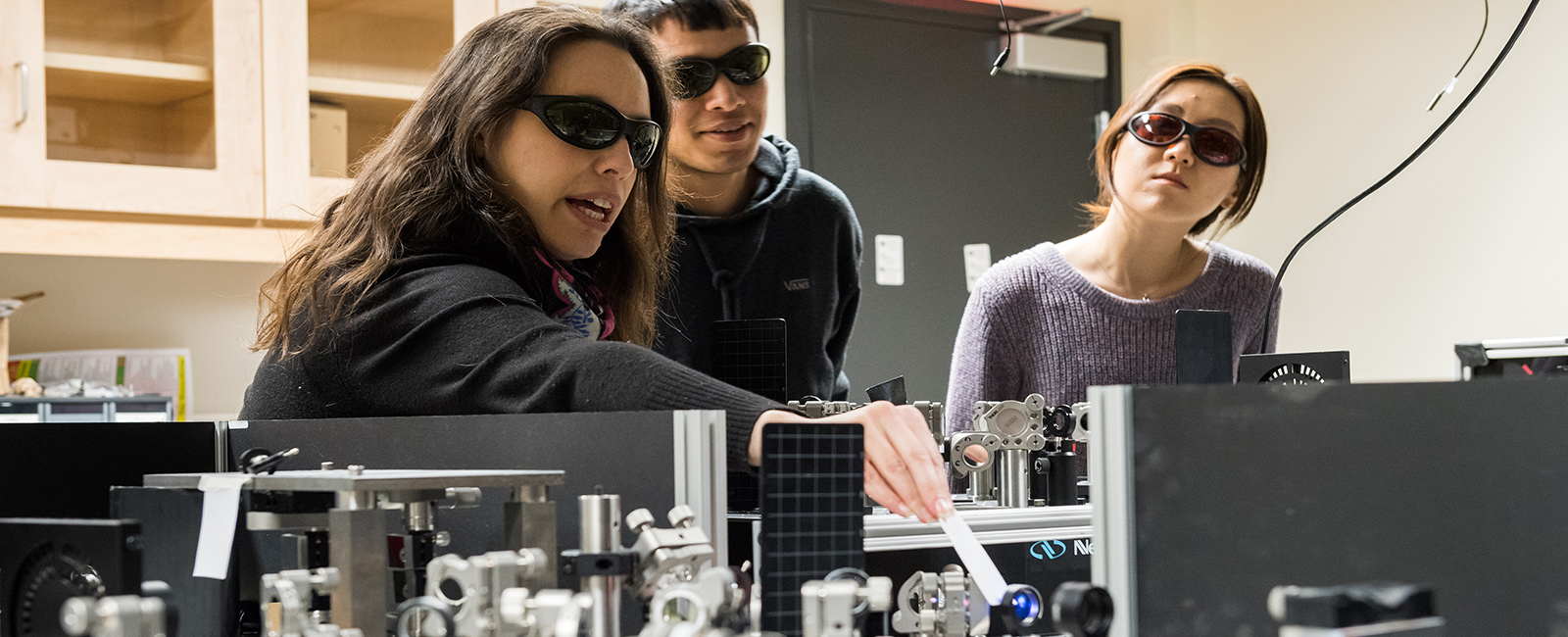
Excitation of molecular systems using laser pulses of short duration, relatively
high intensity, and modulated phase coherence reveals a range of dynamic responses
not present in the linear response regime. The goal of the study is to model
the evolution of molecular systems interacting with ultrafast laser fields,
to explore coherence in non-linear optical excitation as a new way to extract
details of molecular interactions, and to predict and test excitation schemes
for population transfer, selective bond breaking and formation, and wave-packet
control in molecular systems.
3. Structure and Dynamics of Molecular Liquids
The goal of this study is to develop statistical approaches and molecular models
for solvents and complex liquids, and to test these models with numerical
simulations and with optical spectroscopy, x-ray, and neutron scattering
measurements. Theoretical progress will be made to better understand the
interplay between intermolecular and intramolecular forces, quantitative
correlations between potential landscapes and relaxation behavior, and the
underlying relations between transient molecular structures and long-time
structural relaxation. With such insights, we are able to investigate molecular
mechanisms in(i) diffusion and other transport properties of molecular liquids,
(ii) dielectric responses of water and other hydrogen-bonding systems, (iii)
structural relaxation in proteins and glassy systems, and (iv) diffusion-controlled
enzyme reactivity.

Spectral analysis of electron transfer kinetics I.
J. Cao and Y. Jung, J. Chem. Phys. 112, 4716 (2000)
Event-averaged measurements of single molecule kinetics
J. Cao, Chem. Phys. Letts. 327, 38 (2000)
Single molecule tracking of heterogeneous diffusion
J. Cao, Phys. Rev. E, 63, 041101 (2001)
Non-linear spectroscopy in liquids I: Third-order response of Xe,
Non-linear spectroscopy in liquids II: Fifth-order response of Xe
J. Cao, J. Wu, and S. Yang J. Chem. Phys. 116, 3739 (2002)
Direct measurements of memory effects in single molecule kinetics
S. Yang and J. Cao, J. Chem. Phys. 117, 10996 (2002)
Brownian motion in dynamically disordered media
J. Wikoskie, S. Yang, and J. Cao, Phys. Rev. E 66, 051111 (2002)
Gaussian factorization and mode-coupling memory kernels
J. Wu and J. Cao (accepted to Phys. Rev. E)
|