Skip over navigation Accesskey=1
MIT Chemistry
HomeMain Menu
Directory Contact Us Search Site Map
  Faculty and Research


Robert W. Field

Sidebar Graphic


Robert W. Field

Robert W. Field
Haslam and Dewey Professor of Chemistry


Room 6-219
(617) 253-1489
Fax: (617) 253-7030
rwfield@mit.edu
Admin. Assistant: Peter Giunta
Tel: (617) 253-2457

Field Research Group

A.B. Amherst College 1965
A. M., Ph.D. Harvard University 1972
Sc.D. (hon.) Amherst College 1997


Research Summary

Polyatomic molecules are like balls-and springs, yet eigenstates are stationary. Where has the intricate and beautiful dance of atoms gone and how do we recover movies of intramolecular dynamics from complicated line-spectra that are recorded in the frequency-domain? Is Intramolecular Vibrational Redistribution (IVR) a code for "I really don't know what is going on" or is it an explainable, cause-and-effect mechanistic process: where does the initially localized energy flow, how fast, and why? A complete description is like a telephone directory, true but unmemorable. Mechanism is insight, even if it is neither as true nor complete as a telephone directory.

How does an electron exchange energy and angular momentum with vastly more massive nuclei? Frequency- and time-domain spectra of Rydberg states can reveal the fundamental mechanisms of electron—nuclear interactions, provided that we learn how to recognize and interpret the characteristic patterns of these simple interactions rather than the more traditional but opaque state-by-state multi-digit molecular constants. When the periods of classical mechanical motions of electrons and nuclei are equal, "resonance" occurs and energy flow is rapid. How is resonance encoded in a spectrum? Can we design experiments to be explicitly sensitive to resonance or to use resonance for rational external control of intramolecular dynamics?

In Freshman Chemistry we teach/learn about the periodic table, and simple ideas about atomic electronic structure provide elegantly simple explanations for diverse properties of matter. Oxidation states emerge as a descriptive concept capable of making sense of a wide range of chemical and spectroscopic properties of metal-containing molecules. Yet, for metal-containing diatomic and triatomic molecules, both spectroscopists and ab initio quantum chemists seem to have no use for oxidation states. The spectra of these molecules are extremely complicated and understanding them will require unconventional spectroscopic techniques and heretical electronic structure models.

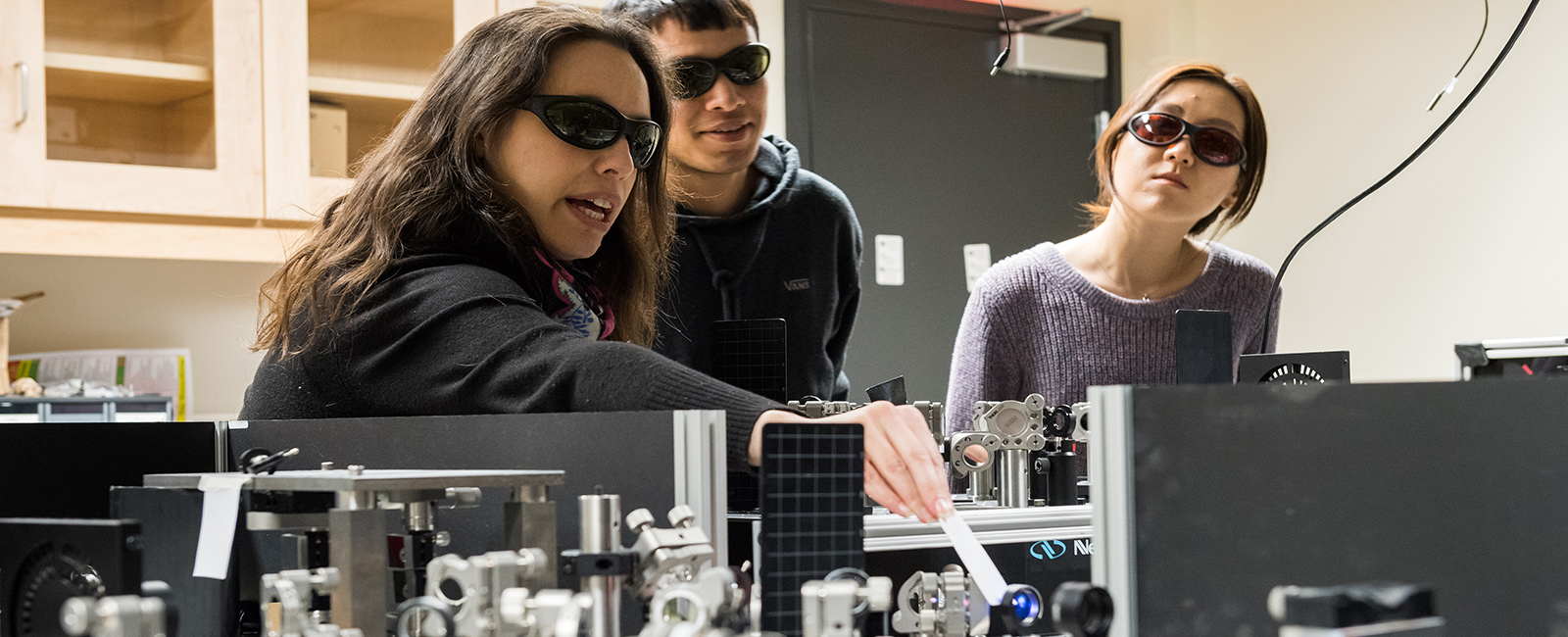
Tunable lasers, often two or three simultaneously, are used in Field's Current Research Group to investigate the structural and dynamical properties of small, gas phase molecules. Textbooks present a misleadingly simple picture of how spectroscopists extract information from spectra (which are never born with assignments attached). New, multiple-laser-based and chirped-pulse millimeter wave techniques are making it possible to decode prohibitively complex appearing spectra. Classical mechanics and pattern recognition are becoming important tools for extracting information from spectra.

Stimulated Emission Pumping (SEP) Pump-and-Dump spectroscopy, a technique invented at MIT, is providing unprecedented insights into the dynamics of small polyatomic molecules with chemically significant amounts of vibration-rotation excitation. Soon we will be able to uncover in a spectrum the same molecular gymnastics that an Organic Chemist envisions when she speaks of "1,2-hydrogen shifts." The quality, quantity, and simplicity of SEP spectra make it possible to exploit new pattern recognition schemes to extract short-time dynamics directly from frequency domain spectra.

Recent Publications

H. Lefebvre-Brion and R.W. Field, BOOK: Perturbations in the Spectra of Diatomic Molecules, 465 p., Academic Press, 1986.

R. W. Field,"Autobiography" J. Phys. Chem. A 113, 13045-13075 (2009).

M.P. Jacobson, S.L. Coy, and R.W. Field, "Extended Cross-Correlation: A Technique for Spectroscopic Pattern Recognition," J. Chem. Phys 107, 8349-8356 (1997).

M.P. Jacobson, C. Jung, H.S. Taylor, and R.W. Field, "State-by-State Assignment of the Bending Spectrum of Acetylene at 15,000 cm-1: A Case Study of Quantum-Classical Correspondence," J. Chem. Phys. 111, 600-618 (1999).

H. Ishikawa, R.W. Field, S.C. Farantos, M. Joyeux, J. Koput, C. Beck, and R. Schinke, "HCP‹-›CPH Isomerization: Caught in the Act!," Annu. Revs. Phys. Chem. 50, 443-484 (1999).

M.P. Jacobson and R.W. Field, "Acetylene at the Threshold of Isomerization," J. Phys. Chem. (feature article) 104, 3073-3086 (2000).

J. J. Kay, S. N. Altunata, S. L. Coy, and R. W. Field, “Resonance between Electronic and Rotational Motions in Rydberg States of CaF,” Mol. Phys., 105, 1661-1673 (2007).

H. A. Bechtel, A. H. Steeves, B. M. Wong, and R. W. Field, “Evolution of Chemical Bonding HCN‹-›HNC Isomerization as Revealed Through Nuclear Quadrupole Hyperfine Structure,” Angewandte Chemie 47, 2969-2972 (2008).

J. J. Kay, S. L. Coy, V. S. Petrovic, B. M. Wong, and R. W. Field, “Separation of Long-Range and Short-Range Interactions in Rydberg States of Diatomic Molecules,” J. Chem. Phys. 128, 194301/1-20, (2008).

M. de Groot, R. W. Field, and W. J. Buma, “Interference in Acetylene Intersystem Crossing Acts as the Molecular Analog of Young’s Double-Slit Experiment,” Proc. Nat. Acad. Sci. 5, 1-5 (2009).


MIT Logo      
 
About the Department
News and Events
Faculty and Research
Academic Programs
Life at MIT
After MIT and Career Resources
Environmental Health and Safety
Chemistry Outreach Program
Useful Links and Resources