| ||||||||||||||||||||
|
|
||||||||||
|
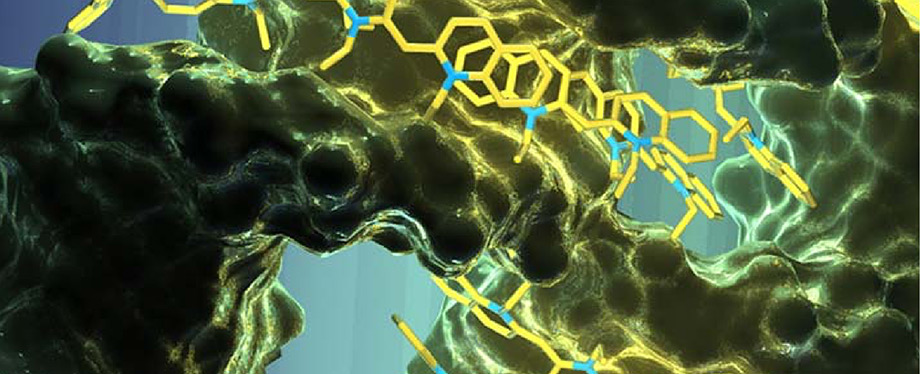
The second major part of our research is the application of the magnetic resonance techniques described above to interesting chemical, biophysical, and physical problems. We are currently employing MAS NMR experiments to investigate the structure of large enzyme/inhibitor complexes, membrane proteins and amyloid peptide and proteins. By measuring chemical shifts and dipolar couplings between homonuclear and heteronuclear spin pairs in inhibitors or active sites, we have been able to address structural questions in several cases. For example, we have performed NMR on photochemical intermediates of bacteriorhodopsin trapped at low temperature to study the mechanism of proton pumping and the origin of the opsin shift in the optical spectrum of retinal in this protein. More recently we have completed the initial two structures of peptides with MAS dipole recoupling techniques. One of these, an 11-mer from the protein transthyretin, is illustrated in the bottom part of the figure and is the initial structure of a peptide in an amyloid fibril. Since these molecules do not diffract and are not soluble, their structures can only be determined by high resolution solid state NMR.
G. Bar, M. Bennati, H.T. Nguyen, J. Ge, J. Stubbe, R.G. Griffin, “High Frequency (140 GHz) Time Domain EPR and ENDOR Spectroscopy: The Tyrosyl Radical-Diiron Cofactor in Ribonucleotide Reductase from Yeast,” J. Am. Chem. Soc. 123, 3569-3576 (2001) M.Bennati, J. Stubbe, and R.G. Griffin, High Frequency EPR and ENDOR: Time Domain Spectroscopy of Ribonucleotide Reductase,” Applied Magnetic Resonance 21 389-410 (2001) C.P. Jaroniec, J Lansing, B. Tounge, M. Belenky, J. Herzfeld, and R.G. Griffin, “Measurement of Dipolar Couplings In a Uniformly 13C/15N Labeled Membrane Protein: Distances between the Schiff Base and Aspartic Acids in the Active site of Bacteriorhodopsin” J. Am. Chem. Soc. 123, 12,929-12,930 (2001) C. M. Rienstra, M. Hohwy, L. J. Mueller, C. P. Jaroniec, B. Reif, R. G. Griffin "Determination of multiple torsion-angle constraints in U-13C,15N-labeled peptides: 3D 1H-15N-13C-1H dipolar chemical shift spectroscopy in rotating solids,", J. Am. Chem. Soc. 124, 11908-11922 (2002) M. Rosay, V. Weis, K.E. Kreischer, R.J. Temkin, and R. G. Griffin, “Two-Dimensional 13C-13C Correlation Spectroscopy with Magic Angle Spinning and Dynamic Nuclear Polarization”, J. Am. Chem. Soc. 124, 3214-3215 (2002) C.M. Rienstra, L. Tucker-Kellogg, C.P. Jaroniec, M. Hohwy, B. Reif, T. Lozano-Peres, B.Tidor, and R,G, Griffin, “De Novo Structure Determination of Peptides and Proteins with High Resolution Solid State MAS NMR” Proc. National Academy of Science 99, 10260-10265 (2002) C. P. Jaroniec, C. Filip and R G. Griffin, “3D TEDOR NMR Experiments for the Simultaneous Measurement of Multiple Carbon-Nitrogen Distances in Uniformly 13C,15N-Labeled Solids,” J. Am. Chem. Soc. 124, 10728-10742 (2002) C.P. Jaroniec, C.E. MacPhee, N.S. Astrof, C.M. Dobson, R.G. Griffin, “Molecular Conformation of a Peptide Fragment of Transthyretin in an Amyloid Fibril, Proc. National Academy of Science 99, 16748-16753 (2002) V.S. Bajaj, C.T. Farrar, M.K. Hornstein, I. Mastovsky, J. Bryant, K.E. Kreischer, R.J. Temkin, and R.G. Griffin, ”Dynamic Nuclear Polarization at 9 Tesla Using a Novel 250 GHz Gyrotron Microwave Source,” J. Magn. Resonance 160, 85-90 (2003) |
|||||||||||