





Briefings
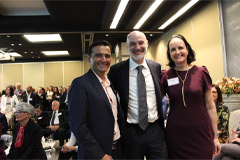
MISTI's Patricia Gercik Receives MIT Excellence Award
|
As associate director of MISTI, Gercik supervises the high functioning work of ten different country program managers. As managing director of the MIT-Japan Program, Gercik teaches students about Japan, supervises their placement in Japanese internships, cultivates relationships with firms and institutions on both sides of the Pacific, raises funds, and manages relationships with the Japanese community.
Gercik joined MIT more than 25 years ago to help develop what was then a fledgling program in Japanese studies at MIT. That program—now known as MIT-Japan—marks the genesis of applied international studies at MIT and is a cornerstone of the ten (and growing) country programs of MISTI. MISTI is today the nation's largest and most successful programs of applied international studies.
"Pat is an aggressive and successful fundraiser in the corporate world; a dedicated mentor to students and staff; and an imaginative architect for each next phase of program development. Every successful project and institution requires such a visionary. She has been ours," says Richard Samuels, Ford International Professor of Political Science, director of the Center for International Studies, and founding director of the MIT-Japan Program.
Suzanne Berger, Raphael Dorman and Helen Starbuck Professor of Political Science and director of MISTI, adds: "Pat has a great capacity to bring intuition together with sharp observation and analysis in problem solving. I have never met anyone with the same combination of realism and toughness in judgment together with kindness and compassion in approach."
Gercik's reach extends far beyond MIT. She has been a national leader in coordinating efforts on campuses from Massachusetts to California to stimulate more and better understanding about Japan and international studies. She has been the interface between MISTI and the US government, from the National Science Foundation to the Pentagon. To that end, she authored a book, On Track with the Japanese, which has become required reading for the executives of many firms. Born to a British mother and a Russian father who relocated to Kobe, Japan, in the 1930s, Gercik lived a Japanese childhood. She has vivid memories of "confronting" U.S. soldiers during the Occupation and wandering through the black markets of a reconstructing Tokyo; she recently wrote a novel about this experience. "Then, as now, she had a remarkable sense of how to understand human behavior—and how to explain it in ways that de-mystify," says Samuels.
Meet the Center's Senior Fellows
|
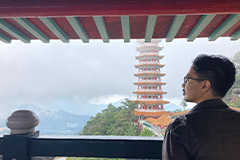
Earlier he served as Moscow bureau chief for U.S News & World Report starting in July 1997. Before moving to Moscow Caryl spent 13 years as a freelance journalist in Germany, where he contributed to publications including The Wall Street Journal, The New Republic, The Spectator and Der Spiegel. He was a 1999 finalist in the International Consortium of Investigative Journalists Award for Outstanding Investigative Reporting. In his journalistic career he has reported from 37 countries. A 1984 graduate of Yale College, he speaks Russian and German.
|
His publications have appeared in Foreign Affairs, The National Interest, Current History, The Washington Quarterly, Bungei Shunju (Japanese: Literature Salon), Er Shi Yi Shi Ji Shang Ye Ping Lun (Chinese: 21st Century Business Review), and Jingji Yanjiu (Chinese: Economic Research). He is the co-author of a forthcoming book with Eric Heginbotham, Comparing Chinese and Indian Strategic Behavior: Jackals From The Same Hill?
Gilboy is a 2008-2010 Public Intellectuals Program Fellow at the National Committee on U.S.-China Relations. He holds a Ph.D. in political science from Massachusetts Institute of Technology, and a B.A. in political science from Boston College.
|
Ambassador Bodine on Yemen and Other Events
|
CIS Audits the Defense Budget
The Center's series Audit of the Conventional Wisdom continues with an analysis of the defense budget—the largest since World War II. Is it a rational response to the threats and the dangers that the United States faces—or not? Benjamin Friedman, PhD student at the MIT Department of Political Science, member of the Center's Security Studies Program and research fellow in defense and homeland security studies at the Cato Institute, makes his case in a video, "Why's the Defense Budget So Big?".Barry Posen Elected to American Academy
Barry Posen, Ford International Professor of Political Science and director of the Center's Security Studies Program, was elected membership to the American Academy of Arts and Sciences on April 19, 2010. Posen is among two hundred and twenty-nine leaders in the sciences, social sciences, the humanities, the arts, business and public affairs to have been elected membership in 2010 to the prestigious honorary society. Posen joins other CIS scholars who also are Academy members, including: Suzanne Berger, Philip Khoury, Richard Samuels, and Eugene Skolnikoff.Carl Kaysen, MIT Professor Emeritus and National Security Expert
|
He had a distinguished and fruitful career as a scholar, academic leader, and government official. He was a professor of economics at Harvard University, deputy special assistant for National Security Affairs to President John F. Kennedy, director of the Institute of Advanced Study at Princeton, vice chairman and director of research for the Sloan commission on higher education, and director of MIT's STS Program. A long list of fellowships and awards is testament to the high standards of excellence and creativity of his individual contributions. During the Second World War, he served in the Office of Strategic Services (OSS) doing intelligence analysis in support of air operations.
"Carl was an enormously knowledgeable individual whose interests spanned economics and politics. He had a matchless intelligence that could penetrate to the heart of the matter, even if he had only just heard the briefing. And he could readily bring a vast store of accumulated wisdom to the assessment of new problems," said Barry Posen, director of the Center's Security Studies Program and Ford International Professor of Political Science.
Since joining SSP, Kaysen devoted much of his scholarly energy to international security, in particular to questions of international order, including how to improve the United Nations, and how to strengthen international law. He co-authored with George Rathjens, Peace Operations by the United Nations: The Case for a Volunteer Military Force (1996) and co-edited The United States and the International Criminal Court: National Security and International Law (2000). As chair and more recently co-chair (with John Steinbruner) of the CISS, he served as godfather to several other important studies of how to manage the security challenges of the post Cold-War world. CISS has a particular interest in nuclear arms control, a matter of long-standing concern to Kaysen. He played a central role in nuclear weapons issues during his service in the Kennedy Administration.
Kaysen was always willing to advise students who were working on issues in which he had policy experience or special knowledge, particularly on matters related to nuclear weapons. He spent much time speaking with scholars and journalists about these issues as well and helped shaped the historical record of the Cold War.
"Carl was a regular participant at the Security Studies Program Wednesday seminars, which feature a guest speaker. In recent years I have been privileged to direct this program and to lead these seminars. Though I kept a list during the question and answer session that followed, Carl was on his own list. Because Carl could be counted upon to ask the crucial question that would move the conversation forward, I would call on him whenever the room needed new energy, or a speaker seemed too comfortable. Even the most incisive critique was delivered with gentle charm and a smile," said Posen.


