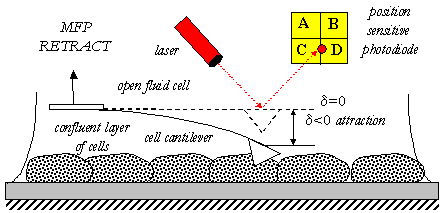
Binding Forces in alpha-Dystroglycan-Laminan Interactions Studied Using High-Resolution Force Spectroscopy
GEORGE GLUCK (*in conjunction with
Rich Gilbert (MECHE-MIT))
The laminin-binding protein alpha-dystroglycan (alpha-DG)
is a member of a glycoprotein complex associated with dystrophin.
The dystrophin associated glycoprotein complex serves as a
transmembrane link between the cytoskeleton and the extracellular matrix.
Disruptions between the interactions of proteins in this complex have
been implicated in the etiology of several muscular dystrophies.
In this study, we have characterized normal binding forces between
laminin-1 and the muscle cell surface. Specifically, we sought to
characterize the forces of adhesion between laminin (LN) and alpha-
dystroglycan on mouse C2C12 myoblasts (muscle cells) using high resolution
force spectroscopy (HRFS). It was found that in clear
force curves, there was an average of 4 distinct
unbinding events before the alpha-dystroglycan-laminin bond was finally broken.
Individual unbinding events ranged from 75 - 250 pN,
and the average force of the entire unbinding event
(the force required to break the protein-protein bond)
was on the order of about 400 pN. Contact times ranged from 0 - 60 seconds.
In the wild-type cell line, it was found that a contact time of 10
seconds was needed to produce a good binding event. Increasing the
time beyond this point did not have any clear effects on force curve
shape or intensity. Preliminary experiments with the mutant cell
lines showed that the minimum time needed to produce a good binding
event was at least 30 seconds.