10.301 Spring 2014
INTRODUCTION
psdoyle
frbrushett psvirk /140208/
Year: U(2)
Units: 12 (Lec-Lab-Homework, hrs, = 4-0-8)
Prereq: 18.03, 10.10
URL: http://web.mit.edu/10.301/www/welcome.html
Stellar Site: http://stellar.mit.edu/S/course/10/sp14/10.301/
OBJECTIVES OUTLINE METHODS TEXTBOOK(S) CLASS SCHEDULE
INSTRUCTORS & TAs EXAMS & GRADING HOMEWORK GUIDELINES
A quantitative introduction to the theoretical and physical principles in fluid mechanics that are of fundamental importance to chemical engineers.
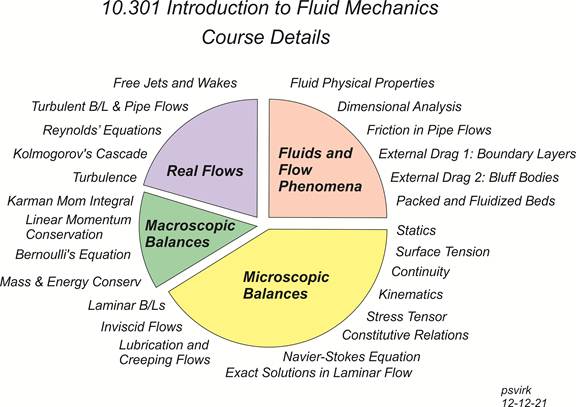
Four areas are addressed, namely:
(1) Fluids and Flow Phenomena; Dimensional Analysis, Pipe Flow and External Drag Relations.
(2) Statics and Microscopic Balances; Stress, Navier-Stokes Equation, Laminar Flows, Inviscid Flows.
(3) Macroscopic Balances; Bernoulli's Equation, Linear Momentum Conservation, Applications.
(4) Real Flows; Laminar Boundary-Layers, Turbulent Flow Structure, Reynolds’ Equations, Wall turbulence.
METHODS
The preceding principles will be illustrated by lectures, examples, and homework problems that are both theoretical and practical in nature.
The weekly class cycle, beginning on day T, say, is of the form:
T Lecture, introducing a topic T.
R Lecture, continuing on T. Problem set concerning T handed out in class.
M Recitation sections discuss T, often using simple problems from textbook.
T Lecture on topic T+1.
R Problem set T due. Lecture on topic T+1. Problem set concerning T+1 handed out in class.
Continue.
Denn, M.M.: Process Fluid Mechanics, Prentice-Hall, 1980.
Still the best intro to chemical engineering fluid mechanics; attempts to be both relevant and rigorous.
Deen, W.M.: Chemical Engineering Fluid Mechanics, 411pages on Stellar Site, 2013.
Brand new, by a distinguished, longtime 10.301 instructor.
Additional References (Optional)
Middleman, R.: An Introduction to Fluid Mechanics, Wiley, 1998.
Emphasizes analytic, microscopic aspects of fluid mechanics. Attractive, physically insightful, chem-e flavored examples.
Fay, J.A.: Introduction to Fluid Mechanics, MIT Press, 1995.
Balanced blend of theory with physical intuition. Copious, well-explained, modern mech- and aero-e type examples.
Bird, R.B.; Stewart, W.E.; Lightfoot, E.N.: Transport Phenomena, Wiley, 1960.
Classic chem-e undergraduate transport text. Many worked examples. Priceless appendix on vectors and tensors.
CLASSES
Lec TR12-1:30; all in Rm 66-110.
Rec 1-4 M11,M12 in Rooms 66-154 and 66-160 (Note 4 rec secs, not 6)
CLASS SCHEDULE is on a separate sheet below.
INSTRUCTORS & TEACHING ASSISTANTS
|
Patrick Doyle |
pdoyle |
Rm E17-504f |
Office Hrs: by appointment |
|
Fikile Brushett |
brushett |
Rm 66-558 |
Office Hrs: by appointment |
|
Preetinder Virk |
psvirk |
Rms 66-157; E34-454; 253-3177 |
Office Hrs: by appointment |
|
|
|
|
|
|
Rahul Misra |
rpmisra |
Rm NW86-726 |
Office Hrs: TW7:30-9:30 in Room TBA for all TAs. |
|
|
|
|
|
|
Karthik Narsimhan |
knarsimh |
Rm NW86-664C |
|
|
|
|
|
|
|
Lu Yang |
Luyang |
Rm NW86-258B |
Homework, assigned weekly during term, ~10 Problem Sets (~2 Problems each). Counts as 100 points, max (20% of total).
2 Quizzes, 1 hr each, during term. Count equally at 100 points each, max, (20% each).
1 Final, 3 hr, during final exam period. Counts as 200 points, max (40%).
Use of the textbooks and class materials will be permitted in all quizzes and in the final exam.
Course Grade will be determined from the sum [h+q1+q2+f], where the elements respectively represent scores obtained in homework, quizzes, and the final.
Typical percentage grade distributions in the last few years were: 30 A, 44 B, 23 C, 2 D, 1 F.
HOMEWORK GUIDELINES (Abbreviated; see Stellar site for details)
Problem sets will be due at the beginning of class on the date specified.
Problem solutions will be distributed, by ei upload to Stellar or hardcopy, at the end of class on the problem due date.
No credit will be given for homework turned in after the due date and time.
Please:
1. Write your name on each sheet of paper.
2. Be sure all sheets for any single problem are stapled or clipped together.
3. State both the problem set and problem number on your solution.
POLICY ON COLLABORATION AND ORIGINALITY
You are encouraged to discuss concepts and techniques underlying homework problems with fellow students.
However, your final solutions should be your own original work.
Jointly prepared solutions, and solutions closely resembling those available online or elsewhere, are unacceptable.
When in doubt, consult with Professors Doyle, Brushett or Virk first.
CLASS SCHEDULE (Abbreviated, see Stellar Site for details)
|
Lec |
Date |
Day |
Subject |
Read (Dean) |
Read (Denn) |
HW Due |
|
1 |
4-Feb-14 |
T |
Intro, objectives, outline |
Ch1 p1-35 |
||
|
2 |
6-Feb-14 |
R |
Fluid mech,
fluid props, dimensional analysis |
Ch1 p1-35 |
pp. 3-24, 29-32 |
|
|
10-Feb-14 |
M |
Recitation |
||||
|
3 |
11-Feb-14 |
T |
Fluid friction in pipes |
Ch2 p1-29 |
pp. 33-39 |
|
|
4 |
13-Feb-14 |
R |
Pipe flow calculations |
Ch2 p1-29 |
pp. 39-49 |
X |
|
17-Feb-14 |
M |
Holiday |
||||
|
18-Feb-14 |
T |
Recitation (M schedule
of classes) |
||||
|
5 |
20-Feb-14 |
R |
Drag on submerged objects |
Ch3 p1-14 |
pp. 52-73 |
X |
|
24-Feb-14 |
M |
Recitation |
||||
|
6 |
25-Feb-14 |
T |
Flow in porous media,
fluidization, entrainment |
Ch3 p15-35 |
pp. 52-73 |
|
|
7 |
27-Feb-14 |
R |
Fluid
statics: micro. force balance |
Ch4 p1-12 |
X |
|
|
3-Mar-14 |
M |
Recitation |
||||
|
8 |
4-Mar-14 |
T |
Pressure
forces and buoyancy, surface tension |
Ch4 p13-21 |
||
|
9 |
6-Mar-14 |
R |
Microscopic
mass balance |
Ch5 p1-6, 15-24, Ch6 pp1-7 |
pp.
141-146 |
|
|
10-Mar-14 |
M |
Recitation |
X |
|||
|
9 |
11-Mar-14 |
T |
EXAM
1, Room 50-340 Walker |
|||
|
10 |
13-Mar-14 |
R |
Microscopic
momentum balance, viscous stress tensor |
Ch5 p6-9, Ch6 p9-39 |
pp.
147-163 |
|
|
17-Mar-14 |
M |
Recitation |
||||
|
11 |
18-Mar-14 |
T |
Fluid
deformation, Navier-Stokes eq. |
Ch5 p6-9, Ch6 p9-39 |
||
|
12 |
20-Mar-14 |
R |
Exact
solutions |
Ch1 p1-35 |
pp.
169-194 |
X |
|
24-Mar-14 |
28-Mar |
Spring Vacation |
||||
|
31-Mar-14 |
M |
Recitation |
||||
|
13 |
1-Apr-14 |
T |
Order
of Magnitude Analysis |
Ch8 p1,32-37 |
||
|
14 |
3-Apr-14 |
R |
Lubrication
flow |
Ch4 p1-14,37-38 |
X |
|
|
7-Apr-14 |
M |
Recitation |
||||
|
15 |
8-Apr-14 |
T |
Creeping
flow, Inviscid flow |
Ch8 p14-27 |
||
|
16 |
10-Apr-14 |
R |
Pseudo-steady
flow |
Ch4 p27-32 |
pp.
200-208 |
X |
|
14-Apr-14 |
M |
Recitation |
||||
|
15-Apr-14 |
T |
EXAM
2, Room 50-340 Walker |
||||
|
17 |
17-Apr-14 |
R |
Laminar
boundary layer flow |
pp.
277-302 |
||
|
21-Apr-14 |
M |
|||||
|
22-Apr-14 |
T |
|||||
|
18 |
24-Apr-14 |
R |
Macroscopic
balances: mass and energy. |
pp.
79-94 |
X |
|
|
28-Apr-14 |
M |
Recitation |
||||
|
19 |
29-Apr-14 |
T |
Bernoulli's equation, macro
momentum balance |
pp. 95-101 |
||
|
20 |
1-May-14 |
R |
Applications of macroscopic
balances |
pp. 105-132 |
X |
|
|
5-May-14 |
M |
Recitation |
||||
|
21 |
6-May-14 |
T |
Turbulent flow,
introduction, physics, scales |
pp. 307-327 |
||
|
22 |
8-May-14 |
R |
Kolmogorov's hypothesis,
turbulent energy cascade |
X |
||
|
12-May-14 |
M |
Recitation |
||||
|
23 |
13-May-14 |
T |
Reynolds’ equations,
theoretical treatments of turbulence |
|||
|
24 |
15-May-14 |
R |
Wall turbulent flows,
pipes, B/Ls |
|||
|
19-May-14 |
23-May |
FINAL EXAM, Text (Denn) and all notes allowed. Date, Room TBA |
||||
|
Lec |
Date |
Day |
Subject |
Read (Dean) |
Read (Denn) |
HW Due |
Last Mod: psvirk 2014 02 08 ~13:00