mailto:jrose@mit.edu
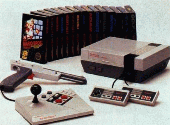
The concept of a "threshold object" to me essentially translates to a physical object that represents a virtual world in some way. An obvious example (that has been forbidden from use in this assignment) is a laser gun, which has been used for interacting with video games for quite some time. In fact, the original Nintendo Entertainment System came packaged with such a gun, an obvious transfer from the arcade that eventually didn't have as much appeal as Nintendo probably would have liked.
While a computerized threshold object, such as the telephone described in Hamlet On the Holodeck, is an effective immersive object, it lacks the tangible quality that one would get by interacting with the game or story or whatever by using their real telephone for a virtual effect. To this end, toy manufacturers have been pioneering threshold objects recently.
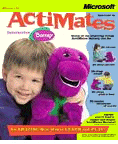
Microsoft has created a sub-$100 animatronic Barney doll that interacts with the TV, the VCR, and the computer. Features include light-sensitive eyes that allow for peek-a-boo play, as well as sensors in the feet and hands to allow Barney to react to touch, that is these sensors act as controllers for dictating Barney's course of action--squeeze a hand and Barney plays one of twelve games, squeeze a foot and he sings one of seventeen songs.
One of the problems with Barney is that while the technology is impressive and the price is right, these happen to coincide with Microsoft's strengths. Getting kids interested in toys, however, isn't thier expertise, and as the result, Barney tends to sing along with the VHS tapes, and the PC, and the TV, without allowing the child a chance to enter. And so, while a tangible object representing virtual space, Barney fails to immerse the child in the experience.
Mattel, on the other hand, has been gaining strength in technology, while drawing on their tremendous experience with child interaction. The results so far have been tremendous, to the point where they have started a Mattel Media page to describe thier interactive products.
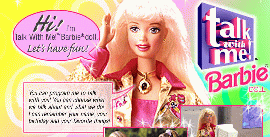
Most notable to come to market so far has been "Talk With Me!" Barbie, which for about $100, kids get a CD-ROM with different games and activities to play with, as well as a toy computer that hooks up to a real computer and through which information is downloaded to a Barbie doll through a great infrared interface, hidden in Barbie's pendant necklace. By sitting Barbie at her computer (as the child sits at the real computer), Barbie can be loaded up with all kinds of information, including the child's name, friends' names, birthdays, and a bunch of other stuff. The interactivity comes when Barbie says things like, "Tomorrow is your birthday! Let's have a party!" This kind of interactivity is priceless, and makes Barbie (who has a barely noticable animatronic jaw) a tremendous threshold object, precisely where Barney fails--in immersion.
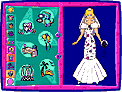
Another successful Barbie product already available is sort of a threshold object in reverse. Barbie Fashion Designer is interesting in that it allows kids to use their computers to design patterns for outfits for Barbie and her friends, and then prints out the patterns on fabric, which can then be cut out and assembled into actual clothing. In this way, the child becomes immersed in the technology backwards, by using it to aid their own story creation, rather than using something physical to aid the computer's story telling.
LEGO has a new product that is the result of a collaboration between them and the MIT Media Lab, called Mindstorms, which incorporates a programmable brick into the usual Lego setup. What this does is establish a link between the physical bricks and the control the computer has to offer, and from there, the possibilities are almost limitless. The potential of this product, which will be available later this year, is to allow people not only the kind of creative exploration that the Fashion Designer software allows, but also has the potential to allow for the creation of unique threshold objects for interfacing with the computer originally. That is to say that if you wanted to write your own hypertext story and have an object similar to the phone described in HOH, there's not much stopping you from building that object out of Lego and using that controller as needed. Incredible projects are already being built, including a functioning copy machine, and a model of an ATM machine, both of which can be seen at the web site lined above.

Finally, although it isn't available yet, Mattel has designed an interactive Winnie the Pooh doll that looks and feels similar to Microsoft's Barney, but which is capable of storing about 20 minutes worth of text, which a child can take away from a computer and interact with through hand and feet sensors (like Barney), only in an immersive way, rather than passive viewing way, as is the case with Barney, who mimics his input devices. There isn't much information on this doll yet, but it should be commercially available by Christmas.
Obviously threshold objects are getting more and more sophisticated, to the point where the difference between physical and virtual reality is becoming blurred. As this line continues to fade, the immersivitiy of the computing experience will become better and better.