 3.11 Administration

Instructor
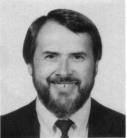 Prof. David Roylance
Room 6-202, phone 3-3309, email roylance@mit.edu
Office hours MTWF 9-10 & 11-12, R 9-12. Special student consultation
appointments arranged by email, but feel free to drop by anytime.
Teaching Assistant:
Sara Ransom, room 8-115, phone 2-1511, email slransom@mit.edu, office
hours to be arranged.
Subject Goals
- Develop the formal theory of solid mechanics - the equilibrium,
kinematic, and constitutive equations.
- Develop closed-form and computational methods for stress analysis
of typical engineering structures.
- Introduce the atomistic mechanisms underlying mechanical behavior
of materials, in the context of process - structure - property -
performance concepts in materials engineering.
- Provide continuing development in mathematics and computer
operations for engineering problems.
- Provide a context for mechanics of materials within the broad
practice of modern engineering, to include statistical approaches,
design methods, case studies, and the societal responsibility of
engineers.
Class meeting times
Lectures MWF10, room 4-149; recitations T10 and T11, room 13-4101.
Text
David Roylance, Mechanics of Materials, John Wiley & Sons,
1996. The table of contents of this text is also the 3.11
syllabus.
Grading
Individual homework and quiz problems will be graded on a 0-5 scale,
and averaged for the problem set or quiz overall grade (no curve).
Quizzes count 35% each toward the final letter grade; problem set
average counts 30%. Final letter grades will be reported as:
- 4.8-5.0 - A+
- 4.6-4.79 - A
- 4.4-4.59 - A-
- 4.2-4.39 - B+
- 4.0-4.19 - B
- 3.8-3.99 - B-
- 3.6-3.79 - C+
- 3.3-3.59 - C
- 3.0-3.29 - C-
- 2.0-2.99 - D
Quiz schedule: March 17, May 12 (no final).
Homework: Problem sets normally submitted on Fridays. Late
submissions will usually be accepted without penalty (subject to
honesty considerations described below), although of course tardinesss
should be avoided if possible.
Academic Honesty
All work turned in for credit - problem sets, quiz papers, etc. - must
be your own individual work unless specific instructions to the
contrary have been given to you by the instructor.
Group discussion of problem sets is allowed and encouraged, but the
problems should then be worked out and written up on an individual
basis. Turning in problems copied directly from bibles is cheating,
and you are encouraged to contact the instructor or TA for help if you get
stuck on a problem.