Landmark Project Makes Real Options Real
Team Shows Power of Flexibility in Development
by Michael Mack
April 17, 2008
The vertical expansion of the Blue Cross/Blue Shield headquarters is arguably the most iconic execution of real options theory in the world. The only project of its kind in Chicago – and one of the few anywhere – the 33-floor high-rise was erected in 1997 with a built-in option of being extended to nearly 60 floors sometime in the future – all while corporate operations continue uninterrupted below.
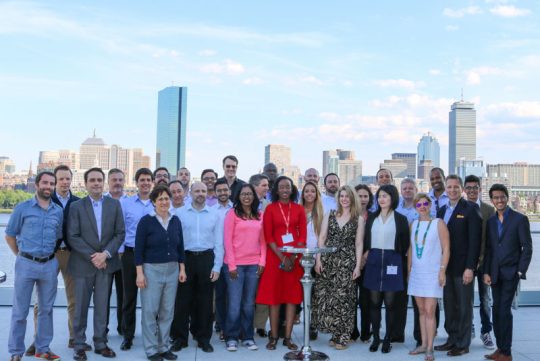
The expansion is now underway. On April 17th, students at the MIT Center for Real Estate had the rare opportunity of hearing first-hand about the project's concept and execution by the project team. As guests of Professor David Geltner's class Advanced Topics in Real Estate Finance, all six of the project's principal team members – the corporate lead, its architects, structural engineer, project manager, and developer & contractor – shared the details behind their pioneering efforts at making real options real.
A Complex Option
Vertical expansion – more aptly called vertical completion – wrestles with unique issues of complexity. Though modest vertical expansions of two or three floors are not uncommon, a 24-story expansion above an occupied building is both challenging and rare.
Not only must the architectural design be fully detailed – both for the Phase I building and its future Phase II completion – but the construction scheme must be planned against future availability of materials and processes. Key to the BC/BS project's success has been the novel and integrated use of design and engineering elements.
Project Background
Andrew J. Pini opened the presentation by sharing the context for the real options concept. As Corporate Vice President of Real Estate & Development for HCSC, Pini has been the driving force behind the vertical completion.
"In the early 1990s," he said, "our company was changing from Blue Cross/Blue Shield of Illinois to Health Care Services Corporation" (HCSC, now parent company of BC/BS), "and we were projecting a 20-year growth from about 3000 employees to nearly 8000." Pini said his company looked to the new building as a long-term real estate solution to manage that growth.
"Since most of our 3000 employees commuted by the train, we wanted to stay in downtown Chicago," he said. "We also wanted a vertical building flexible enough to allow both single- and multi-tenant use – in case our forecasts didn't work out and we needed to lease the building. Finally, as a health care company, we had to be especially conscious of costs."
Going up! Elevators Serve Design and Construction
One way the company sought to control costs and maximize efficiency was with a high density, open-office layout. "A typical attorney's office averages 225sf/person," said James Goettsch, Principal Architect with the project's primary architectural firm Goettsch Partners. "HCSC has a design objective of 140sf/person," he said.
Such high density requires a robust elevator system. A 2007 study of the building's elevator usage revealed an average of 24,000 trips/day, and showed that traffic between floors was almost as heavy as traffic entering and exiting the building.
The Phase I design includes two features essential to Phase II construction. The first is a soaring floor-to-ceiling atrium, which serves as a unifying architectural concept – "You get the visual and physical interconnectivity of the organization," Goettsch said; "look up from the bottom and take in the whole company." – but it also serves the Phase II effort by providing the space for eight more elevators required to service the additional floors.
"Even though it's a 24-story expansion, it's a 57-story elevator challenge," said Joseph Dolinar, Associate Partner in Goettsch Partners, and architect for Phase II. "That's why we picked the best," Dolinar said, referring to the Mitsubishi elevators installed in Phase I and slated for installation in Phase II.
Piggybacking Cranes
Another architectural design feature that will assist the Phase II construction is a third service elevator. "A typical 'spec' office building has two service elevators," said Goettsch. "We'll bring in a third heavy duty freight elevator to help implement the Phase II option of erecting our tower cranes."
Erecting the tower cranes needed to assemble the floors above while corporate operations continue uninterrupted below provides a unique challenge. The team devised an innovative scheme for tower assembly – taking advantage of the building's robust elevator system while also relying on a nearly obsolete technology.
The process will begin with individual sections of a 17-ton derrick crane being transported to the rooftop via the building's enhanced service elevator bank. "The 17-ton crane is an antique," said Jim D'Amico, Project Manager, and Vice President of The John Buck Company. "It's hard to find, and even harder to find operators for it. But it's the largest crane our elevators can transport."
Once assembled on the roof, the 17-ton derrick will construct a larger 35-ton derrick, which will in turn dismantle the smaller derrick and return it to the ground. The 35-ton derrick will then erect a West Tower Crane, which will in turn assemble the platform for an even larger East Tower Crane. After supports for the East Tower Crane are set, the West Tower Crane will return the 35-ton derrick to ground, then complete the East Tower Crane so that construction can begin in earnest. (Dismantling the two tower cranes at the end of construction will approximate the erection procedure in reverse.)
Safety First
"In a project like this, our first priority is safety for the 4000 people in the building," said Jim D'Amico, Project Manager, and Vice President of The John Buck Company. That was echoed by Matthew Walsh, CEO of The Walsh Group. "We'll use a combination of netting systems and an architecturally treated sidewalk canopy that looks like it belongs there. Occupants should feel like it's a pleasant place to work."
Walsh was the design builder for the Phase I structure, and is now construction manager for Phase II. "We want to maintain security, allow the company 24/7 operation, and minimize the construction impact on employees, neighbors, and the public. Ideally, they wouldn't even know we were there."
Cooling Tower "Sandwich"
A challenge to all major decisions on the Phase II completion has been an ice plant in the building's basement. "The plant provides chilled water to HCSC headquarters, as well as to nearby buildings," said Dolinar. "The water is cooled by way of a battery of 23 cooling towers on top of the building."
Because these towers must function throughout Phase II construction, planners devised a clever workaround to let the towers run while the building goes up around them. An open-air "sandwich" scheme will allow the new framing go up beside the towers while leaving the two floors around them open to the atmosphere.
The floors above will be completed and enclosed within the structure's curtain wall, but the two floors sandwiched between the building's upper and lower half will remain open until the project's end. They will also serve as the construction crew's base of operations, and as a staging area for materials.
As the floors above near completion, a new battery of cooling towers will be built on the roof 24 stories above. In a final sequence (during winter, when cooling isn't as critical), the new cooling towers will go online as the old ones go offline, and the two "sandwich" floors will then be finished. "These two middle floors will keep their spacious volume as one large single floor," said Dolinar. "It'll house a conference center and other large function rooms for corporate events."
Building into the Wind
Wind powerfully affects tall buildings. Especially true in this part of "the windy city" where sustained gusts can reach 65 mph, each additional floor increases the cost per square foot because of the additional structural requirements. Since this project will nearly double in height, new structural controls will need to manage the building's "drift" in high winds.
David Eckman is Managing Principal of Magnusson Klemencic Associates, and structural engineer for Phase II. "We weren't the engineers on the original building, so our challenge has been to work within a pre-defined foundation and framing system," he said.
Eckman's team devised a number of innovations to improve on a concept now dated by ten years. While the original building uses two concrete cores and steel framing, the original completion plan calls for a transition to steel framing above using 'inverted chevron' or V-shaped bracing on every floor.
"We've devised an innovative X-bracing design that flips the V-shaped bracing on every other floor to create '2-story X-braces'," Eckman said. "This system increases efficiency and saves money by adding 30% more drift control, meanwhile reducing the bracing's weight by 300 tons. "This has all been confirmed by wind tunnel tests."
A truss at the top of building will provide even more lateral stiffness, and will serve as foundation for the new cooling towers.
Expansion and Completion
Once finished (planned for 2010) the "new" tower will be the first project in Chicago to build up. "We finished Phase I in 1997 and began Phase II in 2006," said Andrew Pini. "We currently have 4400 employees using 1.4M gross square feet in a building 460 feet high. After we add another 24 stories, the building will accommodate about 8000 employees using 2.3M gross square feet in a building 800 ft high."
"You could look at this job a couple of different ways," said Joseph Dolinar. "You could see it as a finished 33-story building that we'll expand by 24 floors. Or you could see what the term 'completion' suggests – it's always been a tall building, and construction simply halted for about 10 years."
Michael Mack is a freelance writer and poet living in Cambridge.