
Sensor Investigation of
Microdroplet Spreading Behavior
by
Tasos Karahalios
B.S. Economics
Massachusetts Institute of Technology, 1998
Submitted to the Department of
Mechanical Engineering in Partial Fulfillment of the Requirements
for the Degree of
Bachelor of Science in Mechanical Engineering
at the
Massachusetts Institute of Technology
June 1999
©1999 Massachusetts Institute of Technology
All rights reserved
Signature of Author................................................................................................................
Department of Mechanical Engineering
May 7,1999
Certified by............................................................................................................................
Dr. Jung-Hoon Chun
Associate Professor of Mechanical Engineering
Thesis Supervisor
Accepted by...........................................................................................................................
Professor Ernest G. Cravalho
Professor of Mechanical Engineering
Chairman of the Undergraduate Thesis Committee
Sensor Investigation of
Microdroplet Spreading Behavior
by
Tasos Karahalios
Submitted to the Department of Mechanical Engineering
On May 7, 1999, in partial fulfillment of the
Requirements for the degree of
Bachelor of Science in Mechanical Engineering
ABSTRACT
Droplet-Based Manufacturing (DBM) relies upon the ability to accurately deposit droplets in a particular pattern in order to produce a desired part. Important to such a process is the ability to control the uniformity of the droplets and an understanding of the spreading and solidification behavior of a droplet as it impacts a substrate.
In this project, the spreading behavior of molten tin droplets was investigated using a microsensor developed at MIT (Kim et al, 1996). The sensor consists of a fine array of resistive lines (Au) on top of a non-conductive silicon base. As the metal droplet spreads across the resistive lines, the sensor resistance is measured. This changing resistance is then correlated to the droplet diameter. In order to determine the diameter, the resistance of a single line must be known. This value was experimentally determined to be 2.6 kW .
Previous experimental work with the sensor had shown that external electrical noise could present a problem by falsely triggering a response. Therefore, a new experimental apparatus for positioning the sensor was designed and fabricated in order to reduce the problems due to noise, and to test the sensor's ability to produce repeatable results. The new apparatus was also designed to allow for testing the spreading behavior response at elevated substrate sensor temperatures.
Molten tin droplets of approximately 400-m m diameter were deposited on the microsensor. The problems associated with noise were reduced, and the sensor produced consistent results for repeated trials under similar conditions. For deposits onto a low temperature sensor (27° C), data reflecting an initial droplet spreading region, and a region of droplet contact area retraction were observed. The average initial droplet spreading velocity was measured to be 5.7 times the impact velocity. This value is comparable to the value of 2.4, determined experimentally in previous work (Kim, 1996). The average maximum diameter recorded during spreading was 815 m m and was achieved in approximately 150 m s. After approximately 800 m s the recorded contact diameter reduced to an average of 337 m m. The experiment was then repeated with a sensor maintained at 100° C. The droplet reached its final diameter in 100 m s and showed no signs of contact area retraction. Micrographs taken of the underside of the droplets and the sensor surfaces support the sensor responses. The results are very encouraging, as they support the sensor's ability to measure droplet spreading behavior as well as changes due to elevating the substrate temperature.
Thesis Supervisor: Dr. Jung-Hoon Chun
Title: Associate Professor of Mechanical Engineering
Acknowledgments
I came to the DBM lab approximately one year ago and it has been a very enjoyable experience. I have had the opportunity to work with very intelligent students and advisors as well as the opportunity to use some extremely expensive and sophisticated laboratory equipment. These opportunities have truly made me appreciate the MIT research environment.
I would first like to thank Professor Jung-Hoon Chun for his advice and guidance from the moment I was given the opportunity to work as a UROP student, up until the completion of my thesis project. I would also like to thank Professor Taiqing Qiu for taking the time to answer many of my questions.
It has been fun working with all the students in the DBM lab. They are a great group of people to work with because they are all willing to take the time to help whenever there is problem. I would like to in particular thank Ho-Young Kim for all his help with this project. I was fortunate to have been given the benefit of his experience working with the sensor, which saved me a great amount of time and aggravation. I would also like to thank Jeanie Cherng for staying up late and helping me run the experiments, and Juan-Carlos Rocha for answering whatever happened to be my question of the day.
Lastly I would like to thank my parents George and Maria Karahalios and my sister Karrie. Whenever I have a problem, I know they are there for me.
Table of Contents
Title Page 1
Abstract 2
Acknowledgments 3
Table of Contents 4
List of Figures 5
List of Tables 6
1 INTRODUCTION 7
1.1 Motivation and Background 7
1.2 Objective of the Investigation 9
1.3 Overview of the Thesis 10
2 SPREADING SENSOR 11
2.1 Sensor Development Background 11
2.2 Sensor Line Resistance 13
2.2.1 Experimental Line Resistance Measurement 15
2.3 Sensor Temperature-Resistance Dependence 16
2.3.1 Temperature-Resistance Experiment 16
2.3.2 Heat Transfer Effect 18
3 EXPERIMENTAL APPARATUS 21
3.1 Uniform Droplet Generator 21
3.2 Sensor Substrate Fixture 22
3.3 Data Acquisition 23
4 DROPLET SPREADING EXPERIMENTS 25
4.1 Sensor Reliability 25
4.1.1 Sensor Response 26
4.1.2 Droplet Diameter Response 27
4.2 Heated Sensor 30
4.2.1 Heated Sensor Response 31 4.2.2 Heated Sensor Diameter Response 32
4.3 Spreading Velocity 35
5 SUMMARY 36
BIBLIOGRAPHY 37
List of Figures
1.1 Diagram of Uniform Droplet Spray Apparatus 9
2.1 Droplet-Sensor Interaction 12
2.2 Droplet Dimensions and Composition 12
2.3 Typical Sensor Defect 13
2.4 Sensor Defect Resistor Model 14
2.5 Sensor Resistance Temperature Response 17
2.6 Heat Transfer Model 18
3.1 Droplet Collection 21
3.2. Substrate Sensor Fixture 22
3.3 Data Acquisition Set-up 24
4.1 Sensor Voltage Response 26
4.2 Diameter Spreading Response 27
4.3 Top View of Sensor 1 after Droplet Acquisition 29
4.4 Top View of Droplet Deposited on Sensor 1. 29
4.5 SEM Micrograph of Bottom View of Droplet Deposited on Sensor 1. 29
4.6 Heated Sensor Response 31
4.7 Heated Sensor Diameter Response 32
4.8 Top View of Heated Sensor after Droplet Deposit 34
4.9 Top View of Droplet on Heated Sensor 34
4.10 Heated Sensor Surface after Droplet Removal 34
4.11 Room Temperature Sensor after Droplet Removal 34
List of Tables
2.1 Experimental Line Resistance Estimates 15
4.1 Initial Spray Conditions 25
4.2 Impact Conditions 25
4.3 Heated Sensor Initial Spray Conditions 30
4.4 Heated Sensor Impact Conditions 30
4.5 Initial Spreading Velocities 35
Chapter 1 INTRODUCTION
Droplet-Based Manufacturing (DBM) systems are based on the principle of depositing molten metal droplets. This process is used in applications ranging from spray forming and rapid prototyping to electronic packaging. Improving the quality of parts produced from DBM systems depends on improving control over the droplets produced by such systems. One major step in that direction is the development of the Uniform- Droplet Spray (UDS) system. This system is able to produce consistently uniform droplets. Such a system is a significant improvement compared to conventional DBM processes, because it removes the complexity of dealing with droplets that vary in size and temperature as well as other parameters.
The UDS system is an apparatus designed to spray uniform electrically charged droplets which all have the same velocity and thermal history (Passow, 1992). A diagram of the UDS apparatus is shown in Figure 1.1. The apparatus works by first using a heater to melt metals in a crucible. The temperature of the melt is monitored by a thermocouple inserted into the crucible, and controlled by a resistance-type band heater around the crucible. A laminar jet is produced through the orifice mounted at the base of the crucible by applying a gas pressure on the molten metal. A vibration rod is actuated by a piezoelectric actuator, so as to perturb the laminar jet at a desired frequency. According to Rayleigh's theory of instability, jet perturbations at the appropriate frequency produce oscillations in the jet radius which grow exponentially as they travel downstream. This causes the laminar jet to break up into uniform droplets. As the droplets exit the orifice, a charging plate induces a negative charge on them. Since the droplets are all of the same polarity they repel each other. This prevents the droplets from merging and causes them to form a cone shaped spray. These droplets can then be either collected for use as powders, or deposited on a substrate.
The ability to produce controlled uniform droplets provides an opportunity to study the spreading and solidification behavior of individual droplets. The spreading behavior of individual molten metal droplets may be influenced by numerous parameters. These parameters include the droplet material, temperature, impact velocity, as well as the substrate temperature, material and surface condition. Understanding how these parameters affect the spreading and solidification behavior of individual droplets can lead to greater insight in the creation of high quality deposited parts. With this in mind a micro-droplet spreading sensor was developed at MIT (Kim et al, 1996). The sensor was designed to capture the transient response of a molten metal droplet as it impacts the sensor and solidifies. Previous testing of the sensor discovered that external electrical noise could affect the sensor response. Tests were conducted with the sensor at room temperature and produced transient responses.
Figure 1.1: Uniform Droplet Spray Apparatus
First, certain characteristics of the sensor will be determined. The individual line resistance will be experimentally obtained for the sensor, and the sensor resistance response to temperature changes will be investigated. Then a series of experiments under similar conditions will be performed in order to test sensor reliability and repeatability. In order to perform these experiments, a new apparatus will be designed and fabricated to position the sensor appropriately and to minimize the problems due to external electrical noise. From the sensor response, the transient contact diameter and the initial spreading velocity can be derived. Another experiment will be performed under similar initial conditions with the exception that the sensor substrate temperature will be raised to an elevated temperature prior to the droplet impact. The purpose of this experiment will be to record any difference in the spreading behavior due to the elevated substrate temperature.
This chapter provides an introduction to the project, its objectives, and a brief look at the motivation and background information concerning the UDS process and the spreading sensor. Chapter 2 will provide more extensive information concerning the spreading sensor. It will also describe the steps taken to characterize the sensor in terms of determining its individual line resistance, and its temperature resistance dependence. Chapter 3 will focus on the procedure and apparatus used to perform the experiments. Chapter 4 will present and discuss the experimental results. Finally a summary of the thesis will be presented in Chapter 5.
Chapter 2 SPREADING SENSOR
2.1 Sensor Development Background.
In order to capture the transient spreading response of molten metal droplets, a micro-droplet spreading sensor was developed at MIT. The sensor is comprised of a very fine array of highly resistive lines. The lines are spaced in such a manner as to form a resistance network. The width of an individual line, l l, and the spacing between lines, l s, shown in Figure 2.1 are both 2 m m. Figure 2.2 describes the overall sensor dimensions and its material composition. As a metal droplet impacts the sensor, it forms an electrical connection across the resistive lines and effectively changes the overall sensor network resistance. The relationship between the changing resistance and the changing droplet diameter was derived as (Kim, 1996):
 [1]
[1]
where R(t) is the changing network resistance which is a function of the original sensor resistance, Ro, the individual sensor line resistance, Rl, the changing droplet diameter, D(t), and both the line thickness and spacing described earlier. Therefore, by measuring the changing network resistance during droplet spreading, the droplet diameter change can be obtained, since all other variables are constants. From this diameter change, the spreading velocity can be determined as well as other spreading characteristics.

Figure 2.1:
Droplet-Sensor Interaction

Figure 2.2:
Sensor Dimensions and Composition2.2 Sensor Line Resistance
In order to use Equation 1, the individual line resistance, Rl, needs to be determined. This resistance can be described theoretically as:
 [2]
[2]
where r is the resistivity, l is the length of an individual line, and A is the cross sectional area of an individual sensing line. For the purposes of this study, two approaches were used to determine this value experimentally.
 The first approach relied on the fact that under high-powered (50x) magnification, defects due to the sensor fabrication process became apparent. Although all the sensing lines were intended to be isolated from each other, in actuality, due to fabrication defects, a small number of them were connected. A picture of a typical defect was recorded in Figure 2.3 using a Scanning Electron Microscope.
Figure 2.3: Typical Sensor Defect (SEM)
 The defect shown in Figure 2.3 can be modeled as a simple electrical connection. Since the two connected sensing lines are much closer to each other (2 m
m) as compared to their lengths (5mm), the length of a current path through the lines is essentially equivalent to the original line length. This implies that every sensor defect can be considered as a single connected line, and modeled as a resistor with a value equal to the line resistance, Rl. This concept is shown below in Figure 2.4.
The defect shown in Figure 2.3 can be modeled as a simple electrical connection. Since the two connected sensing lines are much closer to each other (2 m
m) as compared to their lengths (5mm), the length of a current path through the lines is essentially equivalent to the original line length. This implies that every sensor defect can be considered as a single connected line, and modeled as a resistor with a value equal to the line resistance, Rl. This concept is shown below in Figure 2.4.
Figure 2.4: Sensor Defect Resistor Model
Since every defect can be modeled as a single resistor across the sensor, the total number of defects for a given sensor can be represented by a parallel resistance network comprised of as many resistors as there are defects. This parallel resistance network has a value equal to the original sensor resistance, Ro. For a sensor with defects, the original sensor resistance can be expressed in terms of the line resistance as:
 [3]
[3]
where N is the number of defects on the sensor.
2.2.1 Experimental Line Resistance Measurement
Three sensors were used to estimate the line resistance. The three sensors were carefully viewed with a high-powered microscope at 50 times magnification. The sensors were viewed by using a sweeping motion across the sensor to ensure that all obvious defects similar to those shown in Figure 2.3 were recorded. Then, the overall original network resistance was measured using a multimeter (Fluke model# 83III). With the number of defects and the original resistance, Equation 3 was used to estimate the line resistance for each sensor. The results are shown in Table 2.1.
Table 2.1:
Experimental Line Resistance Estimates|
Sensor # |
1 |
2 |
3 |
|
Original Resistance (W ) |
115 |
48.0 |
147 |
|
Number of Defects |
21 |
60 |
17 |
|
Estimated Line Resistance (kW ) |
2.4 |
2.9 |
2.5 |
From the results, the individual line resistance was determined to be 2.6 kW . In order to verify this value, a second method was also used to estimate the line resistance. A wafer, four inches in diameter, was prepared using the same materials and in the same manner as was used to produce the sensors. Using a four-point probe, a line resistance estimate equal to 2.7 kW was obtained (Qiu, 1999).
Equation 1 can be solved in terms of the droplet diameter to show that the diameter is directly dependent on the line resistance. Thus any error in the line resistance measurement produces a directly proportional error in the diameter measurement. Fortunately, both methods used for measuring the line resistance produced values that varied by less than 4%. For this analysis, the original value of 2.6 kW was used as the line resistance.
2.3 Sensor Temperature-Resistance Dependence
Many metals have resistances that are temperature dependent. Since the sensor itself is comprised of gold and titanium, the sensor temperature response required investigation. There were two issues of concern. The first concern was the ability of the sensor to function at elevated temperatures without deteriorating. The second was the effect on the sensor resistance that a molten metal droplet at a high temperature would have when it contacts a sensor at a lower temperature. The sensor is designed to produce a resistance response that is correlated to an expanding droplet diameter. However, if the sensor resistance is temperature dependent, the heat transfer from the molten droplet to the sensor may influence the sensor response, and therefore bias the correlated diameter response. To address these issues, an experiment and a simple scaling analysis were performed.
2.3.1 Temperature-Resistance Experiment
In order to determine the extent to which the sensor resistance is temperature dependent, a simple experiment was performed. The sensor was placed on a heater. It was raised from room temperature to 100°
C and allowed to cool back down to 23°
C while its resistance was measured at intervals. In order to measure the sensor temperature and the resistance, two sensors were used simultaneously. Since the temperature of interest was the surface of the sensor, a thermocouple was attached to the surface of one sensor while the resistance was measured from the second sensor. Both sensors were placed on the substrate heater next to each other to ensure the amount of heat delivered to each sensor was the same. The reason why one sensor could not be used was that attaching the thermocouple to the sensor surface has the effect of destroying the thin resistance lines. However, since both sensors are of the same thickness and made of the same material, the temperature at either surface is assumed to  be the same. The results from the experiment are plotted in Figure 2.5.
Figure 2.5: Sensor Resistance Temperature Response
From Figure 2.5, it is apparent that the sensor resistance increases linearly with increases in temperature. An equation representing a linear fit of the data is also shown on the figure. The relevant value from this equation is the slope which equals 0.19 ohms/° C. The fact that the sensor returns along the same path to its original resistance at room temperature is evidence that the sensor is stable and does not deteriorate within this temperature range.
2.3.2 Heat Transfer Effect
Another concern regarding heating the sensor arises from the heat transfer that occurs when the molten metal droplet contacts the cooler sensor. Since it was just shown that the sensor responds to increases in temperature in Figure 2.5, the transfer of heat from the droplet to the sensor could have an effect of causing a biased increase in the sensor resistance during the droplet spreading process. Since according to Equation 1, the droplet diameter and the sensor resistance are inversely related, a rise in the resistance of the sensor due to heat transfer would cause the droplet diameter response to be artificially lower than it actually is.
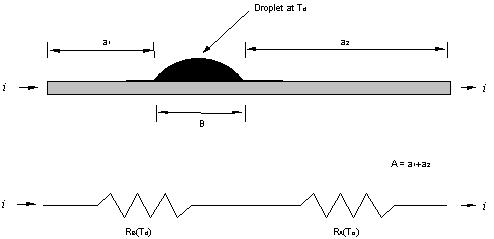 To estimate the effect of the heat transfer from the droplet, a simple scaling analysis can be performed. The diagram in Figure 2.6 describes some of the variables used in the analysis.
Figure 2.6: Heat Transfer Model
Figure 2.6 shows the case of a droplet at an elevated temperature, Td, in contact with a pair of connected sensing lines. For an upper bound estimate, the region of the sensing line beneath the droplet, B, is assumed to be at Td as well. The rest of the sensor line, A, is assumed to be at its original temperature, To. Therefore the sensing line can be modeled as two temperature dependant resistors in series whose values are labeled accordingly in Figure 2.6 as RB(Td) and RA(To). The original resistance of the sensing line, Rl, and the resistance including the heat transfer effect from the droplet, R, are described as:
 [4a]
[4a]
 [4b]
[4b]
From equations 4a and 4b, an expression for the percent change in the resistance due to the heat transfer from the droplet can be shown as:
 [5]
[5]
Next, the expression shown in Equation 6, representing the ratio of the resistance at the droplet temperature to the resistance at the original temperature, can be derived from the linear relationship determined in Figure 2.5. This ratio depends on the original sensor network resistance, Ro, and the slope  ) of the linear interpolation in Figure 2.5. To simplify following equations, the value of this ratio, which is specific to the particular sensor being used in an experiment, is labeled as a constant value, C.
 [6]
[6]
The next ratio to consider, shown in Equation 7, is that of the resistance of the heated region of the sensor line to the original sensor line resistance. This ratio will scale as the ratio of the final droplet diameter, Df, to the overall sensor line length, Lo.
 [7]
[7]
Now using Equations 5,6 and 7 the final expression, describing the percentage change in the measured resistance due to the heat transfer from the molten droplet to the sensor, is shown as:
 [8]
[8]
From Equation 8, it is apparent that the percentage change in the resistance, and therefore the associated error, increases for experiments with larger droplets at higher temperatures. At this point, considering the droplet diameter and temperature range desired for this study (Df  0.5 mm, Td 300°
C, Lo=5 mm,
0.5 mm, Td 300°
C, Lo=5 mm,  , Ro100W
), a conservative estimate for the error due to the change in resistance is approximately 6%. This validates the ability of a sensor to produce a reasonably accurate response without problems due to heat transfer from the droplet.
, Ro100W
), a conservative estimate for the error due to the change in resistance is approximately 6%. This validates the ability of a sensor to produce a reasonably accurate response without problems due to heat transfer from the droplet.
Chapter 3 EXPERIMENTAL APPARATUS
3.1 Uniform Droplet Generator
 The UDS system described in Chapter 1 was used to produce tin droplets. The system is mounted on a gas chamber that can be vacuumed and filled with an inert gas (nitrogen) to avoid problems with uniform breakup due to oxidation. The spreading sensor was installed in the chamber and electrically connected to a current source and an oscilloscope through a vacuum feed-through. In addition, a rotating beaker was included in the chamber in order to calculate the mass flow rate.
Figure 3.1: Droplet Collection
3.2 Sensor Substrate Fixture
A new sensor fixture was developed capable of properly positioning the sensor so that it acquires a single droplet. The new fixture was designed with copper contacts rigidly attached to the sensor so problems with external electrical noise would be reduced. Also, a cartridge heater was included in the fixture design so that the surface temperature of the sensor could be controlled. A solid model of the device is shown in Figure 3.2.

A mask made of thin sheet metal covers the substrate fixture. The mask has a 1-mm diameter hole positioned directly above the sensor. In addition to the mask shown in Figure 3.2, it was discovered that aluminum foil covering the sides of the fixture was necessary to prevent stray droplets from interfering with the sensor. When rotating the fixture through the droplet generator spray, a single droplet is desired to pass through the mask. For a given flight distance, the charging voltage on the UDS generator is adjusted so that the edge of the spray cone barely reaches the position of the hole on the mask. This procedure greatly increases the probability of only a single droplet reaching the sensor.
As shown in Figure 3.2, two sensors were placed in the substrate in order to run experiments. The sensor positioned under the hole has two copper leads attached to it. These leads are supported by a ceramic spacer to insulate them from each other and to allow for the sensor resistance to be measured. A second sacrificial sensor is positioned next to the first sensor. This second sensor is attached to a thermocouple and is intended only to monitor the temperature of the sensor surface. As previously mentioned, since the sensors are all of the same material and thickness it is assumed that the temperature of both sensor surfaces will be the same.
3.3 Data Acquisition
In order to record the sensor response, a Hewlett Packard E3616A DC power supply was used to power the sensor and a Tektronix TDS 420A digital oscilloscope was used to record the response. Based on the current provided, and the measured voltage, the sensor resistance is obtained. A schematic of the set-up is shown in Figure 3.3.
Figure 3.3:
Data Acquisition Set-UpIn order to set the acquisition rate and duration of the oscilloscope, a characteristic spreading time, ts, was used based on the droplet diameter, D, and the impact droplet velocity, Vi .
 [9]
[9]
For the experiments in this study, the characteristic spreading time was calculated to be 100 m s. The experimental results, which are shown in Chapter 4, show that this time corresponds to the approximate time for a droplet to reach its maximum diameter. Therefore, in order to capture the entire spreading response, data was acquired for 1-ms at a sampling rate of 2.5-MS/s.
Chapter 4 DROPLET SPREADING EXPERIMENTS
4.1 Sensor Reliability
The first set of experiments performed was intended to test sensor reliability. Three experiments with similar initial conditions were performed and the resulting responses were recorded. The initial spray conditions for the first set of experiments are recorded in Table 4.1.
Table 4.1: Initial Spray Conditions
|
Experiment |
Orifice Diameter (m m) |
Melt Temperature (° C) |
Mass Flow Rate (kg/s) |
Vibration Frequency (kHz) |
Charging Voltage (kV) |
|
1 |
200 |
300 |
8.3e-4 |
4.25 |
1.50 |
|
2 |
200 |
300 |
7.8e-3 |
4.22 |
2.05 |
|
3 |
200 |
300 |
4.4e-3 |
4.35 |
1.90 |
Next, the droplet temperature, velocity, and diameter at impact were determined by numerical simulation (Passow, 1992). These models were verified by Abel (1993), Chen (1996), and Kim (1996). The results of the simulations are shown in Table 4.2.
Table 4.2:
Impact Conditions|
Experiment |
Substrate Temperature (° C) |
Droplet Temperature (° C) |
Impact Velocity (m/s) |
Diameter (m m) |
|
1 |
26 |
268 |
4.26 |
379 |
|
2 |
27 |
281 |
4.15 |
373 |
|
3 |
27 |
297 |
2.95 |
307 |
4.1.1 Sensor Response
 For the experiments described in Tables 4.1 and 4.2 the resulting voltage responses from the sensors are shown in Figure 4.1.
Figure 4.1:
Sensor Voltage ResponseSince the initial conditions of the experiments were all fairly similar, it is reassuring that the resulting responses are also similar. The discontinuity apparent in Sensor 1 is entirely due to the data acquisition process. When running that particular experiment, the oscilloscope sampling rate was doubled in order to improve the resolution of the measurements and to more closely observe the initial spreading behavior. This required a lower measurement duration period. A final voltage measurement for Sensor 1 was made within seconds of the original response and is represented on the graph. From the graph, the initial spreading region (
0< t < 150m m) is very similar for all three experiments.4.1.2 Droplet Diameter Response
The droplet spreading diameter response can be calculated using the voltage response according to Equation 10. This equation is a rewritten form of Equation 1.
 [10]
[10]
In Equation 10, l l and l s are both constants of value 2 m m each that refer to sensor dimensions described in section 2.1. The value of the line resistance was determined to be 2.6 kW in section 2.2.1. The value for Io is the current provided which was approximately 28 mA, and Ro is the measured initial resistance of each sensor. Lastly, V(t) is the recorded voltage response for each sensor shown in Figure 4.1. From this information the diameter spreading responses were obtained as shown in Figure 4.2.

Figure 4.2: Diameter Spreading Response
Figure 4.2 shows that the droplets reach their maximum diameter within the first
200 m s of spreading. The droplets then seem to undergo a contact diameter reduction for approximately 600 m s. Once again, as mentioned earlier Sensor 1 data was only recorded for the first 450 m s, but a final value was also recorded after a few seconds and is shown in the figure. The mechanism involved in the diameter reduction may be a combination of the droplet retracting due to surface tension effects, as well as contact area reduction due to a peel-back effect at the outer regions of the droplet as it cools.
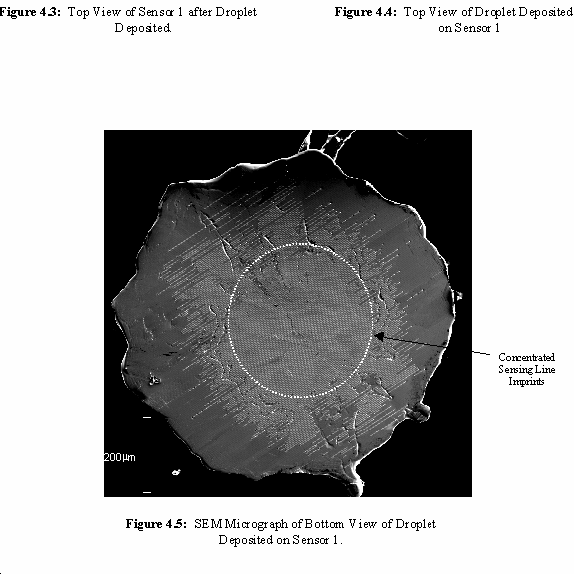
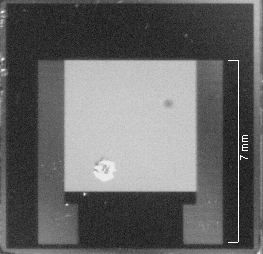
To further investigate the performance of the sensor, photographs of: Sensor 1 after droplet acquisition, the droplet surface, and the droplet underside were taken. They are included as Figures 4.3,4.4,and 4.5, respectively. The maximum splat diameter in Figure 4.4 was determined to be 942 m m using a Nikon Measurescope. In Figure 4.5, an imprint of the sensing lines from the sensor can be seen on the droplet underside. An approximate diameter, referring to the area where these sensing lines are concentrated, has been marked on the figure. This diameter is approximated as 400 m m. The fact that the sensing line imprints appear in this region suggests that this region of the droplet was in contact with the sensor surface as it solidified. The outer regions of the droplet in Figure 4.5 do not show the sensing line imprints, suggesting that this part of the droplet may not have been in contact with the sensor as it solidified. Comparing the diameter of the sensing line region to the final diameter of approximately 290 m m recorded for Sensor 1 in Figure 4.2, they appear to correlate reasonably well.

4.2 Heated Sensor
Once the repeatability of the sensor was tested, its ability to record different spreading behaviors was investigated. An experiment with initial conditions similar to those of the experiments in Section 4.1 was performed, with the exception that the sensor surface temperature was maintained at 100° C prior to droplet impact. The temperature was controlled with the fixture described in Section 3.2. The initial spray conditions, and the droplet impact conditions evaluated by the simulation are listed in Tables 4.3 and 4.4.
Table 4.3: Heated Sensor Initial Conditions
|
Experiment |
Orifice Diameter (m m) |
Melt Temperature (° C) |
Sensor Temperature (° C) |
Mass Flow Rate (kg/s) |
Vibration Frequency (kHz) |
Charging Voltage (kV) |
|
4 |
200 |
300 |
100 |
9.72e-4 |
4.21 |
2.00 |
Table 4.4:
Heated Sensor Droplet Impact Conditions|
Experiment |
Substrate Temperature (° C) |
Droplet Temperature (° C) |
Impact Velocity (m/s) |
Diameter (m m) |
|
4 |
100 |
299 |
5.0 |
401 |
4.2.1 Heated Sensor Response

Figure 4.6:
Heated Sensor Response
4.2.2 Heated Sensor Diameter Spreading Response
 Based on the voltage response for the heated sensor, the diameter spreading response can again be determined. Its response is shown in Figure 4.7.
Figure 4.7:
Heated Sensor Diameter Spreading Response
Two things are immediately obvious from the previous plot. The first is that the droplet reaches its maximum diameter slightly faster than in the previous experiments, but it does not exhibit any signs of diameter retraction. Possible explanations for this phenomenon are that at the higher sensor temperature, either the wettability between the droplet and the sensor increases, or the increase in the contact area is due to the higher sensor temperature allowing the droplet to solidify at a slower rate thereby improving its adhesion.
The second issue with the response is that it predicts a maximum diameter of approximately 500 m m. This value is significantly smaller than the maximum diameters predicted in the previous experiments. The measured value of the diameter was determined to be 782 m m with a Nikon Measurescope. A possibility for this lower diameter could be due to the laminar jet of the UDS system being interrupted temporarily causing a droplet of a different size than expected to strike the sensor. Additional experiments should be performed to address this issue.
Pictures taken of the sensor after droplet deposition and of the droplet surface are included as Figures 4.8 and 4.9, respectively. Attempts were made to remove the droplet in order to photograph its underside, but those attempts proved to be unsuccessful due to destruction of the splats as a result of the large amount of force required to remove them from the sensor. In comparison, splats made with sensors which were at lower temperatures were extremely easy to remove. These splats were touched with double sided tape and they readily adhered. The droplets attached to the heated sensor required scraping with a razorblade, which unfortunately did not leave them in any condition to photograph. However, photographs were taken of the heated sensor surface after the droplet was forcibly removed. This photograph is shown in Figure 4.10 and can be compared to Figure 4.11. Figure 4.11 shows the surface beneath the splat deposited on a cooler (27° C) sensor.


 Figure 4.8: Heated Sensor Droplet Deposit Figure 4.9: Heated Sensor Droplet

Figure 4.10: Heated Sensor Surface after Figure 4.11: Room Temperature Sensor
Droplet Removal after Droplet Removal
From the pictures in Figures 4.10 and 4.11, which were taken at the same magnification, a difference in the sensor surfaces is obvious. Figure 4.10 seems to suggest that for the case of the heated sensor, most of the droplet underside makes contact with the sensor. The diameter of the affected region of that sensor is approximately 770
mm, which is very similar to the measured 782 mm splat diameter. The results from the response shown in Figure 4.7 also support this conclusion. Figure 4.11, on the other hand, shows that the sensor surface of the cooler sensor was not affected as significantly by the droplet. This would suggest that the splat deposited on the cooler sensor had a significantly smaller area of contact. This conclusion is supported by the sensor response shown in Figure 4.2, which suggests that the droplet pulls off from the sensor as it cools, and is further supported by the SEM micrograph of the droplet underside shown in Figure 4.5.4.3 Spreading Velocity
From the diameter response, the spreading velocity can also be determined by taking the derivative of the response. The initial spreading velocities for each experiment are shown in Table 4.5. These values were calculated from the slope of the diameter response curves for the first 20 ms. The ratios of the initial droplet velocity to its spreading velocity are also included in the table.
Table 4.5: Initial Spreading Velocities
|
Experiment |
Impact Velocity (m/s) |
Spreading Velocity (m/s) |
Spreading/Impact (m/s) |
|
1 |
4.26 |
21.9 |
5.1 |
|
2 |
4.15 |
17.3 |
4.2 |
|
3 |
2.95 |
23.3 |
7.9 |
|
4 |
5.00 |
15.3 |
3.1 |
Chapter 5 SUMMARY
In this study the performance of a previously developed spreading sensor (Kim, 1996) was investigated. First, the value of the line resistance of the sensor was experimentally determined to be 2.6 kW . A linear relationship between the sensor resistance and its temperature was also experimentally determined. This relation was used to derive an expression and to produce an estimate of approximately 6% error due to heat transfer effects. This error due to heat transfer would have the effect of increasing the recorded spreading diameter by approximately 6% as well. Also, an average value of 5.7 was determined for the ratio of the spreading velocity to the impact velocity for the experiments performed.
A new fixture, capable of controlling the sensor temperature while positioning it to acquire a single droplet, was designed. This fixture was used to test the reliability and the repeatability of the sensor. A series of three experiments with similar initial conditions were performed. The results of these three experiments were very similar, supporting the sensor's ability to record spreading behavior. From the results, numerous values can be calculated. These values include the time required to achieve maximum diameter spreading, the time associated with contact area retraction, and the spreading velocity.
The sensor's ability to record spreading behavior changes due to an elevated substrate temperature was also investigated. The results were significantly different from those performed at lower sensor temperatures. For the heated sensor case, the results showed that the droplet reached and maintained a maximum diameter until it solidified without signs of contact area retraction. Pictures were taken of the droplet undersides and sensor surfaces for both the heated and unheated experiments and were used to compare the sensor responses. Future work could now be performed with droplets of a different diameter, temperature, and material, on sensors over a wide range of substrate (sensor) temperatures.
BIBLIOGRAPHY
Abel, G. K., 1993, "Characterization of Droplet Flight Path and Mass Flux in Droplet
Based Manufacturing," S.M. Thesis, Department of Mechanical Engineering, MIT.
Chen, C.-A., 1996, "Droplet Solidification and Its Effect on Deposit Microstructure in the
Uniform Droplet Spray Process," Ph.D. Thesis, Department of Mechanical Engineering, MIT.
Kim, H.-Y., Chun, J.-H., Qiu, T., 1996, "In Situ Sensing System for Rapidly Spreading Microdroplets During Droplet-Based Manufacturing," Department of Mechanical Engineering, MIT.
Kim, Ho-Young, 1996, "Microsensor Development for the Study of Droplet Spreading,"
S.M. Thesis, Department of Mechanical Engineering, MIT.
Lesser, M.B., 1981, "Analytic Solution of Liquid-Drop Impact Problems," Proceedings of the Royal Society of London, A, vol. 377, pp. 289-308.
Mills, A. F., 1992, Heat Transfer, Richard D. Irwin, Inc., Boston, pp.156-159.
Passow, C. H., 1992, "A Study of Spray Forming Using Uniform Droplet Sprays," S.M.
Thesis, Department of Mechanical Engineering, MIT.
Private conversation Taiqing Qiu, Assistant Professor of Mechanical Engineering at
MIT, 1999.
Rayleigh, Lord., 1878, "On the Instability of Jets," Proceedings of the London
Mathematic Society, V.10: 4-13