Transition to Lean Product Vision
LAI Transition to Lean Module
I. Background
The Lean Aerospace Initiative (LAI) Lean Enterprise Model (LEM) provides a taxonomy of lean practices, metrics and supporting data. The LEM is serving as an invaluable tool to guide both industry and government LAI consortium members in their journey towards "lean". However, the LEM does not adequately address members? needs for more information on "how-to" become lean. Nor does it provide guidance on the appropriate order or sequence in which to effectively implement the lean practices.
In order to fulfill the needs of the consortium members in creating a tool that will facilitate the "how-to" process in becoming lean, a product identified as the Transition-to-Lean (TTL) module is currently being developed. The TTL module includes both an enterprise and factory operations level models in its prototype phase. For the purposes of this report, the enterprise level model will be the model referred to throughout the document.
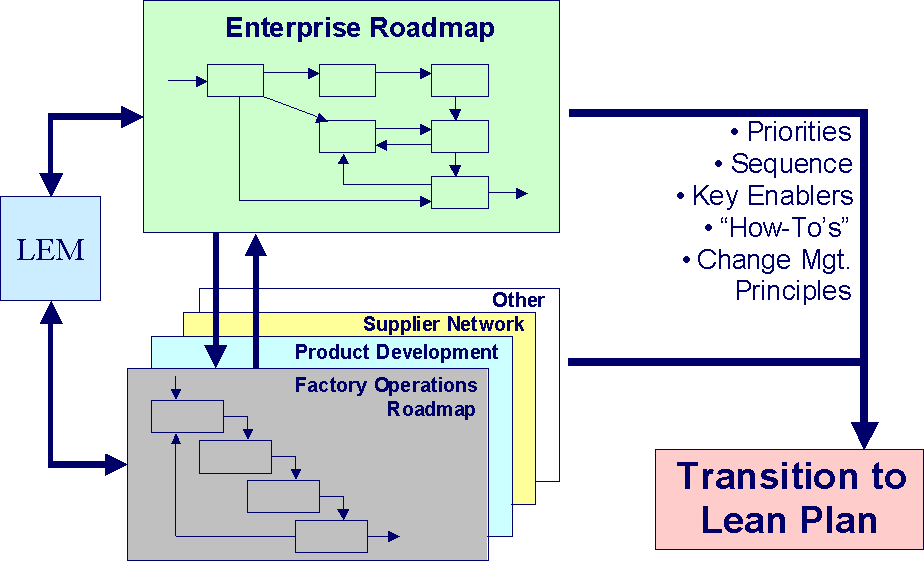
In development of the enterprise level TTL model, a precedence diagram will be created, along with descriptions for each element in the precedence diagram. Precedence diagrams are a technique for representing the priority and sequence of activities to be performed. Diagrams will be developed that designate the order or sequence of implementing lean practices. These precedence diagrams will serve as a tool for organizing LEM principles. Descriptions will be developed for each precedence activity in the diagram. It is envisioned that they will be comprised of some or all of the following elements: 1) discussion of what each box or node means, including definition of terms; 2) recommendations on industry "best practice" in implementing the activity; 3) examination of potential implications of the practice; and, 4) review of alternative approaches. Figure 1 below identifies the TTL product vision.
Transition to Lean Product Vision
Figure 1. Transition to lean product vision (Source: Deborah Nightingale, LAI-LEM Focus Lead, Massachusetts Institute of Technology, Cambridge, Mass, 1998)
Research Assistants
Dave Tonszuck
Affiliated People
Joe Mize
Ron Milauskas