 Current
Transaction
Current
Transaction
The transaction between companies and companies are now mediated by banks. Some companies, however, attempt to remove banks from their financial settlement by with EDI (Elec tronic Data Interchange). In this sense, we can say that the EDI among companies is one of the electronic payment systems.
Current
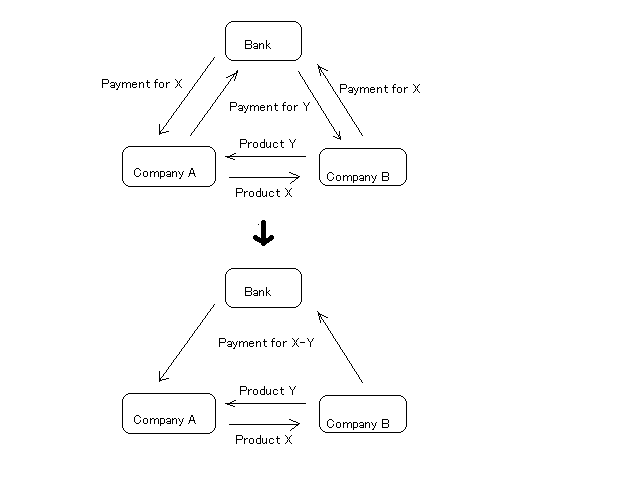
TransactionCurrently, transactions between companies are mediated by banks. One typical transac tion pattern is shown in figure 2. In this pattern, when company A sells product X to company B, company A makes payment for product X via the bank. When company B sells product Y to company A, company B also makes payment for product Y via the bank. In each payment, com panies pay commission to the bank.
Future
TransactionsDue to the development of the electronic payment systems, the transaction mentioned above can be changed to the style shown in figure 2. In this style, the transaction between companies and banks occurs only for the payments for the difference between sales of product X and that of product Y. If sales of products X is larger than that of product Y, the transaction caused by these trades is only that company B makes the payment of the difference to company A via the bank. This process is called "netting", which means to compress the amount of settlement via banks by offsetting the debit and the credit among companies.
Figure 2 : Change of transactions between companies
ImpactsNetting will bring a great opportunity of cost reduction to companies and a threat of losing the business opportunity to banks.
 Impact
on companies
Impact
on companies By the netting, companies can reduce the cost of the commission which would havbeen paid to banks and save their labor for the transaction. For example, Hitachi Co. in Japan is now attempting to reduce the cost by netting. The total amount of settlement among the Hitachi Group, which consists of 46 companies including the head company in Japan, come up to about 100 billion yen per month now. The settlement mediated by banks, however, amounts to about 75 billion yen per month. In other words, they succeed to compress about 25 billion yen per month in their settlement and reduce the commission fee for the settlement. Now they are proceeding the project to introduce the netting into their overseas companies. Sony also expanded the process of netting their group companies in Europe, where the regulation is not relatively strict. The total amount of settlement among their European group companies is about 140 billion yen per year, among which they compress about 40 billion yen by the netting. Due to this, they reduce the commission fee by about 100 million yen per year. They also consider that they can reduce the risk of involved in international settlement by netting. As we can see the above case, the improve ment of the electronic payment system by the EDI can bring a great benefit to companies.
Impact
on banks The advent of the netting is a great threat to banks due to the lost of not only the profit but also the information about the business movements accompanied with the transaction. Moreover, when the netting can be done in the international settlement through deregulation, the total foreign exchange commission fee which companies in Japan have to pay to banks will be reduced by 30 billion yen per year in addition. To overcome the threat, some banks attempt to expand their busi ness area by acquiring the knowledge of the technology and business related to the EDI and pro viding total integrated finance systems to companies. The competition between companies and banks concerning the settlement will become stiffer from now on.
IssuesAs mentioned above, several practices of the electronic payments among companies are being proceeded. However, for expanding these systems over the boundary of companies or countries, the following issues have to be solved:
StandardizationIf companies introduce the netting into the transaction with the companies which belong to the different groups, they can definitely get more benefit. However, for doing this, the protocol for the interface between companies has to be standardized. Currently, the netting is closed within companies which belong to the same group, so that they construct their system by their own methods. Without the standardization, it is difficult to expand the electronic payments all over the industry.
RulesTo spread the electronic payments to all over the industry, the new rules for the settlements between companies have to be defined. Today, companies are follow the rules of settlements which are dealt with by banks. Without the mediation by banks, companies will have to make new rules to maintain public order of the settlements.
RegulationIn some countries such as Japan, the regulation of foreign exchange is strict. In such countries, companies cannot easily make transactions internationally without the mediation by specific banks. Therefore, Sony is doing "netting" only in Europe and not in Japan. To spread the electronic payment systems internationally, the deregulation will be indispensable.
