Introduction
 |
The increase in global population has
placed stress on water resources, in some locations critically.This
scarcity of water is due to factors such as: lack of infrastructure for
distribution and treatment, inefficient water use, and poor environmental
management.Many countries recognize
the need for careful and sustainable resource management and have started
development andimplementation of
comprehensive water resource plans. Current approaches to solving water
resources problems however, tend to focus either on development of additional
sources (supply-side management), or on management of the demand for water.
In the methodology of the Water Allocation System
(WAS),the two ideas are brought
together in a comprehensive manner.Furthermore,
the social aspects of water management aretreated
explicitly. By combiningCRA’s expert
knowledge in the field of economics and WL | DELFT HYDRAULICS extensive
experience in the field of water resources management we have developed
a very powerful instrument that comprehensively treats supply and demand,
in both an economic and social context. |
The Concept
 |
The Water Allocation
System (WAS) allows for the evaluation of alternative strategies for
socially and environmentally sustainable development of water resources.Standard
approaches to water management do not typically treat water as an economic
good, where WAS explicitly includes the fact that the quantity of water
demanded varies with price.In addition,
WAS goes further than including strictly market-based economics by allowing
for the incorporation of policies that reflect the social and environmental
importance of water. These policies can be in the form of subsidies, price
policies, and either maximum or minimum quantities to be provided to certain
users or for environmental purposes.WAS
finds the optimal allocation of water resources by maximizing net social
welfare for a region.
Net social welfare is a measure
of direct and indirect social gains from the use of water.All
costs are accounted for in the solution of the tool.One
of the results from the tool is the value of water for each water source
in various locations in the area.The
value of water should be understood to be the social and economic value
that contributes to social welfare.This
value should not be confused with water prices charged to consumers, which
may be set independently.The values
determined by the tool can be used to assess infrastructure investment,
which may include water treatment, the capacity of plants and water conveyance
systems.WAS could find water management
strategies that would otherwise go undiscovered, as direct, indirect, and
system-wide effects are accounted for. |
The Decision Support Tool
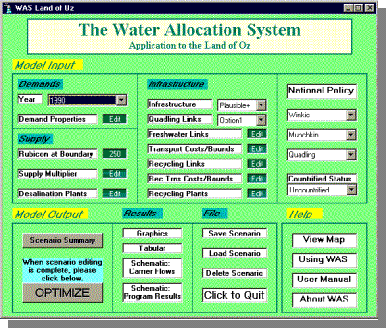 |
The
Water
Allocation System is a user friendly decision support tool for the
analyses of regional water allocation in a social and economic context.The
region is divided into a number of districts. Each district is treated
as a separate economic unit.Economic
activities, production, consumption, prices, and welfare are measured separately
for each district.The only commodity
in the tool is water. WAS accounts for surface water and ground water resources,
where for each resource different water qualities can be taken into account.The
present version of WAS is based on average annual quantities.If
appropriate, development of inter-seasonal or multi-year tools will be
undertaken as part of future projects. |
 |
Water
is used for many different purposes (e.g. households, industry, agriculture,
power and the environment). In the model, the water demand of each
private user category is characterized by a relation between price and
quantity (demand curve). Recycling of effluent from public water supply
to irrigation can be taken into account. For the determination of the demand
curve for agriculture an Agricultural Sub-Model (AGSM) is available (see
below).
The movement of water between
districts can be viewed as trade between districts. In the model, users
can specify conveyance links. A link is characterized by a district of
origin and destination, a capacity and a transport cost in $/m3.
The Water Allocation System (WAS) can be used
for water management and/or conflict resolution among parties sharing a
common water resource. |
Water Management
WAS
can be used to evaluate current and future water management issues. It
is important to note that such evaluation is system-wide. In particular,
it takes account of the opportunity cost of water everywhere in the studied
region. Possible applications include:
Infrastructure
evaluation, both capacity and timing
Cost
benefit analyses of both infrastructure and policies
Evaluation
of new supplies
Planning
for drought conditions
Value
of improving existing infrastructure, e.g. leakage problems
Costs
of environmental policies and regulations
Conflict
Resolution
 |
WAS allows users in situations of conflict or competition
for scarce water resources to examine the impact of various levels of ownership
or allocation. Also WAS can be used to explore opportunities for cooperation.The
tool is particularly useful in its application to dispute resolution by
showing the joint gains from trade or reallocation of water resources among
the competing parties.These gains
may be realized by simple trade where one party values the resource higher
than the other party.The power of
WAS comes in finding opportunities for cooperation between competing parties
that other approaches to water modeling are likely to miss.For
example, it may be advantageous for competing parties to invest in joint
infrastructure. Where there is competition between urban and agricultural
water use, it may be advantageous to invest in recycling infrastructure:
more fresh water can then be transferred to urban use, and in exchange,
recycled water transferred to agricultural water use.Our
decision support tool can identify not only where this kind of cooperation
is beneficial, but when and to what capacity.The
tool can also simulate drought conditions, and identify options for water
allocation in times of short-run water scarcity. |
The Agricultural Sub-Model AGSM
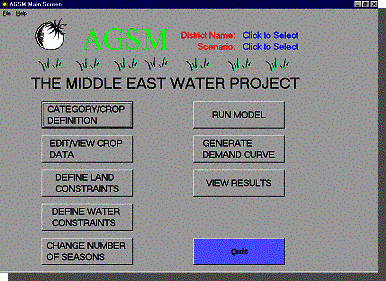 |
The Agricultural Sub-Model
optimizes the crop distribution in a district, taking into account the
availability of water and land, and the relative values of various crops
and costs of inputs. AGSM is a seasonal model, in which different water
qualities can be taken into account.
Input data are:
-
the crops that can be grown in the district;
-
the water requirement per crop and per season;
-
the income generated by crop production, computed as
crop yield multiplied with the crop value minus the cost of non-water inputs;
-
constraints on water and land availability.
|
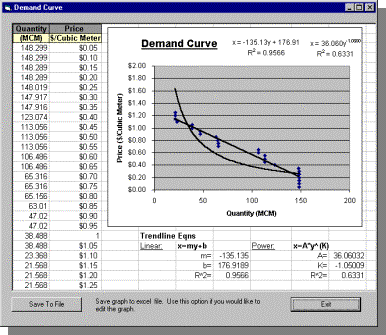 |
If AGSM is used with
the price of water given, it will compute the optimal cropping pattern
taking into account the specified water- and land constraints. AGSM can
also be used to derive the agricultural demand curve. |
WL | Delft Hydraulics
 Founded
in 1927, WL | delft hydraulics is an independent consulting and research
institute located in the Netherlands. For more than 70 years, we have been
providing clients, at home and abroad, with decisive advice and technical
assistance on water-related issues. These projects range from applied research
and consultancy queries to multidisciplinary policy studies. Our current
staff of 400 qualified and committed professionals combine an in-depth
command of critical details with an across-the-board overview.
Founded
in 1927, WL | delft hydraulics is an independent consulting and research
institute located in the Netherlands. For more than 70 years, we have been
providing clients, at home and abroad, with decisive advice and technical
assistance on water-related issues. These projects range from applied research
and consultancy queries to multidisciplinary policy studies. Our current
staff of 400 qualified and committed professionals combine an in-depth
command of critical details with an across-the-board overview.
Clients
Our
national and international clients include government authorities, policy
makers and administrators responsible for the short- and long-term governance
of bodies of water and related infrastructures. Our clients are also in
the private sector: for example, among multilateral agencies, consulting
engineers, contractors, and in industry. They all have one thing in common:
the need for solid, practical advice. They come to us because they know
that we understand their concerns and are prepared to approach their questions
from independent, fresh perspectives.
Our Services
 WL
| delft hydraulics has a long-standing reputation for excellence in hydrology,
hydraulics, morphology, water quality and ecology. Construction and design
matters related to offshore, coasts, harbors, estuaries, rivers and canals,
and industry - also our forte - are approached in a manner tuned to the
specific requirements of the client. In addition, we operate at the policy
level by delivering decision support and carrying out environmental impact
assessments in the above mentioned working areas.
WL
| delft hydraulics has a long-standing reputation for excellence in hydrology,
hydraulics, morphology, water quality and ecology. Construction and design
matters related to offshore, coasts, harbors, estuaries, rivers and canals,
and industry - also our forte - are approached in a manner tuned to the
specific requirements of the client. In addition, we operate at the policy
level by delivering decision support and carrying out environmental impact
assessments in the above mentioned working areas.We have a
full range of experimental facilities and computer programs - most of which
have been developed and validated by our experts in residence. On the basis
of a sound understanding of the processes involved, all water systems can
be simulated by us, numerically, experimentally, or through a combination
of the two. At WL | delft hydraulics, transfer of technology and know-how
is an inherent part of our approach. This is done through a variety of
training courses and seminars, and on the job.
Charles River Associates
 Charles
River Associates is an economics, finance, and business consulting firm
serving clients worldwide. Founded in 1965, CRA has completed more than
3,000 projects for law firms, corporations, and government agencies from
around the world.
Charles
River Associates is an economics, finance, and business consulting firm
serving clients worldwide. Founded in 1965, CRA has completed more than
3,000 projects for law firms, corporations, and government agencies from
around the world.
CRA’s Litigation
and Regulation group provides economic and financial analysis, expert testimony,
and other support to clients involved in legal or regulatory proceedings.
Our Business Consulting group combines expertise in microeconomics, technology,
industries, and markets to assist clients with business strategy, market
assessment, and technology assessment.
Charles River Associates & WL |
Delft Hydraulics
 Demands
of increased production and economic growth are frequently coming in direct
- and public - conflict with environmental concerns. Balancing the needs
of one with those of the other, not only for today, but also for the future,
is often expressed in the phrase “sustainable development”. No simple matter,
it makes our clients' jobs more demanding. In turn, they demand more of
us, not only for construction- and design- related issues, but also for
far-reaching policy and management concerns. They expect and get from us
optimal performance: a multidisciplinary, scientifically rigorous approach
linked to cost-conscious good business sense.
Demands
of increased production and economic growth are frequently coming in direct
- and public - conflict with environmental concerns. Balancing the needs
of one with those of the other, not only for today, but also for the future,
is often expressed in the phrase “sustainable development”. No simple matter,
it makes our clients' jobs more demanding. In turn, they demand more of
us, not only for construction- and design- related issues, but also for
far-reaching policy and management concerns. They expect and get from us
optimal performance: a multidisciplinary, scientifically rigorous approach
linked to cost-conscious good business sense.
Home
| CV | Papers
| Courses