
Title IV of the United States' 1990 Clean Air Act Amendments (CAAA), also known as the Acid Rain Program, is the largest public policy experiment in the use of tradeable permits. It also incorporates two voluntary compliance programs, the substitution and opt-in provisions. These programs are analogous to JI and therefore, provide instructive insight into the potential barriers to broad JI investment.
The response to the substitution and opt-in programs has been significantly different. Many more units have entered the substitution program than the opt-in program. Based on an analysis of these programs, this paper concludes that high transaction costs, particularly the monitoring costs associated with Title IV compliance, deter potential opt-in participants from entering the Acid Rain Program. The differing response to Title IV's two voluntary programs suggests that transaction costs can be a substantial barrier to JI and that minimizing this cost is necessary for encouraging greater JI participation.
Title IV of the United States' 1990 Clean Air Act Amendments (CAAA), also known as the Acid Rain Program, is the largest public policy experiment in the use of tradeable permits. Additionally, it is the first trading program to incorporate two voluntary programs, the substitution and opt-in programs. These programs are analogous to JI projects because they allow non-mandated units to voluntarily enter Phase I of the Acid Rain Program and participate in the Program's tradeable permit market. The substitution provision allows Phase II-affected electric utility units to enter the Acid Rain Program early while the opt-in provision applies to industrial sources that are not otherwise required to comply with Title IV. Correspondingly, JI enables countries or parties that have not ratified the FCCC or accepted a GHG emissions reduction commitment to voluntarily contribute to the FCCC's stabilization objective through international abatement actions.
The response to the substitution and opt-in programs has been markedly different. Many more units have entered the substitution program than the opt-in program. This disparity suggests that there is a cost or barrier to entering the opt-in program that does not affect participation in the substitution program. The purpose of this paper is to investigate the cause for the differing responses to the two programs and based on this analysis, to draw appropriate conclusions for the implementation of JI. The experience of the Acid Rain Program offers an instructive comparison for JI as well as the development of a tradeable emissions entitlement market.
Whereas JI allows parties to invest in low-cost international projects for reducing GHG emissions, a system of tradeable permits enables individual firms to seek the least-cost method for achieving environmental compliance. Under a tradeable permit scheme, the total allowable level of emissions is set in advance, and this quantity is allotted in the form of permits among polluting firms. Affected firms that reduce their emissions below the allotted level can sell their surplus permits to other firms or bank them for future use.[3] Firms that face a high marginal cost of abatement can supplement emissions reduction activities with the purchase of additional emissions permits. Whether firms participate in the tradeable permit market or not, they have the flexibility of reducing emissions through a variety of measures including technological improvements, fuel switching, or the reassignment of production activities to cleaner plants.
Table 1. Cost Differences for Emissions Trading
ERM Model
GREEN Model
Year
Tax ($/ton C)
GDP Loss (%)
Tax ($/ton C)
GDP Loss (%)
2020
No Trade
283a
1.9b
149
1.9
Trade
238
1.6
106
1.0
2050
No Trade
680
3.7
230
2.6 Trade
498
3.3
182
1.9
Joint Implementation and tradeable entitlements not only enable parties to secure global environmental benefits at a low global cost, but they also involve the possibility of increased financial and technological transfers from developed to developing nations. The OECD Green model estimates that the financial flows could amount to as much as $75 billion by the year 2020 (Table 2; Clarke, 1995). The OECD results are based on an overall reductions in CO2 emissions of 2 percent per year, with major emissions reductions in OECD countries and a 20 percent increase in developing countries' emissions during the period from 1990 to 2020. Due to the potential size of the financial transfers associated with as well as the investment structure of JI projects, JI offers an opportunity for industrialized countries to promote individual projects independently of the participation of global tenders such as the Global Environment Facility (GEF). Increased private investment in JI may result in international institutional structures and agreements that more efficiently allocate resources to environmental projects than do the GEF or other international aid agencies. Projects developed under JI can result in technology choices that not only meet the development objectives of host countries but also achieve the environmental objectives of the FCCC.
Table 2. Transfers and Change in Welfare given by the OECD Green Model
United States
Other OECD
Soviet Union
China
Energy Rich
Developing CountriesIndia
Total
1995: 9.5% abatement
transfers ($1000 million)
-1.4
-1.7
1.6
1.8
-0.5
0.2
0
Household real income (% change)
0.0
0.0
1.3
1.0
-1.0
0.9
0
2000: 18% abatement
transfers ($1000 million)
-4.2
-8.6
6.0
7.4
-1.6
1.0
0
Household real income (% change)
-0.2
-0.2
1.9
1.8
-2.3
1.2
-0.2
2005: 25.7% abatement
transfers ($1000 million)
-9.8
-17.2
12.0
16.7
-4.4
2.7
0
Household real income (% change)
-0.4
-0.5
2.0
2.6
-3.6
1.4
-0.5
2010: 32.7% abatement
transfers ($1000 million)
-15.4
-30.6
17.8
31.2
-8.4
5.4
0
Household real income (% change)
-0.7
-0.8
2.1
3.6
-5.0
1.7
-0.8
2020: 44.8% abatement
transfers ($1000 million)
-31.9
-64.1
28.7
75.7
-22.6
14.2
0
Household real income (% change)
-1.3
-1.4
1.7
5.8
-7.4
2.4
-1.5
Opponents of JI argue that JI reduces the willingness of developed countries to "take the lead" in mitigating climate change, compromises the national sovereignty of host countries, and is too costly. By allowing Annex I countries to offset their commitment to reduce GHG emissions with investments in non-Annex I countries, JI decreases the imperative for developed countries to invest in GHG abatement projects within their own borders. The validity of these claims will depend on the implementation and final structure of JI agreements in addition to the future commitments of all parties under the FCCC. Any JI project involving international emissions abatement measures will require reaching an agreement between two parties. There are costs and benefits associated with negotiating agreements, and it is important to weigh both the potential costs and environmental opportunities when evaluating any JI project.
Joint Implementation has been criticized for directly undermining the objectives of the FCCC. It is feared that enabling Annex I countries to offset their emissions reduction commitments could result in uncontrolled global emissions growth (Jackson, 1995). This implies that JI projects will not be monitored to ensure that they are achieving the reductions claimed or that the emissions offsets gained through JI will not be equivalent to the Annex I countries' reduction commitments. Initially, JI is unlikely to occur at a large enough scale for this criticism to hold, and the number of allowable JI projects available to each country can always be limited. Additionally, it is improbable that Annex I countries will invest in JI projects that cannot be monitored or that result in a greater amount of emissions due to emissions allocation or accounting differences between the two nations. As long as there are credible certification and enforcement measures, it will be difficult for parties to cheat or violate their commitment to reduce GHG emissions.
Politically, JI is criticized for threatening the national interests and sovereignty of the host country (Parikh, 1995). This argument overlooks the fact that JI projects are voluntary and that JI provides developing countries with direct access to financial and technological resources. The amount of financial and technological resources available, however, will depend on how JI investment affects and interacts with other international monetary flows. Many critics of JI fear that the level of international aid dedicated to other development issues will decline as a result of increased JI investment. Although host countries may not always be in a strong position to negotiate for JI projects that suit their development needs, JI offers an opportunity for developing countries to attract additional international assistance. By designing appropriate JI criteria and approval processes, the sovereignty of the host countries can be better protected.
The attractiveness of JI is that it achieves GHG emissions reductions at a minimum global cost. This argument assumes that the marginal cost of abating emissions in developing countries and countries with economies in transition is lower than the marginal cost in developed nations. It is unclear whether this is true or whether the transaction costs associated with implementing JI, particularly monitoring costs, cause international projects to be more costly than initially assumed. Opponents of JI argue that transaction costs reduce the number of relatively low-cost JI projects and diminish the potential contribution of JI to mitigating climate change. Allowing JI may cause parties to overlook economical energy saving projects available in developed nations (Jackson, 1995).
In October 1993, President Clinton announced the U.S. Climate Change Action Plan for stabilizing GHG emissions at 1990 levels by the year 2000. Although the plan relied entirely on domestic actions, the Administration recognized the potential for low-cost abatement activities in other countries. In June 1994, the U.S. Government established the U.S. Initiative on Joint Implementation (USIJI). The USIJI aims to 1) encourage rapid development and implementation of mutually voluntary, cost-effective projects, particularly in developing countries and countries with economies in transition; 2) promote a broad range of projects to test and evaluate methodologies for measuring, tracking, and verifying JI projects; 3) establish an empirical basis for developing international criteria for JI; and 4) encourage private sector investment and innovation in technologies for reducing or sequestering GHG emissions (U.S. Initiative on Joint Implementation, 1996).
Any U.S. private sector firm, non-governmental organization (NGO), government agency, or individual is eligible for participating in the USIJI program, and as of April 1996, the USIJI had reviewed fifty-one JI proposals (U.S. Initiative on Joint Implementation, 1996). Of these, fifteen were accepted, eighteen were placed "in development," ten were rejected, and eight were withdrawn. The projects placed "in development" were not accepted because they lacked host country acceptance, raised financial and emissions additionality questions, or contained insufficient monitoring and verification information. Table 3 lists the projects accepted into the USIJI program. The USIJI is one of the first JI pilot programs worldwide and is designed to build a core of experience and knowledge for post-pilot phase JI programs.
International criteria for JI were initially discussed at the first meeting of the FCCC Conference of the Parties (COP-1) in Berlin in April of 1995. At COP-1, the Parties agreed to implement an initial pilot phase of JI referred to as "Activities Implemented Jointly" (AIJ). The initial AIJ phase will end no later than the year 2000, and during AIJ, no credits will be awarded to any party for achieving GHG emissions reductions (U.S. Initiative on Joint Implementation, 1996). In addition, the COP-1 resulted in the Berlin Mandate, an agreement to set quantified GHG reduction targets for specific years (such as 2005, 2010, or 2020). By initiating the discussion of JI and quantifiable emissions reduction targets, AIJ and the Berlin Mandate provide a basis for analyzing the feasibility of JI and likelihood that nations will accept a verifiable emissions cap. An emissions cap is necessary for establishing a tradeable emissions entitlement system and useful for crediting international JI projects.
At the second meeting of the Conference of Parties (COP-2) in July of 1996, the U.S. voiced its support of JI and the use of tradeable entitlements as a least-cost method for mitigating climate change (Affairs, 1996). Recognizing that most developed countries will not achieve the goal of reducing emissions to 1990 levels by the year 2000, the U.S. advocated the adoption of medium term reduction targets, after 2010, that are both binding and achievable. Individual nations should be allowed maximum flexibility in achieving these reduction targets and mitigation measures should be implemented through national programs. Additionally, the U.S. stressed the need for all nations, including developing nations, to take actions to limit GHGs. The COP-2 meeting provided a blueprint for action that was widely endorsed but failed to define specific provisions or requirements for JI. Instead, it instructed the Parties "to accelerate negotiations on the text of a legally binding protocol or another legal instrument to be completed in due time for adoption at the third session of the Conference of the Parties"[4] in December 1997.
Table 3. USIJI Projects
Project Title |
U.S. Participants |
Host Country Participants |
Emissions Reductionsa
|
|---|---|---|---|
| Belize | (mt C) |
||
| Rio Bravo Carbon Sequestration Pilot Project | Nature Conservancy; Pacificorp; Cinergy; Wisconsin Electric Power Co.; Detroit Edison | Programme for Belize |
1,300,000 |
| Costa Rica | |||
| Aeroenergia S.A. Wind Facility |
Power Systems, Inc.; Bluefields, International; EnergyWorks | Aeroenergia, SA |
9,800 |
| BioDiversifix: Forest Restoration |
The Nature Conservancy | Guanacaste Conservation Area; National System of Conservation Areas; National Institute of Biodiversity |
5,040,000 |
| CARFIX: Sustainable Forest Management |
Wachovia Timberland Investment Management | Foundation for the Development of Central Volcanic Mountain Range; MINAE |
5,939,000 |
| Dona Julia Hydroelectric Project | New World Power Corporation |
MINAE; Compania Hidroelectrica Dona Julia | 57,400 |
| ECOLAND: Esquinas National Park | Tenaska, Inc.; Trexler and Associates, Inc.; National Fish and Wildlife Foundation | COMBOS Foundation; MINAE; Council of the Osa Conservation Area | 345,500 |
| Klinki Forestry Project | Reforest the Tropics, Inc. | Cantonal Agricultural Center of Turrialba | 1,968,000 |
| Plantas Eolicas Wind Facility | Merrill International, Inc.; Charter Oak Energy, Inc.; Northeast Utilities; KENETECH Windpower, Inc. | Plantas Eolicas S.A. | 71,800 |
| Tierras Morenas Windfarm | New World Power Corporation | MINAE; Energia del Nuevo Mundo S.A.; Moilnos de Viento del Arenal S.A. |
51,000 |
| The Czech Republic | |||
| City
of Decin: Fuel-Switching for District Heating |
Center
for Clean Air Policy; Wisconsin Electric Power Co.; Commonwealth Edison Co.;
NIPSCO Development Co., Inc. |
City of Decin |
165,600 |
| Honduras | |||
| Bio-Gen Biomass Power Generation Project | Nations Energy Corporation; Add-on Energy 1; International Utility Efficiency Partnership |
Biomasa-Generacion |
647,400 |
| Solar-Based Rural Electrification | Enersol Associates, Inc. | COMARCA; AHDEJUMAR; AHDE | 4,700 |
| Nicaragua | |||
| El Hoyo - Monte Galan Geothermal Project | Trans-Pacific Geothermal Corporation | C and R, Inc. | 5,391,000 |
| Russian Federation | |||
| RUSAFOR: Saratov Afforestation Project | Oregon State University; U.S. EPA |
Saratov Forest Management District, Russian Federal Forest Service; International Forestry Institute | 35,000 |
| RUSAGAS: Fugitive Gas Capture Project | Oregon State Univ.; U.S. EPA; Sealweld Corporation; Sustainable Development Technology Corpation | GAZPROM; Center for Energy Efficiency | 8,182,000 | a Cumulative projected project greenhouse gas emissions reductions in metric tons (mt C) of carbon equivalent. A metric ton of carbon equivalent is one metric ton of carbon or any quantity of one or more other GHGs determined as equivalent by the global warming potentials defined in the U.S. Draft Protocol Framework. |
The U.S. Draft Protocol Framework is the U.S. proposal of a climate change policy architecture. The January 1997 Draft allows carbon equivalent[5] emissions trading among Parties and credits JI projects with non-participating countries.[6] Additionally, it requires the development of national measurement and reporting systems for tracking anthropogenic emissions as well as compliance and enforcement programs. The Protocol provides a flexible architecture that allows future policy changes, but it lacks a clear mechanism for moving from short-term to long-term goals. According to Schmalensee, "the Report pays insufficient attention to the long-term consequences of possible near-term choices and fails to develop analytical points of which policy-makers should be aware."[7] Despite its short-term view, the U.S. Draft Protocol Framework is a clear commitment in support of JI and tradeable emissions entitlements as necessary instruments in the climate change policy architecture.
Tom Tietenberg and David Victor have proposed a comprehensive structure for limiting GHG emissions that incorporates voluntary JI projects and culminates in an international tradeable emissions entitlement market (Tietenberg and Victor, 1994). As compared to the architecture proposed in the U.S. Draft Protocol Framework, Tietenberg and Victor's proposal provides a framework for developing JI and a tradeable emissions entitlement market from an initial to a final phase. The framework accounts for short and long-term economic and environmental concerns and allows flexibility in adapting to new scientific data or incorporating additional parties.
According to Tietenberg and Victor, an effective trading system relies on two types of institutions and procedures. The first involves the market institutions that specify the conditions under which entitlements can be exchanged and provide information on the entitlement trades as well as financial transfers. These market institutions must be complemented by administrative institutions. Administrative procedures ensure that the market process operates efficiently and produces the environmentally desirable outcome. Tietenberg and Victor highlight the issues associated with designing the administrative structure, including the role of certification, monitoring, and enforcement, and recommend a system that evolves through three stages.
The first stage has been established by the FCCC and involves only those countries that have accepted the goal of stabilizing GHG emissions at 1990 levels by the year 2000. The stabilization goal is not a requirement and only applies to a limited number of countries. According to Tietenberg and Victor, countries have two choices for meeting this goal. They can either seek reductions within their own borders or through international abatement projects. The transborder approach closely resembles the AIJ pilot phase. However, the AIJ phase and Tietenberg and Victor's first stage differ in that AIJ projects do not receive credit for achieving emissions reductions. Although the first stage bears little resemblance to a market in tradeable emissions entitlements, it enables participants to learn about the comparative costs of monitoring and measuring emissions as well as the costs of different types of JI projects.
In the second stage of Tietenberg and Victor's JI process, the stabilization goal is replaced by specific emissions requirements for each of the participating countries. The COP-1 and COP-2 meetings as well as the U.S. Draft Protocol Framework have begun the international discussion of emissions reduction targets, but strict requirements have not yet been set. Once reduction requirements are defined, they will provide a basis for allocating actual emissions entitlements that are freely transferable among participating countries. Although Tietenberg and Victor limit emissions entitlements to CO2 during this stage, trades in other GHGs are possible subject to certification procedures. The informal trading system of the first stage is replaced by an organized exchange as well as a reporting network designed to minimize transaction costs and provide a public means of accountability. The second stage does not presume any particular domestic strategy for achieving emissions reductions.
During the second stage, non-participating countries can enter the trading process in two ways. First, non-participating countries can negotiate a country-specific limit on CO2 emissions with the COP and thereby receive a certified number of national emissions entitlements. By accepting a country-specific limit, the non-participating country would become a full participant in the FCCC agreement and gain complete access to the tradeable entitlement market. This transition is comparable to an Annex B country, as defined by the U.S. Draft Protocol Framework, accepting an aggregate emissions cap similar to, but less constraining than, the cap for an Annex A or Annex I country. The U.S. Draft Protocol Framework's differentiation between Annex A and Annex B countries corresponds to Tietenberg and Victor's distinction between participating and non-participating nations. A second means for non-participating nations to join the tradeable entitlement market is by creating and selling offset reductions through individual JI projects. The second method is much more limited than the first, but it allows increased participation by countries that are not yet prepared to fully agree to the FCCC's restrictions.
The final stage of Tietenberg and Victor's process expands entitlement trading to include more participants, a greater number of trades, and all GHGs. More governments will implement domestic markets that parallel the international trading market and a much larger number of trades conducted privately between sources will be expected. Developing the market in these dimensions will result in a denser trading market and greater potential cost savings and flexibility. Each of these developments is a matter of degree and three administrative procedures, certification, monitoring, and enforcement, are necessary for a smooth evolution from the first to final stage.
The certification requirements for created entitlements differ from the requirements for allocated entitlements. Allocated entitlements are certified once a country accepts an emissions reduction target. Created entitlements are certified on a case-by-case basis. As opposed to allocated entitlements, created entitlements must satisfy the following three conditions: 1) created entitlements must demonstrate emissions reductions below an established baseline, 2) created emissions reductions must be quantifiable and feasible, and 3) created emissions reductions must be enforceable (U.S. Initiative on Joint Implementation, 1996).
Two classes of sources must be monitored in the climate change policy architecture. First, emissions sources in participating countries require monitoring to ensure that emissions levels are at or below target levels. Under the FCCC, participating countries have agreed to report national GHG emissions, and most of these nations are already technically prepared to provide accurate emissions data.[8] The second class of sources that demands monitoring are sources in non-participating countries that have earned created entitlements through JI projects. Monitoring requirements for these sources include establishing baseline data, verifying that offset reductions are achieved, and ensuring that total emissions do not exceed the target emissions level minus any traded credits.
While monitoring provides the information for judging claims of non-compliance, enforcement is the process for imposing penalties. The challenge to a tradeable entitlement system is that as the price of the entitlements rises, incentives to defect will increase and as the JI system evolves, the number of actors in the market will grow. Traditional international enforcement instruments are not suited to handle a global entitlement market that results in large financial transfers and involves many parties. Therefore, Tietenberg and Victor argue that JI and the tradeable emissions entitlement market will have to rely on domestic enforcement, international standards and accepted penalties, as well as a clear dispute resolution process.
The definition of the emissions baseline level and allocation of entitlements is relatively straightforward for the countries that have accepted country-specific emissions reduction targets. Once the FCCC's stabilization goal is replaced by a specific reduction target, each country will receive entitlements based on a combination of their historical emissions levels and an allocation rule. These countries have accepted the responsibility of mitigating climate change through emissions reductions. Therefore, they are likely to agree to a mutually acceptable allocation rule through international negotiations. The difficulty in assigning entitlements arises in the case of created entitlements.
The certification of created entitlements raises the issue of "additionality." Created entitlements are intended to reflect "additional" emissions reductions, not reductions that would have occurred regardless of whether the JI project was undertaken or not. Currently, USIJI proposals are required to demonstrate additionality by presenting a "reference case," showing the emissions that would have occurred without the JI project, as well as a "project case," demonstrating the emissions reduction projections over the life of the project (U.S. Initiative on Joint Implementation, 1996). The calculation of the reference and project cases is a technical issue and requires some form of verification if parties are to accept JI as a legitimate tool for mitigating climate change. Proving that JI emissions reductions are real and additional is necessary both for effectively crediting created entitlements and for ensuring the integrity of the international tradeable emissions entitlement market. These concerns can be partially alleviated by utilizing appropriate monitoring procedures as well as international guidance for standardizing the created entitlements certification procedures.
The relationship between the created entitlements emissions reductions and the eventual emissions cap for the host country influences the incentives for non-participating countries to accept JI projects and to limit their current emissions. An eventual emissions cap based solely on historical emissions creates an incentive to defer abatement actions and to reject JI investment now in order to elevate the future established cap. Additionally, a historical emissions rule does not account for developing countries' desire to continue to industrialize. It is generally agreed that developing countries will be given entitlements according to an allocation rule that accounts for future development, and this rule may be calculated on a population or GDP basis (Shah, 1994). To the extent that the eventual emissions cap is determined independently of historical emissions, the incentive to pollute more now is decreased. The issue of "additionality" affects the certification of individual JI projects, while the determination of the eventual emissions cap influences the incentive for host countries to accept JI investment.
The AIJ program highlights the importance of establishing an acceptable crediting system for created entitlements whether it is based on historical emissions or allows for additional industrial growth. According to a 1995 U.S. Department of Energy (DOE) study on the benefits and obstacles of JI projects, a primary obstacle to participation in the AIJ program is the lack of GHG offsets crediting (Vetleseter, 1995). At the COP-1, the parties agreed that an investor conducting JI projects under the AIJ pilot phase would not receive credit for any GHG emissions reductions. Essentially, this decision removed a major benefit from investing in JI projects and has acted to discourage broad participation in the AIJ program.
To achieve its SO2 emissions reduction, the Acid Rain Program requires a two-phase tightening of the emissions restrictions placed on fossil fuel-fired power plants. Phase I begins in 1995 and affects 263 units[9] at 110 mostly coal-burning electric utility plants located in the Eastern and Mid-Western States. These units must reduce emissions to a level equivalent to 2.5 pounds of SO2 per million Btu (lbs SO2/mmBtu) times the average of their 1985 through 1987 fuel use or "baseline." Phase II, which becomes effective in 2000, tightens the annual emissions limits placed on the Phase I units, sets restrictions on about 2000 smaller units fired by coal, oil, and gas, and imposes a permanent annual emissions cap of 8.95 million tons. All existing generation units with an output capacity greater than 25 megawatts (MW) as well as all new utility units must comply with the Title IV provisions. The two-phased approach is designed to achieve early reductions by the largest, highest polluting plants that are thought to contribute most to the acid rain problem in the Eastern half of the U.S. and Canada.
Title IV also calls for a 2 million ton reduction in nitrogen oxide (NOx) emissions from 1980 levels. Similar to the SO2 emissions reduction requirements, the NOx program is implemented in two phases, in the years 1996 and 2000. However, the NOx program does not permanently cap NOx emissions nor does it utilize an allowance trading system. All of the NOx emissions reductions will be achieved by coal-fired utility boilers that are required to install low NOx burner technologies and to meet stricter emissions standards.
The owner or operator of any source subject to the Acid Rain Provisions is required to install, certify, and operate a Continuous Emissions Monitoring System (CEMS) on each affected unit at the source. The CEMS tracks hourly emissions which are reported to the U.S. Environmental Protection Agency (EPA) each quarter. Accurate, complete, and consistent emissions measurement data are essential for ensuring the integrity of the market-based allowance system and the achievement of the emissions reduction goals. According to EPA's 1995 Compliance Results, 98 percent of the installed and tested monitors passed the required 10 percent relative accuracy test, and these monitors were successfully operating over 95 percent of the time.
Allowance transactions and the status of allowance accounts are tracked by EPA's Allowance Tracking System (ATS), an electronic record-keeping and notification system. The ATS provides EPA with the necessary data for determining compliance with the emissions limitations. Any party can open an ATS account, and each account contains the serial number of traded allowances, the individual unit's account balance, and the name of the account representative. The ATS is intended to expedite the flow of data between EPA and the utilities and to promote the development of an efficient permit trading system.
In addition to the private sales and purchases of allowances that continuously occur through the tradeable permit market, EPA holds an annual auction and a direct sale. The auctions are intended to send a price signal to the allowance market as well as to provide utilities and other parties with an additional avenue for purchasing permits. The direct sale offers allowances at a fixed price of $1,500 (adjusted for inflation) and guarantees Independent Power Producers (IPPs) first priority in purchasing the allowances. This guarantee enables IPPs to access the necessary allowances for building or operating any new units.
Electric utilities can choose how to dispatch electricity, and the two-phased nature of the Acid Rain Program creates an incentive for utilities to shift generation and emissions from Phase I to Phase II units. In order to account for possible shifts in emissions through the reduced utilization of a Phase I unit,[10] Title IV requires the submission of a Reduced Utilization Plan for any Phase I unit that will be used below its baseline as a method of compliance. The plan must either 1) designate a Phase II unit (compensating unit) to which generation was shifted; 2) account for the reduced utilization through energy conservation or improved unit efficiency measures; or 3) designate sulfur-free generators (such as hydroelectric or nuclear generators). A Reduced Utilization Plan is not required if the underutilized Phase I unit surrenders allowances in proportion to the reduced utilization, if over-utilization occurs at other Phase I units in the same dispatch system, or if there is a decrease in the total dispatch system load.
The Acid Rain Program allows for a number of compliance options. Utilities can reduce emissions by burning cleaner fuel, by reassigning some of its energy production capacity to lower emitting units, or by utilizing energy conservation measures to reduce total electrical demand. Because of the wide variety of utility plant types, ages, and fuel use, there are large variations in the costs per ton of SO2 removed. This cost differential provides utilities with a substantial opportunity to take advantage of an emissions trading scheme. Generating units with high marginal costs of abatement can achieve emissions reductions by supplementing emissions abatement actions with the purchase of emissions permits. By reducing emissions below the target level, units with lower marginal costs of control can generate additional revenue through the sale of excess permits.
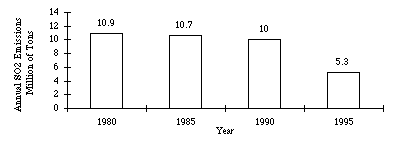
Figure 1. 1995 SO2 Emissions Reductions by Phase I Affected
Utility Units
The allowance trading market increasingly resembles a more established commodities market. At the time Title IV was passed, the projected price for Phase I allowances was about $250 to $350 per ton of SO2 and the price for Phase II allowances was $500 to $700 per ton. Actual allowance prices have been much lower than expected, and the price of a Phase I allowance has dropped to as low as $63 per ton. In addition, the total volume of permit trading has been much larger than the minimum amount of trading required for all units to meet compliance in 1995 (Ellerman et al., 1996). Table 4 shows the level of private trading as well as annual EPA auction sales and demonstrates the large increase in trading since 1994 (Bailey et al., 1996). The number of allowances sold in the private market is a low estimate because it only reflects those trades that the electric utilities chose to report to the ATS. Both the evolution of the allowance price and the volume of trading reflect an allowance trading market that is increasingly becoming more efficient and highlight the fact that electric utilities are taking advantage of the tradeable permit market in order to meet the 1990 CAAA emissions limitations.
Table 4. Allowances Sold in the EPA Auction and in the Private Market
Number of Allowances Sold in EPA Auctions
Number of Allowances Sold in the Private Market
Total Allowances Sold
Through March 1993a
150,010
130,000
280,010
April 1993-March 1994
176,200
226,384
402,584
April
1994-March 1995
176,400
1,466,966
1,643,396
April
1995-March 1996
275,000
4,917,560
5,292,560
Total
777,610
6,740,940
7,518,550
The Acid Rain Program is not only the largest domestic program to incorporate tradeable permits, but it is also the first trading program to include two voluntary compliance programs, the substitution and opt-in programs. The substitution program allows Phase II affected utility units to voluntarily enter Phase I of the Acid Rain Program whereas the opt-in program allows non-utility, industrial sources to enter the program, receive tradeable allowances, and trade allowances with other utility and non-utility sources. The substitution and opt-in programs contribute to the compliance flexibility of the Acid Rain Program and have resulted in an increased level of participation in the program.
Following approval, a substitution unit becomes subject to all Phase I requirements with regard to SO2 and NOx emissions. Incentives for joining the substitution program include early access to the tradeable SO2 permit market as well as the potential benefit of avoiding the stricter Phase II NOx emissions requirements. Electric utilities are a main contributor to national NOx emissions and the majority of these emissions come from coal-fired power plants. The CAAA requires Phase I units with Group 1 boilers to reduce annual NOx emissions by 400,000 tons from 1980 levels between the years 1996 and 1999. Coal-fired boilers are classified as Group 1 or 2 depending on their type of burner technology.[11] Beginning in 2000, NOx emissions will be reduced annually by 2 million tons by 1) maintaining the same standards for Phase I, Group 1 boilers; 2) imposing stricter standards on Phase II, Group 1 boilers; and 3) establishing new standards for Group 2 boilers.
Through the substitution program, Phase II units with Group 1 boilers can comply early with the Phase I NOx requirements and avoid the more costly standards of Phase II. These units, as long as they substituted in by January 1995, are never subject to the stricter NOx emissions limitations but incur the extra cost associated with early compliance. This is commonly termed "NOx grandfathering." (Montero, 1997) Units that substitute in after January 1995 are not subject to the revised NOx limitations until 2008 and fall under the NOx early election provision. The early election provision applies to any Phase II unit that chooses to meet the NOx emissions reductions early whether the unit is a designated substitution unit or not. The early compliance provision is always an option, and therefore, the only NOx benefit of the substitution program is the NOx grandfathering.
There are three reasons for units to enter the substitution program including a low level of unrestricted emissions, low control costs, and NOx grandfathering. Montero has shown that while some non-affected units have joined the substitution program because their actual unrestricted emissions are below their historical emissions and therefore receive excess allowances by substituting in, others have entered the program because they have low marginal control costs. Additionally, Montero demonstrates that among the 124 substitution units with Group 1 boilers, 104 are subject to NOx grandfathering and that the incentives for substituting in increase dramatically for units with Group 1 boilers and high NOx marginal costs. Table 5 (Montero, 1997) summarizes the participation statistics of the substitution program.
Table 5. Substitution Program Statistics
Variables
Phase I Affected Units
Substitution Units
Total Phase I Units
Other Eligible Units
Number of Units
263
182
445
447
Total Capacity (MW)
88,007
41, 643
129, 650
98,588
Coal-fired
Units
257
154
411
299
Units with Scrubbers before 1990
1
25
26
31
Units with Title IV Scrubbers
27
0
27
0
Baseline Fuel Use (1012 Btu)
4,363
1,740
6,103
3,223
Total 1993 Fuel Use
4,395
1,718
6,113
3,890
Total 1995 Fuel Use
4,551
1,931
6,637
4,583
SO2
emissions 1988 (mm)
8.89
1.28
10.17
2.34
SO2
emissions 1993
7.58
0.97
8.55
2.51
SO2
emissions 1995
4.45
0.85
5.30
2.88
Average SO2 rate 1988 (lbs/mmBtu)
3.86
2.01
3.11
1.14
Average
SO2 rate 1993
3.30
1.67
2.63
1.08
Average
SO2 rate 1995
2.10
1.21
1.74
1.04
1995
Allowances (106)a
7.22
1.33
8.55
-
Although there has been significant participation in the substitution program, the substitution units have had little impact on the environmental performance of the Acid Rain Program. Approximately 96 percent of the 1993 to 1995 SO2 emissions reduction comes from Phase I units. (Table 5) This implies that the majority of 1995 SO2 emissions reduction is due to actions by Phase I units. Additionally, 15 percent of the 3.4 million allowances banked for future use are allowances from substitution units (Montero, 1997). The substitution program has successfully created incentives for Phase II units to enter the Acid Rain Program early, but these units have not contributed substantially to the environmental accomplishments of Title IV.
By reducing emissions below its allowance allocation, an opt-in source can sell unused allowances on the SO2 permit market. Opting-in is profitable only if the revenue from selling allowances exceeds the combined costs of the emissions reduction and the costs of entering the opt-in program. Although the opt-in program results in the allocation of additional allowances above the 8.95 million ton cap set for utility units, it does not increase total SO2 emissions. The allowances are allocated to existing sources and do not authorize new emissions. Through trading, emissions merely shift between the utility and industrial sectors, but total emissions do not increase. Additionally, opt-in regulation requires an opt-in source to return allowances when it reduces its utilization, shuts down, or withdraws from the program.
By March 1997, five companies had applied to the opt-in program. DuPont and the Aluminum Company of America (Alcoa) submitted opt-in applications that were subsequently accepted while Union Camp, the City of Dover, and the Iowa Interstate Power Company withdrew their applications citing financial and administrative issues. Union Camp submitted an application for a steam plant at its organic chemical manufacturing facility in Ohio, but its management would not approve the capital investment necessary for installing and certifying CEMS. The City of Dover, DE decided to withdraw its McKee Run application because it would have received too few allowances to offset the cost of the CEMS and of joining the opt-in program. Finally, the Iowa Interstate Power Company withdrew its application because planned modifications to its potential opt-in source will make it an affected source under 72.6 of the Acid Rain Regulations, and affected sources cannot opt-in (Miller, 1997). By November 1996, DuPont and Alcoa received admission to the opt-in program and were allocated a total of 95,882 allowances (EPA, 1996).
The TiO2 production process consumes enormous quantities of steam. Until recently, four coal-fired boilers located on the New Johnsonville site provided the plant with its necessary steam. However, located adjacent to the DuPont plant is Tennessee Valley Authority's (TVA) Johnsonville Steam Plant, and because this plant produces electricity, it is subject to the Acid Rain Provisions. By applying as a Thermal Energy Exception within the opt-in program, DuPont was able to shut down its four boilers, obtain replacement steam from the TVA plant, and thus reduce its overall manufacturing costs.
Title IV allows an opt-in source to transfer allowances that otherwise must be deducted to account for a source's reduced utilization or shut down to a unit that is replacing the thermal energy originally supplied by the opt-in source. A replacement unit must be affected under the Acid Rain Program and prove that it actually replaces the opt-in source's thermal energy. Allowances are transferred from the opt-in source to the replacement unit annually and are fixed in quantity according to the Thermal Energy Plan. The calculation of transferable allowances is based on the thermal energy provided by and the allowable SO2 emissions rate of the replacement unit. DuPont's decision to opt-in to the Acid Rain Program will provide TVA with about 7,000 annual allowances (Alexander, 1996). A Thermal Energy Plan has a fixed duration and the term of the plan extends over full calendar years. DuPont was the first industrial site to submit an opt-in permit application and it took approximately one year for DuPont to gain approval.
The three AGC opt-in units received 30,372, 30,732, and 27,668 annual allowances, respectively, for a total allocation of 88,772 allowances. The entire opt-in process took six years from the passage of the 1990 CAAA to the issuance of AGC's permit in June 1996. The promulgation of the final opt-in regulations took about five years, and the consideration of AGC's permit required another ten months. This delay disappointed AGC and made operational planning and contracting for fuel extremely difficult. Additionally, it prevented AGC from committing to any sales of emissions permits because AGC did not know how many permits it was going to receive (Rasmussen, 1997).
According to Philip Rasmussen, the President of AGC, the opt-in process involved significant administrative and legal costs. Approximately six person-weeks were required to resubmit data previously submitted on other governmental forms, and additional legal and administrative costs were incurred while searching for desirable regulatory changes that would make the program more workable for AGC. Designating the three units as opt-in units only involved minor monitoring costs because the three industrial boilers were already equipped with CEMS. State regulations required AGC to purchase CEMS when AGC added natural gas co-fire capacity to the units. The cost of the monitors, had they been required for the opt-in program, would have been about $125,000 per unit or a total of $375,000. AGC was, however, required to make revisions to the State environmental reporting software in order to accommodate the changes required for acid rain reporting and these changes cost about $25,000 (Rasmussen, 1997).
In 1995 and 1996, AGC sold 5000 allowances each year to Ohio Edison. These allowances were created, for the most part, on the Phase I named unit because the opt-in of the other units was not accomplished until June 1996. In 1996, AGC purchased a total of 14,482 allowances from sources including AIG Trading, Arizona Public Service, Cenex, Emissions Trading, Ohio Edison, Enron, and Hunt Refining. AGC has a continued obligation to supply Ohio Edison with allowances over the next three years, and beyond that obligation, AGC will buy or sell permits depending on the current price of allowances, high sulfur coal, and low sulfur coal.
AGC's initial incentive for designating its three units as opt-in units was both economic and environmental. By opting in, AGC hoped to both reduce emissions and achieve economic gains that would help keep the cost of producing aluminum at the Warrick smelter competitive in world markets. However, the utilities' response to the Acid Rain Program was to overbuild scrubbers thereby reducing emissions to a greater extent than expected. This resulted in an excess of allowances in Phase I which in turn drove the market price of allowances downward. The availability of low-cost emissions permits prevented AGC from over-complying with its 1996 emissions requirements through the burning of additional low sulfur coal, but provided AGC with an alternative dimension to consider in its economic fuel burn models. AGC's ultimate decision was to utilize high sulfur coal and buy allowances rather than to employ the additional blending of low sulfur coal. This decision may change, however, as the price of allowances rises and the cost differential between high and low sulfur coal diminishes.
In May 1995, the Cadmus Group published a draft report on the feasibility of process sources entering the opt-in program. The report analyzed eleven process industries and concluded that only three of these industries, the cement production, natural gas processing, and primary zinc smelting industries, demonstrated an ability to monitor plant-wide SO2 emissions to a 10 percent relative accuracy. Maintaining a 10 percent relative monitoring accuracy over a compliance year is a minimum CEMS requirement for participation in the Acid Rain Program. The major cause for the sources' inability to satisfactorily monitor emissions is the fact that many process industries are characterized by multiple processes and SO2 emissions points. In order to meet the 10 percent accuracy requirement, these plants would have to install CEMS on each stack and "the cost of applying several CEMS would be prohibitively expensive for most plants."[12]
Cement plants have substantial opt-in potential because cement kilns burn fuel and generate emissions in a manner similar to electricity units. Procedures applicable to electric utility and industrial boilers for reducing and monitoring SO2 emissions are generally applicable to cement plants. However, the cost of applying CEMS and tracking SO2 emissions limits opt-in feasibility for many cement plants. Cement plants are small relative to the energy consumption and SO2 emissions of electric utility units, and few plants currently monitor their SO2 emissions. Similar to the City of Dover, many cement plants would receive too few allowances to offset the cost of opting-in to the Acid Rain Program. In 1985, only five cement plants had emissions greater than 5,000 tons of SO2 (The Cadmus Group, 1995).
Natural gas processing and primary zinc smelting plants are better prepared and designed to enter the opt-in program than cement plants. Natural gas processing units typically have only one emissions stack and virtually no fugitive SO2 emissions. Therefore, the cost of installing CEMS is less prohibitive for these plants. SO2 emissions reduction options are available for primary zinc smelting plants and most plants already have CEMS installed and operating. Of the eleven industrial process sources considered in the Cadmus Report, only the natural gas processing and primary zinc smelting industries appear capable of financing the cost of the CEMS. For the remaining nine sources, installing CEMS is too costly due to either the high number of emissions stacks that would require monitoring or the low level of SO2 allowances that would be earned by opting-in to the Acid Rain Program.
The "technology of compliance" cost involves the cost of installing, certifying, and operating the CEMS as well as the cost of establishing emissions inventories which is required for all units participating in the Acid Rain Program. More specifically, the cost of the CEMS includes hardware and software costs as well as the cost of the necessary probes and analyzers for measuring opacity, SO2, NOx, CO, and CO2 emissions.
New England Power (NEP), a subsidiary of the New England Electric System (NEES), provides an useful example for estimating the magnitude of the CEMS cost. Establishing a measure of the "technology of compliance" cost is necessary for evaluating its role in the substitution and opt-in programs. NEP owns and operates three major fossil fuel generating facilities including Brayton Point Station, Salem Harbor Station, and Manchester Street Station. The Brayton Point Station in Somerset, MA, has three coal-fired units that together provide 1,092 MW of baseload capacity and one dual fuel oil/gas fired unit that provides 441 MW of intermediate cycling capacity. The Salem Harbor Station in Salem, MA, includes three coal-fired units that together generate 310 MW of baseload capacity and one oil-fired unit that provides approximately 400 MW of intermediate cycling capacity. Finally, the Manchester Street Station in Providence, RI, consists of three natural gas fired units totaling 420 MW.
NEP designated its four Brayton Point units and three Salem Harbor units as 1995 compensating units under Phase I of the Acid Rain Program. Naming compensating units is entirely optional. Therefore, compensation units can be considered similar to substitution units because both types of units are Phase II affected units that voluntarily enter Phase I of the Acid Rain Program. By 2000, all ten of NEP's units will be subject to the Phase II requirements of the Acid Rain Program.
NEP's total capital cost of CAAA compliance has been on the order of $113 million. This includes the capital cost of the CEMS at Brayton Point and Salem Harbor which are estimated as $6.2 million and $5.8 million, respectively. The capital cost of the CEMS for the Manchester Street units was not available, but is approximately $4 million (Kenison, 1997). Based on these numbers, the total CEMS cost is about 14 percent of NEP's total capital cost of Title IV compliance (Table 6). This cost does not include the annual CEMS maintenance, calibration, and labor costs that average about $100,000 per year for each station. Although the cost of installing, certifying, and maintaining the CEMS varies from unit to unit, NEP's estimated total capital cost of CEMS as compared to its total cost of compliance serves as an approximate measure of the Title IV's monitoring and information technology costs.
Table 6. NEP's Cost of "Technology of Compliance"
MW (total)
Total Capital Cost
BraytonPoint Station
3 coal-fired units
1 dual fuel oil/gas-fired unit1533
1092
441$6,200,000
Salem Harbor Station
3 coal-fired units
1 oil-fired unit710
310
400$5,800,000
Manchester Street Station
3 natural gas-fired units420
420$4,000,000
Total
Percentage of NEP Total Capital Cost of Compliance ($113 M)
Cost of CEMS per kilowatt (KW) of Capacity$16,000,000
14%
$6/KW
Table 7. Comparison of Participation in the Substitution and Opt-in
Programs
Substitution Program
Opt-in Program
Number of Units
182
7
Total Number of Allocated Allowances
1,330,000
95,882
Number of Allowances per Unit
7308
13,697
Percentage of Total 1995 Allocated Allowancesa
16%
1% 3.5.2 Role of the Monitoring and Information Technology Cost | Contents |
All affected utility units, including potential substitution units,
must have CEMS installed and operating by 1995. Therefore, the cost of the CEMS
is not an additional cost incurred by substitution units and does not directly
impact the decision to designate a unit as a substitution unit. Opt-in sources,
however, are not required to install CEMS or to participate in the Acid Rain
Program. In order to enter Title IV, these units must not only purchase
emissions monitors but also learn how to operate and maintain the CEMS. This
additional CEMS cost is a direct result of the regulatory differences between
the substitution and opt-in programs.
The level of participation has been substantially higher in the substitution program than in the opt-in program. Almost 30 percent of the eligible units have entered the substitution program while only two firms have been accepted to the opt-in program. As a whole, substitution units have received about 16 percent of the total 1995 allocated allowances, and on average, each substitution unit has received about 7300 annual allowances. Together, the DuPont and AGC opt-in units received about 1 percent of the 1995 allocated allowances and an average of 13,697 annual allowances per unit (Table 7). This disparity is due to the high incurred monitoring and emissions tracking costs for opt-in units joining the Acid Rain Program as compared to the costs for substitution units. Chapter Four presents the evidence for this hypothesis and analyzes its implications for the development of JI projects and an international tradeable entitlements market.
Industrial sources of SO2 are not required to install CEMS unless they participate in the opt-in program, and therefore, they must evaluate the potential cost of monitoring and tracking emissions when analyzing whether to join Title IV. As shown in the case of NEES, the CEMS cost is a significant portion of the total cost of compliance. This cost has discouraged broad participation in the opt-in program. DuPont, AGC, and the firms that later decided to withdraw their opt-in applications clearly demonstrate the impact of the monitoring and information technology costs on the decision to enter the Acid Rain Program.
The cost of the CEMS did not play a role in DuPont's decision to enter the opt-in program. By opting-in its four coal-fired boilers under the program's Thermal Energy Exception, DuPont avoided the cost of installing CEMS. Once DuPont was accepted into the opt-in program, DuPont simply shut down its four boilers and transferred its SO2 emissions allowances to TVA in exchange for replacement steam. The number of allowances DuPont received was calculated from the thermal energy provided by and the allowable emissions rate of the TVA units. The allowances are fixed in quantity and are transferable over a specific number of years. Under the opt-in program's Thermal Energy Exception, DuPont was never required to determine the emissions rate of its boilers or to incur an additional monitoring cost. Rather, DuPont's only cost in joining the Acid Rain Program was the administrative and labor costs associated with filing the opt-in application and Thermal Energy Plan.
Similarly, AGC's decision to opt-in three industrial boilers was unaffected by the cost of installing and operating emissions monitors. The industrial boilers were already equipped with CEMS due to State regulations that required AGC to purchase CEMS when it added natural gas co-fire capacity to the units. The only monitoring cost that AGC incurred in joining the Acid Rain Program was the cost of updating its CEMS software to accommodate the acid rain reporting requirements. This cost was estimated at $25,000 which is minor in comparison to the capital cost of the CEMS. Therefore, the cost of the "technology of compliance" had little impact on AGC's decision to enter the Acid Rain Program as AGC's units already had CEMS installed and operating.
AGC's opt-in units are large units, and each unit received many more allowances than the average substitution unit. About 30,000 allowances were allocated to each AGC unit as compared to the average allocation of 7,000 allowances per substitution unit. Additionally, because the AGC opt-in units had CEMS installed by 1995 and share a common owner with a Phase I unit (the fourth Warrick unit operated by AGC and SIGECO), they are essentially substitution units. The AGC opt-in units' similarity with substitution units in addition to the relative size of the units meant that AGC not only faced a low cost in entering the opt-in program, but that it could also more easily recapture the remaining fixed cost of entering Title IV through small percentage emissions reductions.
The hypothesis that the cost of the monitoring and tracking emissions is a barrier to entering the opt-in program is supported by the comparison of the DuPont and AGC cases to the experiences of Union Camp and the City of Dover. Both Union Camp and the City of Dover cited the cost of the CEMS as a major cause for withdrawing their opt-in applications. Union Camp's management could not justify the capital cost of the CEMS and applying to the opt-in program given its financial situation, and the City of Dover would have received too few allowances to offset the cost of the CEMS (Miller, 1997). The fact that these firms stated that the cost of the CEMS played a major role in their decision to withdraw their applications validates the hypothesis that the "technology of compliance" cost is a deterrent to entering the opt-in program. Additionally, the Cadmus Report, which evaluates the feasibility for process sources to opt-in, clearly echoes the experiences of DuPont, AGC, Union Camp, and the City of Dover. It highlights the impracticality and expense of monitoring sources with many stacks or a small total quantity of emissions.
Although the delay in the promulgation of the opt-in rules may have prevented some units from applying to the opt-in program, it does not explain the different experiences of DuPont, AGC, Union Camp, and the City of Dover. There remains a clear distinction between the units that were accepted to the opt-in program and the units that withdrew their applications. The CEMS cost is minimal or absent for the units that were accepted and high for those that withdrew their applications. Additionally, the Cadmus Group report suggests that even if final rules for process sources had been promulgated, many sources would not have participated in the opt-in program due to the cost of installing CEMS. Therefore, it is unlikely that an earlier promulgation of the opt-in rules would have encouraged significantly greater participation.
A second potential explanation for the disparity between the amount of participation in the substitution and opt-in programs is the cost of learning about and participating in the Title IV tradeable permit market. The owners of substitution units have already incurred these costs for Phase I units so there is no additional learning cost associated with the substitution units. The experience of the opt-in program to date suggests that this cost is significant. AGC faced minimal learning and participation costs due to its common ownership of the Phase I designated Warrick unit, and DuPont avoided any learning cost by selling its permits to TVA. However, two cases are too few to determine the full impact of this cost. Additionally, the statements by Union Camp and the City of Dover as well as the conclusions of the Cadmus Report point to the cost of the CEMS as the primary obstacle to joining the opt-in program.
The substitution and opt-in programs are analogous to JI projects. Both the substitution and opt-in programs, like JI projects, are voluntary. Additionally, these programs allow non-affected units to enter the Acid Rain Program and participate in the tradeable permit market just as JI projects allow non-participating countries to earn tradeable entitlements through emissions abatement actions. Joint Implementation projects and an international tradeable emissions entitlement market involve many more parties, industries, types of projects, and political interests and in general, are vastly more complex than Title IV. Therefore, complications within the Acid Rain Program and its voluntary programs will most likely be amplified by the JI process as well as the international trading of emissions entitlements.
The success of JI critically depends on the ease with which JI projects can be arranged between interested parties. If JI projects are too difficult or costly to arrange due to high transaction costs, few projects will be undertaken and the potential gains of JI will be lost. Additionally, there are limited resources for investing in international JI projects, and transaction costs act to reduce the effectiveness of these resources by diminishing the amount actually devoted to mitigating emissions. The type and size of the transaction costs associated with investing in JI projects will depend on the criteria for JI established by the COP as well as the institutions and procedures designed to facilitate the JI process. A recent report by the Organization for Economic Cooperation and Development (OECD) concluded that there are six types of transaction costs that are likely to impede JI transactions including search costs, negotiation costs, approval or certification costs, monitoring costs, enforcement costs, and insurance costs (OECD, 1996).
Effective certification and monitoring procedures are necessary for ensuring compliance in both the Acid Rain Program and an international emissions crediting program. The cost of monitoring and tracking emissions is unavoidable for units complying with the Title IV requirements and parties investing in JI projects. Additionally, the monitoring procedures and requirements applied to the JI process will act to build confidence in the tradeable emissions entitlement market and encourage greater international participation. Among the transaction costs listed in the OECD report, the cost of monitoring is significant because it is not only a critical component for ensuring the integrity of the JI program but also a mandatory cost regardless of the project's type or size. Based on the importance of the CEMS cost in the substitution and opt-in programs and the similarity between these programs and JI projects, it is clear that monitoring and information technology costs will influence the amount of JI investment.
The OECD Group on Economic and Environment Policy Integration conducted interviews to determine the approximate size of the transaction costs associated with JI projects. The Group selected projects resembling potential JI projects and attempted to elicit the following information: 1) the search and information costs involved in choosing the project; 2) the number of person-days lost and legal costs incurred during the bargaining and negotiation process; 3) the monitoring and project appraisal costs; and 4) the total travel time and cost (OECD, 1996). Because the criteria for JI projects have not yet been finalized, the given transaction costs are only rough approximations of the costs that will affect actual JI projects. Table 8 presents some of the results of the OECD report and highlights the fact that the monitoring cost constitutes a large portion of each project's costs. The monitoring cost includes the cost of technical expertise, monitoring equipment, and operating expenses. The search and negotiation costs are also significant largely because these JI projects are among the first JI projects attempted. Although these costs are in some cases comparable or greater than the monitoring cost, this paper focuses only on the impact of the monitoring cost.
Table 8. The Transaction Costs of JI Projects
JI Project
Total Cost
Search Cost
Negotiation Cost
Monitoring Cost
Coal to Gas Conversion (CTG) Project, Poland
$400,000a
$280,000
$50,000
$50,000(12.5%)
High
Efficiency Lighting Project, Mexico
$1,590,000b
$97,000c
$23,000
$260,000d
(16%)
Reduced
Impact Logging Project, Malaysia
$600,000
$70,000
-
$150,000
(25%)
Bynov
Heating Plant Project, City of Decin, The Czech Republic
$1,500,000
-
$824,000
$300,000
(20%)
Mbaracayu
Conservation Project, Paraguay
-
$10,000
$15,000
$225,000
b Only includes the management cost of the project.
c Equals one half of the cost of surveys for the purpose of monitoring and research.
d Includes one half of the cost of surveys for the purpose of monitoring and research.
The monitoring cost of the Reduced Impact Logging (RIL) Project and NEP's total CEMS capital cost provide a useful comparison of the cost of entering the Acid Rain Program and investing in a JI project. The RIL Project is an agreement between New England Power (NEP) and Rakyat Berjaya SDN, a Malaysian forests products company, and involves the implementation of improved forest management techniques on 1,400 of the Malaysian company's 970,000 hectares (OECD, 1996). The NEP pilot project, completed in 1995, will reduce CO2 emissions by as much as 600,000 tons over the 40 year life of the project. The UtiliTree Carbon Company is expanding the NEP pilot project to include an additional 2,500 acres that will sequester about 147,000 tons of CO2 by the year 2000 (International Utility Efficiency Partnerships, 1997). The total budget for the NEP pilot project was $600,000, including $150,000 in monitoring and research costs.
An international Environmental Audit Committee (EAC) is responsible for monitoring the RIL project and for verifying its GHG benefits. The EAC includes the Forest Research Institute of Malaysia, the Rainforest Alliance, and the University of Florida. Research efforts to quantify and estimate CO2 emissions reductions were led by Dr. Francis Putz of the University of Florida during the pilot phase of the project, and these efforts will continue under the expanded project. The expanded project will also incorporate research on the methane component of the RIL emissions. The EAC does not rely on a standardized method for calculating GHG emissions reductions but is in the process of developing a more reliable method for calculating the GHG benefits of carbon sequestration projects (International Utility Efficiency Partnerships, 1997).
A comparison of NEP's cost of monitoring for the RIL Project and NEP's monitoring and emissions tracking costs under Title IV supports the theory that the complexity of JI projects may amplify the comparable costs of entering the Acid Rain Program. The cost of monitoring the RIL Project is approximately 25 percent of the total project cost and is significantly higher than NEP's 14 percent cost of complying with the Acid Rain Program's CEMS requirement. This is a rough comparison because the monitoring costs described in the OECD report do not directly correspond to the cost of installing, operating, and maintaining the CEMS. Whether this amplification occurs for all JI projects or not, it illustrates that monitoring and information technology costs are substantial in the JI process.
The experience of the substitution and opt-in programs as well as the similarity between these programs and JI projects suggest that Annex I multi-national companies (MNCs) are in the strongest position to invest in JI. Similar to Phase I unit owners, MNCs can take advantage of their familiarity with GHG emissions monitoring requirements and techniques to reduce the transaction costs associated with investing in JI. The Southern Company owns, wholly or partially, generating units in the U.S. and China. Similar to other MNCs, the Southern Company already understands the technicalities of reporting emissions due to its operations in an Annex I country. China Light and Power, Ltd., however, owns units in non-Annex I countries and faces a higher learning cost in investing in and monitoring JI projects. Therefore, for identical MNC and China Light and Power plants located in a JI host country, there is a greater expectation that the MNC plant will become a JI project due to the lower transaction costs associated with its emissions compliance. The MNCs' previous monitoring experience acts to internalize the "technology of compliance" cost and lower the total cost of investing in JI.
The Cadmus Report, on the feasibility of process sources entering the opt-in program, highlights the difficulty in addition to the cost of monitoring sources with many emissions points and low total emissions. Based on this analysis, successful JI projects are likely to be those projects which require minimal monitoring but involve a relatively large amount of emissions. The relative cost of tracking emissions is reduced when only a few number of emissions sources must be monitored. Additionally, more credits can be potentially gained when the initial emissions baseline is high. Larger JI projects offer the opportunity to achieve substantial GHG emissions reductions thereby furthering environmental and international support for JI as a policy instrument for mitigating climate change.
The OECD Group on Economic and Environment Policy Integration's report concludes that "transaction costs, implicitly or explicitly imposed, are probably the single most serious threat to the eventual emergence of a JI market."[15] The impact of the cost of the "technology of compliance" on the Acid Rain Program's voluntary programs supports this claim and suggests that any reduction in the impact of this cost can only benefit the development of JI projects and a tradeable emissions entitlement market. There are four specific recommendations for diminishing monitoring and emissions tracking costs and for encouraging broader JI investment.
First, the emissions reporting procedures and requirements for JI projects must be standardized. Standardizing these procedures will lower JI monitoring and emissions tracking costs because it will clarify the reporting needs and thereby define the technical monitoring requirements for JI projects. In considering possible alternatives, it is important that the COP evaluate the technical impact of imposing specific monitoring requirements. The monitoring requirements do not necessarily have to be technology-based but could simply account for the carbon content of fuel consumed. Once the requirements for the monitoring equipment are known, JI investors can dedicate more resources to improving the current methods rather than to searching out possible monitoring systems. Some of the current monitoring cost associated with JI projects is the cost of the technical expertise necessary for developing appropriate monitoring procedures. Implementing standard reporting procedures reduces the need to individually design monitoring specifications for each JI project and therefore, helps reduce the overall information technology cost associated with JI investment.
Second, the COP should designate an international organization as a central source for technical monitoring information. The organization will gather data on the applicable monitoring equipment and procedures for each type of JI project and assume the responsibility for maintaining and diffusing this information. This action will have a similar effect as standardizing the reporting procedures for JI in that it will lessen the technical uncertainties of investing in a JI project. Additionally, by assigning this task to an international organization, the COP will signal its support of JI to potential investors and encourage further JI investment.
Third, the COP must encourage public and private institutions to finance, publicize, and organize JI projects. Transaction costs reduce the amount of JI investment partially due to the general lack of available financing for JI projects. According to many electric utilities and IPPs interviewed by the DOE, the lack of financing is a primary obstacle to JI investment (Petricone and Vetleseter, 1995). Increasing the amount of available JI financing decreases the potential impact of high monitoring costs and facilitates investment in more JI projects. Additionally, publicizing and organizing JI projects diminishes the risk and management costs incurred by JI investors. As shown in Table 8, the search and negotiation costs are a large component of the JI project cost, and any effort to publicize available JI projects would help reduce these costs as well.
As final recommendation to diminish the impact of the monitoring and information technology costs on JI is for the COP to favor larger JI projects over smaller ones and to encourage MNCs to invest in JI. Increasing the size of the project reduces the relative size of the monitoring cost to the total project cost. Larger projects may involve higher administrative and management costs, but the monitoring cost appears to be a more dominant factor in deciding on whether to invest in JI. Additionally, as mentioned earlier, larger projects can potentially earn more emissions offsets than smaller projects, and MNCs are in a more advantageous position to invest in JI projects. Therefore, by encouraging MNCs and others to invest in JI, the COP will reduce the potential impact of the "technology of compliance" cost and test the limits of the environmental gains accrued through JI.
Credible certification and monitoring procedures are essential for establishing confidence in the JI process and tradeable emissions entitlement market. Title IV's CEMS monitoring requirement ensures compliance with the SO2 emissions reduction requirements and maintains the integrity of the tradeable permit market. Due to the CEMS accuracy, utility units and EPA are confident that the tradeable permits reflect tangible emissions reductions. This confidence eliminates the need for EPA to approve each permit transaction, frees the tradeable permit market from unnecessary regulatory interference, and allows the permits to be properly valued by the market. The JI process will demand a similar level of monitoring as required in the Acid Rain Program. Appropriate JI monitoring procedures and requirements must be designed to hold down these costs while also maintaining the integrity of the international trading system.
The learning costs associated with interacting with the tradeable entitlement market also appear significant. The experience of Title IV's substitution program suggests that those who are already involved in the trading program are more likely to participate. These participants have already incurred any learning costs through previous interactions with the tradeable permit market. In the context of JI, the learning cost can be minimized through the participation of MNCs or other Annex I parties. Not only do these participants bring monitoring and other technical expertise to JI projects but they also bring the motivation to achieve tangible emissions reductions.
The experience of the Acid Rain Program demonstrates that the response to voluntary programs can be large when transaction costs are low. The monitoring and learning costs associated with complying and participating in Title IV have deterred greater participation in the opt-in program but not affected participation in the substitution program. Based on this analysis, it is clear that minimizing these costs will allow interested parties to more easily arrange JI projects and will further the potential economic and environmental gains of JI.
Alexander, David, Senior Environmental Consultant, 1996, personal communication, DuPont White Pigment and Mineral Products, DuPont.
Atkinson, S. and T. Tietenberg, 1991, Market Failure in Incentive-Based Regulation: The Case of Emissions Trading, Journal of Environmental Economics and Management, 21:17-31.
Bailey, Elizabeth, Paul Joskow, and Richard Schmalensee, 1996, Auction Design and the Market for Sulfur Dioxide Emissions, Massachusetts Institute of Technology, MIT-CEEPR 96-007WP.
Bernstein, Mark, Alexander Farrell, and James Winebrake, 1995, The Clean Air Act's Sulfur Dioxide Emissions Market: Estimating the Costs of Regulatory and Legislative Intervention, Resource and Energy Economics, 17:239-260.
Bertram, G., 1992, Tradeable Emission Permits and the Control of Greenhouse Gases, Journal of Development Studies, 28(3):423-446.
Bohm, Peter, 1992, Distributional Implications of Allowing International Trade in CO2 Emissions Quotas, The World Economy, 15(1):107-114.
Bohm, Peter, 1993, Incomplete International Cooperation to Reduce CO2 Emissions: Alternative Policies, Journal of Environmental Economics and Management, 24(3):258-271.
Burtraw, Dallas and Byron Swift, 1996, A New Standard of Performance: An Analysis of the Clean Air Act's Acid Rain Program, Environmental Law Reporter, 26:10,411-10,423.
The Cadmus Group, Inc., 1995, Process Source Opt-in Program Technical Background Document, Draft, U.S. Environmental Protection Agency, EPA Contract No. 68-D2-0168.
Carraro, C. and D. Siniscalco, 1993, Strategies for the International Protection of the Environment, Journal of Public Economics, 52:309-328.
Clarke, Robin, 1995, Controlling Carbon Dioxide Emissions: The Tradeable Permit System, UNCTAD/GID/11.
Coggins, Jay and John Swinton, 1996, The Price of Pollution: A Dual Approach to Valuing SO2 Allowances, Journal of Environmental Economics and Management, 30:58-72.
Cole, Joseph B., M. Eileen Kelly, and Richard L. Sandor, 1994, Model Rules and Regulations for a Global CO2 Emissions Credit Market, UNCTAD/GID/8, Part II.
Dornbush, R. and J.M. Poterba, 1991, Global Warming: Economic Policy Responses, MIT Press, Cambridge, MA.
Ellerman, A. Denny, Juan-Pablo Montero, and Richard Schmanlensee, 1996, The U.S. Allowance Trading Program for Sulfur Dioxide: An Update After the First Year of Compliance, Brussels: Massachusetts Institute of Technology.
EPA, 1995, The Opt-in Program: Overview for Combustion Source, U.S. Environmental Protection Agency, EPA 430-F-95-048.
EPA, 1996, Acid Rain Update No. 3, U.S. Environmental Protection Agency, EPA 430-R-96-004.
EPA, 1996, Clean Air Act Compliance Review, U.S. Environmental Protection Agency.
European Union, 1996, European Union Proposal for a Draft Protocol to the United Nations Framework Convention on Climate Change.
Folmer, H. and Z. Zhang, 1995, The Choice of Policy Instruments for the Control of Carbon Dioxide Emissions, Intereconomics, May/June:133-142.
GAO, 1994, Air Pollution: Allowance Trading Offers an Opportunity to Reduce Emissions at Less Cost, U.S. General Accounting Office, GAO/RCED-95-30.
Hahn, R., 1989, Economic Prescriptions for Environmental Problems: How the Patient Followed the Doctor's Orders, Journal of Economic Perspective, 3:95-114.
Hahn, Robert and Carol May, 1994, The Behavior of the Allowance Market: Theory and Evidence, The Electricity Journal, 7(2):28-36.
Hahn, R. and R. Stavins, 1995, "Trading in Greenhouse Permits: A Critical Examination of Design and Implementation Issues," in: Shaping National Responses to Climate Change: A Post Rio Guide, H. Lee (ed.), Island Press, Washington, DC.
Hoel, M., 1991, Efficient International Agreements for Reducing Emissions of CO2, Energy Journal, 12:93-107.
Hoel, M., 1994, Efficient Climate Policy in the Presence of Free Riders, Journal of Environmental Economics and Management, 27(3):259-274.
International Utility Efficiency Partnerships, Inc., 1997, <http://www.ji.org/iuep/utree2.shtml>.
IPCC, 1996, Climate Change 1995: Second Assessment Report of the Intergovernmental Panel on Climate Change, Intergovernmental Panel on Climate Change.
Jackson, Tim, 1995, Joint Implementation and Cost-Effectiveness under the Framework Convention on Climate Change, Energy Policy, 23(2):117-138.
Jorgenson, Dale and Peter Wilcoxen, 1995, "The Economic Effects of a Carbon Tax," in: Shaping National Responses to Climate Change: A Post-Rio Guide, Henry Lee (ed.), Island Press, Washington, DC.
Kenison, Ray, 1997, personal communication, New England Electric System (NEES).
Larsen, B. and A. Shah, 1994, Global Tradeable Carbon Permits, Participation Incentives and Transfers, Oxford Economic Papers, 46:841-856.
Leary, N. and J. Scheraga, 1992, Improving the Efficiency of Policies to Reduce CO2 Emissions, Energy Policy, 20(5):394-404.
Leary, N. and J. Scheraga, 1994, Policies for the Efficient Reduction of CO2 Emissions, International Journal of Global Energy Issues, 6(1/2):103-107.
Loske, Reinhard and Sebastian Oberthur, 1994, Joint Implementation under the Climate Change Convention, International Environmental Affairs, 6(1):45-58.
Malueg, D.A., 1990, Welfare Consequences of Emission Credit Trading Programs, Journal of Environmental Economics and Management, 18:66-77.
Miller, Robert, 1997, personal communication, Acid Rain Division, EPA.
Montero, Juan-Pablo, 1997, Volunteering for Market-Based Environmental Regulation: The Substitution Provision of the SO2 Emissions Trading Program, Massachusetts Institute of Technology.
NEES, 1996, Integrated Least Cost Resource Plan, New England Electric System.
Nordhaus, W., 1991a, The Costs of Slowing Climate Change: A Survey, Energy Journal, 12(1):37-64.
Nordhaus, W., 1991b, To Slow or Not to Slow: The Economics of the Greenhouse Effect, Economic Journal, 101:920-937.
Nordic Council of Ministers, 1995, Joint Implementation as a Measure to Curb Climate Change--Nordic Perspectives and Priorities, TemaNord:534.
OECD, 1991, Responding to Climate Change: Selected Economic Issues, Organization for Economic Cooperation and Development.
OECD, 1992a, Convention on Climate Change: Economic Aspects of Negotiations, Organization for Economic Cooperation and Development.
OECD, 1992b, Climate Change: Designing a Tradeable Permit System, Organization for Economic Cooperation and Development.
OECD, 1996, Joint Implementation, Transaction Costs, and Climate Change, Group on Economic and Environmental Policy Integration, ENV/EPOC/GEEI(96)1/REV1.
Parikh, Jyoti K., 1995, Joint Implementation and North-South Cooperation for Climate Change, International Environmental Affairs, 7(1):22-41.
Petricone, Stephen and Tonje Vetleseter, 1995, U.S. Participation in Joint Implementation Projects: Benefits, Obstacles and Policy Responses, U.S. Department of Energy, DE-AP01-95P030245.A000.
Poterba, J.M., 1993, Global Warming Policy: A Public Finance Perspective, Journal of Economic Perspectives, 7(4):47-63.
Rasmussen, Philip, Alcoa President, 1997, Letter from Alcoa Generating Corporation.
Rentz, Henning, 1996, From Joint Implementation to a System of Tradeable CO2 Emission Entitlements, International Environmental Affairs, 8(3): 267-276.
Reuter, 1997, Economists Urge Reduced U.S. Emissions, The Washington Post, February 14 (A3).
Rico, Renee, 1995, The U.S. Allowance Trading System for Sulfur Dioxide: An Update on Market Experience, Environmental and Resource Economics, 5:115-129.
Rose, Kenneth, 1995, Twelve Common Myths of Allowance Trading: Improving the Level of Discussion, The Electricity Journal, 64-69.
Saile, Sharon Brennan, 1995, The Acid Rain CEM Program: EPA's Implementation Experience, San Antonio, Texas: Air & Waste Management Association.
Schmalensee, Richard, 1996, Greenhouse Policy Architectures and Institutions, MIT Joint Program on the Science and Policy of Climate Change, Report No. 13, Cambridge, MA.
Sebenius, J.K., 1991, "Negotiating a Regime to Control Global Warming," in: Greenhouse Warming: Negotiating a Global Regime, A. Chayes, R. Benedick, D. Lashof, J. Matthews, W. Nitze, E. Richardson, J. Sebenius, P. Thacher, and D. Wirth (eds.), World Resources Institute, Washington, DC, pp. 69-98.
Soloman, Barry, 1995, Global CO2 Emissions Trading: Early Lessons from the U.S. Acid Rain Program, Climate Change, 30(1):75-96.
Stavins, Robert, 1995, Transaction Costs and Tradeable Permits, Journal of Environmental Economics and Management, 29:133-148.
Stewart, R. and J. Wiener, 1992, The Comprehensive Approach to Global Climate Policy: Issues of Design and Practicality, Arizona Journal of International and Comparative Law, 9:85-113.
Tietenberg, T., 1985, Emissions Trading, An Exercise in Reforming Pollution Policy, Resources for the Future, Inc., Washington, DC.
Tietenberg, T., 1995, Tradeable Permits for Pollution Control When Emission Location Matters: What Have We Learned?, Environment and Resource Economics, 5:95-113.
Tietenberg, T. and D. Victor, 1994, Administrative Structures and Procedures for Implementing a Tradeable Entitlement Approach to Controlled Global Warming, UNCTAD/GID/8, Part I.
UN, 1992, Combating Global Warming: Study on a Global System of Tradeable Carbon Emission Entitlements, United Nations, Geneva.
U.S. Initiative on Joint Implementation, 1996, Resource Document on Project Proposal Development under the U.S. Initiative on Joint Implementation (USIJI), Department of Energy.
U.S. Initiative on Joint Implementation, 1996, Activities Implemented Jointly: First Report to the Secretariat of the United Nations Framework Convention on Climate Change, Department of Energy, DOE/PO-0048.
U.S. Geological Survey, 1996, Trends in Precipitation Chemistry in the United States, 1983-1994: An Analysis of the Effects in 1995 of Phase I of the Clean Air Act Amendments of 1990, Title IV, U.S. Department of the Interior, 96-0346.
U.S. Government, 1997, U.S. Draft Protocol Framework, January.
Victor, D., 1991, Limits of Market-Based Strategies for Slowing Global Warming: The Case of Tradeable Permits, Policy Sciences, 24.2:199-222.
[2] The words "entitlement" and "permit" are used throughout this paper to differentiate between an international trading system and the domestic Acid Rain Program, respectively. These terms can be used interchangeably and are not meant to imply any distinct property or trading rights.
[3] The U.S. Acid Rain Program allows affected electric utilities to bank permits for future use, but this is not true of all tradeable permit systems.
[4] Geneva Declaration.
[5] A metric ton of carbon equivalent is one metric ton of carbon or any quantity of one or more GHGs equivalent to one metric ton as determined by the global warming potentials defined in the U.S. Draft Protocol Framework.
[6] U.S. Draft Protocol Framework, Articles 6 and 7.
[7] Schmalensee, Greenhouse Policy Architectures and Institutions, p. 1.
[8] FCCC, Articles 4.1.(a) and 4.2.(b).
[9] A unit is defined as a "fossil-fuel-fired combustion device" in Section 402 of the CAAA and corresponds to a single generator and associated boiler.
[10] A Phase I unit is underutilized if, in any year in Phase I, the total annual utilization of fuel at the unit is less than its baseline.
[11] Group 1 boilers include tangentially-fired boilers and dry bottom wall-fired boilers and other units applying cell burner technology. Group 2 includes wet-bottom wall-fired boilers, cyclone boilers, boilers applying cell burner technology, vertically-fired boilers, arch-fired boilers, and any other type of utility boiler that is not included in Group 1.
[12] The Cadmus Group, Inc., Process Source Opt-in Program Technical Background Document, Draft, (Washington, DC: U.S. Environmental Protection Agency, May, 1995), p. ES-3.
[13]40 CFR Part 74, 60 FR 17100.
[14] 40 CFR Part 72, 58 FR 3590.
[15] OECD, Joint Implementation, Transaction Costs, and Climate Change, Group on Economic and Environmental Policy Integration (Paris: OECD, August 1996), p. 51.
| Top of page |