
|
Hatton Group Member
 |
Harpreet Singh
Graduate Student
Department of Chemical Engineering
Massachusetts Institute of Technology
Room: 66-325
77 Massachusetts Ave.
Cambridge, MA 02139 USA
Phone: (617) 253-0651
E-mail: harpreet@mit.edu
Web Site: http://web.mit.edu/harpreet/www
|
|
Personal Information and Interests
Education:
M.S.in Chemical Engineering Practice
Massachusetts Institute of Technology, 2003
B.S. Chemical Engineering
India Institute of Technology, Kharagpur, India, 1999
|
Academic Interests
Research Interests: Controlled Synthesis and Clustering of Nanoparticle Suspensions
Thesis Advisor: Alan Hatton, Paul Laibinis
|
Research Description
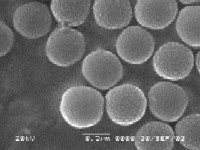
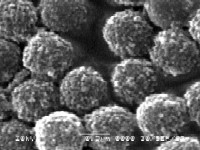
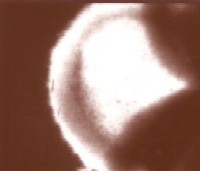
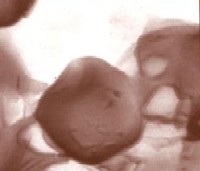
Magnetic fluids are colloidal dispersions of magnetic nanoparticles that are stable with respect to gravitational and moderate magnetic fields due to their small particle size and to unbounded aggregation due to their surface coatings. My research focuses on using these magnetic nanoparticles as building blocks to synthesize advanced materials. I have explored radiation and chemical crosslinking as a route to induce clustering in magnetic fluid in a solution phase. Templating technique has been adopted to create 3-D magnetic structures with interesting properties. Electrostatic interaction between the magnetite nanoparticle and the oppositely charged template is exploited for particle adsorption. Cross linking of particles on the template surface and dissolving the template leads to the formation of magnetic nanostructures. Polystyrene beads and mixture of surfactants have separately been used as templates. Also controlled precipitation of a second material like titanium yield bimetallic structures. I am also trying to model the behavior of these magnetic structures under external magnetic field.
 |
 |
 |
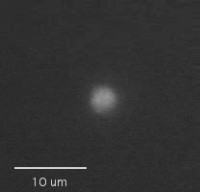
| Plain Polystyrene Beads |
Polystrene Beads Coated with Magnetite |
Magnetite Coated PS Beads Coated with Titania |
|
 |
 |
 |
| A |
B |
C |
| Surfactant Templates (Icosahedras (A,B ) and Discs (C) ) Coated with Magnetite Nanoparticles |
|
 |
| Potential energy surface of a magnetic ring composed of nanoparticles under external
magnetic field. The minimum energy configuration of the ring is when the applied field is in the plane of the ring. |
|
|
|
