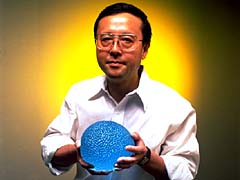
Discover Magazine, July 1996, Photograph by Len Irish
Toyoichi Tanaka is the Otto and Jane Morningstar Professor of Physics at the Massachusetts Institute of Technology and the chief science adviser to Gel Sciences in Bedford, Massachusetts.
Since coming to MIT 19 years ago, Dr. Tanaka has carried out research on the basic principles of gels. In 1973, when he was a postdoctoral fellow working with Professor George B. Benedek, the group discovered that the network of polymer fibers within a gel was moving. They observed the thermal motion of the fibers with sophisticated laser scattering techniques.
Professor Tanaka is the creator of smart hydrogels. In 1978, Professor Tanaka's gel research group discovered the extraordinary phenomenon of a gel that experienced a very sudden expansion--an abrupt swelling--as the concentration of liquid (acetone) in the gel reached a certain critical value. The next year, the group discovered how to make a gel with its fluid concentration fixed that would experience the rapid swelling at a critical temperature change.
Imagine a bowl of Jell-O suddenly swelling to 1,000 times its volume or shrinking 1,000-fold. Smart hydrogels are a new class of soft materials that, in response to a tiny change in temperature or light, a solvent, or another environmental stimulus, will swell up to several thousand times in volume or shrink that much. They can undergo these volume changes on a moment's notice or slowly--whatever speed is designed into them.
Discover Magazine, July 1996, Photograph by Len Irish
The discoveries have been non-stop. In the early 1980s, the MIT gel researchers discovered that slight changes in chemical pH, tiny changes in electrical field, or a pulse of ultraviolet light could do the trick. Then in 1990 came the light fantastic--a gel that twitched when a pulse of visible blue light from an argon-ion laser passed through. Their discovery was reported in the journal Nature in July, 1990.
In 1990, Professor Tanaka received the Vinci d'Excellence in France for his work. His other honors include The Award of the Polymer Society of Japan in 1986 and the Nishina Memorial Prize in 1985.
Professor received the 1994 Inoue Prize for Science, awarded for outstanding achievements in basic sciences in general and given each year to a scientist under the age of 50. The award, established in 1984 to honor Setsuko Inoue, consists of $20,000, a gold medal and a citation. It was presented in Tokyo in February.
Professor Tanaka and his colleagues envision a host of possible applications for their light-activated gels: robot actuators, for example, or even fiber-powered "engines." It is possible to imagine light-triggered optical shutters based on the gel technology.
The many other conceivable applications of physically activated gels in general, says Professor Tanaka, include temperature, chemical, and electric field sensors; diapers and absorbers of toxic chemicals; fluid switches; oil recovery and desalination systems; and even implantable drug-delivery devices.
Tanaka is trying to train these swell gels to release pharmaceuticals, like insulin, or suck up toxic wastes. The first product to incorporate a smart hydrogel is a golf shoe liner that expands to match the contour of the foot inside the shoe, the trigger being the foot's temperature. Tanaka also wants to build artificial muscles out of smart hydrogels. "A muscle just expands and contracts," says Tanaka, "and that's what these gels are quite good at doing."
< Previous | Tanaka Introduction | Next >