August 25,
2017
More joy
from the geniuses who are working on the Commonwealth Avenue bridge over the
Massachusetts Turnpike. They seem to have gotten an idea from the european roadways that separate bikes from cars, so there
is now a separate bicycle stoplight at the intersection of the jug handle.
Trouble is, they are still working on the rightmost two lanes and have them
blocked off. And they have timed the lights so that one should not turn right
to go around the jug handle when the light to go straight on Commonwealth is
on, and one should not go straight when the green arrow to turn onto the jug
handle is on. The result is indecision and delay from motorists trying to do
the right thing. One wonders why they have turned on the traffic lights in
configuration for the whole intersection, before they have all of the roadway
online.
August 24,
2017
So what do we do with Afghanistan? It is
certainly a very tough nut to crack, since it’s people don’t seem to care very
much about their own condition or even safety, but they resent foreigners
telling them what to do. President Trump seems to be adopting the failed
policies of his predecessors.
Sixteen
years ago, they allowed a foreigner to set up an attack on the United States
that killed about 3,000 people (not all Americans) in New York and a much
smaller number in Arlington, VA. And did substantial property damage as well.
For that, the United States would have been justified in doing to them what we
did to Japan in the middle of the Twentieth Century: demanding unconditional
surrender of the country and backing up that demand with nuclear force. But we
didn’t and, despite President Bush’s disdain for Nation Building, he went for
Nation Building. It hasn’t worked. The Taliban is back. This is a group that
should be anathema to any person with any respect for civilization. After all,
these were the people who blew up statues that had sat in caves in the
mountains of the country for millennia (in the name of a doctrine of their
religion that demands eliminating ‘graven images’). They, of all people, should
have been treated like we treated the Nazis who had run Germany in the early
and middle years of the twentieth century: they should have been determined to
‘never again’ be allowed to have any power, or even to show their faces in
public. Nazis are not allowed in public in Germany, even if we tolerate little
bands of them in the US.
But I
digress. The Taliban is back and, if we don’t do something, they will take on
Afghanistan again. Maybe they will learn to keep their terrorist ways to
themselves this time, but one has to be guilty of wishful thinking to believe
that. But we really need to consider if it is up to us to prevent these bad
guys from taking power in another country. I would argue that their background,
including the attack on the United States sixteen years ago, gives us the right
to interfere in the politics of their country. So now the question is, do we
really want to do it? I think we should and we must. But then, we also have to
ask the most important question of all: how many American kids are we willing
to get killed in this noble quest? And I don’t think the number is very large.
I also don’t think it needs to be very large.
Of course it is water under the bridge, but at the
time, I think a much better position for President Bush to have taken would
have been to tell Afghanistan that it was responsible and must pay for the
damage it had done. Seventy five or so Billion dollars
for the World Trade Center, a few million bucks for each of the 3,000 odd
people they killed, and a fee for collections that might have, added up, made
the whole thing a respectable fraction of a trillion bucks. But still a lot
less than we have spent so far. Yes, you say: they didn’t have and will almost
never have that kind of money. All they have is rocks. But there will be value
in those rocks. What we could have done (and could still do) is to identify
where the valuable rocks are, kick all of the Afghans out of the regions where
those rocks are located, and mine the rocks. We need no pretense that we are
being friendly to the Afghans; we do not to do any ‘nation building’; and we
don’t even have to mix with them. All we have to do is make it clear that no
Afghan gets anywhere near our mining operations. This solves our current problem of
not being able to tell good guys from bad guys. Just make sure we have no
locals in the locality.
The other
thing that we could and would be justified in doing is hunting down and killing
all of the Taliban and Daesh. But that would expose
our guys to a lot of danger, and I am not sure I would want to do that, even if
all of our guys were volunteers. And there is always the practical problem of
identifying the bad guys, who would almost certainly do sheep’s clothing when
we close in. But morally it would be right.
I have no
idea how long it would take to mine 100 billion dollars
worth of rocks from the country. But our making it clear that this is our
reparation would make the point
that you should not allow people like Osama Bin Laden to use your territory to
do what he did to the United States. And, while it would certainly stoke low
level resentment, it is hard to imagine that a move like this would generate a
whole lot more motivation for terrorism than we have now.
So after the unfortunate happenings in
Charlottesville, Virginia, and perhaps even before, we find people advocating
removing statues of people associated with the Confederacy and the rebellion
against the United States in the middle of the nineteenth century. i guess people don’t think that taking Robert E. Lee’s
house and farm and turning it into a cemetery was enough retribution. They want
to erase his memory too. This strikes me as a bit like the Taliban taking down
the big Buddha statues in the Bamiyan hills, and Daesh destroying the Roman ruins at Palmyra. Faced with
some cultural remains you don’t understand or perhaps disagree with, you
destroy them. I suppose there is a certain logic in that. But this sort of
thing can go both ways. Do we all want to let temporary advantage lead to
permanent loss of all of our cultural history? I should think that putting up
statues of Lincoln, MLK, Arthur Ashe and Venus Williams in the town squares of
the south would be a better thing to do.
August 23,
2017
Well, we have had another DDG get run into by a
commercial ship, with loss of life. This one is the John McCain, named after
the Senator’s father, who ran the air wing of the Navy during the second world
war. Just about the same time, the Navy
cashiered the CO and Exec of the Fitzgerald, which had a similar accident a few
months ago. This morning we hear that the Vice Admiral who commands the seventh
fleet has been relieved. I remember a few decades ago when Pan Am had two bad
accidents in the pacific, the Chief Pilot, who is in charge of training, was
fired. I guess when you run a big, important organization with safety
implications, you run a serious risk. It is a lot less stressful being a
college professor…
And a couple of weeks ago we got the word that Senior
House will be used by graduate students starting this fall, which means all of
the undergraduates will be kicked out and re-assigned to other dormitories.
Many of them are unhappy, many alumni are unhappy and even a couple of parents
have written angry letters. So everyone is calling for Cindy’s head. But not
the Provost, who thinks she is doing a good job. I think I agree. At least she
took her time and considered carefully the situation before, first, preventing
freshmen from living there last year, and then when the situation did not
improve, taking the move she just did. This was unlike Chuck Vest’s precipitous
move back in 1994. I have suggested, both to Cindy and to Marty, the Provost,
that it might be time to revisit the 1994 decision. No answer to that
suggestion yet.
August 19,
2017
Today we
have dueling demonstrations in Boston (I am not attending), one in favor of
freedom of speech for the alt-right, neo-nazis, the
KKK and so forth. The other demonstration is against the foregoing groups of
people. I think both of these are profoundly wrong. The alt-right consists
mostly of losers: people who don’t seem to be able to make it and blame their
own failure on things like affirmative action, preference for other people, and
generally dislike of people who are doing better than they are. This is, I am
convinced, why some people hate Jews, who tend to be smart, prosperous and
generally make substantial contributions to our society. If you are a badly
educated, lazy white guy who can’t get a good job, perhaps you would be anti semitic too. Doesn’t make it right. On the other hand,
one of the fundamental precepts of our (American) society is freedom of speech.
It is un-American and wrong to prevent people from saying their piece. We will
never be able to make good public decisions if we can’t have a robust debate.
And that means both sides must be able to make their case. Without, of course, breaking heads.
We have seen
a bunch of very bad things going on recently: like the violent demonstrations
made by lefties the have prevented people like Charles Murray from speaking on
college campuses. One suspects that the real reason the lefties don’t like
Murray is that they know he is right, and that violates their world view. President
Trump seemed to be trying to say something like this, but he does not appear to
be very good on his feet and he was not able to make the argument very well.
And that he didn’t denounce the neo-nazis and the KKK
quickly enough gave the lefties the opportunity to say that he is on the wrong
side. And the press was not about to acknowledge that the anti-fa people were
present at the riots in Charlottesville.
This is
something I sent to my state rep (Frank Smizik),
state senator (Cynthia Creem) and Governor Charlie
Baker. Frank had a minion respond, Creem responded by
noting that the problem was resolved (they kept the roadways out of service for
only about two weeks, but word is they will do the same thing next summer.)
Nothing from Charlie.
I write with a few
questions about the road reconstruction project involving the Massachusetts
Turnpike and Commonwealth avenue. As I suspect you already know, some of your
constituents have been sorely affected by the difficulty in getting from
Brookline to Cambridge because of this work. I do understand that maintenance
is necessary, and sometimes major work needs to be done. But my observation
indicates that complete closure of Commonwealth Avenue over the whole distance
from Kenmore Square to Packer’s Corner and closure of the Cottage Farm Bridge
were both un-necessary and unduly burdensome on the public. So here are my
questions:
First, given
that there are four bridges crossing the lower basin of the Charles River,
notably the Boston University Bridge, the Massachusetts Avenue (Harvard)
Bridge, the Longfellow Bridge and the old Dam (in front of the Museum of
Science), and that the Longfellow is out of service, who was the genius who
decided to close half of the bridge capacity across the lower basin from Boston
to Cambridge?
The other
questions are based on my personal experience. Wednesday, because the last few
days I had spent an abnormal amount of time driving from my home in Brookline
to my job in Cambridge, I decided to walk. As it turns out, walking was about
as fast as driving.That
said:
Second: I
noticed that buses and heavy trucks driving over the Boston University Bridge.
Is there any good reason why cars could not also be allowed to drive over the
bridge?
Third: I
also noticed that the approach from the east to the bridge was functional (I am
sure that is how the buses I observed got to the bridge). And that part of
Commonwealth avenue to the east of the bridge was also functional. Why did the
powers that be forbid traffic from crossing the bridge and from using those
parts of Commonwealth Avenue?
Fourth: And related. Why was Commonwealth avenue taken
out of service for the whole stretch from Kenmore Square to Packer’s Corner? It
would seem that Kenmore to St. Mary’s Street and St. Paul’s Street to Packer’s
Corner might have been allowed to stay in service, even if the (by now very
short stretch near the crossing over the Massachusetts Turnpike were to be
taken out of service).
And Fifth:
Why are buses allowed along Commonwealth Avenue in those parts where cars are
not allowed?
Let me
allege my own guess as to the reasons for all of this: it is because the people
who run traffic in the Commonwealth are similar to the United States
Transportation Safety Administration: they want to show that they are the boss, and
the way of demonstrating this is to provide maximum dis-accommodation to the
public.
This
situation requires that someone get fired. I hope you can figure out whom, and
follow through. Please let me know who has walked the plank.
August 1,
2017
This note
went to my congressional representative plus both senators. Some time in May.
None responded. I note that, as of some time in July, both Etihad and Emirates
have satisfied the TSA and laptops can indeed go there (and come home). But it
illustrates how little thinking we get out of these people. I also note with
some alarm that General Kelly, the Secretary of Homeland Security who
threatened to make this laptop ban universal for international flights, is now
Chief of Staff at the Trump White House. Good that he is out of Homeland
Security, but who knows what sort of mischief he might do when he has the ear
of the President…
Word has
gotten out that laptops may be not allowed in carry on baggage on flights from
Europe to the United States, as they are now not allowed on flights from
certain airports in the Middle East.
This would be absolutely unacceptable to me
and to many of my colleagues, and I hope you can talk some sense into the
Administration and to the TSA. Let me give you my objections:
1. Time on an aircraft, particularly on long
flights as from Europe, is very valuable time. I get things done on such
flights. And everyone else I speak with does too. Forcing us to not have our
laptops would cause us to waste all of that valuable time.
2. A checked laptop is a stolen laptop. What
the TSA is likely to be doing is asking us to not take our computers with us at
all. And when traveling for business that is not acceptable either. We all know
that you cannot trust valuables in checked baggage. It is forbidden to lock
your checked suitcase (or to use TSA approved locks, to which all of the
thieves have keys).
As I am sure you are also aware, the measures
taken by the TSA are mostly just harassment of honest travelers. The charade
they go through at the airport is nothing more than ‘security theater’.
Fortunately, all of the things that they forbid in the cabin are harmless (e.g.
swiss army knives). If the bad guys want to bring
down an airplane with a bomb, they will check the bomb. If they really want to
prevent bad things from happening to an aircraft, they need to use ordinary,
rigorous police work. This is known to work, has worked in the past, and will
prevent terrorist activities.
I value my skin too, and have no desire to
have someone bring a bomb on an airplane. But this proposal has no value in
preventing a bad guy from bombing an airplane, and would cause substantial loss
of time and property.
I don’t want you to think that this is a
minor matter. It is a big deal and a matter on which I will vote. I want to
hear you complaining loudly to the TSA about this matter, and I want the
President to hear about it.
March 25,
2017: On the way to St. Martin.
I am
reviewing an NAP report on electric utility system robustness and reliability.
I just made a comment that the airline industry has done a really good job of
reducing the incidence of airline disasters by paying attention to each one and
making sure the last one doesn’t happen again. But then look at governments:
airline cockpit doors still are absolutely impenetrable, even after that German
Wings copilot committed suicide, along with a whole airplane load of people, by
locking the captain out.
Speaking of
governments: the United States and United Kingdom have both, in their wisdom,
decided that travelers can’t carry their laptops or tablets with them on
flights from certain countries in the Middle East. this is going to be
problematic, as it is about impossible to imagine traveling on a 15 hour flight (as in from Dubai to Boston) without my
laptop. The ‘responsible’ authorities give only very vague reasons for this, as
if they have caught someone fitting a bomb into a laptop. And of course they
have demonstrated they are not good at catching these things. So now a
terrorist will check his laptop in Abu Dhabi, take it out of his checked
baggage in Zurich and blow up the next flight… What this will do is cause me to
take British to Abu Dhabi. I sleep on the AUH/LHR flight anyway. i think that Etihad and Emirates should be very unhappy.
And talking
about TSA futility, there is a debate raging on the CSAIL discussion remailer
about a comment that Richard Stallman made, suggesting that in the event of a
manual pat-down, he would ask that a woman agent do it, because as it is now, only gays get to
appreciate being searched (I paraphrase). Others think that Richard is being
insensitive to the poor TSA agents, who may not really want to do this. For
about the first time in my life, I agree with Dr. Stallman. We don’t engage in
slavery in this country and TSA agents are doing that job of their own
volition. For many of them, getting paid to be the equivalent of a schoolyard
bully must be the ideal job.
And the
first attempt to repeal the ‘Affordable Care Act’ has come a cropper. Nancy
Pelosi still owns it. One day in the not too far distant future, it will
collapse (not sure exactly how this will happen, but there will emerge some
parts of the country with no willing insurance carriers and many with only one
such carrier; premiums (premia?) will get very large
very fast and there will be panic. Hopefully it will happen shortly before an
election and we will get a whole new batch of conservative republicans. Then we
will be able to get rid of the damn thing.
March 12,
2017, Beijing
I have
finally gotten around to reading the Faculty Newsletter. In it, Fred Salvucci is waxing frustrated at plans for the Volpe
Center, which include a parking garage. I don’t know if it is true that Fred
was instrumental, or even involved, in preventing Logan Airport from building
the second 15/33 runway, but his writing makes it plausible: he seems to be
hostile toward any form of transportation that works well, and favorable to
modes like the MBTA, which absorb money and do a lousy job of getting people
around. It is good that he is frustrated with the MIT development corporation.
And the
Editorial Subcommittee has a piece disapproving of modernizing our fleet of
nuclear weapons. As if they want most of them to be duds. They say that
modernizing our fleet of weapons would cause the Russians and Chinese to do the
same, and lead to proliferation. Do they think that some country beyond North
Korea is ready to build weapons and is just waiting for us to give the an
excuse? Anyway, they point out, possibly correctly, that a single submarine
full of missiles could cause global climatic change through putting a lot of
soot into the air. A possible cure for global warming?
Very
strangely, I can see blue sky over Beijing. We had a bit of a polluted day
yesterday (Saturday), but Thursday and Friday were very nice. Today looks good
too, but is a bit chilly (11, I think). I understand it is stormy (snow) back
home. This is one of the first times I have experienced warmer than normal
weather when on the road. Usually people are telling me it is warm somewhere
else.
The train
from Beijing to Nanjing was ‘nominal’, meaning it left on time and got in on
time. Very comfortable (we were in Business Class). And they even fed us a
decent meal. It was good that I had Chris with me, as I would not have been
able to negotiate the taxi cab.
March 15,
2017 Nanjing
It took an
hour standing in line for the fellow from the Industrial Liaison Program
leading me in China to get our train tickets from here to Wuxi. Fortunately, he
was able to get tickets for the rest of our itinerary at the same time. This
seems to be a bug in the otherwise great high speed
train system here in China. In many cases one can use a machine to buy tickets,
but strange cases, like us foreigners, must use ordinary ticket booths; and
that takes time. While Graham was in line, the fellow manning his booth took a
break, leaving people standing. That does not seem right, but it is the kind of
treatment one might expect from a government.
Nanjing is a
kind of neat city. We stayed in the Westin hotel, which is very nice, except
for it has inadequate elevators. Last night, at CC’s insistence, we went to a
famous restaurant which has two locations. Our driver took us to the wrong one;
and then we wandered around for some time before we found the right one.
Interesting look at Nanjing night life, which appears to be quite lively for a
Tuesday evening.
January 30,
2017
London
(Heathrow). Editorial in the Wall Street Journal this morning pointed out that
growth in the United States economy (GDP, I think) was about 1.9% in the last
quarter of Mr. Obama’s administration. Over Obama’s term in office, the economy
grew at about 1.8% on average, from the depths of the ‘great recession’ that
ended the G.W. Bush (43) term. That is close to what the economy achieved,
ending with the depths of the great recession.
It is
interesting that the press will report these numbers with a straight face,
adding that the Obama term coincided with the longest period of growth in a
long time (maybe since the very slow growth of the Roosevelt administration?).
Business does have cycles, and if Obama managed to iron out the wrinkles in the
economy, he did it by suppressing growth spurts so there were no corrections to
be made. Because of the slow growth in the economy, limited by Obama’s
regulations, many people in the United States have had no increase in real
income since well before he became president. There is no wonder many people
are sore. But the Press seems to want to channel their anger to the Republicans
in Congress rather than where it belongs, with the Obama Regime. The editorial
(review and comment) pointed out that what Mr. Obama did was focus on
redistribution of income rather than growth. And of course that is what
Obamacare is: redistribution. That is taking money from someone and giving it
to someone else. It is a bad (inappropriate) word. A better word for that kind
of activity is ‘theft’.
And today
there is a flurry of news about Mr. Trump issuing an executive order excluding
citizens of several Moslem majority countries from entering the United States.
Among the first to be ensnared by this were a couple of former Iraqi folks who
had served as interpreters with the US military. This gave the lefties an entry
to asking for a court order (an injunction?) suspending the president’s order
for a week. The executive action could have been done much better. For one,
while Iran supports terrorism in many places, it tends to not use its own
citizens: is sends money to outfits like Hizbollah.
So we are targeting the wrong (largely harmless) people. Second, to the extent
we (the academic establishment) in the United States) can attract bright iranians to come live in the US, we have removed the same
bright iranians from Iran. I think the government of
Iran knows this, and makes it difficult for its students to come to the Us for
graduate school, even if it doesn’t admit such. Anyway, my observation about
this lends credit to neither side. Mr. Trump has painted with a very broad
brush in an attempt to keep islamic terrorist lowlife
out of the US. The lefties are using the courts to get the islamic
lowlife into the US, and neither side understands that we need, not the lowlife
but the high class people of the islamic
world (as we need the high class people of the rest of the world as well).
So, after
Mr. Trump has been office for a week (I have been outside of the US for the
whole week), he has appointed an outstanding cabinet, issued a number of really
stupid executive orders (this one on immigration, the Mexican wall), made a
weak start at crippling Obamacare, and done not a whole lot about Obama’s
running rampant. And I haven’t heard of a pardon for Scooter, which should have
been his first action.
And there
has been a lot of hand-wringing about what to do about Obamacare. Some of the
weaker members of the Republicans in Congress want to have some sort of
replacement before they repeal the ACA. They shouldn’t. The medical business in
the US would work better with the complete absence of the kind of interference
represented by Obamacare. They should focus on getting the government out of
the way and let free enterprise run. The first step would be a clean repeal of
the ACA, and then the Republicans in Congress should go looking for other laws
and regulations that interfere with providing medical care. Protection for
makers of generic
drugs for example. If there were freedom of entry to the market of, say,
‘epi-pens’, the maker of those things would not be able to get away with big
price increases because another manufacturer would enter the market and
undercut excessive prices. (OK: I am repeating Econ 101, which really does
work).
With respect
to health care, let people buy health insurance that is real insurance (that
is, you buy it when you don’t need it so that when you need it you have it). Opening up
the insurance market would obviate he issue that the lefties think is cured by
the ACA, with the exception of the people who complain about ‘pre-existing
conditions’. And most of those would be fixed by letting competition in. In
Massachusetts, like in many other states, laws like ‘certificates of necessity’
protect existing hospitals and let them set arbitrary fees and room rates. Get
rid of them and hospitals would become more affordable. One must remember that those who are
winners from the Affordable Care Act are recipients of subsidies that come from
people who were coerced into buying care policies at inflated prices by the
fines that John Roberts call taxes.
The
newspaper I picked up in London was talking about the impact of increases in
the prices for cancer drugs, mostly generics, in the United Kingdom. The
increases are not attributed in the paper, but I suspect it is because they
come, mostly, from the United States, where generic drug manufacturers are
protected from competition by FDA rules and regulations. But in the United
Kingdom, increases in drug prices don’t mean that people will become
impoverished to buy their cancer medicines: it means they will die because the
National Health Service won’t buy those drugs. Think about that as the result
of nationalized medicine.
December 26, 2016
Now the lefties are trying to delegitimize Mr.
Trump by noting his conflicts of interest, as if the country didn’t know who
ran the Trump hotels and casinos. They are also huffing and puffing at his
cabinet appointments, suggesting that he is ‘re-stocking’ the swamp. Brings to
mind the Engineering adage that ‘when you are up to your ass in alligators, it
is sometimes hard to remember you are here to drain the swamp’. It appears that many of the appointments the
lefties are objecting to are the kind of people who will do substantial damage
to the Obama legacy. But we see no particular reason to think that they will do
the kind of dumb things that the Obama administration has done. Maybe just
different kinds of dumb things…
This morning I did the online check-in thing
for our flight south in the morning. American Airlines web site wanted some information
about the passengers, including passport number, birth date and passport
expiration date. As it turns out, I had entered, when buying the tickets six
months ago, passport expiry dates wrong by one day (I had conflated the
effective date of the passports: mine was effective on June 11, 2013 and
expires on June 10, 2023. I had entered June 11, 2023. But of course I didn’t
know that when the web site demanded that I correct the date. So I called AA.
The reservation person couldn’t help, but she passed me on to a ‘tech support’
person who led me through correcting the original record, which I was able to
do from the check-in page. There is good news and bad news here: Since I could
have corrected this myself (and eventually did), I didn’t really need to call
AA. The other is the same: if I wanted to give them bad data, all I had to
remember was that the bad data had to be entered consistently. Of course I
would have been found out the first time someone actually looked at our
passports. The good news is that AA had people who could help and had the
patience to lead me through correcting things. Kudos to AA for that.
December 20, 2016
The talking heads and lefties are still
confused and bitter about the election in the United States. They even appeared
to think they could derail Mr. Trump’s election by subverting individual
electors. But it didn’t work as the Electoral College met yesterday and voted
as they had been instructed. The same set of people are musing about Russian
interference in the election. They can’t understand why they lost. They do
realize that Mrs. Clinton was a lousy candidate. Not likeable, dismissive of
others and not particularly articulate. But what they don’t understand, and
neither does the mainstream press, is that she would have represented a third
term of Mr. Obama. No way would the American people return that fellow to
office. Nor his surrogate. It is cheap for me to say this now, of course, but
it would have been unthinkable to have another term of that way of running the
country.
I don’t know the details yet, but the press is
suggesting that Mr. Obama is invoking a 60-odd year old law to remove,
permanently, offshore lots from oil exploration. Of course his motive is to
damage the economy of the country, but he may not succeed. We don’t need to tap
all of the possible oil reserves of the United States now. Eventually we may
need those reserves, but there will be time to change the law so our
descendants can drill there, eventually. Possibly that will happen after the Middle
East has been tapped out.
Speaking of the Middle East: we had three
terrorist attacks yesterday. In Zurich someone shot up a mosque. In Ankara, a turk (probably religious) shot the Russian ambassador to
Turkey dead. And in Berlin, someone killed a dozen people with a truck, running
them over in a marketplace. While I know nothing of who might have done the
deed in Switzerland, I wonder what these terrorists are thinking. They seem to
be saying that they object to the treatment of Moslems in western societies.
But what do they think that this makes the rest of us think of Islamic people?
From the behavior of Islamic State and its fellow travelers, many of us might
conclude that Moslems are bloody nuts. I know better, since I have a number of
associates who are themselves Moslems. They are not murderous nuts. But it is
to take note that many westerners don’t have a lot of contact with people of
different religious backgrounds. And the behavior of the Islamic State and its
fellow travelers won’t do much for the status of people from Islamic lands in
the western world.
12/3/16: Munich
I made a quick trip over here to visit an LGO
student and site. Lufthansa is using A340-model 600’s on the Boston/Munich run.
On the way over, I noticed that the seat, while it reclined fully, was
uncomfortable. Some of my complaint was fully justified. The seat is narrow and
comes to a sharp point at the foot end. But now as I look at the console, I see
that there is a control for ‘firmness’. I wonder if my problem with the bed
being uncomfortable had something to do with that.
Lufthansa had a strike on when I came over, but
that did not impact the Boston to Munich flight. And it seems to be over now. I
didn’t notice any cancellations on the boards in the airport.
We pushed about 20 minutes late due to, the
Captain said, some late arriving connecting passengers. But he also said we
have a quick flight plan and will be in Boston on time. We will see. It was
foggy this morning; clear and cold when we took off. Just below freezing.
I generally rent small cars and did so this
trip. Got a Ford Fiesta. But with the way they drive on the Autobahn, I wonder
if I should move up a bit. That little Ford was just able to make 160 and no
more. Unfortunately, we are seeing speed limits on much of the roadway system.
This A340-600 is a real nice airplane. I
particularly like the ‘Flight Info’ display that shows a variety of views,
including realistic cartoon views of the ground with legends pointing out
places.
We got to Boston almost an hour ahead of
schedule (LH must really pad their schedules!) and of course there was no place
to park. So we spent half an hour on the taxiway waiting for a gate. I was
still early getting through immigration and customs, but Commonwealth Coach was
there waiting for me.
The lefties still haven’t gotten over the
election. Apparently, Mr. Trump will appoint a retired general, a fellow named
James Mattis, to be secretary of defense. If I have
this right, Mattis was forced out by Obama three years
ago because Mattis has strong views and wasn’t taking
the (Obama) party line on Iran. He is going to have a bit of a fight in the
Senate. Trump’s chose for Treasury, Steve Mnuchin, is
getting negative press because he is a wall street type. This is odd since
Trump, the press implies, ran against Wall Street and now they are giving him
grief for being inconsistent. I wonder which way they want it: does Trump
appoint ‘yes’ men, in which case the press criticises
him for that, or does he appoint good people, in which case they will accuse
him of being inconsistent. I guess that is part of the political game.
I got a note from Cindy Barnhart (the
Chancellor), also prompted by the election, declaring MIT’s support for
‘undocumented’ students. In the past, I thought that MIT would not register a
foreign student without the proper visa, and had advised students on that
basis. I wonder what Cindy has in mind. Will we now let a student who comes
with a tourist visa register and worry about getting an F visa later? Or is
this just for long term scofflaws? I intend to keep this letter close at hand
for the next time someone in the Dean’s office tells me that a student should
be given extra time on an exam, despite my best judgement, and tells me I have
to do it because ‘it is the law’.
November 29, 2016:
Today the newspapers are calling into
question Mr. Trump’s honesty, citing a few whoppers and exaggerations he has
made during the campaign and since, including his accusation that there were a
lot of illegal votes against him in a few states, which is why he lost the
popular vote. The newspapers cite any lack of evidence for such illegal voting
but don’t present any evidence of their own. One might wonder why the left was
so dead set against voter identification before the election, but now, without
voter identification, they can claim that there were no illegitimate votes.
What would have happened if there were some real means for identifying
legitimate voters?
And then, if one wonders about the
legitimacy of the Oval Office, go ahead and explain to me this: ‘If you like
your health plan, you can keep your health plan’. That was not only a lie, but
a lie told to the American people to get a particular law passed.
There are a couple of words that have
me annoyed. One is ‘progressive’, as applied to politicians of the left, Like
Bernie Sanders. That fellow is not ‘progressive’: he is a throwback to Williams
Jennings Bryan. The cheap money fellow. The other word I have a problem with is
actually two words: ‘working class’. Particularly leftie politicians use this
to mean ‘lower class’: people who didn’t do well in school and who have no
particular skills, but expect to make a good living with an unskilled job. Like
bolting fenders onto automobiles. People like this are easily, and
increasingly, being replaced by robots. I understand their pain. What I object
to is calling them ‘working’. As if I don’t work.
November 12, 2016:
An interesting editorial in the Wall
Street Journal before the recent election: actually dated November 1. By Rodney
Nichols and Harrison Schmitt. The title, ‘The Phony War Against CO2’ is perhaps
a bit too strong. I would not have used ‘Phony’, but maybe ‘Misplaced’ or
perhaps even ‘Ignorant’. I know some of the ‘CO2 warriors’ and they
are not bad people. We won’t get anywhere without some informed discussion.
Just what is bad about warming the climate up by a few degrees? Nichols and
Schmitt point out that there are benefits to agriculture. On the other hand, a
rise in sea level would not be good for people living, perhaps unwisely, right
on the coast. And, eventually, we will need to find alternatives for petroleum
as a transportation fuel. Fortunately, we can (and I believe will) rediscover
nuclear generation of electricity, so we won’t all freeze in the dark when we
run out of coal. Anyway, it seems to me that we need to consider the issue of
carbon emissions in more depth and more carefully than we have so far.
The reaction to the recently completed
presidential election is kind of amusing. Large numbers of kids (mostly, I
suspect, first time voters) don’t apparently think much of the democratic
process. They are out on the streets protesting and some are throwing bottles
at cops. Not the sort of behavior one would expect of people who believe in the
democratic or republican process. And the Globe this morning had the brass to
be critical of Mr. Trump for not condemning a few whack jobs who drove around
saying nasty things to people who were easily identifiable as Trump opponents. I
am old enough to remember when Richard Nixon was elected (and re-elected), and
there was a fellow who merited protest.
But then the adults in our society are not behaving well either. I have
read of colleges somewhere that cancelled classes (or was it just exams?) to
allow the students to grieve. At least MIT didn’t do that.
On the other hand, Mr. Trump is already
‘going wobbly’ on us. There is speculation in the newspapers this morning
suggesting that he might be willing to continue the very worst parts of the
‘Affordable Care Act’, AKA Obamacare. If you can wander down to an HMO and sign
up for a policy once you get sick, why bother to buy insurance in the first
place. In fact, it ain’t insurance if that is
possible. I won’t repeat the argument, but it should be clear that the ACA
should be repealed completely. It was passed illegitimately in the first place,
was (and is) unwise, and does not address the fundamental problem, which is
that government regulations have made health care more expensive than it should
be. Look at the self-imposed problem with ‘epi-pens’, which are so expensive
because the government protects the manufacturer from competition. Mr. Trump
made repeal a major part of his platform, and I hope he follows through. On the
other hand, I will forgive him if he doesn’t build the promised big wall on the
southern border. I might have to follow through on my threat to open a ladder
factory in TJ.
August 31, 2016:
Another round trip on Jet Blue. This
one to SFO to visit a sponsor. Flew out in a regular (‘extra length’) seat.
Back on the ‘red eye’ in MINT, which appears to be like international business
class. It is configured a bit like Swiss International: where there would be
three abreast, they do alternate one and two seats, and so can achieve recline
to flat. This was good. But Jet Blue has not gotten the rest of Business Class
right. Meal was no great shakes, although the flight attendants were good and
attentive. And again they messed up and didn’t mark me up for TSA Pre, so I had
to deal with one of their louts. The fellow allowed a woman in a hijab to go
through a metal detector but put me through the nude-o-scope. And gave me lip
because I had my boarding pass in my pocket. And seemed insulted when I told
him I knew what I was doing.
I still don’t understand what the story
is with pieces of paper in pockets. We see photos of people with knives wrapped
in newspapers being detected by these millimeter wave imagers. Why are they
sensitive about single pieces of paper in a shirt pocket? Oh, yes. I know: it ain’t about security or viability of screening. It is about
knowing who is the boss. I don’t think that Jet Blue as an organization
understands how frustrating it is for their passengers to deal with the TSA.
This negligence on their part will affect my choice of airline in the future.
On the way home yesterday, I was
accosted by another bicycle advocacy group. I sent them this editorial that had
been prompted by something that appeared in one of the local newspapers:
This fall will mark the fifty first anniversary
of my bringing a bicycle to Boston to commute to work. Over that time I have
been a bicycle commuter, a recreational cyclist and a bicycle tourist. In
addition to the Boston area, I have ridden to work in upstate New York and toured
in several countries in Europe, including some of the most bicycle friendly
countries like the Netherlands. Given this extensive experience, I claim
expertise in the use of bicycle paths.
 We seem to
have four choices when it comes to use of bicycles for transportation: First,
we can accept bicycles as vehicles on public roads. Second, we can paint
special bicycle paths along the side of roads, visibly taking space from lanes
used by automobiles. Third, we can have bike paths that are separated from traffic.
And fourth, we could emulate what countries in Europe do, like the Dutch, and
have bicycle roadways that are completely separated from roads reserved for
automobiles and sidewalks, with their own traffic signals. The solution we seem
to have adopted here in Boston is the worst possible one of those four choices.
We seem to
have four choices when it comes to use of bicycles for transportation: First,
we can accept bicycles as vehicles on public roads. Second, we can paint
special bicycle paths along the side of roads, visibly taking space from lanes
used by automobiles. Third, we can have bike paths that are separated from traffic.
And fourth, we could emulate what countries in Europe do, like the Dutch, and
have bicycle roadways that are completely separated from roads reserved for
automobiles and sidewalks, with their own traffic signals. The solution we seem
to have adopted here in Boston is the worst possible one of those four choices.
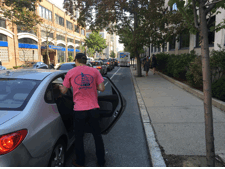
Nearby is a picture I took recently, of a
bicycle path running along Saint Paul street, near Commonwealth avenue. Shown in that picture are two of the problems
that occur with this sort of bike path. In the distance, you can see a delivery
truck using it as a parking place, and that forces bicyclists to move left,
into traffic. The other thing you might notice is a car that has stopped to
pick up passengers. In many cases the car door occludes the bike path, again
forcing the bicyclist to either stop or to veer around the car into traffic.
The good folks who facilitated that picture were unusually clueless (they stepped
right out in front of me). This sort of a bike path, painted on the pavement to
the left of a curb with no physical separation from the roadway, is an
invitation to bad behavior, like the delivery truck parked across the bikc path and visible in this picture. In other parts of
the city, bike paths are painted just to the left of parking lanes. We
bicyclists don’t like those lanes because most of such bike lanes is in the
‘door zone’, where a careless motorist can open a car door right in front of a
bicyclist. In such a situation, the bicyclist has two options: to hit the car door or to swerve into
traffic.
Another problem with these painted on the
street bicycle paths is resentment of motorists. When that path along St. Paul
Street was established, it reduced that street from two lanes to one, making
the right-turn arrow useless and causing traffic to back up. In this case, the
motorists are right: the bicycle path is making their commute worse. With the
right turn lane in place, delivery trucks did not stop where they do now and
traffic worked much better.
A somewhat less bad alternative is the bicycle
path that is separated from the roadway. MIT has built a couple of these along
Vassar Street in Cambridge. the principal difficulty with such paths is that
they are separated, physically and often visibly, from traffic going in the
same direction as the cyclist. But there are often a number of intersecting
roadways and driveways. Traffic crossing
the bike path often does not even notice the bicyclist whose path it is about
to cross. In addition to this, these paths are very often confused, by
pedestrians, as sidewalks. MIT made this problem worse by combining the bike
paths with sidewalks. Pedestrians will walk down the bike path, often several
abreast, slowing down the cyclists severely.
The solution most cyclists would think ideal is
to have completely separate bikeways, with traffic lights assisting them in
crossing the roadways. This is used, apparently to great effect, in cities in
Europe. Such a solution would be fine were we to have the space. But we don’t.
So my solution
is to erase the bike paths and make it clear to motorists that the bicycle is
here to stay and must be allowed to ride on the street.
August 13, 2016:
Discovered that the reason we were
having issues with Jet Blue and the TSA has to do with JB’s inability to
properly handle ‘Extra Seat’. So we will travel without Extra Seat until we
hear they are doing better. This winter I have managed to score tickets with AA
using frequent flier miles, so this problem is in abeyance for a while.
I am in Delhi, waiting for a flight
home through Dubai on Emirates. Indira Ghandi Airport
is a first class place; or at least Terminal 3 is. Clean and slick like
airports in most first world places. And of course India is striving to become
a first world country. It has a ways to go. I was here with the Tata Center and
visited IITB and several industrial firms. Stayed in a couple of Taj hotels
(President in Mumbai, Taj Mahal in Delhi). Those are first class hotels. That
said, the roads here are not very good and the drivers are, mostly, real jerks.
Maybe this has to do with inadequate roads, but the drivers will put their nose
out in front of an oncoming car just to get the advantage, even if they block
traffic for some time, and even if they risk a collision. Things are
complicated by the large number of three wheeled vehicles that serve as taxis:
they look like motorcycle tricycles with covering. And bicycle rickshaws. And
handcarts. And the occasional sacred cow. There are pockets of crummy hovels (I
won’t say ‘poverty’ because I understand some people choose to live that way).
There are many hovels built on top of garbage heaps. And a non trivial number
of roofs covered by blue tarps held down by old tires and rocks.
The Indians are doing some very interesting
things with their electrical system. It was restructured, sort of like the
British did a couple of decades ago: generation companies operate independently
of transmission and that operates independently of distribution. But the
government has a hand in all of it. They are introducing large numbers of LED
bulbs (I think they bought several hundreds of millions of 9 watt LED bulbs to
be sold to consumers and paid for with savings from their electrical bills.
They will be doing similar things with ceiling fans and irrigation pumps.
June 26, 2016
Checked in with Jet Blue for our flight
to SXM. The Jet Blue web site is a bit flaky but I got it working: passports
entered, trusted traveler numbers in, and printed boarding passes. Both of our
passes from Boston to JFK are marked for TSA Pre, but for the run from JFK to
SXM, only mine is so marked. Jan’s is not. This will not make much of a
difference this time because we don’t have to deal with the TSA in New York: we
should arrive inside the security perimeter. But it will cause some difficulty
if it happens on the way back. Our customer loyalty to Jet Blue is somewhat
weakened by their stopping the run from SJU to SXM and by little fumbles like
this. We may return to AA.
On the way back, Jan’s boarding pass
was not marked for Pre when I printed it from the web, but when we checked in
at the airport it was.
June 25, 2016
Well, the Brits have voted, clearly but
not decisively, to leave the European Union. Lots of talk about it, but it doesn’t
seem to me that many people understand what happened. Maybe I don’t too. But it
seems as if, and I have heard this said, that many people were frustrated by
the rules and regulations propounded by the Bureaucrats in Brussels. That and
an influx of foreigners, like Polish carpenters who might have been willing to
work cheap. I also suspect that many of the folks who voted to exit may have
been resentful of all of the Moslems that have moved into Britain and are
causing trouble. But those people are the result of the Empire, now gone, and
secondarily of the Commonwealth, also now mostly gone and should not be blamed
on the EU. Anyway, it will be interesting to see what comes of this. I don’t
think very much, although the stock markets of the world panicked yesterday. I
think they will come back.
The US Supreme Court got it half right
this week. They ruled against Obama on his illegal immigrant flyer. Actually,
they tied and so refused to rule for him and so let the Circuit court decision
stand. But he still is refusing to do his job and send many of these illegals
home. And they did rule in favor of Affirmative
Action at the University of Texas. The administration at MIT is crowing about
this, since it appears to avoid some meddling in admissions decisions, and MIT
filed a ‘friend of the court’ brief. It won’t make a big difference, but I
continue to be puzzled about how the left has concluded that in order to avoid
racial discrimination one must discriminate against people on the basis of
race. Which is what Affirmative Action is.
Another SCOTUS action they are talking
about on Bloomberg Law is about breath and blood tests of folks the Police
accuse of drunk driving. If I understand it correctly, the Court ruled that
forcing a breath test without a warrant is OK, but that, under the fourth
amendment, the police must get a warrant before doing a blood test. This seems
to me to be about right. My reading of the fourth amendment is that the framers
wanted to avoid destructive searches (back then the authorities would, on pretense of
searching for evidence, bust someone’s house up). A blood test is invasive,
while a breath test is not, so there is at least some rationale for drawing the
line there.
June 19, 2016
Changzhou, Jiangsu Province, China. I
am staying the night in the Shangri-La hotel here. Very nice joint that I have
been to before. Well appointed, clean and classy. Nice breakfast. I don’t know
how much it costs, however.
While the wi-fi
is open and works fairly well, I am having some issues, and I wonder if the
Great Chinese Firewall has come to life here. I have been trying to download a
book from Amazon for a couple of days: ‘Nobody’s Fool’ by Richard Russo. I have
no idea why or if the Chinese authorities might have something against Russo. I
managed to download the sequel, ‘Anybody’s Fool’, but it took quite a long
time. I will see if the problem is with the channel or with Amazon after I get
home, hopefully later today. Another cause for suspicion, all of a sudden,
Cisco AnyConnect, the VPN that MIT uses, is not connecting. It has worked
everywhere else in China, but I wonder if the authorities are wising up. I have
noticed popup ads for ‘China VPN’, with implication that this is a way of
finding web sites otherwise unavailable in the country.
In the news today is further anguishing
among the governors of the Fed over whether or not to bring interest rates back
to normal. This is interleaved with an observation that mortgage rates are
lower than ever and people are starting to refinance, take money out, … The
makings of another bubble like we had burst nine years ago. The Fed doesn’t
seem to observe this and insists that low interest rates are necessary (or
justified) by the fact that the US Economy isn’t working very well. They don’t
seem to understand that their regime of low interest rates is not working.
When I was in college, I took Economics
as my HASS concentration. I got Microeconomics and largely stuck with that for
most of the subjects I took. (I also used Economics as my doctoral minor, so I
have taken eight subjects in that general field: I think that means I am almost
as qualified to comment on this field as someone who majored in Economics as an
undergraduate). Macroeconomics, on the other hand, I just didn’t see. I am
thinking now that this was not my fault, but the fault of my professors who
taught Macroeconomics, which I now regard as utter nonsense. The notion of
aggregating everything in the economy never did make any real sense. The Fed is
proving that right now. They are stumbling around in the dark, using real
numbers that, in the aggregate don’t add up, and making decisions that are, at
best, meaningless and probably seriously harmful. What they are doing does not
work, but they insist on doing more of it (or continue doing it) because they
don’t know any better and are incapable of observing that it is not working. It
is sort of like the Democrats, who pursue policies that put people out of work,
hoping that unemployed or underemployed people will vote Democrat. One would hope
that the Democrats understand what they are doing, but I suspect some of them
are so dumb that they don’t know the implications of their policies.
Also in the news today is the word that
the Iraqi army has recaptured Fallujah from Daesh.
This is good, but the news does not say if they captured or killed any
substantial numbers of the bad guys, or simply let them run away. There is news
of complaints by Sunni leaders in the town that members of the Shiite militias
are detaining Sunni men. Of course, Daesh is made up
primarily of Sunni men (I understand they hate Shiites), so it is reasonable
that, having detained a Sunni male person, the Shia militia would want to ask
about that person’s recent activities. It also seems to me that our objectives
with respect to Daesh, or ISIL as Mr. Obama prefers
to call the, should be to kill every one of them we can. Given that some of
them will surrender, we have a place in Cuba to put them.
June 18, 2016
I am in Dongguan, Guangdong Province,
China. It is quite warm here, with air that looks unstable. In a Silver World
hotel right on a pretty little lake. We came down here on China’s high speed
rail. For the first leg, I got to ride in ‘business’ class. This has seat
spacing like the finest European trains: two seats on one side of the aisle,
one on the other. And in this train the seats fully recline. I actually got a
couple of hours of sleep. That was to Wuhan. From Wuhan to here, we were in
‘first class’ Four abreast and adequate leg room. Food for sale but really not
very good. Would have done better to buy a sandwich in the station. Ride is
good and the trains are fast and run on time. My principal grief with them is
that the rest rooms are what one would expect in China: grubby and there is no
paper to dry your hands with.
The Silver Lake hotel here in Dongguan
is fairly nice, with big, clean rooms and a good restaurant. The variety of
food at breakfast is enough to keep me happy. The principal issue with the room
I am in is that I can’t find any supplies for making coffee or tea. Most hotel
rooms in China (and many in Europe) have a hot water pot and a small supply of
tea bags. This room doesn’t even have a coffee cup. It does have a hot water
pot.
When I arrived in Shanghai; actually
when we were driving away from Pudong airport, I
discovered there had been a terrorist bombing in the airport. Not a major one:
a beer bottle full of firecrackers that injured three or four people with
flying glass. Fortunately there were no fatalities. John Hu, my host here,
heard the bang. No big disruptions and I didn’t know about it until after. One
suspects that in an American or European airport the whole place would have
been in lockdown for several hours. Jan
didn’t even know about it until she saw my message and heard my voice mail.
That was largely because it happened about the same time a deranged Islamist
shot up a gay bar in Orlando, killing 48 and hurting a number of people. It may
be extravagant to call the fellow an Islamist terrorist since he appeared to be
a loser: one of those folks who might have become a TSA agent. He was born in
the United States to immigrants from Afghanistan, and his father, who is still
alive, sounds like a piece of work himself. I really don’t know how the fellow
managed to kill so many people: he apparently had to reload his weapons
multiple times and was not tackled or hit over the head by a chair while doing
so. And apparently there was no, in the words of the ARA guys ‘no good guy with
a gun’ present.
And Disney world has a problem: they
let an alligator kill a 2-year old visitor on one of their inland beaches. Now,
after the fact, they are rounding up ‘gators and ‘euthanizing’ them. Fine
example of locking the barn door. The plaintiff’s lawyers are rejoicing in this
one.
Anyway, while it would be apparent that
this incident at the gay bar in Orlando should rebound to the benefit of Mr.
Trump (and it probably will), the lefties seem to think it will do the gun
control cause some good. So Hillary and Obama are making hostile noises about
‘common sense gun control’, as if they had never read the Constitution. I
wonder if, while we are amending the Constitution by law, if perhaps we could
think of two things. The first is that most, but not all of the Terrorist
incidents in the United States over the past decades have been religiously
motivated. And that is not just Islamic motivation, but that of the Roman
Catholics and some Evangelicals over Abortion as an issue (remember the guy who
shot up Planned Parenthood in two locations in Brookline several years ago, and
a couple of incidents in which physicians who do women’s health care have been
shot dead?). Maybe rather than violate the second amendment we should think
about violating the first amendment and put some pressure on religious
organizations to behave and tell their people to lay off folks who are not
members of their particular sect. And maybe we should get them to pay taxes on
their real estate.
The second thing is citizenship by
birth. I know it is enshrined in the US Constitution, but if we are going to
start ignoring the Constitution about weapons, we might as well go whole hog
and start deporting bad people who just happen to be US citizens by birth if we
can find a place to send them to. In the case of the Orlando shooter, that
would be Afghanistan. It would be easy to say that an immigrant who acted as he
did in the years before this incident would have been deported. But then we
might consider that woman who was half of the San Bernadino
shooters, who was actually admitted to the United States, despite being known
to be an Islamic whacko.
Shortly before I left for China, I got a
message from the MIT administration saying that it is concerned about the
relatively low graduation rate of students living in Senior House. They won’t
let freshmen live there this fall. This brought to mind a little history that I
was a minor part of:
In the fall of 1994 (was it that long ago?) a
freshman named Scott Kreuger who was a pledge at Phi
Gamma Delta drank himself to death in the fraternity house. President of MIT
Charles Vest, perhaps under the influence of his Chancellor at the time,
Lawrence Bacow, decided on collective punishment
against the independent living groups (chiefly fraternities at the time) and
ruled that all freshmen should live in MIT on-campus housing. To accommodate
the increased number of students living on campus, Simmons Hall was rushed to
completion, involving months of ‘round the clock construction and much expense.
My part of this was that, several years earlier, I was part of the Committee on
Academic Performance and noted that we were kicking out a disproportionate
number of PGD members. I should have raised a flag then. The other thing was
that, when Chuck made the ruling about freshmen living in dorms, I made enough
of a stink that I was called into Larry’s office and told to shut up.
The reason I think that Larry was to blame in
Chuck’s decision about freshmen was that, some time
before the Kreuger incident, a committee led by Molly
Potter (course 21, I think) recommended to the Faculty that freshmen be
required to live on campus. Larry was part of that committee and spoke in favor
of Potter’s motion. I spoke against it and my side won the resolution. Having
failed in the Faculty meeting, they managed to get Chuck to do it by fiat. This
was part of the end of the Faculty Meeting as an important element of Institute
governance.
Back to the story. Recently, it came to the
attention of the MIT administration that students were doing drugs and,
consequently, doing badly academically at, first, Bexley
Hall and then Senior House. Bexley was closed and
torn down, we were told, because of structural defects. The residents were
disbursed to other locations on campus. In the fall of 2016, Senior House will
have additional staffing but no freshmen. One might notice a bit of an
asymmetry here. When a problem arose in the fraternities, (Kreuger
was, admittedly, not the only problem noted among the independent living
groups, just the most spectacular) all of the independent living groups were
punished. When serious problems arose in Institute run housing, focused
solutions were found and used.
MIT refuses to release, ostensibly on privacy
grounds, grade point averages aggregated on a group-by-group basis. But it is
reasonable to expect that many of the independent living groups are at least as
good at nurturing good academic habits among their students as the dormitories.
(Is that why MIT won’t release the data?)
It is long
past time to revisit that hastily arrived at decision with respect to where
first year students can live.
June 5, 2016:
Had a busy term. The limo company I
referred to in December is Commonwealth Coach. Their first driver took a few
minutes to find us (early in the morning, before light), but then the rest of
our relationship has been fine. I haven’t used Uber very much since I can call
these guys ahead of time. They bill my credit card and send timely invoices. And their cars are definitely nicer than any
taxi.
I wrote to Charlie Baker about the
Cambridge end of the Cottage Farm Bridge. Several months ago. No response and
they are doing the same damn stupid filling in of the developing cracks with
asphalt.
Went to the MIT commencement on June 3.
The speaker was an actor named Matt Damon. A fellow fairly famous because he
grew up in Central Square, went to but did not graduate from Harvard, and
starred in Goodwill Hunting, in which he plays a janitor at MIT who just
happens to be a math genius. Local kid who did good, I guess. But he is one of
those self-righteous lefties who thinks highly of Elizabeth Warren and accuses
bankers of theft. Not sure where that particular problem comes from, but the
guy makes me think less of actors.
So a few idly determined numbers. There
has been a lot of talk in the press recently about TSA induced airport delays.
So think of it this way: if we assume a person lives 90 years, on average, that
is 788,940 hours, or about ¾ of a million hours. The average person killed in
an accident or tourist incident would therefore lose about 3/8 of a million
hours of life. According to the Department of Transportation, on a seasonally
adjusted basis, there were 67.38 and 66.79 million airline boardings
in the United States in the first two months of the year, which would indicate about 800 million
boardings per year. Were the TSA to delay each
passenger by 1 hour, that would be, in sum, the equivalent of just over 1,000
person-lifetimes. Or it would be the equivalent, in lost life, of over 2,000 people
being killed at, on average, at mid-life. That is the equivalent of 10 aircraft
carrying 200 people each.
One can’t determine how many terrorist
airplane destructions the TSA may have deterred, but in view of the fact that
they have yet to catch a terrorist actually in the process of trying to take an
airplane down, it would seem that they are wasting a lot of people’s time in
screening and waiting in line for screening. And this is in addition to an
unknown (at least unknown to me) number of people who, faced with the hassles
of the TSA, drive in automobiles rather than fly. Some of those people will be killed in auto
accidents. I know that I have driven to New York a couple of times, rather than
flying. Fortunately, I and my passengers survived the trip.
December 26, 2015:
We are getting ready to head off for a
few weeks in a warm place. I just had a nice conversation with a local limo
company, arranging for pickup and delivery. I think I was dealing with a
relatively small limo company which I will not name yet – will see how they do.
But the telephone conversation was very pleasant, and the fellow there asked
about our return, so we have them booked for both directions. The cost will be
about what a taxicab would have charged. The car will be a limo: hopefully more
comfortable than a taxicab, and the contrast between the person I spoke with
and the taxicab dispatcher is remarkable. This brings to mind an op-ed piece in
the Globe the other day, written by a former mayor of Cambridge, suggesting
that Uber is a bad thing because it competes with taxicabs. We now have so many
options for getting around that it is hard to see why we still have taxicabs.
These poor guys operate under severe government regulation, have to pay the vigorish for a medallion, and really are not checked for
background issues. On the other hand, Uber drivers are known (and so are their
customers: a real security plus for the drivers. I hope that, with pressure
from Uber, Lyft and the limo services, the price of medallions will wither away
to nothing. Perhaps the traditional taxi dispatchers will all go out of
business and the new app based dispatch systems will cover all taxicabs. This
is one government backed monopoly that has a good chance of going away. Former
mayors of leftie communities like Cambridge notwithstanding.
Several years ago, I wrote to (then)
Governor Michael Dukakis about what I considered to be an unsafe practice by
the Public Works people: they had paved over the expansion joints on the
Cottage Farm bridge. With a couple of thermal cycles, the paving material
cracked and formed a hole. So they put more asphalt into the hole, making the
problem worse. The Governor turned over my note to his chief of DPW who sent me
a snarky note saying, in essence, that I am an idiot and the stuff they were
putting in the joint was ‘elastic material’. Subsequent to that, they have
rebuilt the bridge, narrowing the approaches and making Rush Hour even worse,
to the point where I use the Massachusetts Avenue bridge when I leave MIT at
rush hour. I can usually avoid morning rush hour by coming over either early or
late. However, I have noted that in the rebuilt bridge they did the same thing:
you can see where the expansion joints are located, because the pavement has a
different color. But it is deteriorating in just the same way, leaving large
potholes. And the DPW is filling those potholes in with asphalt. I wonder if I
would get the same snarky response if I write to Charlie Baker. ?
December 15, 2015:
So I am in the Ukraina
hotel again. Room 1859: maybe as high as I have been in this hotel:
overlooking the Moscow River and the White House. I could see the Kremlin but
there are other buildings in the way. Weather is what one would think of Moscow
in December: light snow with the temperature just below freezing. Prices here
are quite cheap. The Rouble has fallen by a factor of
more than two since oil prices started collapsing, and inflation in Roubles has not caught up. We had a long taxi ride back
from Skoltech this evening, due to both the taxi
driver and me missing a turn. A ride that should have been 600 Roubles turned into 1250. But that was only about $18. This
year would be a good time to take that vacation in Russia, if one wanted to
vacation in Russia…
Back home (I do get the news here),
there is this zany stuff coming out of the government. On learning of the flood
of refugees from Syria and the large number of people from other countries
seemingly wanting to emulate the Syrians, a large number of governors of US
states, including our own Charlie Baker, have expressed an unwillingness to
house many middle eastern refugees, citing security for their own citizens. The
federal government feigned outrage, calling those governors (or at least their
positions) ‘un American’ and insisted that these refugees are very well checked
out before they are allowed to come to the US. And given what we did to those
Vietnamese and Iraqi translators who we left behind to the tender mercies of
our enemies in those countries, this sounds right. But then we have since
learned that the female of the couple who shot up the party in San Bernardino
was easily spotted on social media as a jihadist, if only the State Department
had bothered to look. So people emigrating from the Middle East (the woman was
from Pakistan and Saudi) are not as carefully checked as Obama told us. Well
this is not the first time, nor likely will it be the last that what Obama has
told us is not quite the truth.
All of this is good news for The Donald
and his supporters. And that is good news for Hillary and her supporters. And
that is bad news for the United States.
December 13, 2015:
Heathrow lounge. As usual, I am early
for my flight to Moscow. BA really needs to add to the capacity of its lounges
here at Heathrow or risk making angry its business class passengers. Breakfast
is ok here, but the place is crowded.
The news is awash with tales of a
conference going on in Paris about ‘climate change’ (AKA ‘Global Warming’).
Delegates from a large number of countries seem to have come to an agreement
that would limit global temperature change to 2 C. And it appears that they
have everyone on board. This leaves me with a few questions. First, how do they
know what needs to be done to establish that 2 C limit? Second, why do they
think they can bind the various countries? Mention is made of binding the
United States without involving Congress. How, I wonder, can that be done? I
know no way of actually binding the US without a Treaty, and to ratify a
Treaty, you need a super majority of the Senate. Mr. Obama might agree to
something, but his word ain’t worth much; there is only
so much he can do by executive order; and he is toast in just about a year. Yet
another reason I am concerned about Mr. Trump, who looks to be trying to get
Hillary Clinton elected President; that would be a third Obama term.
And the discussion of climate change is
referring to ‘since pre-industrial times’. That is problematic too. Literature
talks of ice skating on the polders in the Netherlands. (In fact, I think there
is mention somewhere of ice skating on the Thames). That would involve
temperatures substantially below freezing in those locations, which never
freeze any more. Now, maybe, ‘climate change’ involves larger changes in
temperature in some
places rather than others. And it does seem as if it is getting
warmer in the colder parts of the planet: high altitudes and high lattitudes, where glaciers and sea ice seem to be melting.
But then Europe already seems to have had substantive warming in the last 200
years. Finally, given the very broad
extent of different climates, how does one establish an ‘average’ temperature?
I suspect there is ample room to suspect that we don’t know what we are doing,
and all of these international actions are being taken without an understanding
of what the consequences might be.
December 12, 2015:
So now I am at Heathrow, in the Sofitel
next to Terminal 5. This is a really good setup: the hotel connects to the
terminal with an indoor corridor that is about 100 yards long, so I can make my
flight in the morning with some certainty. My flight from Boston was
uneventful, and I actually slept almost all the way, so Jet Lag has been quite
minor. I made the road trip up to Sheffield and back, driving on the wrong side
of the road, without incident. But it was a miserable drive: rained most of the
way, and on the way back I was stuck for about 40 minutes by an accident. On
the drive up, the GPS app I bought for my iPhone was speaking to me in
Indonesian. So it was of little use. Fortunately the car had a navigator built
in and I used that to get me to Sheffield. After reaching the safety of my
hotel room in Sheffield I had to fuss with this app a bit to force it to speak
English. This app (called ‘Sygic’ )
cost twenty bucks, and I had no chance to try it out before I got here. There
are no gas stations near this end (The Terminal 5 end) of the airport; at least
none visible from the obvious route, so I found a couple of gas stations in the
area using Google Maps and programmed the zip code for one of them into the
iPhone app. It took me right past a Shell Station. And then I programmed the Hertz
zip code in and the app took me from the gas station to the Hertz station. So
now my remaining issue is that the holder for my ‘phone isn’t very stiff and it
vibrates.
When the Hertz driver learned I was going
to the hotel rather than departure, he insisted on dropping me at the front of
the hotel. Guy gets points.
And I guess the Donald is starting to
sound stupid. (Well, ‘starting’ is not the right word, but he is now really
taking the cake.) Wants to exclude Moslems from the country. As if he could
tell who is a Moslem. I guess some countries include that information on
passports. I wonder if Donald has read the Constitution recently. Or paid
attention. But the guy is making my point: I think he is a stalking horse for
Hillary, and I suspect he knows it. Does Hillary know it? Is this a conspiracy?
December 9, 2015:
I am at Logan airport, preparing to fly
to England and, eventually, Russia to finish up the term at Skoltech.
Going through the TSA screening was the same old, same old; the TSA people
being self-important and inefficient. A fellow came by while I was in line,
riding in a wheelchair. He got out of the chair and walked through the
nude-o-scope. The wheelchair went around the search mechanism. Goodness knows
what might have been hidden in the steel tubes that made up the structure of
the thing. The guy was re-united with it after the search/non search. I hope
the guy wasn’t a plant. And I hope there wasn’t any ammunition in the structure
of the wheelchair. The TSA certainly doesn’t know.
And one wonders, if the nude-o-scope is
all that good, why
can’t it tell the difference between a belt and a bomb? Just asking. This whole
thing brings to mind Shakespeare. ‘It is a tale told by an idiot, full of sound
and fury, signifying nothing’. Hey, Jeh! Are you
listening?
While I was on the line, waiting to go
through the nude-o-scope,
a Lufthansa crew came by, passing everyone in the line. I moved a
bit right, into their way. One of them pointed out that it was important that
everyone in the crew should stay together. I failed to point out that this
would have been the case if they had taken their proper places in line, but I
did make it clear to the fellow that the rest of us in the line were annoyed. I
understand it is politically incorrect to make negative comments about people
based on their group identities. I know this counts for anyone who might be
characterized as a member of an ‘under-represented minority’ (UOM). But does it
count for Krauts?
We are going through a couple of cycles
of fire alarm testing: ‘may I have your attention please, may I have your
attention please’, followed by an explanation that there would be a test of the
fire alarm system: please disregard. So then the test consisted of a voice
saying we should ‘stand by’. Then an all clear. Then it happened again.
And while on fire alarms, the holiday
party for the Skoltech/MIT crowd was interrupted by a
fire alarm in the Stata Center. These things happen often enough that it is my
inclination to ignore them. But more stable minds in the crowd suggested we
should pay attention and leave the building. So we did and went home. I
understand I missed the best part of the party, after the alarm. Sorry about
that.
December 6, 2015:
We have had a couple of terrorist
incidents here in the United States, that have been compared to what happened
in Paris a couple of weeks ago. One was in Colorado Springs and involved a
loser shooting up a Planned Parenthood clinic. Of course we had one of those in
Brookline, MA some years ago. (Planned Parenthood has moved, and my dentist is
in that office now, so I visit the site of that crime a couple of times a
year). In both cases only a few people were killed, with some others injured. The
Government of Mr. Obama was unwilling to acknowledge that this incident was
terrorism, but of course it was.
The second incident was in San
Bernardino, CA. A couple of Moslem extremists, one born in the USA and the
other a Pakistani who lived for a while in Saudi, shot up a holiday party at a
state office building, killing 16. Interestingly, the Pakistani is a woman who
was married to the American. In this one, the Obama regime desperately wants it
to be a ‘lone wolf’ incident because nobody saw it coming. They might be right,
since it looked like Amateur Hour. The perps tried to get away, but then when
the police stopped them they provoked a fire-fight and the police killed both
of them. Fortunately, no police were seriously hurt in that gunfight. One might
speculate that if NSA had still be connecting telephone metadata (‘dots’), that
maybe they would be able to see something, and perhaps could figure out how
these folks acquired all of that ammo. This is still on the news, so there may
be more to this.
All of this news seems to be good for
Mr. Trump’s ambition to be President. Every time there is an incident involving
gunfire, Mr. Obama makes more statements about ‘common sense’ gun controls. (He
don’t need no stinkin’ Constitution). And a bunch of people go out and buy a gun.
Good for the firearms business.
Several days ago, I got a letter that
appeared to be from the government’s Office of Personnel Management. It was
about a cybersecurity incident last spring in which some perps managed to steal
a whole bunch of personnel records, including data such as social security
numbers. This letter said my information was among the records stolen. I
presume this is related to a security clearance that I have had since I was 19
or 20 (that makes it 50 years old), and that was renewed in 2013. This letter
from OPM included a 25 digit PIN and directed me to visit their website so I
could sign up with a monitoring company, presumably to watch for fraudulent
transactions involving my financial data.
So I went to that web site and started
to fill out a form to get this monitoring started. But I stopped when it asked
me for my social security information. I won’t fill out that form. First, why
should the OPM need to have this information when they had it and acknowledge
it had been compromised while in its possession? Second, how do I know this is
not an elaborate and well performed phishing expedition?
When I did a google search on OPM, I
discovered that I am not the only person concerned about this very issue.
Further, apparently some crooks have been designing phishing expeditions based
on this information compromise.
November 17, 2015:
Shanghai Pudong
Airport. I have been in China for several days, principally to attend a
robotics conference on behalf of John Hu. I am still suffering from the cold
that I must have caught in Russia, that manifest itself on the Saturday after I
got home and that has a really good cough as a symptom. I think it is
lessening, and I am half convinced the schnufmittel I
bought before leaving for China made the symptoms (particularly the cough) worse.
I am still snuffling.
Anyway, I let John buy me tickets that
went BOS-ORD-PVG-CAN and, going home, in reverse. The conference was in
Dongguan, a city between Guangzhou (Canton) and Shenzhen. When there, I learned
that the airport in Hong Kong has a ferry terminal and there is ferry service
between there and Dogguan. Next time I will insist on
doing the nonstop BOS-HKG on Cathay Pacific, or at the outside flying nonstop
from Boston to PVG. These days with four
airports in them are killers. But China Southern was very good in both
directions. I had a bowl of beef noodles coming up and it will do for both
lunch and breakfast. Arrived at PVG about 11:30 AM to discover that American
will be checking in about 14:35. Yet another reason for flying some other
airline. Maybe I should have taken a later flight to Hongqiao
and made an adventure of getting across town. Too bad they didn’t run the
maglev train between airports.
And, speaking of that, Doug Parker, the
Chairman of American Airlines is leading a multi airline charge against the
three Gulf airlines: Etihad, Emirates and Qatar. One should note that these
outfits are running circles around AA (and UA and Delta). It is unlikely that I
would ride AA to Abu Dhabi, even if it did fly there, but it seems a bit
unseemly for the guy to complain about being out-competed on a run he doesn’t
even fly. Next time I go to the Emirates I am flying British Air. Not to avoid
Emirates or Etihad, but because I want to stop in London on the way back.
Somehow I don’t think Mr. Parker swings much weight with the US Government. At
least not enough to have sanctions taken against his competitors. I note that
AA has been making a relatively big deal about new cabins on its aircraft. The
777-200 I rode over had the same old Business Class cabin I have become used
to, with seats that recline short of horizontal. At the same time, I can note
that British is flying some of its A321’s with excellent, new Club World cabins
with seats that do, indeed, recline to horizontal. That, along with BA’s
Arrival Lounge makes the 5:35 flight out of Moscow tolerable.
The conference was kind of interesting,
although I didn’t understand very much of it. Mingguo
Zhao was there and he introduced me to a fellow who makes robotic toys in Dogguan. Yesterday we had an interesting tour of his
factory. I collected a few business cards that might turn out to be useful.
Over the time we were here, there was a
bad terrorism incident in Paris. The guys who are trying to establish a
caliphate in Syria and Iraq have figured out the French security people. Mr.
Holland ranted and raved and, as I understand it, dropped a few bombs on Raqqa.
Obama is as ineffective as ever. I am beginning to think that the fellow is,
through weak and deceptive, ineffectual action, trying to buy time for the bad
guys.
October 31, 2015: Moscow.
I am here to do some teaching at the
new, emerging Skolkovo Institute of Technology. I am
staying in the Radisson Royal Hotel, AKA Ukraina.
This is one of seven spectacular buildings built after the second world war:
apparently Joe Stalin liked this fabulous architecture: spires and towers and
so forth. A few observations.
This hotel has a number of restaurants.
The number is hard to discern, however, because at least one listed in the
hotel directory of services has no location, and the one on the second floor
that does an excellent breakfast doesn’t do dinner. The first floor bar does
have good food as well as local beer on tap, but I think most people just go
there to drink. I had dinner in the Italian joint on the 30th floor.
But the last time, the waiter forgot my dinner and was surprised when, after
presenting me with a bill that had the dinner dish on it, I was miffed at him.
No tip for him.
Uber works in Moscow, but in many cases
you should have a map to tell the driver where you are going, at least if, like
me, you don’t speak Russian. Uber X cars are very much like taxis and turn out
to be cheaper. Sometimes. My ride from this hotel to the Skoltech
campus costs something liken300 to 400 Roubles. The
ride back in ordinary taxis (for some reason I can’t get Uber out there, but
the staff at Skoltech can call taxis that meet me
there and take me back to the hotel) cost between 450 and 600 Roubles. That is still cheap, with the Rouble
at about 63 to the dollar. The ride is about 19 km.
The Ukraina
is, despite its appearance from the outside quite a nice hotel. Rooms are not
very large but very well appointed. Complementary internet works well and the
staff is quite friendly. As I said, the Veranda restaurant on the second floor
does a very good breakfast.
Some other things on my mind from the
last couple of years.
The BU bridge has finally been
renovated. In line with my rhetorical question about ‘do you want your health
care run by the same people as run the BU bridge?’: after about two years in
service, the gunk they put into the expansion joints is coming out and there
are quite deep potholes over on the Cambridge side. This is the same problem that
I referred to during the Dukakis administration. I don’t know if Charlie will
cause any reform in this respect, but it does seem to reflect on the public
works people in the state.
And this year we had the first real
impact of all of the anti-terrorist measures taken since 9-11-01. The very
secure cockpit doors we forced the airlines to install resulted in an airplane
wreck that killed all aboard. A suicidal copilot on a discount carrier in
Germany waited until the captain had to pee, locked him out and crashed the
airplane in France. I do admit that the American carriers I have observed don’t
leave a pilot alone in the cockpit: they station a flight attendant in there
when the pilot needs to use the head, but I am unsure if this is a universal
practice. I hope the Germans have started to adopt it.
MIT appears to be up to a bunch of
things that may lead to trouble, but I am unsure if the administration actually
means it or is just being masterful with PR. On the one hand, it appears that
MIT has joined the national hysteria over ‘unwanted sexual contact’ (aka
‘Rape’). The administration is talking about handling accusations of this
nature using specially designated members of the Committee on Discipline (COD)
(those who presumably will agree to be a hanging jury) and have even more staff
within ‘S cubed’ to handle such matters. This all leads to concern for things
like due process and basic fairness. But it is quite possible that, when an
actual case comes around, the good people who form the COD will use common
sense. I hope so.
And there is a new document sent around
by Rafael last week that declares MIT to be fully on board with the climate
panic. It is interesting that this document also declares that MIT will not
divest itself from its investments in energy producing companies. The show of
panic may have been meant to fool the students who are demanding such
divestment. It also declares a whole bunch of initiatives that would result in
lowering carbon dioxide emissions, both from on-campus activities and to
develop low(er) carbon technologies. These will all,
of course, cost money and this is an excellent fund raising document. I wonder if we can handle this and the
nanotechnology building that is abuilding just outside my office.
And speaking of the nano
building: I have missed a meeting or two that might have explained something.
They have dug a bunch of deep, narrow trenches and filled them with reinforced
concrete. That is, they dig these slots with a specialized digger. They hold
the slots open with some heavy goo they call ‘slurry’, then they drop a rebar
cage and fill the slot with concrete, displacing the slurry. So far, so good.
But after the walls were cast, they came along with a tractor mounted
jackhammer and knocked that top foot or so off the wall, then came back and
formed the top of the wall up again, put in more rebar and poured the top of
the wall. Again. I wonder if they made a mistake in dimensioning the walls in
the first place…
September
14, 2013:
Took a
trip to Pittsburgh; out on Thursday afternoon, back on Friday. There were
thunderstorms in the area Thursday, and it is pretty clear that the airlines
and the FAA have gotten no better at handling these things than they were 20
years ago. But we passengers have much more information, so we can see how
badly screwed up things are. The airplane was coming from DCA, and the airline
told us it had departed. Well, it had ‘pushed’, meaning it had left the
terminal, but it sat on the tarmac for about two hours waiting for a clearance.
I could see it hadn’t left the ground by using one of several of those tracking
utilities you can get on the web, but Jet Blue insisted it had departed.
Finally, the little airplane appeared on the tracking sites. And by comparing
that map with a similar view of the weather, we could see what it was doing. It
flew way out of the way to get to Boston (it flew north of Rutland, VT). There
were many other opportunities to avoid the CB’s and, of course, I couldn’t see
all of the other airplanes in the air. But it seems to me that a smarter air
control system could have guided that airplane on a straighter, faster track.
And of course a smarter system would not have left that airplane on the ground
in DCA. As we were going to PIT, the same thing was happening, although I
couldn’t see it since I was on the airplane and did not have access to the Web.
I wonder if the FAA still uses vacuum tubes…
And
Syria is all the talk today. A few days ago, Barak Obama threatened to throw a
few Tomahawks at Bashar el Assad to ‘punish’ him for gassing the opposition,
which seems to be making some advances that are threatening to take over Syria.
Like many people, I have my doubts about this. Assad is a bad guy, but his
opposition is rumored to include a number of Al Queda
types and other such Islamic extremists. People I would want to have nothing to
do with. Of course, if one were to believe John Kerry (the lightweight who just
quit being my Senator to be Secretary of State), Mr. Obama was going to throw
only a few Tomahawks; Presumably just enough to impress Assad. It is to be
observed that there are Christian (and possibly even Jewish) communities in
Syria, and the opposition has been burning churches. Anyway, just before he
left for a road trip, Mr. Obama said he would ask Congress for permission to
use military force, even as he said he didn’t need such permission. Then, after
he saw Vlad Putin, he agreed to let Russia take a shot at segregating and
controlling Assad’s poison gas. Now Obama looks like an idiot and Putin looks
like a smart, nasty, controlling guy. I think both assessments are right, but
this has taken some of the heat off of Obama for all of the other scandals that
are starting to get old, and therefore beyond the attention span of the news
networks. I guess looking like an idiot in foreign policy is better than
getting impeached and removed from office. Now there would be another first for
the guy…
September
1, 2013:
Back
from a trip to Spain, by way of the UK. It is very interesting to note how much
more professional and courteous the screeners of air travelers are in those
countries than are our own TSA folks. Who probably don’t travel much
themselves.
Since we
returned, I had some correspondence with people in MIT’s Office of Sponsored
Programs (OSP) regarding a research project I carried out for the Department of
Energy’s (DOE) National Renewable Energy Lab (NREL). Seems NREL wants some money back
(about $11 k) because I spent more money on parts than were in my proposal. Of
course I spent less on labor and my contract monitor was aware of what I was up
to. No matter: they reminded me that this was a ‘contract’, not a ‘grant’. And
OSP seems to have no interest in arguing the matter once I came up with a
discretionary account number so I am paying the refund. Given the revelations
we have had about this administration using its power (the IRS) to harass its
political enemies, if the cause of this might be someone reading this web page
and making assumptions about my politics. Anyway, whomever is responsible for
this is also responsible for my future refusal to have anything to do with DOE.
And the people I helped with some of the alphabet soup initiatives (REACT, GENIE,
Solar ADEPT…) will just have to do without me. OSP has not earned a friend
either.
July 26, 2013:
Went to the IEEE PES General Meeting in Vancouver. A great venue for
a conference. Vancouver has a really nice conference center on the waterfront.
Had good weather too. Just a few comments on airline travel. I bought first
class tickets for Jan and for me because, at my age, sitting in the back of the
airplane in the very restricted seats they offer is uncomfortable and dangerous
to my health. (I did that on a leg from DFW to SFO last fall and came down with
a spectacular illness that I won’t further describe.) Anyway, at least on Delta
the seats in First Class are not that much better. They are wider and thicker,
but the seat to seat room is not enough to satisfactorily work on a laptop, if
the person in the seat in front reclines. There was a meal on each leg of the
BOS/MSP/YVR/SLC/BOS itinerary, but the meals are no better than we used to get
in Coach (when they fed the coach class passengers). The first three legs were
on time, but when we got to SLC on the way home, we found the flight was going
to be late. In fact, it was four hours late, ostensibly because of a
maintenance item that was not further explained to us. The flight turned out to
be four hours late; it was on an aircraft that arrived in SLC from DFW. One
might have thought that Delta might have had a suitable aircraft that could
have been ferried in from somewhere less than four hours away from SLC. But
that would have cost them extra money, I guess. When I complained they sent me
a nice apologetic note and added 5,000 miles to my frequent flier account. That
is likely a free gesture, since I am very reluctant to fly with them again. As
if I can avoid it.
June
19, 2013:
The
gravel was still there this morning when I left (this morning on my bicycle).
And it was still there when I came home, with the tire marks from when I came
in last evening. But then, rather late in the afternoon, someone came over,
removed the gravel from the groove and filled it with asphalt. It is still not
finished: there is a big pile of dirt on one side of the drive and the asphalt
does not come up to the level of either the driveway nor the concrete pad. My
guess is that they will put a finish layer of asphalt in that space, probably
tomorrow.
 June 18, 2013:
When I
got home from work yesterday, the driveway was blocked again: where the
mismatch between the old driveway and the new concrete was, there was a fairly
deep trench: deep enough that I was unwilling to try to drive over it. It looks
as if they intend to fill that with concrete. I also noticed that they had
damaged the brick gutter along one side of the drive. I don’t know if they have
any plans to fix this. There was no action evident when I left home about 9:30.
When I
got home at about 5:20, that trench was filled with gravel. Since it had been
raining quite hard, the gravel was pretty soft and I left grooves in it when I
backed my car up the driveway. At least they let me do that.
June
16, 2013:
The new
concrete does not match with the end of the undamaged part of my driveway. I
don’t know how or when the town will fix this. There is a gap of about 18”
between the new, concrete pad and where they saw cut my old pavement. My
driveway is not as bad off this way as the neighbors’, which has a gap of more
than three feet. I also noticed that they have poured only about half the
length of sidewalk that has been taken out. Jan theorizes that my complaint may
have prompted them into doing our section first. Some of my neighbors won’t be
able to use their driveways for some time longer. We can get in now, but I
think I won’t move the cars back in quite yet: they may yet do some more
mischief tomorrow.
The
reason we went out was to visit the Immigration and Border Patrol people at
Logan Airport. I have a new passport and Jan needed to go to her interview for
GOES. We were 15 minutes early, but the guys inside noticed us and dealt with
us right away. They couldn’t have been nicer. One did the interview while the
other registered my new passport. We now can both use the entry kiosks.
June
15, 2013: About 3 PM.
They
have started to pour. A bit later, maybe 4 PM, they put a few boards across the
sidewalk so people can cross.
June
15, 2013:
Time
flies when you don’t have much to complain about. On May 30, we had a notice
from the town left between the screen and front doors. Said they were going to
be replacing the sidewalks, that parking would be restricted and ‘you may
experience some inconvenience’. Ok. They might actually have to replace
sidewalks and that is likely to involve narrowed paths for vehicles and so
forth. It is a residential neighborhood. But one wonders why they could not
have waited for a couple of weeks until school is out. Most of the high school
students walk down Greenough Street to get to school.
Then on
June 5 (Wednesday) we get a notice saying that they are going to replace a
concrete driveway apron and we need to get our cars out onto the street before
7 AM on Monday morning. Just about then the contractor ripped out the bottom of
our driveway (with essentially no consultation or even notice to us). Well, I
went email unstable, complaining to everyone I could think of in town
government. On Thursday I got a note from someone named Peter Ditto, a town
employee in Public Works, telling me that the town wanted to work with me. He
even came over to look at the situation on Friday. I pointed out that it would
be difficult to get out to the street on foot, given the damage that they had
done and he promised to, first off, keep me closely informed about what they
were doing and, second, make sure that a good, flat access path to the street
would be maintained.
We have
had a lot of rain and this, I think, screwed them up. On Saturday we got a note
saying that the projected day for the project (Monday, June 10) had been
cancelled.
On
Thursday, June 13, we got another notice, saying the work would be done today
(Saturday the 15th) and that we should get our cars out by 7 AM on
6/15. I figured one car would do, since we have to go over to the airport for
Jan’s interview with GOES. But one car could stay in. Peter assured me that the
pour would be done today, cured through Sunday and that the forms would be
removed by noon on Monday.
About 2
PM on Friday, Jan noticed a big stone blocking the driveway. Turns out the town
employees don’t work after noon on Fridays, even when they have construction
projects, done by contractors, going. I emailed and called Peter, to no avail.
I called the Public Works department and got a recording. It stated a number to
call in ‘emergencies’. That number was not monitored either, but it said that
in case of emergency to push ‘5’. (I think it was 5: a single digit anyway).
That elicited ‘you have pushed the wrong button’ or some such error message.
Along that way I left angrier and angrier voice mail messages. Jan predicts
none will be answered.
At 11 AM
on Saturday they are still prepping. Forms have been built and a guy is running
a very noisy machine around. I think that is a compactor. But nothing has been
poured yet.
Speaking
of GOES (Global
Entry). Here is a government program that works! I saw a puff piece on the
television about what turned out to be a non-existent TSA program to bypass the
intrusive security lines. The reporter said he passed a background check and
got a card that let him go through a special line: no taking off of shoes, no
taking computer out of bag, etc. Well, it turns out that was a myth, probably
TSA propaganda. But I did find this program of the Immigration and Border
Patrol agency that allows you to, when entering the United States from abroad,
put your passport into a machine, put your hand on a window, stare into a
camera and bypass the immigration lines. I paid $100, filled out a
questionnaire (sort of like security clearance lite), and was scheduled for an
interview. When I found the office (it is down an obscure corridor at Terminal
E), I found the nicest possible guy asking me a few questions and then
demonstrating how the kiosk works. Over this past year I have made quite a few
international trips and that hundred bucks was worth it in just one entry at
JFK.
And, as I found out from the
interviewer, the Global Entry program does lead to those shorter security
lines. Once I had my GOES number, I told the airlines about it and found myself
going through the TSA-PRE ™ line. So far, I know AA and USAir have such lines
in some of their terminals and they both know of my GOES number. And the TSA
people running those lines are not the louts who harass other passengers.
October
8, 2011:
Returning
from a trip to Texas A&M, where I gave a speech on hybrid automobiles. Came
down on Continental through Houston. Houston to College Station was on Colgan Airways, dba Continental Connection. Should call
themselves Amateur Air. At IAH on the way there, the time for departure came
and went with no announcement. The flight also disappeared from the
announcement screens. When I asked about where the flight had gone, the person
behind the desk said simply that the time for the flight had come and gone. She
told me the reason for the delay was that they were waiting for crew. It gets
worse, but eventually they combined the flight I was supposed to be on with the
next flight and we got there an hour and a half late. No apologies. Coming back
was similar. The flight before mine had not left when I got to the airport.
They wound up putting everyone: my flight and the one before on that airplane,
which they seemed to have gotten fixed in the interim. There were four
passengers left and we went (a bit late) on the airplane I should have been on.
Colgan flys old turboprop
aircraft that look poorly maintained, and that is probably why they have
mechanical problems with them. I think it is going to hurt United Continental
unless they get rid of Colgan. I will certainly seek
alternatives to them. The good news is that the TSA people in College Station
are actually nice. And the airport there has free internet.
And then
Continental itself got out of IAH for BOS about half an hour late. They blamed
late arrival of the aircraft from somewhere south, but then there was a further
delay for some maintenance item. I think the real reason is over-scheduling
aircraft, leaving themselves not enough margin.
Houston’s
George Bush Airport is a pleasant surprise. It has installed a tramway that
connects four different terminal buildings, inside the security perimeter. I
just missed one, but the headway is only a couple of minutes. Massport should think about doing something like this. And
so should the folks who run Laguardia. Having to go
outside security and submit to the depredations of the TSA just to change
planes is adding insult to injury when you have to fly through one of those
airports.
The
newspaper today notes that Eric Holder is squirming about his apparently false
testimony to Congress. It also notes that the Solyndra
scandal was plain and simple political corruption. One would think that both
situations should result in special prosecutors being appointed, and were it
happening during a Republican administration, the press would be calling for
such. Wanna bet that will happen now? Maybe that is
why there are so many Democrat politicians.
August
15, 2011:
On the
way to DC for some business with ARPA-E. Weather here in Boston is slowing
everything up. The TSA people are their usual: rude and ineffectual. They ran
me through the nude-o-scope, apparently in pique that I didn’t want to take my
belt off (it doesn’t set their magnetic detectors off). Then they insisted in
running my wallet through the x-ray machine. I made a show of counting the
money when it came back. I guess that makes me hostile. I still wonder why,
with hardened cockpit doors, they won’t let me carry my Swiss Army Knife.
There is
a neat U-tube rant about ‘Smart Meters’ and the Spectrum has a piece on them
too. The issue is that the smart meter reports one’s usage of electricity
frequently enough that the activities of the customer can be discerned. This
raises the accusation of spying on individuals. The good news is that this
problem was solved in 1982. Patent number 4,317,175.
July
21, 2011:
The news
networks are abuzz with a threat to power plants coming from committed
terrorists. Apparently some known bad guy has worked in several nuclear plants
and has passed security checks. One would think that, were the government to
put as much resource into police work as it does into harassing airplane
passengers, these guys would be found out.
July
11, 2011:
Radio
reports that, after a Jet Blue flight from Boston landed at Newark yesterday, a
Stun Gun was found in a seat pocket. TSA incompetence is outed once more.
I have
been reading books about the relationship between the hoods in Southie and
Medford (Bulger, Flemmi, Salemme,
etc.): Howie Carr’s ‘The Brothers Bulger’ and ‘Hit Man’ and ‘Black Mass…’ by
Dick Lehr and Gerard O’Neil. These are not kind to the FBI (sister agency of
the TSA), nor to Whitey’s brother Billy, or to Mike Dukakis. I was amused by a
judge in Boston dismissing Dukakis during the 1998 election cycle: ‘How is he
going to stand up to the Russians if he can’t stand up to a corrupt midget from
South Boston?
June
28, 2011:
Brookline
is at it again. Closed the same section of St. Paul Street for Rush Hour. I
went through at 8:30 and they were working on a water pipe that crosses the
street. I wonder if they had given any thought to maybe waiting an hour or so
to let commuters get through. Ah! but that would presume thought on the part of
our public servants…
And
while on public servants, the FBI finally caught James ‘Whitey’ Bulger, who had
been on the lam since 1995. There is a lot of speculation that people within
the FBI actually knew where he had been, and they finally decided to bring him
out of the cold, either because he is old enough and notorious enough that they
won’t be able to bring him to trial or because there are enough young guys
within the Bureau, who were not tainted by the corruption that put him on the
lam in the first place, that the jig was about to be up anyway.
The talk
show I listen to in the morning is run by a former speaker of the Massachusetts
Great and General Court and himself a felon. Recently he has been getting calls
suggesting, in intemperate and largely incoherent fashion, that crooks like
Whitey Bulger and politicians like his kid brother Billy are all the same. The
Felon takes umbrage at that, saying he knows Billy well and that, in his
opinion, Billy is not a crook. Well, we can take one felon’s word for it that a
fellow politician is not a crook, but it occurs to me that there may be a good
basis for equating the two. Mobsters like Whitey and politicians like Finneran (the felon) and Billy do have something in common:
they don’t do economic transactions, but resort to coercion to do their
transactions. Remember, and economic transaction is one in which both sides
come away better than before. I buy a car: I get a car and the car dealer makes
some money. We both enter the transaction voluntarily. On the other hand, I pay
the government taxes not because I value what the government does (which I do,
in some cases) but because if I don’t, I spend time in Club Fed. People paid
Whitey protection money, not because he gave them any protection, but because
if they didn’t he would break their legs (or worse).
On the
flip side of this is that some transactions carried out by criminals actually
are economic in nature: cocaine, heroin, marijuana, gambling and some
prostitution are all voluntary transactions. But they are illegal for reasons
that people try to articulate to me, but they have never quite made the case.
June
23, 2011:
Trip to
Baltimore. The TSA was running only one lane and that had a nude-o-scope. I
asserted to the TSA person that I thought they had given up on running these
things, after all of the kerfluffle about them a few
months ago. In return she asked ‘Don’t you want to feel safe?’ My retort was
not strong enough, but I told her, and she did not respond, that they hadn’t
yet caught a terrorist. (Which I believe to be true). I should also have added
that the activities of the TSA do not do anything to make me feel safer.
Same day
the feds caught some fellow who was preparing to shoot up, in the name of
Islam, some military base out west. I don’t know if this was a good catch or a
PR stunt on the part of the FBI. But, just think, if the feds put as much
effort into police work to detect and track down terrorists as they do in
harassing innocent air passengers, they could catch a lot more of them and,
possibly, save some lives. I say possibly since there have been no successful
terrorist attacks in the US for quite some time now.
June
21, 2011:
This
morning the town of Brookline chose to block a section of St. Paul street to do
some plumbing work. They did this just before the morning rush hour. This is
the same road on which they set up a bike lane. The bike lane is regularly
blocked by badly parked delivery vehicles and is not cleaned so it has leaves
and other crap in the way, so it is useless as a bike lane. But it also means
that there is no right turn lane at the intersection with Commonwealth Avenue.
Boston owns the traffic light there, and there is a right turn arrow. But cars
still idle because some want to go straight.
June
12, 2011:
A few
weeks ago, one of my graduate students, who is from China, was in the American
Consulate in Shanghai to renew his student visa. They at first told him it
would take a few days, but then for some reason demanded a whole pile of
documents and then told him it would take at least three weeks. This is
problematic for me since the fellow was supposed to lead a group building an
experiment this summer. When I asked for the reason for this by email, I got
this from the consulate:
Sir,
the application is required to go through administrative processing.
There is no alternative.
So then
I asked them to let me speak to a responsible person who could make decisions,
and they directed me to the public inquiries division of the State Department.
They were even good enough to give me an email address for that division.
I wrote
to that email address with what I believed to be a fairly polite inquiry,
asking why my graduate student was being held up: was there something I should
know? In response I got a note telling me that all inquiries about visas in
process should go to the consulate.
So now
my government has two offices, both of which are telling me to talk to the
other one: neither will speak with me and both say that the issue is out of its
hands. Really remarkable circular finger pointing. And neither would even tell
me their names. The United States can’t issue a routine student visa renewal in
less than a month, and when a US citizen and taxpayer makes a simple inquiry he
is treated like a mushroom. This is embarrassing. I have applied for and gotten
visas from several countries: Egypt, China (twice), Japan (back when that was
necessary) and India. None of them were as bad or bureaucratic as the United
States. The Indian folks even called me to discuss what I had done wrong and
how to fix the problem.
I also
approached my congressman. His local staff called me to ask about the problem,
but the fellow there got no further with the consulate in Shanghai than did I.
But he was careful to redact the name of the consular employee.
So,
between the TSA and the State Department, I am not very happy with the federal
government.
November
11, 2010
Yesterday I had my
first encounter with one of those new terahertz scanners: the machines that are
supposed to give a good view through clothing so that things that won't set off
metal detectors can be seen by screeners. There was no problem with the
machine, but the demeanor and demands of the staff were unacceptable. Unless
the TSA changes its policies and instructions to its staff, the number of
travelers going by air will decline, and that will hurt the airlines, who don't
need this.
This machine uses a
part of the electromagnetic spectrum, between visible light and radio waves,
that does not interact strongly with fabric and so can 'see through' clothing.
Because it can see a lot more than a metal detector it could be used in a way
that is a lot less intrusive: the traveler should be instructed to pause while
in the middle of the thing and go on. But the TSA people seem to want to use
the existence of this machine to be far more intrusive than they have in the
past: everything out of your pockets, including plastic pens and paper that
have never before been a problem. Then they pose the traveler carefully and, when out of the
machine he or she must wait until the attendants decide to do a 'pat down'
(that is frisk the traveler). That didn't happen to me (a 65 year old white guy
who was obviously annoyed), but I understand that the TSA 'pat down' is getting
to be pretty aggressive -- to the point where it is bothering even pilots. (Why
do they bother to search pilots anyway?)
The behavior and
treatment of passengers by TSA personnel has been moving only in one direction,
and that is to be more intrusive. First it consisted of screening carry-on bags
and walking travelers through the metal detector, with a follow on of finding
out why the machine beeped, if it did. Then, after some bright terrorist
thought to hide a bomb in his shoes, it was shoes off and through the detector.
After another bright terrorist threatened to make a bomb that could be hidden
in a water bottle, travelers can take only small quantities of toothpaste and
such and lay them out on the screening conveyor. Now, after a would be
terrorist tried to hide a bomb in his underwear, the TSA is using the terahertz scanner
to take naked pictures of the traveler and making the whole process very
intrusive and annoying. Follow this trajectory and the behavior of some of the
middle east bomb makers and where it lands is a full strip search, including
body cavities. The TSA probably is thinking of the frog in a pot paradigm,
where if you try to put a frog in a pot of hot water he will jump out, but if
you put a frog in a pot of lukewarm water and subsequently heat the water
slowly, you will have a cooked frog. I doubt they are right about this: sooner
or later the traveling public will stop putting up with them.
If the TSA is not
moderated, air travel will suffer. Many people will stop riding in airliners,
and that will hurt the airlines.
March
6, 2010:
Today
the President of the United States spent his whole weekly radio address on his
health care proposal. Told us a whole bunch of good things would happen to
health insurance. This was the usual stuff about how insurance companies would
be required to do a whole lot of expensive things like cover anyone, even
people who are already sick, not have annual or lifetime limits to coverage,
and so forth. Then he repeated the canard that ‘if you like your current health
care plan, you can keep it’. What if you have and like a health care plan that
doesn’t have all of these required coverages? Probably part of why you like it
is it is not as expensive as plans that DO have those coverages. He didn’t
mention that. Makes me wonder which of the things he says I can believe.
Also
today (yesterday, actually, but it was in the papers today), Hugo Chavez’ buddy
and congressman Bill Delahunt announced he wasn’t going to run for re-election.
Said it had nothing to do with politics. Nothing to do with the election of
Senator Brown. Nothing to do with the sour mood of the public over Mr. Obama’s
attempt to use the Democrats to ram through congress his health care program.
Nothing to do with that college professor who blew away three colleagues over a
tenure decision in Alabama. Same woman who, several years ago in Quincy, killed
a relative with a shotgun, tried to hold up a car dealership and got away with
all of this at a time when Delahunt was District Attorney. Yea, Right.
October
29, 2009:
So how
long has it been since the Boston University Bridge has been partially out of
order? Anyway, a couple of days ago they put up Jersey barriers to reduce the
width to two lanes. There may be work going on out of sight, but nothing is
being done in the newly cleared area. This is causing traffic jams on both
sides of the bridge. I wonder if the geniuses in Congress really want the
nation’s health care to be put in charge of the same sort of people who are
running its infrastructure. The radio this morning reported that that the
Speaker of the House will introduce today her health care bill. It will cost a Terabuck and will coerce everyone in the country to buy a
health insurance policy. It also has that Trojan Horse provision of a ‘Public
Option’: an insurance company supported by taxes. And Mr. Obama says he won’t
sign anything that increases the national deficit. Yea, Right…
Last
Friday, the President of the United States gave a speech in Kresge.
It was a short speech about energy. It was really given here to justify using
Air Force One to bring him here for a fund raiser for Deval Patrick, who is
likely to be unelected next year. Anyway, MIT disrupted all of its activities:
forbidding even pedestrians in the main lot for most of the day. It was a dry
day so I came in on my bicycle and found that not all of the main lot was
fenced off as the parking people had told me, so I was able to get to a grade
level entry at Building 4. And something else good happened: the place was
deserted (I guess because most other people here decided they couldn’t get to
work, and they didn’t do any work on the Great Dome so the crane that they set
up outside my office wasn’t running. I had forgotten what it was like without
that big diesel engine running right outside.
The President’s speech was AT MIT, but not really TO MIT as only about 200
seats were allocated to MIT people. The rest of the auditorium was devoted to
the press and to people invited by the White House (My guess is to contributors
to the Patrick campaign, although MIT insists that no tickets were sold). I
think it unbecoming of a great institution like MIT to serve as an excuse for
this kind of political corruption, but then, I don’t run the place.
December
4, 2008:
The
folks who are working on the Boston University (Cottage Farm) bridge seem to
have gone away again, leaving a mess. There are still jersey barriers that
reduce the inbound side to one lane, causing traffic problems in the evening,
and the sidewalk on that side is inaccessible (actually, nonexistent). A few
weeks ago there were people working there, at least during morning rush hour, and they were causing serious traffic problems
then, too. They even half blocked the outbound side of the bridge. But now they
are gone again. One wonders when they will finish with whatever they are
doing.
All this
time we are enjoying the spectacle of the argument about turnpike and bridge
and tunnel tolls. The Turnpike Authority wants a big toll increase (seven bucks
to get to the airport!) and the people who have to use the harbor crossings and
merchants in East Boston are really concerned. (Maybe ‘concerned’ is an
inadequate word.)
There
have been interesting stories about traffic congestion in the local press
recently. I had long said that I thought the ‘big dig’ was the result of a
conspiracy between Michael Dukakis, when he was Governor, and Fred Salvucci, who was as I remember, ‘Transportation
Secretary’. According to my conspiracy theory, these two guys wanted to, and
apparently achieved, taking all of the funds available for road work and
spending them in ways that would not improve traffic flow. Thus the
deterioration of the bridges across the river and all around the state. If the
newspapers are to be believed, Salvucci has admitted
this, (that is, that he knew before the project started that the central artery
and third harbor tunnel would not improve rush hour commute times for almost
all drivers), but puts it in terms of a lack of investment in public
transportation.
December
3, 2008:
It was
very good to see the Moslems of India demonstrating against the terrorist
attacks on Mumbai. It is long past time the good people of that religion (and
obviously there are many good people of that religion) disavow the bad guys who
murder and destroy in the name of that religion. Now, will Pakistan give
up the directors of that terrorist organization?
September
27, 2008:
The Weekend Journal has a column by Peggy
Noonan (my favorite columnist at the present time) that comments on the TSA and
its reign of annoyance on air travelers. “Why do we do this when you know I am
not a terrorist and you know that I know you know that I am not a terrorist?”
What I would like to know is this: why does the TSA continue to exist, given
that they have yet to actually catch a terrorist and that they cause so much
trouble to the traveling populace? And that they cost us so much money?
This may
not be of much interest right now, with the markets melting down as congress
fiddles. My representative in congress is Barney Frank, one of the principal
actors in the current drama. But he is also one of the principal villains.
Barney was a defender of Fannie/Freddie and, if I have it right, one of the
folks who facilitated their existence and freedom from any level of regulation.
And Barney was clearly one of those folks in Congress who insisted that banks
erase their redlines and extend home loans to everyone, including those who
could not pay the loans back. Now, when this is coming home to roost, Barney
has the balls to blame the lenders for all of the defaults. This is dishonesty
to the extreme.
September
20, 2008
So, as I
understand it, the federal government is going to bail out all of the banks and
other financial institutions that bought bad mortgage backed securities by
buying those securities ‘at a discount’ from those institutions. According to
Barney Frank, they expect to make money on this exercise by waiting three years
and selling those securities at a profit. One wonders, if this were possible
(and predictable) why could not those institutions do exactly the same thing?
(That is, just wait three years when the securities would be liquid.) I expect
that we taxpayers will be paying for this exercise, just like we will be paying
for the other half trillion dollars of expenditures the Treasury and Fed have
made this week. There have been a couple of good editorial pieces in the Wall
Street Journal yesterday and today about the accounting rule that has played a
major role in this crisis. The banks are required to ‘mark to market’ the value
of these securities, which have become quite illiquid recently, even if most of
the loan portfolio reflected in the securities is still performing. The
discounted stream of revenue may be substantially greater than the immediate
sale value for those securities. After all, most people are paying their
mortgages, so these securities can hardly be worthless.
Anyway,
I wonder: since as a taxpayer I am going to be paying for this mess, should I
stop paying on my mortgage? Maybe the feds will just bail me out…
September
17, 2008
The
geniuses who are working on the BU bridge have taken to using orange cones to
reduce it to one lane in each direction. When they do this at rush hour it
tends to form a Boston Square at the Commonwealth Avenue end of the bridge,
because the average driver around here is even dumber than the folks working on
the bridge. This morning I even saw a cop car participate in this, by driving
part way across the street, blocking the exit from the jug handle. Fortunately
I was on my bike this morning.
MIT is
painting window frames. This year they are using two of those man-lift things:
a working platform on a mobile crane. They have taken to blocking off parts of
the sidewalk, bike path and whole areas of the parking lot in unpredictable
ways with absolutely no regard for those of us who work there. One
wonders if this might be something that could be done during non-working hours,
so that it would cause less disruption.
September
11, 2008
One wonders, amongst all of the grief and hand
wringing, where is the anger? Seven years ago today,
an bunch of Arabs murdered nearly three thousand people in New York and
DC. Our reaction has been underwhelming. The bad guys are still at large
and we Americans are still wringing our hands in grief and helplessness while
Osama Bin Laden is living the high life in rural Pakistan. It is very difficult
to sustain good humor under these circumstances. The problem is that GW is
doing too little while the Democrats suggest that he is doing too much. By now
the World Trade Center should be back to 2X 110 stories and Afghanistan should
be facing the bill for the restoration. And about 3,000 wrongful death lawsuits
at maybe 2 mil apiece. I understand the problem:
Afghanistan would say it doesn’t have that kind of money. Too bad. We should
take what they do have and let them worry about their next meal. Maybe Saudi
can help them. A decent respect for the opinion of mankind should have sent a
bunch of American trial lawyers led by John Edwards to persecute the Taliban
leadership of Afghanistan.
The fact
of the matter is that the bad guys won. They knocked down the World Trade
Center, an object that the resented because it represented the peace and
prosperity that comes from a free, liberal society. Rather then rebuilding the
WTC immediately, we wrung our hands and started a regime in which we treat
everyone as if he or she is a terrorist. Today we can’t carry on an airplane
even toothpaste (not to mention duty free wine or perfume) or our swiss army knife (if you are not an engineer, you don’t
understand how much of a problem this is). To date, seven years out, the TSA
has yet to catch a single terrorist, despite the serious annoyance and real
disturbance to most travelers in, to and from the US. So the Moslem terrorists
have caused us to treat each other as terrorists, have disrupted our normal
civic feelings toward each other, and have survived what should have been our
reaction to their assaults. By now, the world trade center should have been
rebuilt as two 110 story buildings, the Taliban leadership of Afghanistan
should have been presented with a bill for the reconstruction and for
compensation for all of the people who were killed and hurt. What sayst thou, you political candidates? (Barney?,
John?, John?, Barak?, Joe?, Sarah?)
September
10, 2008
The Boston University Bridge is still not
fully open, and there does not seem to be a lot going on. What work there is
seems to indicate that they are going to weld together and seal up all of the
expansion joints. There is some possibility that they know something I don’t,
but it is my guess that they don’t and that there will be serious problems with
this bridge in the not too distant future. One only hopes that enough tracks
will have been laid down that, when the bridge fails and people are injured or
killed, that the at-fault folks can be held accountable. Similar to this
is Vassar Street. It will not fall down as may the Bridge, but it has a bicycle
path that crosses several parking lot access points, and it is likely that this
will cause an accident. Use caution while riding that piece of road,
particularly westbound from Massachusetts Avenue.
September
9, 2008
(San Francisco) SFO is not as bad as CDG, but
it is still the pits. The terminals are not connected together on the air side
of security, so if you arrive at, say, Terminal 1 on Alaska and are connecting
to its code share partner American (Terminal 3), you have to go back out to the
insecure world and back through the indignities of TSA. This evening the guy who
was checking passengers was a Russian. Over to one side was one of those
celebrated GE machines that puffs air and reports if there are any explosive
particles on you. And that allows you to keep your shoes on. But it, like two
of the four X-ray machines was not in service. Seems like they need a line of
certain length to justify their existence.
I will
vote for the first candidate who first declares that he will fire everyone who
works for TSA on his first day in office (even if it is Obama). Fat chance. The
thing is that I don’t think these guys (TSA) do
a whit for air transport security. And I think they know this too. They are in
it for the simple pleasure of invoking discomfort on their fellow citizens.
August
24, 2008
(Paris) All
of Aerogare 2 is the pits. It was too small when it
was built and now, some years later it is totally overloaded. And badly laid
out. You have to already know where baggage claim is, because there is
virtually no guidance when you get off the airplane. And when you get there you
find the place is mobbed. The taxi stand outside has a small area for loading
cabs and an officious woman who insists on loading only one cab at a time. Of
course long lines build up, making the crowding worse. And then the airport
exit necks down to one lane, so even on a Sunday afternoon there is a traffic
jam to get out of the airport.
August
23, 2008
(Burgos) Sociologists are fretting about the low birth
rate in western Europe, particularly southern Europe. It is said that women are
having fewer than the 2.1 children per required to maintain their numbers.
Anecdotal observation in Spain and Portugal does not agree. There seem to be
kids, particularly small kids, everywhere and in large numbers. My guess
is that we will see a shift in what the sociologists are saying, and now it
will be concern about overpopulation in Europe.
August
20, 2008
(Bilbao)
The Guggenheim Museum here is a travesty from just about every perspective. The
building itself is a Frank Geary creation, and like the Stata Center it
exhibits a terrible use of enclosed volume. The place is enormous but has
surprisingly little useful floor space. But what was disappointing was the
contents of the building. Much of the floor space was devoted to several large
steel sheets (typically about 5 cm thick and maybe four meters high) in shapes
like spirals. The other works of ‘art’ were even less impressive, ranging from
two big black squares painted on the wall to old dresses. I felt ripped off,
having spent twenty five euros for two of us to tour
the place. But I suppose the contents were roughly what one would expect of
that building. Silly and wanting of adult supervision.
August
13, 2008
(Porto,
Portugal). Negative restaurant review. It is, of course, tourist season here
and the joints along the riverfront are jammed. Went into a place at 40 and 42 Ribeira called, I think, Casa Filhao
do Mae Preta. Took two hours
after the guy brought the wine before any food came. They were more
interested in getting tables set up at the junk shop that had just closed next
door then they were in feeding their patrons.
Autust 12, 2008
(Porto,
Portugal). Drove here from Lisbon. Interesting that, in the world of $8 per
gallon gasoline, they drive at near 100 miles per hour. (The speed limit is 120
km/h (75 MPH) but traffic moves at between 130 and 140, with the occasional
Beamer of Mercedes going quite a bit faster.) But they behave well on the road:
keeping to the right except for passing, not tailgating and generally being
quite predictable.
August
4, 2008
(Madrid).
Well, Air France didn’t get our bag on the flight from Paris to here, despite
having a couple of hours of connection time. They delivered it this evening,
just over a day late. One wonders about people who stay only one night in the
hotel their first day in country: their bag might have chased them all over the
continent. Anyway, a little forensics on the various tags left on the suitcase
have convinced me the problem was with Air France rather than American.
August
3, 2008
(Roissey, France) Terminal 2F is the pits. I haven’t
been through CDG in a few years and never really liked this airport. It is
poorly organized and chaotic. But the (relatively) new Air France terminal is
just awful. Too small for the crowds: not enough seating. Acoustics are really
terrible. Our flight from the US (AA 146) was two hours late because of
something stuck in the baggage hold, so it turned out to be wise for us to have
chosen the longer connection to Madrid. Turned out to have saved us a couple of
hours in this lousy terminal too.
July
16, 2008
The
State has closed half of the roadway crossing the B.U. (Cottage Farm) bridge
from Cambridge to Boston, ostensibly for repairs. It is about time as that
bridge is quite decrepit and desperately needs work. But they closed the bridge
in mid May. No work has been done on it. Your public servants at work, with
your tax money. It is causing really spectacular traffic jams at rush hour.
Fortunately, with good weather I can take my bike to work, but I am sorry for
the poor folks who are stuck in their cars.
The town
of Brookline has made some important roadway changes to Beacon Street. At
Coolidge Corner they even replaced the traffic lights. The old ones had an
audible signal that informed “Walk light is on across Beacon Street and T
tracks” or “Walk light is on across Harvard Street”. The new one says “Walk
light is on…Walk light is on…” for both directions. I am amazed we haven’t
killed a blind man yet. Maybe the town figured out that blind folks are smart
enough to not trust the walk lights.
July
14, 2008
Another
annoyance provided with your tax money. We arrived in San Juan on a flight from
St. Maarten with a comfortable connection time to clear immigration and customs
and go through the TSA charade. But then at Immigration there was some sort of
a problem with my passport. So they grabbed the forms and took us to that
office at the top of the stairs and said ‘wait over there’. No explanation.
When I asked one of the (gun toting) officers ‘What is up?’ he said “Ask that
guy”, indicating another person so inconvenienced. That fellow told me that the
airline (American) must have spelled my name wrong. Why that should make any
difference I don’t know. My flight coupons had my name spelled right (and the
same as my passport). I have a valid US passport, issued in 2004, so there were
no expiration issues. After about 40 minutes they called my name and said “you
are all set” and gave me back my passport and customs form. So we hustled
through the TSA thing and would have just made our flight back to Boston, but
it turned out to be a bit more than an hour late. You can guess why: American
didn’t have a pilot to fly it and had to bring a fellow down from DC.
September
19, 2006
At 7:45,
Vassar street was open both ways, but the street closing and detour signs were already up, and the construction guys were
getting their stuff out. It looked as if the street would be closed by about
8:00, right in time for morning rush hour. The construction guys are gone by
mid afternoon. If they shifted the work schedule back by an hour and a half
they would miss both the morning and afternoon commute periods and make life a
lot easier for several thousand people who work in the vicinity of MIT.
I am
sure that has been thought of, but dismissed. If you are not inconvenienced
coming to work, how will you know all of the good these folks are doing for
you?
September
18, 2006
Poor Joe
Ratzinger. The fellow just doesn’t get it. Quoted some fourteenth century guy
who was critical of Mohammed, in the context of a longer speech. The Moslems of
the world went nuts, saying he was disrespectful of the prophet, rioting in the
streets, torching churches and even shooting a nun. Joe went and apologized, as
if he had caused all of the problem himself. This ain’t
good. Joe’s behavior, after making the initial insult, is simple appeasement.
The
traffic light at the corner of Commonwealth Avenue and the BU bridge access is
still out. The construction guys and cops who guard them did well this morning.
Vassar Street was backed up almost all the way to Westgate. It appears they are
changing out the curbstones on Massachusetts Avenue and installing ‘Traffic
Calming’ bulges in the sidewalk (taking away a few parking spaces). And for
that little job they are doing a wonderful job of jamming up traffic.
Much
talk in the news about spinach. Over 100 people have come down with e-coli
infections over the past couple of weeks, and the food and drug people think it
has to do with fresh (uncooked) spinach. They seem to be catching the same
panic syndrome as homeland security, telling everyone to throw out any fresh
spinach that might be in their icebox. Don’t wash it, don’t even cook it. Just
throw it out. And this is even before they have definitively identified the
source of the infection. Apparently they have identified a single company in
California, but subsequent investigations have not turned up any of the cooties
in their fields or equipment.
I think
they know what is causing these infections and they just don’t want to identify
it. Of course everyone knows that these particular cooties live in the guts of
cattle and, of course, are in manure. Groundwater that is in the vicinity of
cow manure will be contaminated with these cooties. Organic farming uses manure
as fertilizer and groundwater for irrigation. So the problem is almost
certainly ‘Organic’ farming. Just think: people who are paying more for
‘Organic’ produce are putting themselves at risk for a really bad case of food
poisoning.
Maybe
not that big a risk. How many people were killed in car accidents in the past
two weeks?
September
16, 2006
Traffic
around MIT is as chaotic now as it was at the end of the Spring term. Despite
assurances that the last time Vassar Street was
closed would be the last (or was it Massachusetts Avenue?), they have done it
again. Vassar Street behind MIT was closed to eastbound traffic yesterday
morning. The first warning sign for those of us coming from the west was posted
about 100 feet from the intersection. Cops didn’t do any good and traffic was
backed up in all directions. Don’t know if the problem was that the guys doing
the digging can’t get their act in order (as in fix what needs to be fixed
while the street is open) or if they just like stopping traffic. Maybe it makes
them feel important.
And speaking
of that, I am told that MIT is going to go ahead with the Vest era Vassar
Street project, from Massachusetts Avenue westward. This one will feature
‘traffic calming’ measures and the same idiotic bicycle lanes they installed
east of Massachusetts Avenue. If a bicyclist is hurt because of the design of
that bike lane, MIT is going to have a problem with a senior professor with
good bike riding expertise testifying for the cyclist. The folks who designed
the system have been yelled at and told what is wrong with their bike lane.
September
7, 2006
The International Herald Tribune reports that British Airways lost about 40 million pounds due to the “Terror Alert” in August.
They cancelled 1,280 flights to try to alleviate congestion at Heathrow and
other airports in Britain. That congestion was caused, of course, by the
panicky British Airport Authority. I have received a document, dated yesterday,
describing what can and cannot be brought onto an airplane. It is very similar
to what we saw a bit more than two weeks ago and it still reflects what looks
like panic, not reasoned precaution. It has been postulated that what we are
seeing is not panic or stupidity at all, but a calculated means of injecting
fear into the flying public on the part of the government (in this case,
Britain’s, but we all know who is calling the aviation shots). The reasoning
here is that, first, the public equates inconvenience with safety (or can be
made to) and that if the public is fearful enough that it can be controlled.
I
disagree. I think the British Airport Authority is as stupid as the American
TSA. They are just more civil about it.
August
31, 2006
Upon
hearing that his customers were American, the waiter in the beach bar in Matala, Crete, described a firefight in Baghdad that killed
100 people. Probably a bit hyperbolic, but the next thing he said was more
interesting: he declared “there are no musselmans
here”. It seems to be true: in two weeks of touring in Greece we have not noticed
anyone who was obviously moslem. I know that the greeks and the turks have not
gotten along very well for some time, but it didn’t sound like this was the
guy’s beef: he wasn’t talking about turks, but about iraqis. I think he was reflecting a general distaste
for muslims arising from the behavior of the more
religious and less responsible amongst them, in particular the terrorist
tendencies they are showing.
In the
past the “Ugly American’”has been spoken of. But now
the arrogance and aggressiveness of religious Islam may be exceeding even the
ugly American, and the guy on the street (at least the greek
street) is noticing.
August
30, 2006
In
east-central Crete there is an agricultural valley known as the “Lassithi Plateau”. This area is about 800 meters above sea
level, quite flat and said to be quite fertile. It is approached by a
relatively small number of mountain roads and was fairly inaccessible until
modern roads were built. Today is is rather bucolic
and pleasant looking. It has one rather unusual feature: hundreds of derelict
windmills. These things were apparently used for pumping water for irrigation.
They are all over, just sitting there rusting.
This
should give us some thought. These windmills are already built so the capital
expense has been paid for, but they have been replaced by electric motors,
presumably because the expense and trouble of maintaining them is too high. And
pumping water must be the ideal use for wind energy: you size the wind turbine
to the average amount of water you need (considering of course the wind
conditions) and provide enough storage to handle the peaks and valleys in wind
and usage. This area of Crete is said to be quite windy, by the way. So why
have all of these paid for machines with free fuel been replaced?
It has
been observed that reliability and maintenance of wind turbines is a major
issue with large scale applications of this technology to electricity
generation. As has been demonstrated with earlier wind technologies, this is
something that will require a lot of our attention as we try to develop wind as
a major source of electric power.
August
29, 2006
There
was a bombing in Antalya, Turkey, yesterday that killed three people. This on
top of four smaller incidents, one in Istanbul and three in Marmaris.
The latter four caused injuries but no deaths. Two of the five incidents (one
in Marmaris and the one in Istanbul) were claimed by
Kurdish extremists. We don’t know anything about the others. The Kurds, who are
generally secular moslems, have a bad history in
Turkey for terrorism in pursuit of autonomy for their region or a country of
their own. My opinion on the matter had been that W should have talked Turkey
into giving them a bit of southeastern Turkey and combining that with the oil
rich northern third of Iraq to form a Kurdistan that presumably would be
friendly.
But not
after this.
As to
the other incidents – they were probably caused by religious moslems who are trying to damage the tourist industry in
Turkey. Antalya (site of next year’s IEMDC) is apparently a popular destination
for European tourists. I doubt it will work.
August
28, 2006
Today
the Herald Tribune reports that the airplane bomb plot detected by the Brits
was not very far along when they interrupted it by putting the bag on almost
two dozen people. Apparently they felt their hands were tied by Pakistan’s
arrest of some fellow who was tied up in it and they panicked. And then Mike
Chertoff panicked too and air traveler’s can’t carry
toothpaste in their checked bags. Toothpaste. The bad guys were experimenting
with various types of explosives (what is HTMD?) and with
some Gatorade like sports drink called Lucozade.
Despite the fact that a couple of the gang had made ‘martyrdome’
tapes, no airplane tickets had been purchased and some of them had not even
applied for passports. The paper reports that some explosive materials were
found hidden in a suitcase but does not report that any actual explosives had
been made or tested. It looks like they were a long way from having a real plan
of action.
One of
the better retrospective statements quoted by the paper was by Michael Sheehan,
who is described as a former director of counterterrorism for New York, “there
may have been too much hyperventilating going on”.
Sounds
like Keystone Cops chasing the Gang that Couldn’t Shoot Straight.
Also in
the paper was a story from Turkey. A young woman wearing a bikini got into an
argument with some religious moslems. Seems like they
objected to her state of dress and she objected to their discarding dirty
diapers and fouling the beach. Actually the paper was not too clear on this. My
guess is that they were cleaning baby shit out of the diapers in the sea. The
paper said that they were ‘soiling the beach’. Anyway, it came to blows and the
religious folks apparently attacked the woman. The paper indicated that she was
going to make an issue of this. I read this in the English language paper Kathimerini that comes attached to the Herald Tribune, and
it will be interesting to see if the American press reports the aftermath of
this. Turkey has a problem with religious moslems who
breed like rats and think themselves superior to everyone else, to the point of
lecturing folks on their clothing. That is, when they are not throwing bombs.
August
25, 2006
It had
to happen. Today the apologists for the airline security mechanisms currently
in place struck back, in the form of an op-ed piece by Bernard E. Harcourt, who
is described as ‘a law professor at the University of Chicago’. It sounds as if
he is one of the people who designed the system that the TSA is using. Of all
things, he brings up the case of that woman from Vermont who caused the panic
on a United flight from London to Dulles that was diverted to Boston. He
botches the argument that this incident illustrates what is wrong with
behavioral profiling of passengers. In fact, it should be pretty clear that,
while conventional screening in a heightened awareness environment (read ‘all
out panic mode’) did not find several items of flight contraband on the woman’s
person, even the most cursory look at her behavior would have drawn attention
to her. Harcourt then outlines what he describes as a problem with the
procedure used by the folks at Ben Gurion airport,
which is that they use smart, tough people as screeners. This could be a
problem, for if the US were to adopt this, known effective mechanism it would
have to fire almost everyone currently working for the TSA. The screeners would
also have to have more and better training. This is, according to Harcourt, a
problem. Then, he makes the assertion, backed by an ‘according to Rafi Ron,
former head of security at Ben Gurion’, that it takes
on the average 57 minutes per passenger,
to screen passengers there. Harcourt must have misunderstood Ron. Maybe it was
57 minutes total to get through screening or maybe 57 seconds with the profiler. When I went through there, on a flight
to Egypt, I spent no more than a fraction of a minute with the guy asking
questions. In fact, I was kind of disappointed that he had so little interest
in talking to me. The guy seemed to be an interesting fellow. My wife and kids,
who were taking a separate flight back to the US, spent a little longer (maybe
a couple of minutes) because a woman traveling without a husband is thought to
be an interesting case.
Harcourt
then described how he thinks the system should work, and that is like the
procedure used to admit lawyers to high security prisons, where they take away
essentially everything. The analogy is flawed: in the prison the lawyer needs
to take only a limited set of things with him and he gets all back when he
leaves. When one is traveling one has stuff to take along. Checking that stuff
is an inconvenience and takes time, particularly now that the airlines have to
carry a lot more checked baggage. This is expense for the airlines and lost
time for the traveler.
If the
prisons trusted the lawyers there would be no need to have them empty their
pockets, but then lawyers probably can’t be trusted, and this Harcourt fellow
is making a seriously specious (and transparently so) argument for the flawed
policy of the TSA.
August
23, 2006
Today it
was reported in the Herald Tribune that some Moslem terrorists
in the Gaza Strip have kidnapped a couple of Americans and demanded that
the United States release all Moslem Prisoners … or else. I guess they are
trying to replicate the roaring success they achieved with the same ploy
against the Israelis several weeks ago. Seems like somewhat stronger action is
required on our part. Maybe a blockade of Gaza until the two are released
unharmed. The human rights crowd would love it.
The same
newspaper had two excellent editorial comments. One by Alex Woolfe
(“The Comfort of a Panic”), explaining why people support the government when
it engages in idiotic and panicky actions in response to terrorists. Meaning
there is really no hope here. The other was by Jeff Jacoby about security and
how El Al and Ben Gurion airport does it right and
the United States does it wrong. [See August 11, below] Having gone through
security at Ben Gurion I understand and can support
the notion that the way they do things (including talking with each passenger) would make air transport in the US
much more secure. The issue I see is that the dunderheads who currently work
for TSA are just not, on the average, smart enough to do what the Israeli
security people do. They would need a whole new cast of characters. Also the
volume of short haul flights in the US drives things toward more mass
production of security operations. But then most air travelers should be easily
recognized as such and not take much of a screener’s time.
August
23, 2006
On a
high point above Mikonos Town on Mikonos island in Greece there are five
derelict windmills that at one time were used for grinding grain. The use of wind energy was then a great advance over
hand labor and a good source of energy. At first, in looking at these things,
which are now just skeletons of turbines that had sails, one wonders why are
there not modern wind turbines making electricity on the spot. The wind
certainly seems to blow with substantial force and continuity. But then it is
pointed out that these things are a tourist attraction and modern wind turbines
would be ugly and a detriment to the tourist industry on the island (and
tourism seems to be all this island is good for—and it is very good at that).
Perhaps the lesson to be learned is that wind energy is highly maintenance
intensive and these things are just too expensive to keep running. Possibly tourism
has saved the Greeks from making a big mistake.
The Herald
Tribune reports today that one of the two Lebanese fellows arrested in Germany
for planting bombs on trains (the bombs didn’t work) was caught after he had
made “a panicked phone call … to his family [in Lebanon] after video images of
him were broadcast in Germany”. This is a situation in which listening in on a
telephone call made to a foreign country produced a good lead to solving an
important criminal case. In the same issue was an editorial comment (from
Canada) mentioning the ruling by a U.S. District Court judge (a Carter
appointee, if I remember correctly) that holds that intercepting such telephone
calls is a violation of the US Constitution. One wonders if the resulting
criminal case, were it in the United States rather than Britain, would be
derailed by this technicality. It is probably unfair to blame President
Carter for this, but his inaction with respect to Iran in 1979 was largely
responsible for leaving us with a theocracy that has fed radical Islam and
terrorism in the world for the past 27 years.
In the
same newspaper appears a front-page story headlined “Air travelers adjust to a
‘new normal’: Stricter security brings few gripes”. The story is, of course,
carefully constructed to try to make the point, but it fails simply because air
travelers are, indeed, griping about the panicky reaction of the national
transport security apparatus. If there is not open rebellion of the traveling
public it is because the security apparatus has backed down from its most
outrageous provisions. Indeed, the inset quote is “I think it is idiotic to
surrender our normalcy of life to Terrorists”, which is exactly what the
British and American air transport security people have tried to do. These guys
seem to be confusing tolerance with acceptance. The traveling public resents
the ineffective and intrusive measures being taken by the TSA. It puts up with
it only because it has no choice: the TSA has all of the cards. But wait until
a politician offers to fire the rascals. It will not be hard to identify a
block of voters who will vote for that person.
In the
same newspaper there is a halfway hopeful story headlined “US and EU aim to tap
deeper passenger data”. What they are referring to is that they would like to
get the data on passengers that travel agents have already developed: credit
card numbers, hotel and auto reservations and so forth. Chertoff is quoted as
saying that he could use this information to find bad guys: “did Mohamed Atta
get his ticket paid on the same credit card?” This is nice, but Atta probably
used his own credit card, which died with him, or paid cash. And Chertoff won’t
use the fact that he paid cash for his ticket because that is profiling. But
put that one in reverse: That I pay for an airplane ticket with a credit card I
have held for more than a decade should, it seems to me, indicate I am less
likely to be a terrorist. That I have lived in the same place for 33 years,
held the same job for 35 years and been married to the same woman for 39 years
might also tend to lend a feeling that maybe I am not going to strap on an
explosive belt. Do you think maybe Mike could understand that some of us good
guys can be easily identified. Maybe he could
let me carry a tube of toothpaste?
August
22, 2006
Three
different airplane rides in the last three days (now a bit more than a week
after the bomb on airplane scare produced by the arrests in Britain). Boston to
London Heathrow was the first. A week earlier, after we heard of the unseemly
panic in both British and American transport security agencies I tried to
re-book our trip (to Athens) but was told that everything was fully booked. On
the first leg, to London we had booked mileage based upgrades to business
class, and our section of the airplane was less than half full. I don’t
know if this was because of fear, the inconvenience promised because of the
security panic, or if the airlines are not as busy as reputed. But it was a
pretty good trip. Next day, on the London to Athens flight, the British Airways
flight WAS full. Security was not as bad as had been reported in the American
press, although the Brits had made special provisions. It appears people were
going to the airport quite early in the day and causing jam-ups at checkin and security. So, at least at LHR Terminal 1 they
didn’t let people even enter the terminal until about 2 1/2 to three hours
ahead of their flights. Now I can imaging American
security people doing this and letting people stand on the curb in the sun or
rain. The Brits set up some very large tents with folding chairs just outside
of the terminal and served (free) coffee and water. I was told they even had
set up a loo out there, but we didn’t need it. Anyway, when we did get inside, checkin and security were smooth. Turns out The Brits were
not as panicked as was reported after all. They did insist that liquids not be
in checked baggage, but once through security they allowed passengers to buy
stuff in the airport shops, including water and booze, and carry it onto the
airplane. I was told this did not work on flights to America, where the TSA
rules still held. On the third flight, from Athens to Mykonos, it seemed like
normal – the Greeks did not seem affected by all of this and we did checkin and security as normal. Of course in Athens, the
security search is done quite close to the gate, and since we were going on an
ATR, the likelihood of a terrorist doing much damage was about zero.
A couple of notes on this. On the American Airlines flight from Boston to London
we were presented with the normal party favor like thing they usually do. It
included a little tube of toothpaste. We couldn’t bring toothpaste but the
airline could. Makes me think of the time I went to a reception at the Hotel Tallyrand in Paris (part of the US Embassy compound, where
we were warned to leave our Swiss Army knives behind) at which the party favor
was a sharp letter knife. The other was that on the British Airways flight from
London to Athens, about the same length as the Miami to Boston flight I took a
week earlier, we got a real meal at lunchtime, including a glass of wine and/or
a beer. No extra charge.
There must be more competition in Europe.
August
16, 2006
I have been hearing stories about stuff being
stolen from checked baggage on airplanes. This is more of a risk now that the
TSA forbids travelers from locking their checked baggage, ostensibly so they
(the TSA) can look into it for bombs.
The
issue is that TSA, even though it is supposed to
be in charge of the baggage, can’t keep it secure. So thieves can get at it.
This brings to mind an interesting question: if the baggage is left where a
thief can get at it and swipe things from it (a laptop unwisely packed for
example), what is going to prevent a reverse thief from putting a bomb in it?
If the TSA can’t secure the airport from thieves, what is to make us think that
they can secure it from terrorists? With all of the attention paid to water
bottles and toothpaste, one would think that a competent, self-respecting
terrorist would look to checked baggage to get a bomb on the airplane. It need
not be a time bomb (as we all know, these sometimes go off at inconvenient
times if the flight is delayed), but a suicide bomber could set it off by
remote control. I wonder if they will ban garage door clickers from carry-on
bags – now that might be worthwhile.
And I
have also been told, third hand but by usually reliable sources, that the TSA
has been known to confiscate Swiss Army Knives from checked bags, leaving
behind notes accusing said knives of being dangerous weapons. Now, if you look
at their web sites, the TSA specifically says that knives can be in checked
bags. So when they take one they are simply stealing it.
Your tax
money at work.
August
15, 2006
Airplane
ride to Tampa. No great difficulties going through the TSA checkpoint. Seems
like very few people are carrying much on so the guys don’t have as much work
to do. Still they didn’t catch my toothpaste. This is not an issue since I am
not a terrorist, but it does illustrate what the head of the ALPA said a couple
of days ago: they should be focusing on bad guys rather than bad stuff.
And
reported in the newspaper that Mike Chertoff wants the law changed to give the
feds more authority for searches and domestic spying: kind of like MI-5 has. I
would not mind doing this were the government run by competent people, but
Chertoff is a fool and Gonzales is a knave. I would be very unhappy to give
them more authority to chase terrorists and have them use that authority to
chase pornographers (which is what, I am convinced, Gonazales
wants to do).
Terminal
C at Miami International airport is the pits. Looks like a bus terminal and
doesn’t have enough seating. American Airlines should be ashamed of
itself. On my way back to Boston from Tampa there was good news and bad
news. The good news is I managed to catch my illegally short standby
connection. The bad news is the reason I did that was that the flight was late.
It was late because the airplane was late arriving. The airlines are doing too
much ‘Just in Time’ scheduling.
There is
a story today in the Wall Street Journal about air freight, which apparently is
still not well screened for explosives, even as the passengers are not being
allowed to bring their toothpaste with them. I won’t describe to the TSA how a
suicide bomber posing as a passenger could hide a bomb in checked baggage and
set it off by remote control. The terrorists already know and it would just
panic the geniuses at TSA. Actually, that is probably too harsh. The real
reason for the disparity is the TSA doesn’t give a fig for aircraft safety.
They just think that most passengers equate inconvenience with safety. Or they
are control freaks. Take your pick.
As to
that first notion: inconvenience = safety, the flying public is starting to be
disabused of the notion, at least if the letters in USA Today today are any indication. Several of the letter writers
seem to be actively angry at the stupid things TSA is doing to air passengers
in the name of safety. There is a little good news, however, the Brits seem to
be coming out of their funk. They seem to be allowing some hand luggage and
even laptops. Good thing too: they were about to start incurring damage to
people’s computers.
August
11, 2006
This
morning the President’s radio address was about the terrorist threat uncovered
by the Brits and Pakistanis. He mentioned the new ban on carrying water and
toothpaste on airplanes. Then I thought of Mitt calling up the national guard,
specifically to make sure that nobody buys a bottle of water after clearing security
and carries it onto an airplane. Some folks interviewed on the television set
question this: why should water purchased, after all, in the secure part of the
airport, be considered a hazard?
And
apparently one of the people the Brits arrested was an employee at Heathrow,
with a security badge that gave him the run of the airport.
So the
answer is clear: the government can’t trust its own employees or other people
who inhabit the secure areas of the airport. That is why we can’t buy water in
the secure area – it ain’t really secure. Until and
unless the government can get control of its own precincts there is no way of
saying what they are contributing to aircraft security.
Frankly,
I think we should farm the whole deal out to El Al.
August
10
Woke up
this morning to hear the Brits claim to have caught almost two dozen terrorists
who planned to blow themselves up aboard airliners coming, in part, to Boston.
They didn’t know yet how far along the plot was, but I suspect it was like many
others, just in the initial phases. A bit later we heard a senior British
police official explaining why they went to the highest alert level. Seems like
they are not sure they got them all. I noted a bit of a Scottish accent in the
guy’s voice. I wonder if he was MI-5 or 6, and if his name might have been
‘Bond’.
Anyway,
the geniuses in homeland security here in the US are making good on their
watchword:
When in Trouble; When in Doubt;
Run in Circles; Scream and Shout.
As
usual, from reports I am hearing from the airport, they are treating everyone
like a terrorist, rather than just people who might actually BE terrorists.
They are taking the quite understandable steps of not allowing anyone to carry
water or darn near anything else on aircraft. Apparently all aircraft, but that
might be the news networks showing their usual accuracy. Oh. This step is
understandable since these people can’t actually find explosives in your (our)
bags. And they won’t make special provisions for people who might be terrorists
(young Arabs, for example) because Norman Minetta,
who is not an Arab, was involuntarily sent to the desert when he was a kid. I
had hoped that, once W fired Minetta, that the
situation would improve, but the fellow is gone and the situation hasn’t improved.
I am told that the flying public equates inconvenience with safety, so maybe
there is a method to their idiocy.
More
geniuses this morning. The traffic light at Commonwealth Avenue and the BU
Bridge access is still out. It has been out for months. Early in the summer I
saw a couple of guys working on it. Apparently the City of Boston has no
competent electricians. Just in case, I don’t ride underneath the hanging
light.
I
understand Bechtel is complaining about the methods used by the Turnpike
Authority to test the screws used to lag supports for hanging ceilings into the
tunnel top layers. Sounds like they are setting up for a really good
smokescreen excuse.
As I was
riding down Vassar St, before passing the new (remote) MIT off-campus police
station and Chuck’s Folly, I was delayed briefly by what I believe to be
utility piping work. (They are digging and putting pipe into the ground). Why
do these guys always start work early enough to screw up morning rush hour?
They are gone by evening rush hour. (Thanks for small favors).
And just
after crossing Massachusetts Avenue, I was cut off by a truck entering the
campus by the entry between Buildings 35 and 37. The driver probably didn’t see
the sign demanding that motorists yield to bikes. This, as you will remember,
is just about where the bike path departs from the road way. That hide and seek
process will, one day, get a bicyclist seriously injured. I hope that the
Institute will be smart enough to avoid doing this when they re-work the western
part of Vassar Street.
When I
got to MIT, that parking container was still taking up a parking space near the
smoking area of Building 4. Seems to me that, since the crane has come and
gone, they should move this thing to the private parking area of Eastman Court.
I should think, that since I am paying six hundred bucks to be allowed to park
here, there would be a space when I get in. That is not always the case.
I didn’t
say anything beyond giving them (the smokers) a really hard look. But I certainly
thought of some nasty things.
Speaking
of nasty thoughts, as I was typing the above a radio commercial came on. If you
live in New England you have heard it. Starts with “This is David McCullagh” (well, I may have spelled his name incorrectly).
This fellow is obviously wearing a plaid shirt and he is editorializing against
the Cape Wind development. Seems inappropriate for him to be speaking on the
radio, since this requires him to use electricity.
August
4, 2006
I just
applied for parking for next year. Kind of nifty: it is all done on the web now
– the system knows my cars, down to the VIN, so all I need to do is to sign in
(my web certificates get me to the right page) and push the button authorizing
a payroll deduction. This is costing me about $600, to drive to work. And that
is redundant since I bike in half the time. Actually it is costing MIT about
$200. You see, the $600 includes about that much money that goes directly to
federal income and medicare taxes and to
Massachusetts income tax. MIT could pay me $400 less and give me free parking
and I would be just as happy. Ah well, support the troops.