

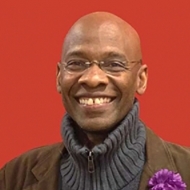
Michel
DeGraff
Professor of Linguistics
32-D826
MIT Linguistics and Philosophy
77 Massachusetts Avenue, 32-D808
Cambridge, MA 02139, USA
Director of MIT-Haiti Initiative. (Like and share Facebook page)
Founding Member of Akademi Kreyòl Ayisyen.
Syntax; Morphology; Language Change; Language & Education
- Platfòm MIT-Ayiti pou yon lekòl tèt an wo (by Inisyativ MIT-Ayiti / MIT-Haiti Initiative)
Yon konbit nimerik pou kreyasyon ak pataj materyèl pou ansèyman an kreyòl nan tout disiplin nan tout nivo klas.
A digital platform / library for the crowdsourcing, exchange and sharing of teaching materials in Haitian Creole (“Kreyòl”) in all disciplines at all grade levels. - Brase lide sou pwojè « estandadizasyon » ekriti kreyòl la — pou n kore edikasyon ak devlopman ann Ayiti e pou n ede Akademi Kreyòl Ayisyen (AKA) nan misyon li
Revi Etid Kreyòl, vol 2, nimewo 1, Oktòb 2023 - Politik lengwistik nan istwa lekòl ann Ayiti
Le Nouvelliste, 7 jiyè 2023 - Language Policy in Haitian Education: A History of Conflict over the Use of Kreyòl in education
(co-authored with William Scott Frager and Haynes Miller)
The Journal of Haitian Studies, Volume 28, No. 2, 2022 - Language has super powers: it can destroy souls or build nations TEDx Talk at MIT on April 23, 2023.
- Ann Ayiti, lekòl yo aprann nou rayi lang nou epi rayi tèt nou
In New York Times, October 14, 2022. - As a child in Haiti, I was taught to despise my language and myself
In New York Times, October 14, 2022. - An nou fè 2 kabès olye pou n rete nan lave men siye atè
Le Nouvelliste, August 29, 2022. - Gwojemoni nan rasin lekòl tèt an ba nan peyi tèt an ba (2yèm pati)
Le National, July 14, 2022. - Gwojemoni nan rasin lekòl tèt an ba nan peyi tèt an ba" (1e pati)
Le National, June 30, 2022. - Nan ki lang lajistis dwe pale ?
Theorizing the Contemporary, Fieldsights, December 22, 2021. - What does justice sound like?
Theorizing the Contemporary, Fieldsights, December 22, 2021. - Rèv Yves Dejean, rèv mwen, rèv ou, rèv nou : « … pou solèy ledikasyon rive klere an kreyòl … »
In Langues créoles : Description, analyse, didactisation et automatisation. Hommage à Yves Dejean et Pierre Vernet. Renauld Govain, ed., Presses Universitaires de la Méditerranée. 2021 - Toward racial justice in linguistics: The case of Creole studies
Language: Journal of the Linguistic Society of America, vol. 96, no 4, 2020 - Language as the invisible ‘canary in the mine’ in the minefield of human-rights violations
“Decolonising the Linguistics Curriculum” workshop, Sheffield University, December 10, 2020 - Black lives will not matter until our languages also matter: The politics of linguistics and education in post-colonies
ABRALIN— Associação Brasileira de Linguística, June 14, 2020 - The politics of education in post-colonies: Kreyòl in Haiti as a case study of language as technology for power and liberation
Journal of Postcolonial Linguistics, vol. 3, 2020 - Kreyòl, pedagogía y tecnología para brindar educación de calidad en Haití: Cambios en las actitudes metalingüisticas de los maestros como los primeros pasos de un cambio paradigmático
(co-authored with Glenda Stump)
Transforming Pedagogy: Practice, Policy & Resistance (Sargasso 2018–2019, vol. I and II) - Gid Fizik Inisyativ MIT-Ayiti
Paul Belony, Michel DeGraff & Glenda Stump, JEBCA Editions, 2019
(Amazon)
(JEBCA Editions) - "Demystifying creolization, decolonizing Creole Studies"
In Different spaces, different voices: A rendezvous with decoloniality
edited by Sayan Dey, 2019 - "Against apartheid in education and in linguistics: The case of Haitian Creole in neo-colonial Haiti"
Foreword to: Decolonizing foreign language education: The misteaching of English and other colonial languages
edited by Donaldo Macedo, Routledge, 2019 - "An n bati lekòl tèt an wo: Lang manman, pedagoji ak teknoloji kòm engredyan fondal natal pou yon chanjman radikal"
(co-authored with Glenda S. Stump)
The Journal of Haitian Studies, Volume 24 No. 2, 2018 - "Flore Zéphir nan entèvyou ak Michel DeGraff ansanm ak Jacques Pierre"
The Journal of Haitian Studies, Volume 24 No. 2, 2018 - "Kreyòl, pedagogy and technology for opening up quality education in Haiti: Changes in teachers' metalinguistic attitudes as first steps in a paradigm shift"
(co-authored with Glenda S. Stump)
Language: Journal of the Linguistic Society of America, vol. 94, no 2, 2018 - "Linguistics' role in the right to education"
Science Magazine, volume 360, issue 6388, page 502, May 4, 2018 - "Error correction and social transformation in Creole studies and among Creole speakers: The case of Haiti"
Language in Society, vol. 47, no 3, 2018 -
Interview for Traces & Dreams with Nerina Finetto, May 2018
- "The language we speak. Education, innovation and the future of Haiti." (2-minute trailer for 30-minute video)
Interview for Traces & Dreams with Nerina Finetto, May 2018
-
"Fòk lang nou kore edikasyon ak inovasyon pou yon demen miyò ann Ayiti." (Entwodiksyon 2 minit an kreyòl) Konvèzasyon ak Nerina Finetto pou emisyon nan Traces & Dreams nan mwa d me 2018
- "Wòl lengwis nan kore bon jan edikasyon pou respè dwa moun"
Le Nouvelliste, May 11, 2018
- "An n konprann Chante Alfabè Kreyòl La"
In Potomitan, 2017 - "La langue maternelle comme fondement du savoir: L’Initiative MIT-Haïti: vers une éducation en créole efficace et inclusive."
Revue transatlantique d’études suisses, 6/7, 2016/17 - "Mother-tongue books in Haiti: The power of Kreyòl in learning to read and in reading to learn"
Prospects: Comparative Journal of Curriculum, Learning, and Assessment. March 2017.
- "Lang matènèl, pedagoji entèraktif, lojisyèl edikatif nan Inisyativ MIT-Ayiti: ‘Twa wòch dife’ pou bon jan edikasyon ak inovasyon alawonnbadè ann Ayiti"
The Journal of Haitian Studies, 22.2., 2016 - (with Enoch Aboh) In The Oxford Handbook of Universal Grammar, Ian Roberts, ed., 2017.
-
"Haiti’s “linguistic apartheid” violates children’s rights and hampers development"
In openDemocracy, January 2017 -
“Diskriminasyon lengwistik” ann Ayiti se yon mepri pou dwa timoun epi sa frennen devlopman peyi aIn openDemocracy, January 2017
- Comments to United Nations on the Linguistics Rights of Children October 17, 2016.
- The MIT-Haiti Initiative: An International Engagement (by Haynes Miller)
MIT Faculty Newsletter, October 2016. - Inisyativ MIT-Ayiti: Yon Angajman Entènasyonal (atik Haynes Miller)
MIT Faculty Newsletter, October 2016. - Linguistic equality is a precondition for political and economic equity
Boston Review, May 9 2016. - Three-minute award-winning video: Opening up education in Haiti
From Teaching and Learning Video Showcase organized by National Science Foundation, May 2015. - "Revolutionizing education in Haiti" Spotlight article, National Science Foundation, Center for Innovative Research in Cyberlearning, May 2015
- "LSA Member Spotlight, October 2014: Michel DeGraff" Linguistics Society of America
- "Pou ki sa mwen te poze kandidati m pou mwen rantre kòm Akademisyen nan Akademi Kreyòl Ayisyen an"
In Le Nouvelliste, October 28, 2014. - "The ecology of language evolution in Latin America: A Haitian postscript toward a postcolonial sequel"
In Iberian Imperialism and Language Evolution in Latin America, Salikoko Mufwene, ed., University of Chicago Press, 2014. - " Some notes on bare noun phrases in Haitian Creole and in Gunbe"
(with Enoch Aboh) In The Sociolinguistics of Grammar, Tor Afarli and Brit Maehlum, eds., 2014. - MIT-Haiti Initiative Uses Haitian Creole to Make Learning Truly Active, Constructive and Interactive.
In Educational Technolology Debate: Exploring ICT and Learning in Developing Countries, July 2013. - Men anpil, chay pa lou: An nou sèvi ak lang kreyòl la pou bonjan edikasyon ak rechèch ann Ayiti
In Akademi Kreyòl Ayisyen: Ki pwoblèm? Ki avantaj? Ki defi? Ak kolòk entènasyonal sou Akademi Kreyòl Aysiyen an, 2013. - "Creoles"
In Cambridge Encyclopedia of the Language Sciences, Patrick Colm Hogan, ed., 2011. - "Baryè lang ann Ayiti: Kreyòl se lang peyi a; se pou sa fòk lekòl fèt an Kreyòl"
In Le Nouvelliste, August 30, 2010. - "Language barrier: Creole is the language of Haiti, and the education system needs to reflect that"
In Boston Globe, June 16, 2010. - "Language acquisition in creolization and, thus, language change: Some Cartesian-Uniformitarian boundary conditions"
Language and Linguistics Compass, 3/4, 2009. - "Creole exceptionalism and the (mis)education of the Creole speaker"
In The Languages of Africa and the Diaspora: Educating for Language Awareness,
Jo Anne Kleifgen & George Bond, eds., Bristol: Multilingual Matters, 2009. - "Haitian Creole"
In Comparative Creole Syntax: Parallel Outlines of 18 Creole Grammars, John Holm and Peter Patrick, eds., London: Battlebridge Publications (Westminster Creolistics Series, 7), 2007. - "Linguists' most dangerous myth. The fallacy of Creole Exceptionalism".
Language in Society, 34.4, 2005. - "Morphology and word order in 'creolization' and beyond".
In The Oxford Handbook of Comparative Syntax, Guglielmo Cinque & Richard Kayne, eds., Oxford University Press, 2005.
[abstract: html - pdf] - "Against Creole Exceptionalism (redux)" .
Language 80.4, 2004. - "Against Creole Exceptionalism" .
Language 79.2, 2003. - "Relexification: A reevaluation" .
Linguistic Anthropology 44.4, 2002. - "On the origin of Creoles: A Cartesian critique of Neo-Darwinian linguistics".
[html - pdf]
Linguistic Typology 5.2/3, 2001.
[table of contents: html - pdf]
[bibliography] - "Morphology in Creole genesis: Linguistics and ideology".
In Ken Hale: A Life in Language, Michael Kenstowicz, ed., MIT Press, 2001.
[table of contents: html - pdf] - "À propos des pronoms objets dans le créole d'Haïti. Regards croisés de la morphologie et de la diachronie".
Langages 138, 2000. - Language Creation and Language Change: Creolization, Diachrony and Development.
(Edited volume) MIT Press. 1999. - "Parameter-setting approaches to acquisition, creolization and diachrony".
In The MIT Encyclopedia of the Cognitive Sciences, Rob Wilson and Frank Keil, eds., MIT Press, 1999.
[lead paragraph and bibliography] - "Nominal Predication in Haitian and in Irish".
In Proceedings of the Sixteenth West Coast Conference on Formal Linguistics, Curtis et al, eds., Center for the Study of Language & Information, Stanford CA, 1998. - "Verb syntax in creolization (and beyond)".
In The New Comparative Syntax, Liliane Haegeman, ed., Longman, 1997. - "UG [Universal Grammar] and Acquisition in Pidginization and Creolization".
Commentary. Behavioral and Brain Sciences 19.4, 1996. - "Creole languages and parameter setting: A case study using Haitian Creole and the pro-drop parameter".
In Creole Languages & Language Acquisition, Herman Wekker, ed., Mouton de Gruyter, Berlin, 1996. - "On certain differences between Haitian and French predicative constructions".
In Contemporary Research in Romance Linguistics, Jon Amastae, Grant Goodall, Mario Montalbetti & Marianne Phinney eds., John Benjamins Publishing Company, Amsterdam, 1995. - "To move or not to move? Placement of verbs and object pronouns in Haitian Creole and in French".
In Papers from the 30th Meeting of the Chicago Linguistic Society, Beals et al, eds., 1994.
[A revised version appeared as "The morphology-syntax interface in creolization (and diachrony)". Studies in the Linguistic Sciences, 24.2, 1994.] - "Predicate-movement, quantification, events and properties".
In Focus & Natural Language Processing, V. 1, Intonation & Syntax. IBM Working Papers of the Institute for Logic and Linguistics, Peter Bosch & Rob van der Sandt, eds., Heidelberg, Germany, 1994.
[A revised version appeared in Niger-Congo Syntax & Semantics 6,Victor Manfredi & Karl Reynolds, eds., Boston, University African Studies Center, 1995] - "A riddle on negation in Haitian".
Probus 5.1/2, 1993. - "Why is my old friend not old?" (with Deborah Mandelbaum).
In Papers from the 29th Meeting of the Chicago Linguistic Society, Beals et al, eds., 1993. - "Is Haitian Creole a pro-drop language?"
In Atlantic Meets Pacific: A Global View of Pidginization and Creolization. Francis Byrne & John Holm, eds., John Benjamins Publishing Company, Amsterdam, 1993. - "The syntax of predication in Haitian".
In Proceedings of the 22nd Meeting of the North-Eastern Linguistics Society. GLSA, University of Massachusetts at Amherst, 1992