Frugal Fish Photography:
Taking pictures of fish on a budget
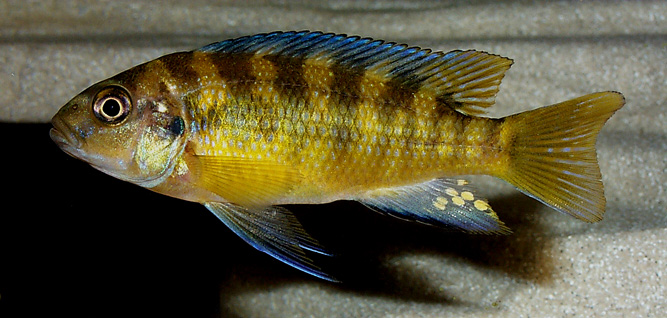
As a first step, I recommend using a digital camera if you don't have a professional camera. Taking good pictures of fish requires taking about 20 times as many bad pictures (fish are really rude about darting away just as you push the button). Digital cameras allow you to erase the bad pictures without wasting any film, and they allow you to quickly tell when you got a good picture. It doesn't need to be a particularly good camera. Most of my pictures (including the one above) were taken using a Kodak DC260 digital camera. However, regardless of what you are using to take the pictures, here are some tricks I've found to take decent photos with consumer camera equipment.
How to get good pictures of uncooperative fish:
- Wash the exterior glass of the tank with vineger or your favorite glass cleaner (ie: Windex). Spray the cleaner onto a paper towel and rub the glass the towel, or you may accidentally spray the cleaner into the tank. This will prevent your camera from autofocusing on dirt on the glass. Use all cotton cloth if your tank is acrylic.
- Clean the interior side of the glass with an algea scraper. The magnet ones are really nice if you don't want to get your hands wet.
- Turn off your bubblers, unless you want nice bubbles in your pictures (and possibly in front of your fish).
- Turn your flash on. Even with all the lights on the tank will be too dark to get decent photos at a high shutter speed (I have a dual bulb fluorescent fixture and that gave me almost black pictures).
- Turn off all the lights in the room, including the tank lights. Use a nightlight or small flashlight so that you can just barely see the fish through your viewfinder (let your eyes adjust). Fish move much more slowly when the lights are out and will be less blurry in your pictures as a result. Always give the fish a chance to relax and slow down between photos.
- Cover any light colored objects around the tank with dark non-reflective paper or cloth. Otherwise they will show up as reflections on the glass due to mirror effects. You can see some of these mirror effects in my pictures where I was lazy.
- Turn your shutter speed to the fastest setting so that you can catch the moving fish. If you are using a non-digital camera, use ASA/ISO 400 film. If your camera doesn't have a shutter speed setting, just hope it figures it out.
- Take all your pictures at an angle to the glass so you don't get a reflection from the flash. The angle doesn't have to be very big.
- When you take pictures of your fish, take them when the fish are in front of a large rock or piece of wood. You can also take them looking down at the fish onto the gravel. This is because you want a large surface for your camera's autofocus to find which is close to the fish. Autofocus cameras need a large surface to focus on, and a single fish is too small. Even if the fish is an inch in front of a rock, focusing on the rock will still give a very good picture. You can also use prefocus on rocks (holding the button down halfway) and then wait for the fish to get the right distance away, but this is harder.
- Once you have your pictures, move them to a digital format and touch up the brightness and contrast with Adobe Photoshop, the GIMP, or a similar graphics tool. If the pictures are a little blurry, you can sharpen them.