

It is sometimes difficult to feed the drill accurately by hand when you're cutting with a very large drill bit. It's easy to push a little bit too hard, causing the drill to bite into the material too much and possibly twist off the shank of the drill. So with a large drill, and when drilling harder materials such as aluminum or steel, it's a good idea to engage the power feed and have the machine feed the drill through the part for you.

|
| The in/out switch for the powerfeed |
On most machines the power feed will be marked with a knob marked "in" and "out." To get it started, turn the machine on and turn this knob to "in." This will engage the powerfeed, and the machine will feed the drill for you in a much more controlled manner than you could feed it.
|
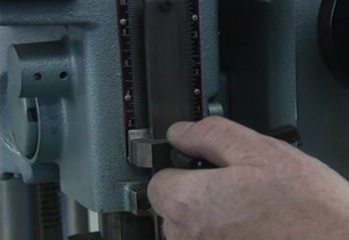
| Setting the depth for the power feed |
You can also set the depth gauge, which tells the drill press how far to drill for before disengaging the powerfeed. So if you're cutting a piece that is 3/4" thick, you can set the depth gauge slightly beyond that, and the drill will cut all the way through and then retract automatically.
Even though the machine is doing all the work for you, you shouldn't shut your brain off. Listen to what the machine is doing and watch what is happening. If you start hearing any strange noises -- maybe the machine starts working harder -- stop the machine and find out what is going wrong.
Small holes
It can be difficult to drill a small hole on a large machine because you'd have no feel for what is happening. There are a couple of ways of dealing with this problem:
|
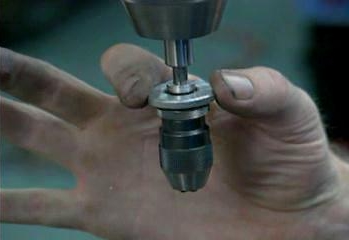
The first is to use a sensitive chuck. It's smaller, which makes it easier to hold small drills, but its main feature is that it's free to move along the long axis. Lock the sensitive chuck into the key, and instead of touching the quill, you can lower the bit by simply pulling down on the chuck. So even if your drill bit is difficult to see, it's possible to get a feel for what that drill is doing when it comes into contact with the part.
Small drill pressAnother solution for small holes is simply to use a small drill press, which is basically just a smaller version of a full-size drill press. The main difference is that instead of moving the quill down to the table, the table is moved up to the bit. A small drill will also run at a higher speed -- around 10,000 RPM.