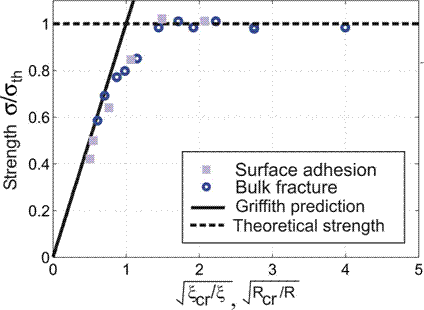
Our atomistic simulations complement recent continuum analysis (Gao et al ., PNAS, 2003) and reveal a smooth transition between Griffith modes of failure via crack propagation to uniform bond rupture at theoretical strength below a nanometer critical length. This indicates that ma terials with characteristic features below a critical length scale always achieve their opti ma l, theoretical strength, independent of the presence of flaws. Our results have important consequences for understanding failure of many small-scale ma terials.
In additional studies, we focus on the size dependence of cylindrical adhesion systems. We demonstrate that optimal adhesion can be achieved by either length scale reduction, or by optimization of the shape of the surface of the adhesion element. We find that whereas change in shape can lead to opti ma l adhesion strength, only reducing the dimension results in robust adhesion devices. An important consequence of this finding is that even under presence of surface roughness, optimal adhesion is possible provided the size of contact elements is sufficiently small.
Our atomistic results corroborate earlier theoretical modeling at the continuum scale (Gao and Yao , PNAS, 2004). We discuss the relevance of our studies with respect to nature's design of bone nanostructures and nanoscale adhesion elements in Geckos. |