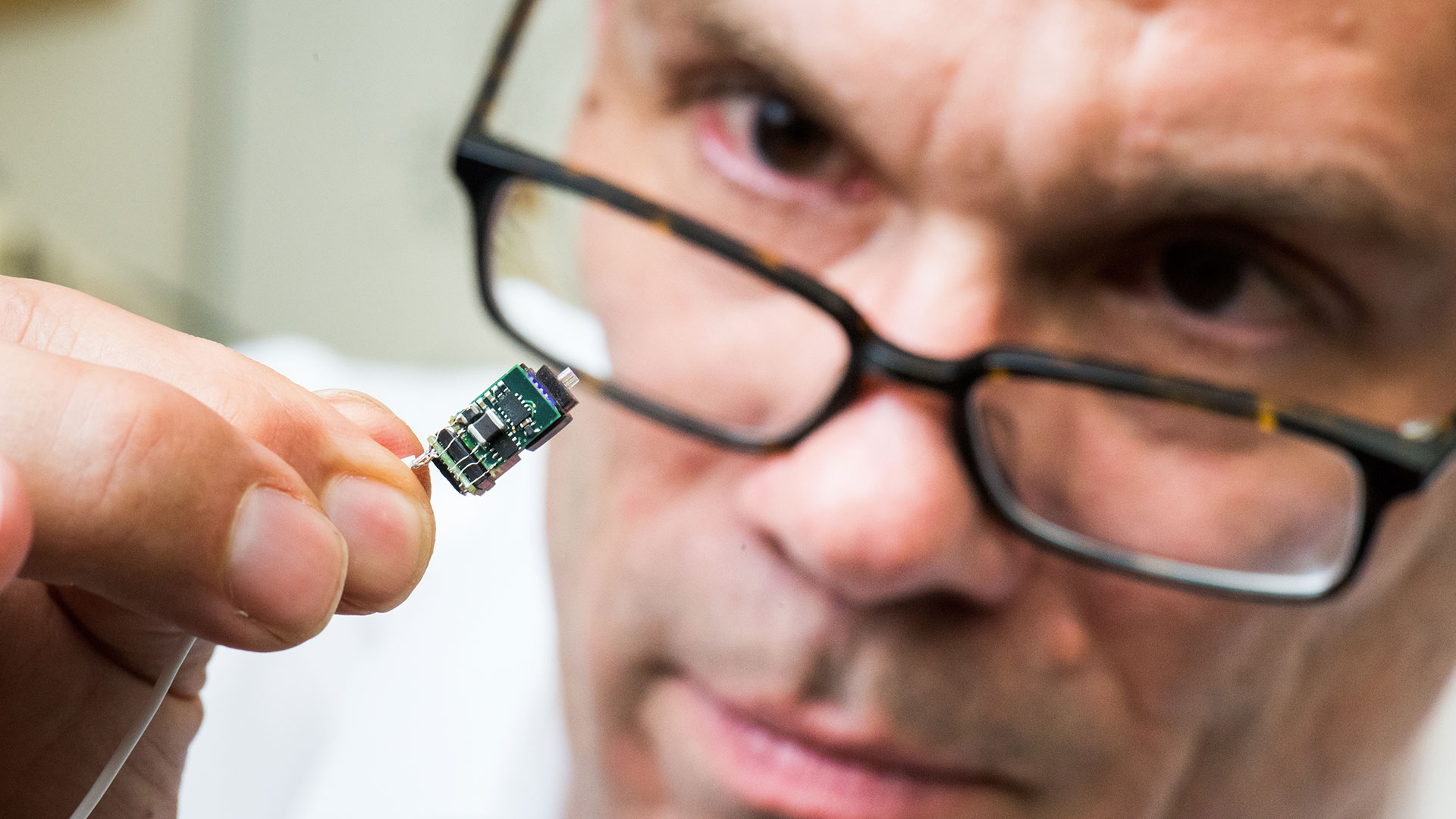
Playing an instrument or riding a bike requires a complex sequence of movements. Michale Fee is interested in the brain mechanisms underlying this kind of learned behavior. By studying birdsong, Fee hopes to understand the neural and biophysical mechanisms underlying the generation and learning of complex sequences, and to develop advanced optical and electrical techniques for measurement of brain activity in behaving animals. He has shown that a brain area known as the higher vocal center (HVC) works like the conductor of an orchestra to control the tempo of the song.
Just as human babies babble before they can speak, a young bird learns to sing by trial and error. They experiment with a variety of sounds and they select the sounds that most closely resemble the memory of their father’s song. Fee studies zebra finches to determine where the brain stores its memory of the father’s song, how it compares this memory with its own attempts to produce a copy, and how it reinforces the brain connections that produce good copies while eliminating those that do not.
The answers could have implications far beyond the field of birdsong. Most learned behavior involves trial and error, and this in turn requires variability on which learning can operate. How the brain sets the right balance between too much and too little variability, and how that balance is disrupted by disease, are some of the questions that Fee expects to tackle in the future.
Member, American Academy of Arts and Sciences
Teaching Prize for Graduate and Undergraduate Education, MIT School of Science, 2016
Excellence in Undergraduate Teaching, MIT Department of Brain and Cognitive Sciences, 2015
Larry Katz Prize for Innovative Research in Neuroscience, 2012