Research in the Jasanoff laboratory is broadly organized in three main directions: (1) developing, refining, and validating innovative imaging probes; (2) using them to study basic neurophysiology relevant to health and disease; and (3) relating novel brain activity measurements to behavior and cognition.
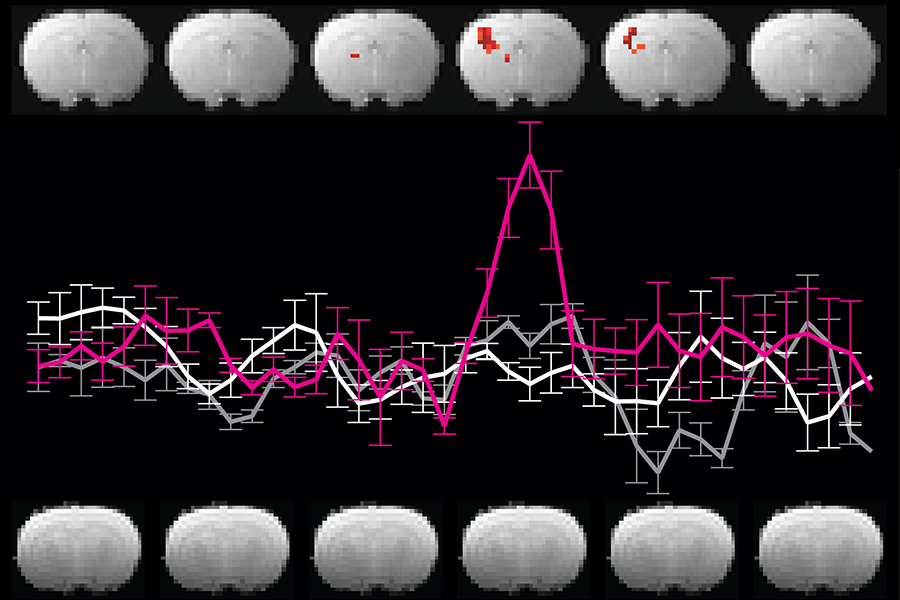
Creating new molecular neuroimaging probes requires rich application of fundamental chemistry, materials science, and bioengineering. Among probes the laboratory has recently introduced are engineered proteins that respond to neurotransmitters, small organic molecules that penetrate brain cells and detect intracellular signaling, nanoparticles that sense communication between neurons, and implantable microelectronic devices that report electromagnetic events in the brain via MRI. Many of the imaging agents are specifically designed to permit noninvasive analogs of the powerful fluorescence imaging techniques that are widely used in neuroscience but cannot be applied in optically inaccessible brain structures.
The Jasanoff lab’s experimental tools provide unprecedented capability for mapping an expanding set of neurobiological processes across the living brain. Working primarily in rodents, the lab has for example obtained the first maps of neurotransmitter release and reuptake deep within the brain. Using a probe for the neurotransmitter dopamine, the group elucidated a three-dimensional profile of neurochemical signaling associated with behaviorally rewarding stimuli, related this profile to complementary brain activity measures, and learned how local dopamine release in a region called the striatum corresponds to patterns of reward-evoked activity across the brain more generally.
Current work in the lab involves applying functional and molecular imaging to characterize the structure and origins of spontaneous and task-related neural activity in awake rodents and primates. Additional projects focus on clinically-relevant deployment of revolutionary imaging tools to animal models of disease and to human subjects.
Alan Jasanoff joined the McGovern Institute as an associate investigator in 2004. He is a Professor of Biological Engineering with joint appointments in the departments of Brain and Cognitive Sciences and of Nuclear Science and Engineering. He currently directs the MIT Center for Neurobiological Engineering and the Neurobiological Engineering Training Program. Jasanoff has been a Whitehead Fellow and a Raymond and Beverley Sackler Foundation Scholar. His first book, “The Biological Mind: How Brain, Body, and Environment Collaborate to Make Us Who We Are” was published in 2018 and featured as a top science book of 2018 by Nature, Forbes, and The Wall Street Journal.
Paul and Lilah Newton Brain Science Award, 2020
Top science book of the year Biological Mind, Wall Street Journal, Nature, Forbes, 2018
Excellence in Postdoctoral Mentoring, MIT Department of Brain and Cognitive Sciences, 2016
Best Advisor, MIT Department of Biological Engineering, 2o12
McKnight Technological Innovations in Neuroscience Award, 2006
NIH New Innovator Award, 2007
NIH Transformative R01 Award, 2011