The
Mechanical Engineering Department
has focused on transforming nanoscience
from a scientific curiosity to a technology of mass manufacturing
of ubiquitous products.
The miniaturization
of devices and systems of ever increasing complexity has been
a fascinating and productive engineering endeavor during the
past few decades. Near-term and long-term, this trend will
be amplified as physical understanding of the nanoworld expands,
and wide-spread commercial demand drives the application of
manufacturing to micro- and nanosystems. Tiny technology research
in the
Mechanical
Engineering Department
cuts across all of the five broadly divided disciplines
of mechanical engineering, including Mechanics
and Materials; Fluids, Energy and Transport; Design and Manufacturing;
Systems, Controls and Information; and Bio-engineering.
Fluids, Energy, and Transport:
research topics include nanostructured thermoelectric materials for
solid-state power generators and coolers, high power density and high-efficiency
thermophotovoltaic energy conversion devices, nanowire-based new nano-patterning
technology, design and fabrication of elastomeric addressable silicone
microfluidic networks for chemical or biological screening, electro-thermal
actuators for manipulating the dynamics of fluid jets and flows.
Biomedical Engineering:
research topics include the development of novel microscopy instrumentation to
study biomedical problems, a new non-invasive method to detect skin cancer,
nanoscale interfaces to biological molecules by switching DNA and proteins,
elucidating the inner-workings of proteins, enzymes and biological motors,
instrumentation that combines optical tweezers, single molecule fluorescence and
pulsed spectroscopy, fundamental study and modeling of electrical, mechanical
and chemical energy conversion in natural and synthetic membranes and biological
tissues.
Mechanics and Materials:
research topics include understanding the fundamentals of small-scale
mechanisms, mechanical properties of polymer nanocomposites, carbon nanotubes,
polymer/carbon nanotube composites.
Design and Manufacturing:
MEMS technology to nano-scale manufacturing, massively parallel assembly of
carbon nanotubes, energy scavenging power MEMS, self-assembly in micro- and
nano-scale systems, millimeter-scale electric induction motor/generators,
micro-scale self-assembly technology to create useful 3D microsystems.
Systems, Controls and Information:
research
topics include the manipulation of light with novel, miniaturized or
nanostructured elements that provide new functionalities for optical information
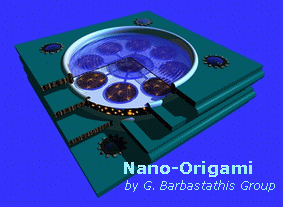
processing, 3D assembly of nanosystems based on “nanostructured origami? design
and manufacturing methodologies for atomic resolution systems for advanced
data-storage systems.
Pappalardo NanoManufacturing Facility:
A new nanofabrication facility
will be constructed. The facility will provide 5,490 square feet of space for
nanoscale mechanical engineering research. A generous gift to the ME Department
from Jane and Neil Pappalardo will cover a significant portion of the expenses.
Back to top